Nutrition
Information on food labels can help you choose healthy foods. What do you look for?
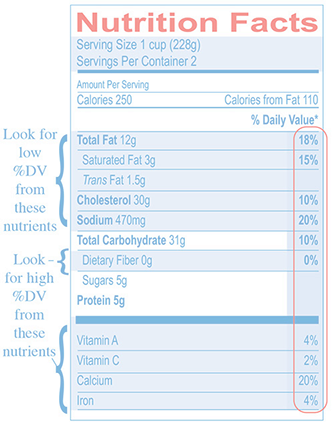
A. Read the “Nutrition Facts”
Look at serving size and how many servings are in the product. Serving sizes are given in familiar units, such as cups or pieces. This is followed by the metric amount (e.g., the number of grams). Serving sizes are often based on the amount of food people typically eat.
B. Read calories per serving
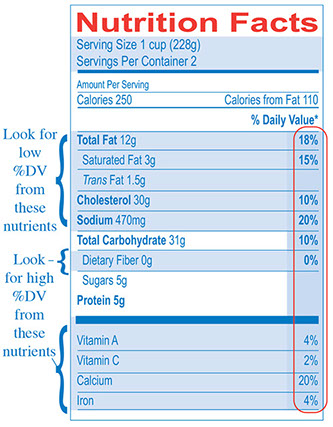
Calories tell you how much energy you get from a serving of this food. The label also tells you how many of the calories in one serving come from fat. In the example, there are 250 calories in a serving of this macaroni and cheese; 110 calories are from fat. This means almost half of the calories come from fat.
C. Look at the nutrients per serving
The nutrients listed first are the ones people eat enough, or too much of. Eating too much saturated and trans fats or too much sodium may increase your risk of heart disease, some cancers, and high blood pressure.
Most people don’t get enough dietary fiber, vitamin A, vitamin C, calcium, and iron in their diets. Eating enough of these nutrients can improve your health and help reduce the risk of some diseases and conditions. For example, getting enough calcium can reduce the risk of osteoporosis, in which bones become brittle and break as one ages.
D. Look at Percent Daily Value (%DV)
Daily Values (DVs) are a way to tell if a food is high or low in nutrients. In general 5% DV or less is low in a nutrient; 20% or more is high in a nutrient.
The Percent Daily Value (%DV) on food labels is based on a 2000 calorie diet. This means that they are not exact for what Daily Values are for 1200-1300, 1500-1600, and 1800 calorie diets. So, use food label %DVs as a general guide to see if a food gives any nutrients for the calories it has.
Quick Tip
In general, look for foods that have low %DV for total fat, saturated fat, cholesterol, and sodium. Balance foods that have 20% or more of these with ones that have 5% DV or less.
In general, look for foods that have 20% or more for fiber and/or at least one of the vitamins and iron or other minerals that can be listed.

Compare Nutrition Facts for Three Cereals
After comparing these three labels, which cereal would you choose?
One advantage for all three is that they are a set portion (a small box that is one serving size). Overall, the wheat squares may be the best choice based on the nutrients you get for the calories it has. It would even be better to choose wheat squares that are not sweetened. The same serving size would have less added sugar and calories. Corn flakes is also a good choice. One serving has 70 calories. This is close to the amount of calories in 1 serving of grains & starches (80 calories).
Can These Meals Be Part of a Healthy Daily Diet?
Besides looking at saturated fat, of the two choices, the Deluxe Combo Pizza has more dietary fiber (6g) and less sodium (550mg).
Four Cheese Pizza:
This choice is harder to fit into a healthy diet. One serving (the whole pizza) uses 50% of a daily saturated fat allowance, leaving only 50% for all other foods and drinks that day.
Deluxe Combo Pizza:
This meal is easier to fit into a healthy diet. One serving (the whole pizza), gives 18% of a daily saturated fat allowance. This leaves 82% for all other foods and drinks that day.
Is this a Healthy Snack Food?
Answer: The good thing about this snack food is that it does not have trans fat. This is because it has vegetable oil, not “hydrogenated” vegetable oil. It does, though, have 250 calories and 12 grams of fat. That is a lot for a snack. Eat foods like this less often. Make 2 or 3 servings out of this individual snack bag, too.
Ingredient List
This lists what’s in the food from most to least by weight. There is more of the first ingredient than the second and so on. Choose foods that list acceptable ingredients first, second, and third. Also, check the list for ingredients that you may be allergic or sensitive to, such as milk, eggs, peanuts, and wheat.
Preparation Instructions
Look at the instructions on package directions. You can change the way the food is prepared to lower total fat, saturated fat, and sodium, as well as to increase nutrients, such as fiber and vitamin C.
Open Dating
Look at this so you won’t buy food items that are spoiled or will spoil before you use them. Buy them before “sell by” or “expiration date,” which is the last date the product should be used.
Resources
Food and Drug Administration (FDA)
© American Institute for Preventive Medicine