Systematic Stress Management Program
Step 7: Communication & Stress Section
Introduction
What is Your Ear-Q?
Ten Blocks to Effective Listening
Listening Blocks in My Life
Skills for Active Listening
Improving Your Ear-Q
Assertiveness
Assertiveness Inventory
Assertiveness with Other People
The Benefits of Assertiveness
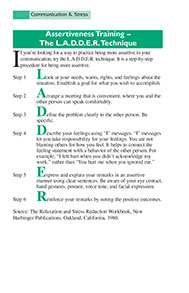
Assertiveness Training – The L.A.D.D.E.R. Technique
My Practice L.A.D.D.E.R.
If you’re looking for a way to practice being more assertive in your communication, try the L.A.D.D.E.R. technique. It is a step-by-step procedure for being more assertive.
Step 1
Look at your needs, wants, rights, and feelings about the situation. Establish a goal for what you wish to accomplish.
Step 2
Arrange a meeting that is convenient, where you and the other person can speak comfortably.
Step 3
Define the problem clearly to the other person. Be specific.
Step 4
Describe your feelings using “I” messages. “I” messages let you take responsibility for your feelings. You are not blaming others for how you feel. It helps to connect the feeling statement with a behavior of the other person. For example, “I felt hurt when you didn’t acknowledge my work.” rather than “You hurt me when you ignored me.”
Step 5
Express and explain your remarks in an assertive manner using clear sentences. Be aware of your eye contact, hand gestures, posture, voice tone, and facial expression.
Step 6
Reinforce your remarks by noting the positive outcomes.
© American Institute for Preventive Medicine
Step 1: Understanding Stress
Step 3: Type A & B Behavior Patterns
Step 5: Thinking Differently
Step 7: Communication & Stress
Step 2: Stress Management at Work
Step 4: Biofeedback Training & Relaxation
Step 6: Time Management
Steps to Systematic Stress Management™
RELATED ARTICLES
© American Institute for Preventive Medicine – All Rights Reserved.Disclaimer|www.HealthyLife.com