Fitness
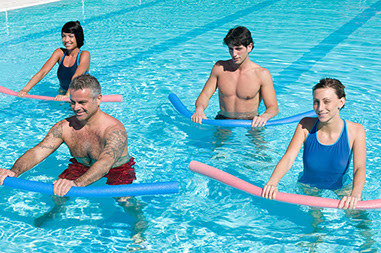
Water exercise (or aquatic exercise, as it’s sometimes called) is popular among people of all ages. Buoyed up by water, you feel light as a feather, and you can move in ways that are otherwise difficult or impossible yet still tone your muscles and improve your circulation, breathing, and endurance. You weigh 90 percent less in water than you do on land, easing the burden on weight-bearing joints like your hips, knees, and back. That means many people who find it difficult or painful to jog or perform other kinds of weight-bearing activities find it easier to work out in water. Water exercises take place in the shallow end of a pool, in waist- to chest-deep water, and you can usually hold on to the side of the pool for safety and comfort.
Swim the English Channel (or Its Equivalent)
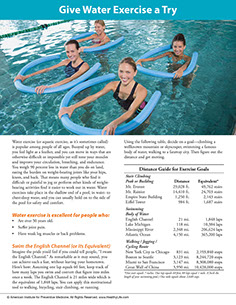
Imagine the pride you’d feel if you could tell people, “I swam the English Channel.” As remarkable as it may sound, you can achieve such a feat, without leaving your hometown. Here’s how: Assuming one lap equals 60 feet, keep track of how many laps you swim and convert that figure into miles once a week. The English Channel is 21 miles wide which is the equivalent of 1,848 laps. You can apply this motivational tool to walking, bicycling, stair climbing, or running. Using the following table, decide on a goal-climbing a well-known mountain or skyscraper, swimming a famous body of water, walking to a faraway city. Then figure out the distance and get moving.
Water exercise is excellent for people who:
* Are over 50 years old.
* Suffer joint pain.
* Have weak leg muscles or back problems.
© American Institute for Preventive Medicine