Systematic Stress Management Program
Step 7: Communication & Stress Section
Introduction
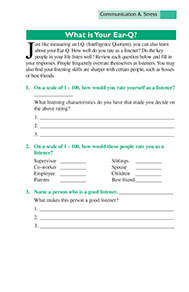
What is Your Ear-Q?
Ten Blocks to Effective Listening
Listening Blocks in My Life
Skills for Active Listening
Improving Your Ear-Q
Assertiveness
Assertiveness Inventory
Assertiveness with Other People
The Benefits of Assertiveness
Assertiveness Training – The L.A.D.D.E.R. Technique
My Practice L.A.D.D.E.R.
Just like measuring an I.Q. (Intelligence Quotient), you can also learn about your Ear-Q. How well do you rate as a listener? Do the key people in your life listen well? Review each question below and fill in your responses. People frequently overrate themselves as listeners. You may also find your listening skills are sharper with certain people, such as bosses or best friends.
1. On a scale of 1 – 100, how would you rate yourself as a listener?
What listening characteristics do you have that made you decide on the above rating?
2. On a scale of 1 – 100, how would these people rate you as a listener?
* Supervisor
* Siblings
* Co-worker
* Spouse
* Employee
* Children
* Parents
* Best friend
3. Name a person who is a good listener.
What makes this person a good listener?
© American Institute for Preventive Medicine
Step 1: Understanding Stress
Step 3: Type A & B Behavior Patterns
Step 5: Thinking Differently
Step 7: Communication & Stress
Step 2: Stress Management at Work
Step 4: Biofeedback Training & Relaxation
Step 6: Time Management
Steps to Systematic Stress Management™
RELATED ARTICLES
© American Institute for Preventive Medicine – All Rights Reserved.Disclaimer|www.HealthyLife.com