Systematic Stress Management Program
Step 7: Communication & Stress Section
Introduction
What is Your Ear-Q?
Ten Blocks to Effective Listening
Listening Blocks in My Life
Skills for Active Listening
Improving Your Ear-Q
Assertiveness
Assertiveness Inventory
Assertiveness with Other People
The Benefits of Assertiveness
Assertiveness Training – The L.A.D.D.E.R. Technique
My Practice L.A.D.D.E.R.
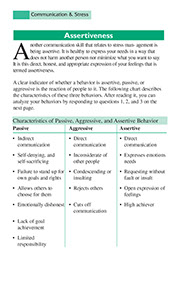
Another communication skill that relates to stress management is being assertive. It is healthy to express your needs in a way that does not harm another person nor minimize what you want to say. It is this direct, honest, and appropriate expression of your feelings that is termed assertiveness.
A clear indicator of whether a behavior is assertive, passive, or aggressive is the reaction of people to it. The following chart describes the characteristics of these three behaviors. After reading it, you can analyze your behaviors by responding to questions 1, 2, and 3 below.
Characteristics of Passive, Aggressive, and Assertive Behavior
Behavioral Analysis Questions
Choose a behavior to analyze, then check off one or more responses to each question.
© American Institute for Preventive Medicine
Step 1: Understanding Stress
Step 3: Type A & B Behavior Patterns
Step 5: Thinking Differently
Step 7: Communication & Stress
Step 2: Stress Management at Work
Step 4: Biofeedback Training & Relaxation
Step 6: Time Management
Steps to Systematic Stress Management™
RELATED ARTICLES
© American Institute for Preventive Medicine – All Rights Reserved.Disclaimer|www.HealthyLife.com