Author: AIPM

  • You’re Built For Kindness

    Social Health

    Heart shape vase with flowers.

    Just as a small stone tossed in a lake can create a wide ripple effect, so can you have a positive impact on your world. Start your day thinking about how you can be kind, compassionate and considerate of everyone around you.

    Having a good life is about more than satisfying our every whim. How we treat others also has an impact. The Golden Rule says, “Do to others as you would have them do to you.” That’s more than just a nice concept – it’s a blueprint for living a happy and healthy life.

    *  People who give practical help to family and friends may live longer lives.

    *  Providing social support reduces blood pressure and may provide relief from chronic illnesses.

    *  Giving without expecting anything in return may help stabilize the immune system and protect against the effects of stress.

    *  Those who practice kindness report greater levels of thankfulness and contentment.
    ays to Well-Being book by the American Institute for Preventive Medicine. www.HealthyLife.com. All rights reserved.

    © American Institute for Preventive Medicine

  • Youth Sports Safety

    Family Fitness

    Young child riding a bike.

    Every year, millions of children are injured while playing sports and doing physical activities. Most of these injuries could be prevented.

    Wearing a safety helmet helps prevent a closed head injury when biking, inline skating, etc.

    Some states and localities have mandatory laws for helmet usage.

    All helmets sold in the U.S. must meet the Consumer Product Safety Commission standard. There must be a sticker on the inside stating this. The fit of the helmet is not tested by the standards, so you should try the helmet on your child’s head before buying.

    Learn more about safety helmets from the Bicycle Helmet Safety Institute athelmets.org.

    Get youth sports safety guidelines from the National Youth Sports Health & Safety Institute atacsm.org/nyshsi/best-practices.

    A Year of Health Hints book by the American Institute for Preventive Medicine. www.HealthyLife.com. All rights reserved.

    © American Institute for Preventive Medicine

  • 10 Action Steps To Quit Tobacco

    Tobacco Cessation

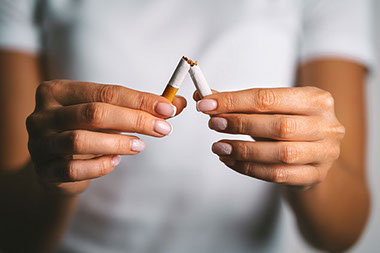
    Close up of female hands breaking a cigarette in half.

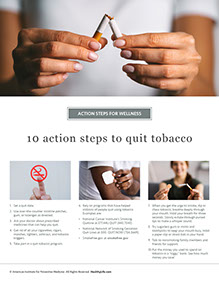
    1.  Set a quit date.

    2.  Use over-the-counter nicotine patches, gum, or lozenges as directed.

    3.  Ask your doctor about prescribed medicines that can help you quit.

    4.  Get rid of all your cigarettes, cigars, matches, lighters, ashtrays, and tobacco triggers.

    5.  Take part in a quit tobacco program.

    6.  Rely on programs that have helped millions of people quit using tobacco. Examples are:

    *  National Cancer Institute’s Smoking Quitline at 877.44U.QUIT (448.7848)

    *  National Network of Smoking Cessation Quit Lines at 800. QUIT.NOW (784.8669)

    *  Smokefree.gov atsmokefree.gov

    7.  When you get the urge to smoke, dip or chew tobacco, breathe deeply through your mouth. Hold your breath for three seconds. Slowly exhale through pursed lips to make a whisper sound.

    8.  Try sugarless gum or mints and toothpicks to keep your mouth busy. Hold a paper clip or stress ball in your hand.

    9.  Talk to nonsmoking family members and friends for support.

    10. Put the money you used to spend on tobacco in a “ciggy” bank. See how much money you save!

    Cover image to the Fitness brochure by the American Institute for Preventive Medicine. www.HealthyLife.com. All rights reserved.

    © American Institute for Preventive Medicine
  • Address Anxiety 2

    Healthylife® QuitWell™

    Part 2

    Zen garden with massage stones and waterlily.

    Anxiety is a feeling of dread, fear, or distress over a real or imagined threat to your mental or physical well-being. Smoking, chewing, or vaping may be a way that you have coped in the past with these feelings. At all stages of change, you can learn to address anxiety in healthy ways.

    First, try to calm your body physically. Calming the physical body can make working through what is in your mind easier.

    *  Breathe deeply and evenly.

    *  Take a walk or get some other form of exercise.

    *  Take a long, warm bath or shower. Or, go for a swim.

    *  Listen to soothing music. Or, go somewhere quiet.

    *  Connect with people. Visit or call someone who will listen to you and support you.

    *  Drink a warm cup of decaf coffee or tea-avoid caffeine, which can make anxiety worse.

    As you take a step back, use these tips to manage the thoughts that are causing your anxiety:

    *  Ask: is your thought based on facts?

    *  Identify what you are trying to do. Know your purpose.

    *  Consider many different outcomes and their effects.

    *  View the situation from many perspectives.

    *  Don’t assume a situation will have the same outcome as it did in the past.

    *  Have good evidence for a generalization before you make it.

    *  Avoid assuming one event caused another just because they happened at the same time.

    You will likely feel calmer after you quit. Nicotine only makes you more nervous. Nicotine is a stimulant. After you get over the initial stress of quitting, you’ll find that without all that nicotine in your body, you feel calmer and more relaxed.

    © American Institute for Preventive Medicine
  • Altering Triggers

    Healthylife® QuitWell™

    Part 4

    A morning cup of coffee.

    Actions, especially habits, are linked. For example, you may light up a cigarette without thinking when you start your car, end a meal, drink coffee, or hear your alarm clock. If you dip or use other forms of tobacco/nicotine, you may have similar triggers.

    Altering triggers can help you break your automatic habits.

    Scrambling

    Scramble your routine to stop the triggers before they happen.

    1. Change your morning routine.

    2. Change your work area and the times of the day you do things.

    3. Change the route you take to work.

    4. Change the way you talk on the phone.

    5. Take a walk with a water bottle instead of a coffee break.

    6. Sit in a new place at the dining room or kitchen table.

    7. What other ways can you change your routines?

    © American Institute for Preventive Medicine

  • Balance Of Choice 2

    Healthylife® QuitWell™

    Part 2

    Man's hand touching an abstract no smoking.

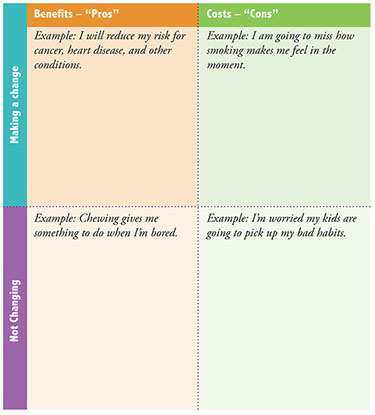
    Learn what is pulling you toward your goal and what is holding you back. All thoughts and feelings are valid. Is your goal more important to you than the challenges to achieve it? Are you pursuing this goal just because someone said you “should” do it? Complete the chart below as well as you can. If you think of something later, come back to this page to add another point to one of the boxes.

    Chart to fill out your choices.

    © American Institute for Preventive Medicine
  • Be Assertive 2

    Healthylife® QuitWell™

    Part 5

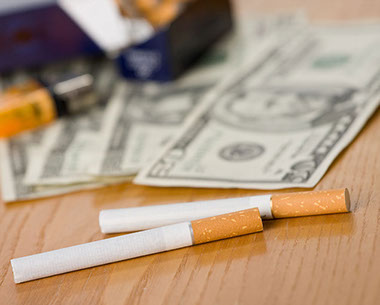
    Image of cigarettes and money.

    Learn the differences between passive, aggressive, and assertive communication.

    Passive

    *  You lack expression for yourself.

    *  You do not stand up for your rights and needs.

    Result: You usually do not achieve your goal. You may feel like someone is walking all over you.

    Aggressive

    *  You stand up for your rights and needs, but at the expense of someone else.

    Result: You usually put down or hurt someone else. You gain no respect and may even start a conflict.

    Assertive

    *  You stand up for your rights and needs without putting down or hurting someone else.

    Result: You build self-respect and feel good about yourself. You are likely to achieve your goal.

    Example

    Your co-worker offers you a cigarette, saying that you can have just one, even though you recently quit. This person wants to smoke with you for old time’s sake. You know this could send you back to using tobacco.

    Passive Response:“All right, I’ll have a cigarette with you, but just this one.”

    Aggressive Response:“You really have some nerve offering me a cigarette. I hate cigarettes and I think it’s disgusting that you smoke. You should smell your breath. Don’t ever come near me with a cigarette again.”

    Assertive Response:“No, thank you. I have quit smoking and I plan to stay that way. Even one can trigger my old addiction. You can help me remain an ex-smoker by not offering me any.”

    © American Institute for Preventive Medicine

  • Clean Your Environment

    Healthylife® QuitWell™

    Part 4

    Man cleaning the inside of his car.

    Go around your house, car, workplace, and other places you have stored tobacco products. Gather all your tobacco, lighters, matches, and other items related to your habit. Don’t forget to check your coats, purses, and drawers.

    If you have quit, throw these products away. Seeing these items will not be helpful to staying quit. If you are still working on quitting, having all these items out of sight will also reduce the unhelpful reminders of your habits. You will be more ready for the day you quit completely.

    © American Institute for Preventive Medicine
  • Cleaning Up Mind Pollution

    Healthylife® QuitWell™

    Part 4

    Image of women relaxing while thinking.

    Start with changing how you react to minor annoyances, like traffic or a chatty co-worker. Work to reduce the number of things that push your buttons. It is not the event itself that determines your feelings-it is what you tell yourself about it. You may have some truly big, serious stressors in your life. Avoid piling the little things on top.

    “Men are not disturbed by things, but by the views they take of them.”  – Epictetus

    Let’s pretend you got stuck in a traffic jam on the way to work today. You feel angry and upset. But it is not the traffic jam that makes you upset. It is what you tell yourself that upsets you: “I’m going to be late for work.” “I have so much to do.” “This is such a waste of time.”

    You cannot change the fact that you are stuck in traffic. Getting angry serves no purpose. If you can look at the delay as a minor problem that you can’t control, rather than a major event, you will feel much better. When your mind stays calm, you may even see ways around the issue, like taking another route or using hands-free calling to join a meeting you’re running late for.

    Your outlook on quitting is also very important. If you tell yourself that quitting will be awful, chances are the process will be as bad as you think. If you accept the fact that you will have urges, but nothing you can’t handle, you will have an easier time quitting. Focus on what is gained from quitting, not on what is being lost or the minor discomfort along the way.

    Thinking Differently

    You can change how you think, feel, and react to any event. The ABCDE model can help you do this.

    Activating Event:An event that triggers thoughts and feelings. Example – “I am trying to quit smoking and this event is making me anxious.”

    Belief:What you think or say to yourself about the activating event. Examples – “I just can’t quit.” “I don’t have any willpower.”

    Consequence:How you feel in response to your beliefs. Examples – “I feel discouraged.” “I feel embarrassed and defeated.”

    Dispute:Question your earlier beliefs. Examples – “Wait a minute here, I can do hard things!” “I don’t need to rely on willpower to quit. I can apply skills I’m learning in QuitWell™.”

    Effect:How you feel after you dispute your earlier beliefs. Examples – “I can succeed.” “I feel my actions are within my control.” “I can handle this.”

    © American Institute for Preventive Medicine
  • Cutting Back

    Healthylife® QuitWell™

    Part 4

    Women smiling with 2 thumbs up.

    While there is no healthy level of tobacco/nicotine use, it can be helpful to cut back before quitting completely. This allows you to:

    *  Reduce the amount of tobacco/nicotine your body must process every day, reducing the damage and toxic load on the body.

    *  Practice strategies without the pressure of quitting completely.

    *  Build confidence as you show yourself how strong and capable you are with making changes.

    *  Get used to going through different times of the day without a cigarette/dip/vape.

    *  Learn which strategies are going to work for different triggers.

    *  Gradually change habits and how you respond to triggers.

    Remember, every less cigarette, dip, or vape gives your body a break.

    Cutting back can be helpful for all stages of quitting.

    *  If you aren’t ready to quit completely, cutting back can still give you all the benefits listed above. You may find that the new tobacco/nicotine-free habits stick and you now are at a lower level of tobacco/nicotine. While it can be hard to stay at a low level for a long time, due to the addictive nature of nicotine, you are now more ready to quit in the future.

    *  If you are thinking about quitting but not fully ready, cutting back can get the ball rolling. As you see yourself succeed with small steps, you may be ready to take more small steps. Eventually, all those small steps take you to the finish line.

    *  If you are fully ready to quit, taking a week to cut back before your quit date can help you prepare for the triggers you may face. It gives you time to try the strategies in this guide and prepare your environment.

    © American Institute for Preventive Medicine