Author: AIPM

  • Eating Right With Gout

    SELF-CARE CORNER

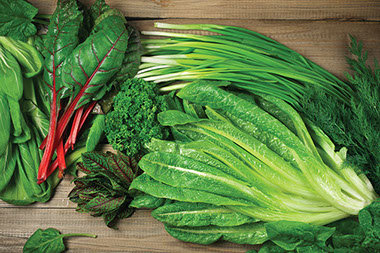
    Variety of leaft greens.

    Gout is a type of arthritis. It can develop if a person has high levels of a substance called uric acid in their blood. Uric acid can form sharp crystals in the joints. This can cause severe pain, redness, warmth and swelling. Gout often affects the big toe, but it can affect other joints.

    Sometimes gout doesn’t cause any pain for a while. Then, a person may get severe pain in the affected joint. This is called a gout attack. When a gout attack happens, uric acid levels go up or the crystals in the joint cause irritation. A gout attack is very painful.

    In addition to pain, gout can cause heart problems. People who have gout may be more likely to have heart failure, a heart attack or stroke. Eating certain foods can help keep uric acid levels low. This can help a person prevent gout attacks.

    What to eat with gout

    If you have gout, you may want to eat more of the following foods:

    *  Leafy green vegetables

    *  Other green vegetables like green beans and peas

    *  Legumes like beans and lentils

    *  Tofu

    *  Low-fat or fat-free milk and dairy products

    *  Whole grain breads and cereals

    *  Vegetable oils like olive oil

    *  Coffee (if you already drink it)

    *  Citrus fruits like grapefruit and oranges

    *  Pineapple

    *  Strawberries

    *  Cherries

    In addition, drink at least eight glasses of water a day.

    Skip these foods & drinks

    Certain foods and beverages can trigger gout attacks. Avoid the following:

    *  Beer (alcoholic and  non-alcoholic)

    *  Alcoholic drinks

    *  Soda, fruit juice, and foods with high-fructose corn syrup

    *  Organ meats like liver and sweetbreads

    *  Cold water fish like tuna, salmon and trout

    *  Shellfish like mussels, scallops, squid, shrimp, oysters, crab and lobster

    Eating a healthy diet is a great way to manage gout and help avoid attacks. It also helps to get regular exercise. Be sure to see your doctor as recommended. Your doctor may prescribe gout medication if needed and will discuss your heart disease risk.

    Sources: American Heart Association, Arthritis Foundation

    © American Institute for Preventive Medicine

  • Email – Use It Wisely

    WORK LIFE

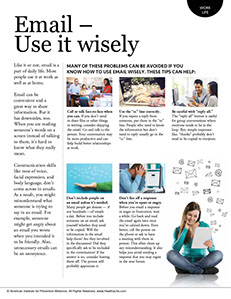
    Hands typing on keyboard of laptop with mail concept icons floating.

    Like it or not, email is a part of daily life. Most people use it at work as well as at home.

    Email can be convenient and a great way to share information. But it has downsides, too. When you are reading someone’s words on a screen instead of talking to them, it’s hard to know what they really mean.

    Communication skills like tone of voice, facial expression, and body language, don’t come across in emails. As a result, you might misunderstand what someone is trying to say in an email. For example, someone might get angry about an email you wrote when you intended it to be friendly. Also, unnecessary emails can be an annoyance.

    Many of these problems can be avoided if you know how to use email wisely. These tips can help:

    *Call or talk face-to-face when you can.If you don’t need to share files or other things in writing, consider skipping the email. Go and talk to the person. Your conversation may be more productive and can help build better relationships at work.

    *Use the “cc” line correctly.If you expect a reply from someone, put them in the “to” line. People who need to know the information but don’t need to reply usually go in the “cc” line.

    *Be careful with “reply all.”The “reply all” button is useful for group conversations where everyone needs to be in the loop. But, simple responses like, “thanks” probably don’t need to be copied to everyone.

    *Don’t include people on an email unless it’s needed.Many people get dozens – if not hundreds -of emails a day. Before you include someone on an email, ask yourself whether they need to be copied. Will the information in the email help them? Are they involved in the discussion? Did they specifically ask to be included in the conversation? If the answer is no, consider leaving them off. The person will probably appreciate it.

    *Don’t fire off a response when you’re upset or angry.Before you email a response in anger or frustration, wait a while. Go back and read the email again later once you’ve calmed down. Even better, call the person on the phone or ask to have a meeting with them in person. This often clears up any misunderstanding. It also helps you avoid sending a response that you may regret in the near future.

    © American Institute for Preventive Medicine
  • Encourage Exercise In Others

    BE FIT

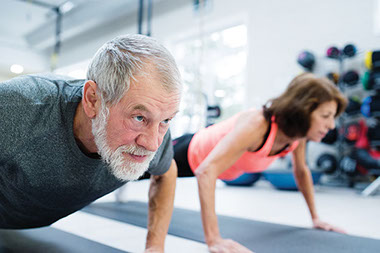
    Image of man and women doing pushups.

    Sticking to an exercise routine can be hard. But sometimes getting support from another person can help you get started. If you’ve been able to work out regularly, you can help a loved one do the same. Be a positive force in their life by supporting them, not forcing them. Try these strategies that can encourage them without pressure.

    *  Make it doable. Don’t suggest signing up for difficult classes or workouts right away. A walk in the evening or doing push-ups while watching TV can be less overwhelming.

    *  Try something new. A new walking route, different stretches or a fun strength program may help them get motivated. Get away from the same old routine that may not have worked in the past.

    *  Let them pick. See if they are interested in any local exercise classes or programs – and go with them.

    *  Plan a meetup time. Many people find exercising right after work is helpful. This may be easier than trying to go back out after you’ve come home to relax. Some people are able to stick to a lunchtime walk if they work in the same place.

    *  Be consistent. Try to make your exercise routine a regular part of your week. For instance, two times each week is a doable but consistent way to start.

    *  Be an early riser. If the person lives with you, see if you both can get up 30 minutes earlier for a walk first thing in the morning.

    *  Ditch the car when you can. If the store or coffee shop is close by, you can walk or bike there together.

    *  See things from their point of view. It’s hard to get started with exercise. Try to understand how challenging it can be. Ask them how you can best support them.

    A positive mindset

    When it comes to exercise, the mind is as important as the body. When starting a new healthy habit or helping someone else, remember to:

    *  Celebrate small efforts. Be happy about seeing an improvement – no matter how small – in strength or fitness level.

    *  Don’t let setbacks take over. If you miss a week or even two, get back to it. Tell the person you’re not giving up, and help them try again.

    Remember that every little bit of exercise is a step in the right direction!

    Source: U.S. Department of Health and Human Services

    © American Institute for Preventive Medicine
  • Ergonomics For The Home Office

    WORK LIFE

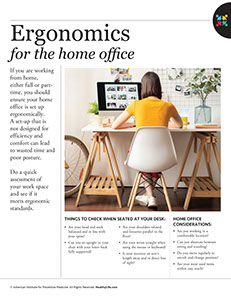
    Women sitting at desk working on computer.

    If you are working from home, either full or part-time, you should ensure your home office is set up ergonomically. A set-up that is not designed for efficiency and comfort can lead to wasted time and poor posture.

    Do a quick assessment of your work space and see if it meets ergonomic standards.

    Things to check when seated at your desk:

    *  Are your head and neck balanced and in line with your spine?

    *  Can you sit upright in your chair with your lower back fully supported?

    *  Are your shoulders relaxed and forearms parallel to the floor?

    *  Are your wrists straight when using the mouse or keyboard?

    *  Is your monitor an arm’s length away and in direct line of sight?

    Home office considerations:

    *  Are you working in a comfortable location?

    *  Can you alternate between sitting and standing?

    *  Do you move regularly to stretch and change position?

    *  Are your most used items within easy reach?

    © American Institute for Preventive Medicine

  • Escape The Holiday Carbohydrate Trap

    HEALTHY EATING

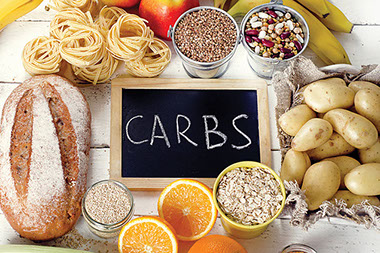
    Small chaulk board with the word CARBS written with a variety of carbs.

    The holidays can feel like one big carbohydrate trap. For people who are watching their carb intake, this time of year can be challenging. Between all the bread, mashed potatoes, and desserts, many people throw up their hands and declare, “I’ll start eating better AFTER the holidays.” But, there is no reason to take an all-or-nothing approach. You can enjoy holiday meals and avoid overdoing it.

    Whether you’re managing diabetes or just trying to eat fewer empty carbs, here are some holiday eating tips:

    *Focus on eating more vegetables.Have the turkey and some of your favorite veggie sides, and hold off on the mashed potatoes or rolls. You might find yourself satisfied, but if not, you can always go back for another serving.

    *Bring a dish you know is low-carb.Make sure it is something you enjoy eating, and that feels festive for the occasion. You’re not depriving yourself; you’re enjoying delicious, low-carb food.

    *Think in advance about what foods are worth the indulgence.Instead of sitting down and throwing caution to the wind, pick one or two of your favorite carbohydrate-rich foods to enjoy. If you really want dessert, try limiting your servings of potato, rolls, stuffing, and macaroni in your main meal.

    *Have a healthy snack in advance.If you show up at the table starving, you’re more likely to be tempted. A handful of nuts or an apple with peanut butter can take the edge off and prevent overeating.

    © American Institute for Preventive Medicine

  • Exercise Safely In The Heat

    BE FIT

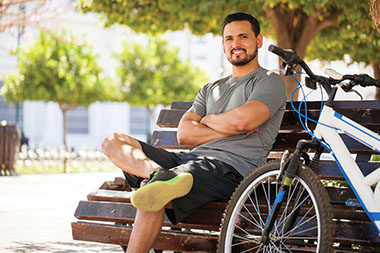
    Man sitting on bench beside his bike.

    Summer seems like an ideal time to exercise. After all, you don’t have to worry about slipping on ice or wearing extra layers to keep warm.

    But summer comes with its own set of safety issues. Heat illness can affect anyone, even people who are in great shape and healthy.

    What is heat illness?

    Heat illness happens when a person’s body gets too hot. This often happens when a person exercises in high temperatures.

    Heat illness can be mild to severe. Sometimes it’s just a sign that you need to cool off and get out of the sun. But other times, it can be dangerous or life-threatening.

    Time to chill out

    Signs of a mild heat illness include heat rash and heat cramps. A heat rash may be red and look like pimples. Heat cramps are muscle cramps or spasms.

    If you notice either of these signs when exercising, seek some shade and cool off. These are not usually serious conditions.

    People who have heart conditions or who follow a low-salt diet should talk to a doctor if they notice muscle cramps or spasms with exercise. If your heat rash doesn’t go away within a couple of days, see your doctor.

    When the heat is an emergency

    Heat exhaustion may cause:

    *  Heavy sweating

    *  Cold or clammy skin

    *  Feeling weak

    *  Weak but fast pulse

    *  Feeling sick

    *  Headache

    *  Fainting

    *  Dizziness

    If you notice these signs in yourself or another person, don’t wait. Seek shade or go indoors. Put cool, wet cloths on the body and head or take a cool bath. Get medical help if it doesn’t get better within an hour or if the person is throwing up.

    Heat stroke is the most severe kind of heat illness.

    It may cause:

    *  Temperature over 103ºF

    *  Skin that is clammy, hot or red, and even dry to the touch.

    *  Fast and strong pulse

    *  Headache or confusion

    *  Dizziness and/or fainting

    *  Feeling sick

    If you suspect heat stroke, get emergency medical care. Call 911 right away. Move the person to a cooler place. Apply cool cloths to their body. Do not give them anything to drink.

    Sources: Centers for Disease Control and Prevention, American Academy of Family Physicians

    © American Institute for Preventive Medicine
  • Exercise To Lower Blood Sugar

    BE FIT

    Gym shoes, dumb bells, headphones, glucose meter.

    If you have diabetes, physical activity is a great way to keep blood sugar in check. Being active makes your body more sensitive to insulin, which helps lower blood sugar to healthy levels.

    Aim for at least 150 minutes of moderate-intensity physical activity per week. Moderate intensity means your heart rate should be elevated, but you should be able to speak normally. Consider adding strength training a few times a week to help your muscles use insulin.

    Here are more tips:

    *  Check with your doctor for exercises that are best for you.

    *  Check your blood sugar before exercising, especially if you take insulin.

    *  Recheck your blood sugar once you finish exercising.

    *  Drink plenty of water before, during, and after exercise.

    *  Have a snack on hand in case your blood sugar gets low.

    *  Wear good-fitting shoes and socks.

    *  Monitor your feet for sores.

    *  Aim for at least 20 minutes of exercise each day.

    © American Institute for Preventive Medicine
  • Exercise Your Feet

    BE FIT

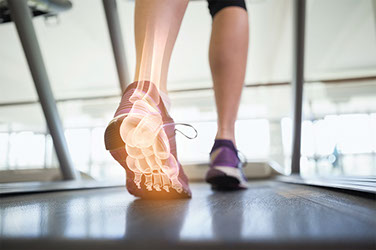
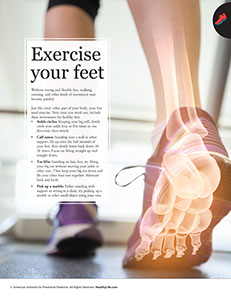
    Close up of feet walking on treadmill, with an overlapping illustration of a foot skeleton.

    Without strong and flexible feet, walking, running, and other kinds of movement may become painful.

    Just like every other part of your body, your feet need exercise. Next time you work out, include these movements for healthy feet:

    *Ankle circles:Keeping your leg still, slowly circle your ankle four or five times in one direction, then switch.

    *Calf raises:Standing near a wall or other support, lift up onto the ball mounds of your feet, then slowly lower back down 10-20 times. Focus on lifting straight up and straight down.

    *Toe lifts:Standing on bare feet, try lifting your big toe without moving your ankle or other toes. Then keep your big toe down and lift your other four toes together. Alternate back and forth.

    *Pick up a marble:Either standing with support or sitting in a chair, try picking up a marble or other small object using your toes.

    © American Institute for Preventive Medicine
  • Exercise Safely In The Heat 2

    BE FIT

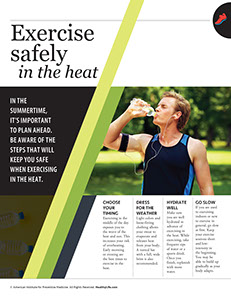
    Man outside drinking water and exercising.

    In the summertime, it’s important to plan ahead. Be aware of the steps that will keep you safe when exercising in the heat.

    Choose your timing

    Exercising in the middle of the day exposes you to the worst of the heat and sun. This increases your risk of overheating. Early morning or evening are the best times to exercise in the heat.

    Dress for the weather

    Light colors and loose-fitting clothing allows your sweat to evaporate and releases heat from your body. A vented hat with a full, wide brim is also recommended.

    Hydrate well

    Make sure you are well hydrated in advance of exercising in the heat. While exercising, take frequent sips of water or a sports drink.  Once you finish, replenish with more water.

    Go slow

    If you are used to exercising indoors or new to exercise in general, go slow at first. Keep your exercise sessions short and low-intensity in the beginning. You may be able to build up gradually as your body adapts.

    © American Institute for Preventive Medicine
  • Farmers Market: Fresh Produce & More

    HEALTHY EATING

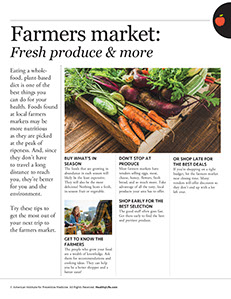
    Variety of fresh produce in wooden box.

    Eating a whole-food, plant-based diet is one of the best things you can do for your health. Foods found at local farmers markets may be more nutritious as they are picked at the peak of ripeness. And, since they don’t have to travel a long distance to reach you, they’re better for you and the environment. Try these tips to get the most out of your next trip to the farmers market.

    Buy what’s in season

    The foods that are growing in abundance in each season will likely be the least expensive. They will also be the most delicious! Nothing beats a fresh, in-season fruit or vegetable.

    Get to know the farmers

    The people who grow your food are a wealth of knowledge. Ask them for recommendations and cooking ideas. They can help you be a better shopper and a better eater!

    Don’t stop at produce

    Most farmers markets have vendors selling eggs, meat, cheese, honey, flowers, fresh bread, and so much more. Take advantage of all the tasty, local products your area has to offer.

    Shop early for the best selection

    The good stuff often goes fast. Get there early to find the best and prettiest produce.

    Or shop late for the best deals

    If you’re shopping on a tight budget, hit the farmers market near closing time. Many vendors will offer discounts so they don’t end up with a lot left over.

    © American Institute for Preventive Medicine