Author: AIPM

  • Love Your Heart

    Heart & Circulation Problems

    Heart shape plate with heart healthy foods.

    Show your heart some love with heart-healthy habits. Eating a healthy diet, maintaining a healthy weight, getting regular activity, avoiding smoke, and managing stress can all help keep your ticker on track.

    And, did you know that having a strong support system lowers your stress level, keeping your heart happy and healthy? So share a meal or enjoy a walk with a friend.

    You’ll love how you feel when you take care of your heart.

    Health at Home Lifetime book by the American Institute for Preventive Medicine. www.HealthyLife.com. All rights reserved.

    © American Institute for Preventive Medicine

  • Lung Cancer

    Respiratory conditions

    Lung cancer is the leading cause of death from cancer in men and women. The rich network of blood vessels that deliver oxygen from the lungs to the rest of the body can spread cancer very quickly. By the time it is diagnosed, other organs may be affected. The lungs are also a frequent site that cancer from other areas of the body spreads to.

    Signs & Symptoms

    When it first develops, lung cancer does not usually cause symptoms. When symptoms occur, they include:

    *  A cough that doesn’t go away. This could be a “smoker’s cough” that gets worse.

    *  Constant chest pain. Back pain can occur.

    *  Hoarseness.

    *  Shortness of breath. Wheezing.

    *  Recurring pneumonia or bronchitis.

    *  Weakness in a shoulder, arm, or hand.

    *  Fatigue. Appetite loss and weight loss.

    Causes

    Cigarette smoking is the major cause. The risk increases with the  more you smoke, the longer you smoke, and the more deeply you inhale cigarette smoke.

    Other causes are exposure to secondhand smoke, asbestos, radon, and other cancer causing agents.

    Treatment

    Tests are done to find out the type of lung cancer and the stage of the disease. There are two types of lung cancer: small cell lung cancer and non-small cell lung cancer. Treatment is aimed at the specific type and includes:

    *  Lung surgery.

    *  Respiratory therapy.

    *  Radiation therapy.

    *  Chemotherapy.

    *  Clinical trials.

    Questions to Ask

    Self-Care / Prevention

    Follow your medical treatment plan.

    *  Do not smoke or use tobacco products. If you smoke, quit! Avoid secondhand smoke.

    *  Avoid exposure to asbestos and/or radon. If these are found in your house, get them removed by an expert.

    *  Follow workplace safety rules for preventing exposure to diesel exhaust and other chemicals that can cause lung cancer.

    Healthier at Home book by the American Institute for Preventive Medicine. www.HealthyLife.com. All rights reserved.

    © American Institute for Preventive Medicine

  • Macular Degeneration

    Eye Conditions

    Macular degeneration is a progressive eye disorder. Known as age-related macular degeneration (AMD), it is the most common cause of central vision loss in older Americans. The central part of the retina (the macula) deteriorates. This results in the loss of central (straight-ahead) vision. One or both eyes may be affected. The most common type is called the dry form. With this, cells under the retina do not function well, causing subtle to overt blank spots in central vision. Only 1 to 2% of people with the dry form have a lot of vision loss. In the wet form, tiny blood vessels leak blood or fluid around the macula. The wet form is less common than the dry form. It causes more vision loss, though.

    Signs & Symptoms

    Macular degeneration is painless. It usually develops gradually, especially the dry form. With the wet form, symptoms can occur more rapidly. Symptoms for both forms are:

    *  Blurred or cloudy vision.

    *  Seeing a dark or blind spot at the center of vision.

    *  A hard time reading or doing other close-up work.

    *  A hard time doing any activity, such as driving, that needs sharp vision.

    *  Complete loss of central vision. Side vision is not affected.

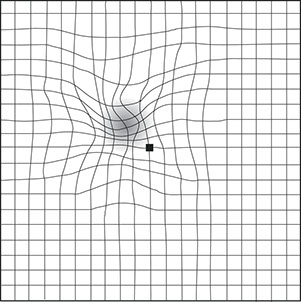
    Cover one eye and stare at the center dot in this grid. Seeing blurry, curvy, or distorted lines or empty spots could be a sign of macular degeneration. Repeat, covering the other eye.

    This grid shows how the lines might look to someone with macular degeneration.

    Causes

    The exact cause of age-related macular degeneration (AMD) is not known. Risk factors are:

    *  Advancing age.

    *  Cigarette smoking. High blood pressure.

    *  Family history of AMD.

    *  Having light-colored eyes.

    *  Exposure to ultraviolet light.

    *  Poor diet.

    Treatment

    Treatment for the wet form includes photodynamic therapy and laser therapy. Medicine called “anti-VEGF therapy” can also be given. Most dry form cases are not treatable. Your eye doctor may prescribe special eyeglasses and low vision aids. He or she may also prescribe a specific high dose vitamin and mineral to reduce the risk of advanced AMD.

    Questions to Ask

    Self-Care / Prevention

    To Reduce the Risk for AMD

    *  Don’t smoke. If you smoke, quit.

    *  Follow a healthy diet. Include green leafy vegetables and fish.

    *  Protect your eyes from the sun’s ultraviolet rays. Wear sunglasses with UV block. Wear a hat with a wide brim.

    *  Use Self-Care / Prevention measures to control high blood pressure and heart disease.

    To Treat AMD

    *  Wear the special eyeglasses and use other vision aids, such as magnifying devices, as advised by your doctor.

    *  Talk to your doctor before taking vitamin and mineral supplements.

    Resources

    Macular Degeneration Foundation

    www.eyesight.org

    National Eye Institute (NEI)

    www.nei.nih.gov

    Healthier at Home book by the American Institute for Preventive Medicine. www.HealthyLife.com. All rights reserved.

    © American Institute for Preventive Medicine

  • Reversing Male Infertility

    Men’s Health

    Image of male doctor.

    If a man has been unsuccessful at fathering a child, he’ll probably be checked for two kinds of problems: low sperm count (too few sperm per given volume of semen) and poor sperm motility (sperm that are poor swimmers and have trouble fertilizing an egg).

    Factors that can reduce fertility in men include:

    *  Extreme overweight.

    *  Heavy smoking. (Smoking has been associated with low sperm count and poor sperm motility.)

    *  Drug and alcohol use. (Marijuana and alcohol lower production of testosterone, a hormone produced by the testicles.)

    *  Wearing tight, restrictive underwear. (Clothing that holds the testicles too close to the body heats them up and thus interferes with sperm production, which is temperature sensitive.)

    *  Work that requires you to sit for long periods of time (for reasons similar to those above).

    *  Frequent use of saunas or hot tubs.

    *  Prolonged occupational exposure to lead, zinc, copper, or radiation. (Pollutants can disrupt the production, quality, and transportation of sperm.)

    *  Prolonged abstinence from sex.

    *  Use of lubricants, such as petroleum jelly and K-Y brand jelly, which can kill or immobilize sperm.

    *  Infection or other illness. (These hamper the testicles’ ability to do their job.)

    *  A varicocele (a congenital defect in the blood vessels to the testes).

    For many men, restoring fertility is simply a matter of switching to boxer shorts, quitting smoking, losing weight, or making other adjustments. Be patient, though. It may take two or three months to restore fertility. If your partner still doesn’t conceive, see a doctor who specializes in treating infertility.

    A Year of Health Hints book by the American Institute for Preventive Medicine. www.HealthyLife.com. All rights reserved.

    © American Institute for Preventive Medicine

  • Managing Male Menopause

    Men’s Health

    Image of smiling couple laying down.

    You never heard of male menopause? It’s a term used to describe the emotional reactions men sometimes have in response to mid-life transitions. Between the ages of 40 and 60, some men begin to feel edgy and dissatisfied, overwhelmed by their obligations, and pessimistic about their futures.

    Typical symptoms include:

    *  Insomnia.

    *  Sexual problems.

    *  Increased dissatisfaction with work, marriage, and family life.

    *  Preoccupation with the past, or worries about illness and death.

    *  Abuse of alcohol, drugs, or both.

    *  Impulsive behavior, or taking unnecessary or dangerous risks.

    These feelings and behaviors are often triggered by changes, such as children moving away from home or other typical mid-life events.

    To cope with mid-life change:

    *  Don’t make radical or impulsive changes, like trading in an economical sedan for a luxury European sports car, or suddenly deciding you want a divorce.

    *  Don’t use alcohol, drugs, or casual sex to escape or lessen the impact of change.

    *  Do share your fears and concerns with your family, and seek professional counseling if your troubles seem to be more than you can handle.

    *  Do cultivate skills and interests you’d enjoy but never took the time to pursue.

    A Year of Health Hints book by the American Institute for Preventive Medicine. www.HealthyLife.com. All rights reserved.

    © American Institute for Preventive Medicine

  • Make The Most Of Mealtime

    Mature Health: Over Age 50

    Image of a man pan stirring vegetables.

    Mealtime is something to look forward to. But for some older adults, especially men living alone, preparing meals can be both awkward and troublesome. This can lead to the “tea and toast” syndrome of skipped or unbalanced meals. Hit-or-miss eating habits can, in turn, lead to loss of energy and malnutrition. Coupled with the fact that older adults often need more calcium than other folks (for strong bones), more fiber (to prevent constipation), and adequate supplies of other important dietary components, poor meal habits can directly affect your health.

    Here are a few hints to make preparing meals and eating meals more pleasant and convenient.

    *  Make a list before you shop for food. Include fish, poultry, lean meats, nonfat dairy products, whole-grain breads and cereals, fresh fruits and vegetables.

    *  When you shop for meat or produce, ask a store clerk to cut or repackage large quantities into smaller single- or double-serving portions.

    *  Take advantage of salad bars in supermarkets. They’re a convenient way to incorporate fresh vegetables into your diet.

    *  Buy some back-up supplies of nutritious foods-like tuna canned in water or low-salt soups-for days when you don’t have the time or inclination to cook a full meal from scratch.

    *  Read labels. Avoid foods high in fat, salt, and sugar. These ingredients contribute to many of the chronic health problems that affect people after age 40.

    *  Prepare double portions of main dishes, so you can reheat leftovers a day or two later.

    *  Share shopping, meal preparation, and meals with a friend or neighbor.

    A Year of Health Hints book by the American Institute for Preventive Medicine. www.HealthyLife.com. All rights reserved.

    © American Institute for Preventive Medicine

  • Get Vaccines To Prevent Measles

    Skin Conditions

    Image of toddler getting a shot by a doctor.

    In January 2015, CDC issued a health advisory to notify public health departments and healthcare facilities about a multi-state outbreak of measles. The outbreak started at Disneyland in Dec., 2014. During that entire year, the CDC reported a record number of measles in the U.S. with 644 cases from 27 states. This is the greatest number of cases since measles was eliminated in the U.S. in 2000.

    Why the rise in measles?

    *  The majority of the people who got measles did not receive vaccines.

    *  Measles is still common in many parts of the world including some countries in Europe, Asia, the Pacific, and Africa.

    *  Travelers with measles continue to bring the disease into the U.S.

    Measles is a highly contagious respiratory disease caused by a virus. Coughs and sneezes spread the virus through the air. Measles starts with a fever, runny nose, cough, red eyes, and sore throat. A rash that spreads all over the body follows. About three out of 10 people who get measles will develop one or more serious problems including pneumonia, ear infections, or diarrhea. These problems are more common in adults and young children.

    Guidelines for measles vaccines

    Children should get 2 doses of measles, mumps, and rubella (MMR) vaccine:

    *  First Dose: 12-15 months of age. Some infants younger than 12 months should get a dose of MMR if they are traveling out of the country.

    *  Second Dose: 4-6 years of age

    *  If not given at these times, a two-dose series is needed for all school-age children and adolescents.

    Adults born after 1956 should get at least one dose of MMR vaccine, unless they can show that they have either been vaccinated or had all three diseases.

    Health News by the American Institute for Preventive Medicine. www.HealthyLife.com. All rights reserved.

    © American Institute for Preventive Medicine

  • Memory Loss

    Brain & Nervous System

    With short-term memory loss, you can’t recall things learned in the past seconds to minutes. With long-term memory loss, you forget things learned in the distant past, such as in childhood. It is normal to have some memory loss as you age. It is common to forget where you put your eyeglasses or keys. You may have a hard time recalling the name of a person or place, and say, “It is on the tip of my tongue.” This memory loss is temporary and not severe. When it persists or interferes with your daily life, it can be a sign of a problem.

    Signs & Symptoms

    Signs and symptoms of serious memory loss, such as amnesia, depend on the cause. The memory loss can be partial or complete. It can occur for a short time or persist. It can also come on suddenly or slowly.

    Causes

    Other than the normal memory loss that comes with aging, causes include:

    *  Depression.

    *  Excess alcohol. Drug use.

    *  Side effects of some medicines.

    *  Alzheimer’s disease and other forms of dementia. Dementias result in a decline of all areas of mental ability. This includes learning, problem solving, language, behaviors, and memory loss.

    *  Mild cognitive impairment. This is a medical illness. With this, people have abnormal memory for their age and education. They have a harder time learning new information or recalling things.

    *  Posttraumatic stress disorder.

    *  Seizures. Head trauma.

    *  Stroke.

    *  Brain infections or tumors.

    Treatment

    Memory loss that persists, is severe, or that interferes with daily life needs a medical diagnosis. When another problem is the cause and is treated with success, memory loss improves. For other causes, such as Alzheimer’s disease, there is no cure. The goal is to treat symptoms and provide safety and comfort.

    Questions to Ask

    Self-Care / Prevention

    To Help Prevent Memory Loss

    *  Keep the brain active. Read, do puzzles, etc.

    *  Eat a balanced diet. Take vitamins and minerals, as advised by your doctor.

    *  Get regular exercise.

    *  Protect the head from injury.

    *  Follow tips under Prevention for Stroke (Brain Attack).

    *  Don’t smoke or use illegal drugs. Limit alcohol.

    *  Manage stress.

    *  Get regular eye exams. Get your hearing checked. If needed, wear eyeglasses and/or a hearing aid.

    To Help Remember Things

    *  Follow a routine for daily and weekly activities.

    *  Listen carefully. Link newly learned things to past memories.

    *  Repeat what you want to remember out loud. Write it down if you need to.

    *  Keep track of important things to do, phone numbers, etc. Use a calendar, planner, PDA, etc.

    *  Set up a system to remind you of daily medications to take, bills to pay, appointments to keep, etc.

    *  Put your keys, eyeglasses, etc. in the same place.

    Healthier at Home book by the American Institute for Preventive Medicine. www.HealthyLife.com. All rights reserved.

    © American Institute for Preventive Medicine

  • Men Need Calcium, Too

    Men’s Health

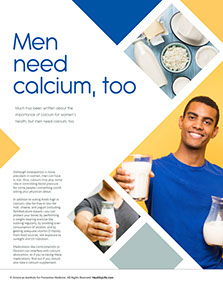
    Image of calcium rich dairy products.

    Much has been written about the importance of calcium for women’s health, but men need calcium, too. Although osteoporosis is more prevalent in women, it can strike men. And studies have suggested that calcium may play some role in controlling blood pressure for some people-something worth asking your physician about.

    In addition to eating foods high in calcium-like fat-free or low-fat milk, cheese, and yogurt-you can protect your bones by performing a weight- bearing exercise like walking regularly, by avoiding over-consumption of alcohol, and by getting adequate vitamin D (from either fortified milk or sunshine).

    Medications like corticosteroids or Dilantin can interfere with calcium absorption, so if you’re taking these medications, find out if you should also take a calcium supplement.

    A Year of Health Hints book by the American Institute for Preventive Medicine. www.HealthyLife.com. All rights reserved.

    © American Institute for Preventive Medicine

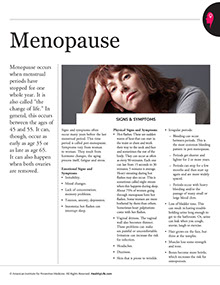
  • Menopause

    Women’s Health

    Menopause occurs when menstrual periods have stopped for one whole year. It is also called “the change of life.” In general, this occurs between the ages of 45 and 55. It can, though, occur as early as age 35 or as late as age 65. It can also result when both ovaries are removed by surgery.

    Signs & Symptoms

    Signs and symptoms usually span 1 to 2 or more years. This is called peri-menopause. Symptoms vary from woman to woman. They result from hormone changes, the aging process itself, fatigue, and stress.

    Physical Signs and Symptoms

    *  Hot flashes. These are sudden waves of heat that can start in the waist or chest and work their way to the neck and face and sometimes the rest of the body. They can occur as often as every 90 minutes. Each one can last from 15 seconds to 30 minutes; 5 minutes is average. Seventy-five to 80% of women going through menopause have hot flashes. Some women are more bothered by them than others. Sometimes heart palpitations come with hot flashes.

    *  Vaginal dryness. The vaginal wall also becomes thinner. These problems can make sex painful or uncomfortable. Irritation can increase the risk for infection.

    *  Loss of bladder tone. This can result in stress incontinence (leaking urine when you cough, sneeze, laugh, or exercise).

    *  Headaches.

    *  Dizziness.

    *  The skin is more likely to wrinkle.

    *  Hair grows on the face, but thins at the temples.

    *  Muscles lose some strength and tone.

    *  Bones become more brittle. This increases the risk for osteoporosis.

    *  Irregular periods:

    – Bleeding can occur between periods. This is the most common bleeding pattern in peri-menopause.

    – Periods get shorter and lighter for 2 or more years.

    – Periods can stop for a few months and then start up again and are more widely spaced.

    – Periods occur with heavy bleeding and/or the passage of many small or large blood clots.

    Emotional Signs and Symptoms

    *  Irritability.

    *  Mood changes.

    *  Lack of concentration. Memory problems.

    *  Tension, anxiety, depression.

    *  Insomnia. Hot flashes can interrupt sleep.

    Causes

    Hormone changes that come with aging cause menopause. The body makes less estrogen and progesterone.

    Treatment

    Self-care may be all that is needed. Just estrogen can be prescribed. This is estrogen therapy (ET). Estrogen plus progestogen can be prescribed. This is called EPT. The term hormone therapy (HT) is used for both ET and EPT. Hormone therapy helps protect against osteoporosis, but has health risks. Each women should discuss the benefits and risks of HT and non-estrogen treatments with her doctor.

    Questions to Ask

    Self-Care / Prevention

    For Hot Flashes

    *  Wear lightweight clothes made of natural fibers, such as cotton.

    *  Limit or avoid alcohol. Limit caffeine.

    *  Have cool drinks, especially water, when you feel a hot flash coming on and before and after you exercise. Avoid hot drinks.

    *  Keep cool. Open a window. Lower the thermostat when the heat is on. Use air conditioning and/or fans. Carry a small fan with you.

    *  Try to relax when you get a hot flash. Getting stressed out over one only makes it worse.

    *  Use relaxation techniques, such as meditation, biofeedback or yoga.

    *  Follow your doctor’s advice for taking herbal products, such as black cohosh; vitamin supplements; over-the-counter menopause aids; and soy products.

    *  If you suffer from night sweats (hot flashes that occur as you sleep):

    – Wear loose fitting cotton nightwear. Have changes of nightwear ready.

    – Sleep with only a top sheet, not blankets.

    – Keep the room cool.

    For Vaginal Dryness and Painful Sex

    *  Don’t use deodorant soaps or scented products in the vaginal area.

    *  Use a water soluble lubricant, such as K-Y Liquid®, Replens®, etc. These make penetration easier during sex. Avoid oils or petroleum-based products. These promote infection.

    *  Ask your doctor about the benefits and risks of using estrogen (pills, patches, vaginal cream, or rings).

    *  Stay sexually active. Having sex often may lessen the chance of having the vagina constrict. It also helps to maintain natural lubrication and pelvic muscle tone. Reaching orgasm with a partner or alone gives these benefits.

    *  If you can, avoid using antihistamines. They dry mucus membranes in the body.

    For Emotional Symptoms

    *  Exercise regularly. This helps maintain hormonal balance.

    *  Talk to other women who have gone through or are going through menopause.

    *  Avoid stress as much as you can.

    *  To deal with stress, use relaxation techniques. Examples are meditation, yoga, listening to soft music, and massages.

    *  Eat healthy. Take vitamins and minerals, as advised.

    Resources

    National Women’s Health Information Center

    www.womenshealth.gov

    North American Menopause Society (NAMS)

    www.menopause.org

    Women's Self-Care book by the American Institute for Preventive Medicine. www.HealthyLife.com. All rights reserved.

    © American Institute for Preventive Medicine