Author: AIPM

  • Men’s Health

    Men’s Health

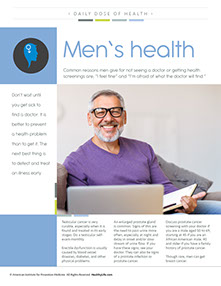
    Older man smiling.

    Common reasons men give for not seeing a doctor or getting health screenings are, “I feel fine” and “I’m afraid of what the doctor will find.”

    Don’t wait until you get sick to find a doctor. It is better to prevent a health problem than to get it. The next best thing is to detect and treat an illness early.

    Testicular cancer is very curable, especially when it is found and treated in its early stages. Do a testicular self-exam monthly.

    Erectile dysfunction is usually caused by blood vessel diseases, diabetes, and other physical problems.

    An enlarged prostate gland is common. Signs of this are the need to pass urine more often, especially at night and delay in onset and/or slow stream of urine flow. If you have these signs, see your doctor. They can also be signs of a prostate infection or prostate cancer.

    Discuss prostate cancer screening with your doctor if you are a male aged 50 to 69; starting at 45 if you are an African American male; 40 and older if you have a family history of prostate cancer.

    Though rare, men can get breast cancer.

    Health at Home Lifetime book by the American Institute for Preventive Medicine. www.HealthyLife.com. All rights reserved.

    © American Institute for Preventive Medicine

  • Menstrual Cramps

    Women’s Health

    Menstrual cramps are also called painful periods. Most females have them at sometime during their lives.

    Signs & Symptoms

    *  Pain or discomfort in the lower abdomen right before or with a menstrual period. The pain can range from mild to severe.

    *  The pain can occur with: A backache; fatigue; headache; diarrhea and/or vomiting.

    *  Symptoms can vary from month to month or year to year.

    Causes

    Menstrual cramps occur when muscles of the uterus squeeze the lining out. This is a part of normal menstruation. They occur often in females who have just begun to menstruate. They may go away or become less severe after a woman reaches her mid-twenties or gives birth. (Childbirth stretches the uterus.)

    Menstrual cramps occur much less often in women who do not ovulate. In fact, birth control pills reduce painful periods in 70 percent to 80 percent of females who take them. When the birth control pill is stopped, the same level of pain returns.

    Menstrual cramps can be due to other problems. Examples are fibroids, endometriosis, ovarian cysts, and rarely, cancer. Having an intrauterine device (IUD), especially if you’ve never been pregnant, can also cause menstrual cramps, except with the Progestasert® IUD. It releases a small amount of progesterone into the uterus. This lessens cramps and lightens menstrual flow.

    Treatment

    Self-care measures treat most cases of menstrual cramps. If not, a doctor can diagnose the cause and prescribe treatment.

    Questions to Ask

    Self-Care / Prevention

    *  Take an over- the-counter pain reliever, such as ibuprofen, naproxen sodium, or aspirin. These nonsteroidal anti-inflammatory drugs (NSAIDS) relieve pain and inhibit the release of prostaglandins. Acetaminophen will help with pain, too. Most over-the-counter menstrual discomfort products contain acetaminophen. Read labels. {Note: Do not give aspirin or any medication with salicylates to anyone 19 years of age or younger due to its link with Reye’s Syndrome.}

    *  Hold a heating pad or hot-water bottle on your abdomen or lower back.

    *  Take a warm bath.

    *  Gently massage your abdomen.

    *  Do mild exercises. Stretch. Do yoga. Walk. Bicycle.

    *  When you can, lie on your back. Support your knees with a pillow.

    *  Get plenty of rest. Limit stress as your period nears.

    *  Consider using birth control pills or the Progestasert® IUD. These lessen menstrual cramps.

    If you still feel pain after using self-care measures, call your doctor.

    Resources

    National Women’s Health Information Center

    www.womenshealth.gov

    Women's Self-Care book by the American Institute for Preventive Medicine. www.HealthyLife.com. All rights reserved.

    © American Institute for Preventive Medicine

  • Mononucleosis (“Mono”)

    Student Health

    A common cause of fatigue in students is infectious mononucleosis, an acute viral disease.

    Signs & Symptoms

    *  Fatigue.

    *  Fever.

    *  Sore throat.

    *  Swollen lymph gland in the neck area.

    *  Pain in the upper left abdominal area.

    Symptoms usually last several weeks.

    Causes

    Epstein-Barr virus (EBV). This is spread from person to person through contact with saliva from a person recently infected with the disease. The saliva can be picked up from hand-to-hand contact, sharing eating utensils, and kissing, which is why “Mono” is called the “kissing disease.” Symptoms usually appear about 4 to 6 weeks after exposure.

    Treatment

    Rest is the mainstay of treatment. Avoiding heavy lifting and contact sports is necessary, because there is a risk of rupturing the spleen with “Mono.”

    Student Self-Care book by the American Institute for Preventive Medicine. www.HealthyLife.com. All rights reserved.

    © American Institute for Preventive Medicine

  • More Than One Baby

    Pregnancy & Prenatal Care

    Causes

    Having more than one baby may happen more often if:

    *  There is a family history of it.

    *  The mother is taking medicine or having treatment to get pregnant.

    *  She is an older mother.

    More than one baby can happen in two ways. The most common way is when two or more eggs are fertilized by two or more sperm. These babies can be either boys or girls. They may or may not look alike. They are called fraternal twins or triplets, etc.

    Less common is when an egg is fertilized by a sperm as usual. Then, for some reason, the egg splits apart. Two or more babies grow. They are the same sex. Their hair, eyes, and skin will be the same color. They are called identical twins or triplets, etc.

    In rare cases, the egg doesn’t split apart all the way. The twins stay joined together at the head or back. Or they may be joined at some other part of the body. They are called conjoined twins. Sometimes surgery can separate them after they are born. This can be very risky.

    Signs

    At first, a woman may not know she is carrying more than one baby. Her health care provider can usually tell within 8 weeks, though. Signs include:

    *  Severe nausea and vomiting

    *  The uterus is growing faster than usual.

    *  There are two or more heartbeats.

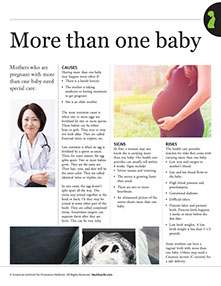
    *  An ultrasound picture of the uterus shows more than one baby.

    Risks

    The health care provider watches for risks that come with carrying more than one baby.

    *  Low iron and oxygen in mother’s blood.

    *  Less and less blood flows to the baby.

    *  High blood pressure and preeclampsia.

    *  Gestational diabetes.

    *  Difficult labor

    *  Preterm labor and preterm birth. Preterm birth happens 3 weeks or more before the due date.

    *  Low birth weights. A low birth weight is less than 5-1/2 pounds.

    Some mothers can have a vaginal birth with more than one baby. Others may need a Cesarean section (C-section) for a safe delivery.

    Questions to Ask

    Self-Care / Prevention

    *  You will need more prenatal health care visits than with just one baby. You will need extra blood tests and blood pressure checks. Your provider will need to make sure each baby is doing well. Call your provider whenever you have questions during your pregnancy.

    *  Eat healthy foods.

    *  Eat smaller meals more often. This helps ease things as your growing uterus presses on your stomach.

    *  Take your prenatal vitamins (vitamin pills) every day. They should include iron and folic acid. They will supply other needed vitamins and minerals, too.

    *  Don’t smoke, drink alcohol, or take drugs.

    *  Exercise only with your health care provider’s consent. Women carrying more than one baby tire more easily. In later pregnancy, avoid any activity that takes a lot of energy. Avoid any activity that could injure you or your babies.

    *  Lie on your left side. This helps blood flow to the babies. It may help keep blood pressure down, too. It also makes you more comfortable. Don’t lie on your back.

    *  Reduce stress in your life. Stress can lead to early labor.

    *  Get enough sleep. Learn and use methods to relax.

    *  Follow your health care provider’s advice on rest during the day.

    *  Get help with daily tasks, like caring for other children. If you can, take time off from your job after the 24th week.

    *  Watch for signs of preterm labor. Your provider may have you wear an electronic monitor. It senses contractions of the uterus.

    *  Choose a well-equipped hospital. Do this with your health care provider’s help. The hospital should be well suited for births of more than one baby. Choose one with a neonatal intensive care unit (NICU). This has special staff and equipment for babies born too early.

    Prenatal Self-Care book by the American Institute for Preventive Medicine. www.HealthyLife.com. All rights reserved.

    © American Institute for Preventive Medicine

  • Multiple Sclerosis

    Brain & Nervous System

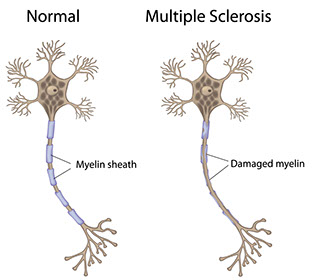
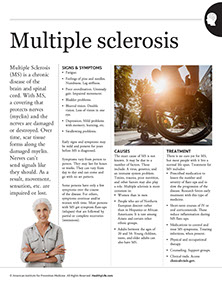
    Multiple Sclerosis (MS) is a chronic disease of the brain and spinal cord. With MS, a covering that protects nerves (myelin) and the nerves are damaged or destroyed. Over time, scar tissue forms along the damaged myelin. Nerves can’t send signals like they should. As a result, movement, sensation, etc. are impaired or lost.

    Illustration showing multiple sclerosis.

    Signs & Symptoms

    *  Fatigue.

    *  Feelings of pins and needles. Numbness. Leg stiffness.

    *  Poor coordination. Unsteady gait. Impaired movement.

    *  Bladder problems.

    *  Blurred vision. Double vision. Loss of vision in one eye.

    *  Depression. Mild problems with memory, learning, etc.

    *  Swallowing problems.

    Early signs and symptoms may be mild and present for years before MS is diagnosed.

    Symptoms vary from person to person. They may last for hours or weeks. They can vary from day to day and can come and go with no set pattern.

    Some persons have only a few symptoms over the course of the disease. For others, symptoms continue and/or worsen with time. Most persons with MS get symptom flare-ups (relapses) that are followed by partial or complete recoveries (remissions).

    Causes

    The exact cause of MS is not known. It may be due to a number of factors. These include: A virus, genetics, and an immune system problem. Toxins, trauma, poor nutrition, and other factors may also play a role. Things known to come before the onset of MS include: Overwork; fatigue, the postpartum period for women; acute infections; and fevers. Multiple sclerosis is more common in:

    *  Women than in men.

    *  Caucasians than in Hispanics or African Americans. It is rare among Asians and certain other ethnic groups.

    *  Adults between the ages of 20 and 50. Young children, teens, and older adults can also have MS.

    *  People who are born and live up to at least age 15 years old in places farther from the equator. These include North America, Europe, and Southern Australia.

    Treatment

    There is no cure yet for MS, but most people with it live a normal life span. Treatment for MS includes:

    *  Prescribed medication to lessen the number and severity of flare-ups and to slow the progression of the disease. Research favors early treatment with this type of medicine.

    *  Short-term courses of IV or oral corticosteroids. These reduce inflammation during MS flare-ups.

    *  Medications to control and treat MS symptoms. Treating infections, when present.

    *  Physical and occupational therapy.

    *  Counseling. Support groups.

    *  Clinical trails. Accesswww.clinicaltrials.gov.

    Questions to Ask

    Self-Care / Prevention

    *  Follow your doctor’s guidelines for home care.

    *  Maintain a normal routine at work and at home. Avoid activities that lead to fatigue or put too much physical stress on the body. Get plenty of rest.

    *  Manage emotional stress.

    *  Avoid the heat and sun. Don’t take hot showers or baths. Increased body temperature can cause symptoms. Cool baths or swimming in a pool may improve symptoms by lowering body temperature.

    *  Have body massages to help maintain muscle tone.

    *  Treat a fever as soon as it occurs.

    *  Get regular exercise. Physical therapy may be helpful.

    *  Get counseling, if needed.

    *  Get a seasonal flu shot every year and other vaccines as advised.

    *  If you smoke, quit!

    Resources

    Multiple Sclerosis Foundation

    888.MS.FOCUS (673.6287)

    www.msfocus.org

    National Multiple Sclerosis Society

    800.FIGHT.MS (344.4867)www.nationalmssociety.org

    Healthier at Home book by the American Institute for Preventive Medicine. www.HealthyLife.com. All rights reserved.

    © American Institute for Preventive Medicine

  • Debunking The Myth Of Senility

    Mature Health: Over Age 50

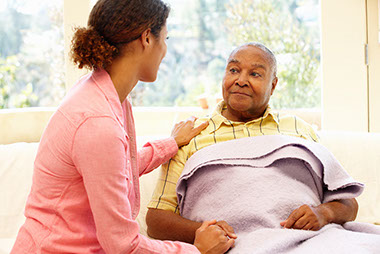
    Image of mature male with a family member holding his hand in comfort.

    Don’t think that you’re getting senile just because you forget someone’s name or can’t remember where you parked your car. Everyone forgets occasionally. The truth is, most people do not become senile. Senility (or senile dementia) is a state of confusion and forgetfulness triggered by mental decline. Almost 100 different conditions mimic the symptoms of senility. (Alzheimer’s disease is the most common. Poor nutrition, hormone disorders, and use of certain medications can also cause confusion and forgetfulness. Even then, senility is misdiagnosed up to 20 percent of the time. So don’t assume that you or anyone else is senile without a thorough medical exam.

    A Year of Health Hints book by the American Institute for Preventive Medicine. www.HealthyLife.com. All rights reserved.

    © American Institute for Preventive Medicine

  • Nausea And Vomiting

    Pregnancy & Prenatal Care

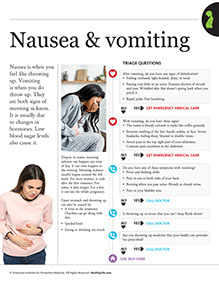
    Nausea is when you feel like throwing up. Vomiting is when you do throw up. They are both signs of morning sickness. It is usually due to changes in hormones. Low blood sugar levels also cause it.

    Despite its name, morning sickness can happen any time of day. It can even happen in the evening. Morning sickness usually begins around the 6th week. For most women, it ends after the first trimester. For some, it lasts longer. For a few, it can last the whole pregnancy.

    Upset stomach and throwing up can also be caused by:

    *  A virus in the intestines. Diarrhea can go along with this.

    *  Spoiled food

    *  Eating or drinking too much

    Questions to Ask

    Self-Care / Prevention

    *  Keep crackers or dry cereal by your bed. Eat a few crackers or a handful of dry cereal in bed. Do this before you lift your head up in the morning.

    *  Get up and out of bed slowly. If you can, sit in bed for a half-hour before you get up.

    *  Use these tips to keep your blood sugar from getting too low:

    – Eat small regular meals and snacks through the day. Focus on foods high in carbohydrates. Examples: whole grain breads and cereals, potatoes, pasta. More examples: rice, beans and other legumes, vegetables, fruits.

    – Have a good source of protein at each meal. Examples: low-fat milk, yogurt, low-fat cheese, dry beans, dry peas.

    – Have a snack before you go to bed at night. Have one if you wake up at night.

    – Avoid foods with high sugar content.

    – Don’t drink alcohol.

    *  Don’t smoke.

    *  Don’t eat fried or greasy foods. These foods have a lot of fat. Fat stays in the stomach for a long time. This can lead to nausea.

    *  Don’t eat spicy foods.

    *  Don’t take any medicine without your health care provider’s okay.

    *  Take your prenatal vitamins (vitamin pills) with meals. This helps prevent stomach upset. Your doctor may prescribe PremesisRx®. This is a vitamin that helps nausea.

    *  Ask your health care provider about taking ginger and in what form.

    *  Write down the times when your stomach is upset and when you throw up. These may happen only after you eat certain foods. Or they may happen with certain smells. Once you know what they are, you can avoid them.

    *  Stay away from smoke and smoky rooms. Even stay away from cooking smells.

    *  Get plenty of rest.

    *  Discuss any home remedies with your health care provider. Do this to make sure they are safe.

    *  Ask your health care provider about a relief band. That’s a wrist band that helps with an upset stomach and throwing up.

    *  If the Self-Care Tips bring no relief, call your health care provider. He or she can prescribe medicines. Sometimes, IV fluids are needed.

    *  To get rid of cooking smells and odors:

    – Open the windows.

    – Run fans in the house. Use the exhaust fan on the stove.

    – Use a portable air cleaner or air purifier.

    Prenatal Self-Care book by the American Institute for Preventive Medicine. www.HealthyLife.com. All rights reserved.

    © American Institute for Preventive Medicine

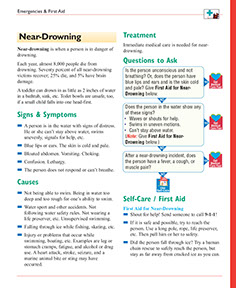
  • Near-Drowning

    First Aid

    Near-drowning is when a person is in danger of drowning. Each year, almost 8,000 people die from drowning. Seventy percent of all near-drowning victims recover; 25% die, and 5% have brain damage.

    A toddler can drown in as little as 2 inches of water in a bathtub, sink, etc. Toilet bowls are unsafe, too, if a small child falls into one head-first.

    Signs & Symptoms

    *  A person is in the water with signs of distress. He or she can’t stay above water, swims unevenly, signals for help, etc.

    *  Blue lips or ears. The skin is cold and pale.

    *  Bloated abdomen. Vomiting. Choking.

    *  Confusion. Lethargy.

    *  The person does not respond or can’t breathe.

    Causes

    *  Not being able to swim. Being in water too deep and too rough for one’s ability to swim.

    *  Water sport and other accidents. Not following water safety rules. Not wearing a life preserver, etc. Unsupervised swimming.

    *  Falling through ice while fishing, skating, etc.

    *  Injury or problems that occur while swimming, boating, etc. Examples are leg or stomach cramps, fatigue, and alcohol or drug use. A heart attack, stroke, seizure, and a marine animal bite or sting may have occurred.

    Prevention

    For Children

    *  Never leave an infant or child alone in any type of bathtub. Supervise young children in the bathroom.

    *  Never leave a child alone near water, swimming pools, etc. Lock gates to keep children from getting near swimming pools.

    *  Have a phone near outdoor pools, etc.

    *  Teach children to swim. Tell them not to swim alone and not to swim too far from shore without a lifeguard or other adult swimmer.

    *  Put a personal floatation device on each child when near the water or on a boat.

    *  Tell children to check the depth of water before diving in. It should be at least 9 feet deep.

    *  Do not allow children to go on untested ice.

    *  Take CPR and water safety courses.

    For Adults

    *  Learn to swim. Never swim alone at the beach or in a swimming pool. A lifeguard or other adult swimmer should be nearby in case you suffer a leg cramp or other problem.

    *  Wear a personal floatation device when you are on a boat, when you fish, etc.

    *  Check the depth of the water before diving in. It should be at least 9 feet deep. Never dive into an above-ground pool.

    *  Do not use a hot tub or jacuzzi if you’ve had any alcoholic drinks. You could fall asleep, slip under the surface, and drown.

    *  Take CPR and water safety courses.

    Questions to Ask

    Self-Care / First Aid

    First Aid for Near-Drowning

    *  Shout for help! Send someone to call 9-1-1!

    *  If it is safe and possible, try to reach the person. Use a long pole, rope, life preserver, etc. Then pull him or her to safety.

    *  Did the person fall through ice? Try a human chain rescue to safely reach the person, but stay as far away from cracked ice as you can.

    *  If you must swim to the person, be sure you are strong and capable enough. Take a flotation device with you. Approach the person from behind in a calm manner. Grab a piece of the person’s clothing. Or, cup one hand under the person’s chin.

    *  When getting the person out of the water, support the head and neck. (Suspect a neck injury, especially with diving or water sports.)

    *  CHECK for a response. Give Rescue Breaths and CPR, as needed. If you suspect a spinal injury, use jaw thrust instead of chin-lift for rescue breaths.

    *  Once out of the water, keep checking the person for a response. Give first aid, as needed.

    *  Put the person in the Recovery Position. Immobilize the person as much as possible. If the person is vomiting, clear his or her mouth of it.

    *  Remove cold, wet clothes. Cover the person with a blanket, etc.

    Healthier at Home book by the American Institute for Preventive Medicine. www.HealthyLife.com. All rights reserved.

    © American Institute for Preventive Medicine

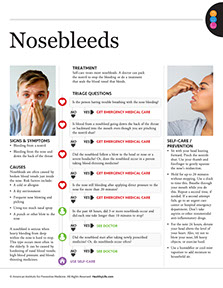
  • Nosebleeds

    Ear, Nose & Throat Conditions

    Signs & Symptoms

    *  Bleeding from a nostril.

    *  Bleeding from the nose and down the back of the throat.

    Causes

    Nosebleeds are often caused by broken blood vessels just inside the nose. Risk factors include:

    *  A cold or allergies.

    *  A dry environment.

    *  Frequent nose blowing and picking.

    *  Using too much nasal spray.

    *  A punch or other blow to the nose.

    A nosebleed is serious when heavy bleeding from deep within the nose is hard to stop. This type occurs most often in the elderly. It can be caused by: Hardening of nasal blood vessels; high blood pressure; and medicines that treat blood clots.

    Treatment

    Self-care treats most nosebleeds. A doctor can pack the nostril to stop the bleeding or do a treatment that seals the blood vessel that bleeds.

    Questions to Ask

    Self-Care / Prevention

    *  Sit with your head leaning forward. Pinch the nostrils shut. Use your thumb and forefinger to gently squeeze the nose’s midsection.

    *  Hold for up to 20 minutes without stopping. Use a clock to time this. Breathe through your mouth while you do this. Repeat a second time, if needed. If a second attempt fails, go to an urgent care center or hospital emergency department. Don’t take aspirin or other nonsteroidal anti-inflammatory drugs.

    *  For the next 24 hours, elevate your head above the level of your heart. Also, try not to blow your nose, lift heavy objects, or exercise hard.

    *  Use a humidifier or cool-mist vaporizer to add moisture to household air.

    Healthier at Home book by the American Institute for Preventive Medicine. www.HealthyLife.com. All rights reserved.

    © American Institute for Preventive Medicine

  • Nutrition For Children

    Children’s Health

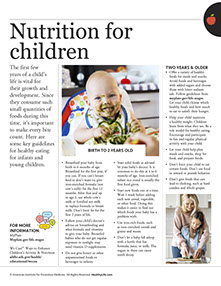
    Image of toddler eating a strawberry.

    Birth to 2 Years Old

    *  Breast-feed your baby from birth to 6 months of age. Breast-feed for the first year, if you can. If you can’t breast-feed or don’t want to, give iron-enriched formula (not cow’s milk) for the first 12 months. After that and up to age 2, use whole cow’s milk to replace formula or breast milk. Don’t limit fat for the first 2 years of life.

    *  Follow your child’s doctor’s advice on breast-feeding and what formula and vitamins to give your baby. Breast-fed babies who do not get regular exposure to sunlight may need vitamin D supplements.

    *  Start solid foods as advised by your baby’s doctor. It is common to do this at 4 to 6 months of age. Iron-enriched infant rice cereal is usually the first food given.

    *  Start new foods one at a time. Wait 1 week before adding each new cereal, vegetable, or other food. Doing this makes it easier to find out which foods your baby has a problem with.

    *  Use iron-rich foods, such as grains, iron-enriched cereals, and meats.

    *  Do not give honey to infants during the first 12 months of life.

    *  Don’t let a baby fall asleep with a bottle that has formula, juice, or milk. The sugars in these can cause tooth decay.

    Two Years and Older

    *  Give a variety of healthy foods for meals and snacks. Follow guidelines from theChooseMyPlate.gov/kidsWeb site. Let your child choose which healthy foods and how much to eat to satisfy his or her hunger.

    *  Help your child maintain a healthy weight. Give proper foods. Promote regular exercise. Lead by example. Children learn from what they see parents do, as well as, from what parents say. Eat with your children. Be a role model for good eating. Exercise, too.

    *  Let your child help plan meals and snacks, shop for food, and prepare foods.

    *  Don’t force your child to eat certain foods. Don’t use food to reward or punish behavior.

    *  Don’t give foods that can lead to choking, such as hard candies and whole grapes.

    *  Teach healthy behaviors in a fun way. For ideas to help get children to eat well and be more active, access the Web sites under “Resources”.

    Resources

    5-2-1-0 Let’s Go!

    www.letsgo.org

    ChooseMyPlate.gov

    www.choosemyplate.gov/kids/index.html

    We Can!™ Ways to Enhance Children’s  Activity & Nutrition

    www.nhlbi.nih.gov/health/educational/wecan

    Page from Healthier at Home book by the American Institute for Preventive Medicine. www.HealthyLife.com. All rights reserved.

    © American Institute for Preventive Medicine