Author: AIPM

  • Sinus Problems

    Ear, Nose & Throat Conditions

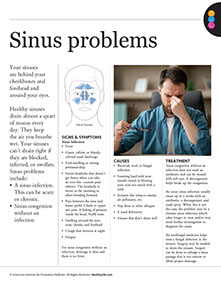
    Your sinuses are behind your cheekbones and forehead and around your eyes. Healthy sinuses drain almost a quart of mucus every day. They keep the air you breathe wet. Your sinuses can’t drain right if they are blocked, infected, or swollen. Sinus problems include:

    *  A sinus infection. This can be acute or chronic.

    *  Sinus congestion without an infection.

    Signs & Symptoms

    For a Sinus Infection

    *  Fever.

    *  Green, yellow, or bloody-colored nasal discharge.

    *  Foul-smelling or tasting postnasal drip.

    *  Severe headache that doesn’t get better when you take an over-the-counter pain reliever. The headache is worse in the morning or when bending forward.

    *  Pain between the nose and lower eyelid. Cheek or upper jaw pain.

    *  A feeling of pressure inside the head. Stuffy nose.

    *  Swelling around the eyes, nose, cheeks, and forehead.

    *  Cough that worsens at night.

    *  Fatigue.

    For sinus congestion without an infection, drainage is clear and there is no fever.

    Causes

    *  Bacterial, viral, or fungal infection. Sneezing hard with your mouth closed or blowing your nose too much with a cold.

    *  Irritants like tobacco smoke, air pollutants, etc. Hay fever or other allergies.

    *  A nasal deformity. Sinuses that don’t drain well.

    Treatment

    Sinus congestion without an infection does not need an antibiotic and can be treated with self-care. A decongestant helps break up the congestion.

    An acute sinus infection usually clears up in 2 weeks with an antibiotic, a decongestant, and nose drops or a nasal spray. When this is not the case, the problem may be a chronic sinus infection which takes longer to treat and/or may need further investigation to diagnose the cause.

    An antifungal medicine helps treat a fungal infection in the sinuses. Surgery may be needed to drain the sinuses. Surgery can be done to enlarge a sinus passage that is too narrow to allow proper drainage.

    Questions to Ask

    Self-Care / Prevention

    *  Use a cool-mist humidifier especially in the bedroom. Put a humidifier on the furnace.

    *  Put a warm washcloth, warm or cold compress over the sinus area of your face. Use the one that helps most for the pain.

    *  Drink plenty of liquids.

    *  Take an over-the-counter (OTC) medicine for pain as directed on the label.

    *  Take an OTC decongestant or an OTC pain reliever with a decongestant (e.g., Tylenol Sinus). {Note: Some persons should not take decongestants.}

    *  Use nose drops only for the number of days prescribed. Repeated use of them creates a dependency. Don’t share nose drops with others. Throw the drops away after treatment.

    *  Nasal washes with salt water. Find out about this technique from the National Jewish Health.

    Healthier at Home book by the American Institute for Preventive Medicine. www.HealthyLife.com. All rights reserved.

    © American Institute for Preventive Medicine

  • Skin Cancer

    Skin Conditions

    Skin cancer is the most common kind of cancer in the U.S. When found early, skin cancer can be treated with success.

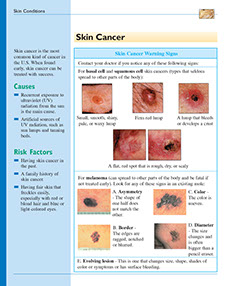
    Skin Cancer Warning Signs

    Contact your doctor if you notice any of these following signs:

    For basal cell and squamous cell skin cancers (types that seldom spread to other parts of the body):

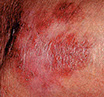
    Small, smooth, shiny, pale, or waxy lump

    Firm red lump

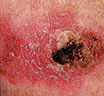
    A lump that bleeds or develops a crust

    A flat, red spot that is rough, dry, or scaly

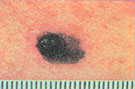
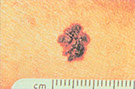
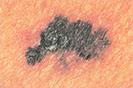
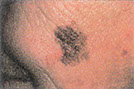
    For melanoma (can spread to other parts of the body and be fatal if not treated early). Look for any of these signs in an existing mole:

    A. Asymmetry – The shape of one half does not match the other.

    B. Border – The edges are ragged, notched or blurred.

    C. Color – The color is uneven.

    D. Diameter – The size changes and is often bigger than a pencil eraser.

    E. Evolving lesion – This is one that changes size, shape, shades of color or symptoms or has surface bleeding.

    Causes

    *  Recurrent exposure to ultraviolet (UV) radiation from the sun is the main cause.

    *  Artificial sources of UV radiation, such as sun lamps and tanning beds.

    Risk Factors

    *  Having skin cancer in the past.

    *  A family history of skin cancer.

    *  Having fair skin that freckles easily, especially with red or blond hair and blue or light-colored eyes.

    Treatment

    Depending on the size, type, and stage of the cancer, treatment includes:

    *  Surgery. There are many types.

    *  Chemotherapy. One form is a cream or lotion with anticancer drugs that is applied to the skin. Other forms are given through an IV.

    *  Radiation therapy. n Interferon drugs.

    *  Skin grafting.

    Questions to Ask

    Self-Care / Prevention

    Start prevention in childhood to protect against skin cancer later in life.

    *  Limit time in the sun, especially between 10 a.m. and 4 p.m.

    *  Use a broad-spectrum sunscreen with a sun protection factor (SPF) of 15 or higher as directed.

    *  Reapply sunscreen at least every 2 hours, more often if you’re sweating or going in and out of the water.

    *  Cover skin exposed to the sun, such as long-sleeved tops, pants, sunglasses, and wide-brimmed hats.

    *  Avoid sun lamps and tanning beds.

    Skin Self-Exam

    *  Do a skin self-exam monthly. The best time to do this is after a shower or bath. To check your skin, use a well- lit room, a full-length mirror, and a hand-held mirror.

    *  Locate your birthmarks, moles, and blemishes. Know what they look like. Check for a sore that does not heal.

    *  Check all areas.

    1.  Look at the front and back of your body in the mirror. Then, raise your arms and look at the left and right sides.

    2.  Bend your elbows and look carefully at the palms of your hands. Make sure to look at both sides of your forearms and upper arms.

    3. Look at the back and front of the legs. Look between the buttocks and around the genital area.

    4.  Look at your face, neck, and scalp. Use a comb or blow dryer to move hair so that you can see the scalp better.

    5.  Sit and closely examine the feet. Look at the soles and the spaces between the toes.

    {Note: Get a skin exam from your doctor or health care provider as often as advised.}

    Resources

    National Cancer Institute

    800.4.CANCER (422.6237)

    www.cancer.gov

    Healthier at Home book by the American Institute for Preventive Medicine. www.HealthyLife.com. All rights reserved.

    © American Institute for Preventive Medicine

  • Skin Injuries / Wounds

    First Aid

    Signs & Symptoms

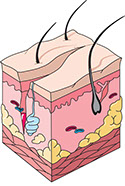
    Cuts slice the skin open. This causes bleeding and pain.

    Scrapes are less serious than cuts, but more painful because more nerve endings are affected.

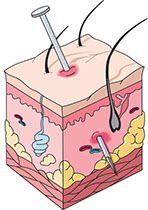
    Punctures are stab wounds. This causes pain, but may not result in bleeding.

    Bruises cause black and blue or red skin. As they heal, the skin turns yellowish-green. Pain, tenderness, and swelling also occur.

    Illustration of a scrape.

    Scrapes

    Illustration of a cut.

    Cuts

    Illustration of a puncture.

    Punctures

    Causes

    For Cuts, Scrapes & Punctures

    The cause can be any object that penetrates the skin. This includes cut glass, a splinter, stepping on a nail or tack, falling on pavement, etc.

    For Bruises

    Common causes are falls or being hit by some force. Bruises result when broken blood vessels bleed into the tissue under the skin. Persons who take blood-thinners bruise easily.

    Treatment

    Treatment depends on the cause and how severe the skin injury is. Simple wounds can be treated with self-care. An antibiotic treats a bacterial infection. Medical care, such as stitches, may be needed for deep cuts or ones longer than an inch.

    Questions to Ask

    Self-Care / First Aid

    For Minor Cuts and Scrapes

    *  Clean in and around the wound thoroughly with soap and water.

    *  Press on the cut for up to 10 minutes to stop the bleeding. Use sterile, wet gauze or a clean cloth. Dry gauze can stick to the wound. Don’t use a bandage to apply pressure.

    *  If still bleeding, lift the part of the body with the cut higher than the heart, if practical.

    *  After the bleeding has stopped and when the area is clean and dry, apply a first-aid cream.

    *  Put one or more bandages on the cut. The edges of the cut skin should touch, but not overlap. Use a butterfly bandage if you have one.

    *  Keep a scrape clean and dry. Dress it with gauze and first-aid tape. Change this every 24 hours.

    For Punctures that Cause Minor Bleeding

    *  Let the wound bleed to cleanse itself.

    *  Remove the object (e.g., splinter). Use clean tweezers. Hold a lit match or flame to the ends of the tweezers to sterilize them. Let them cool and wipe the ends with sterile gauze.

    *  Two to 4 times a day, clean the wound area with soapy water. Dry it well and apply an antibacterial cream. Do this for several days.

    For Bruises

    *  Apply a cold pack to the bruised area as soon as possible (within 15 minutes of the injury). Keep the cold pack on for 10 minutes at a time. Apply pressure to the cold pack. Take it off for 30 to 60 minutes. Repeat several times for 2 days.

    *  Rest the bruised area and raise it above the level of the heart, if practical.

    *  Two days after the injury, use warm compresses for 20 minutes at a time.

    *  Do not bandage a bruise. Try to avoid hitting the bruised area again.

    Healthier at Home book by the American Institute for Preventive Medicine. www.HealthyLife.com. All rights reserved.

    © American Institute for Preventive Medicine

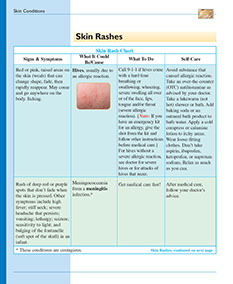
  • Skin Rashes

    Skin Conditions

    This is caused by the varicella-zoster virus. This condition is contagious.

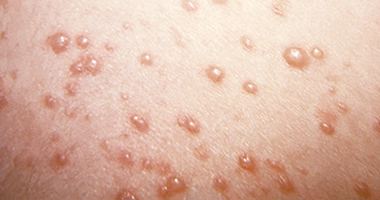
    Chickenpox

    Signs & Symptoms

    Flat, red spots that become raised and look like small pimples. These develop into small blisters that break and crust over. Fatigue and mild fever occur 24 hours before rash appears. Itching may be intense.

    What To Do

    See doctor or health care provider if it occurs in an adult; if self-care measures don’t bring relief in children; or if there are signs of infection (e.g., pus, increased redness, swelling, or pain). A vaccine is given to prevent this disease.

    Self-Care

    Keep from scratching affected areas. Apply cool, wet washcloths with baking soda or calamine lotion to affected areas. Take acetaminophen for fever. Take an OTC antihistamine as advised by your doctor if itching is intense. Chickenpox can be prevented with a chickenpox vaccine.

    Contact Dermatitis

    Causes are direct contact with poison ivy, oak, or sumac or contact with an irritant (cleaning product, cosmetic, jewelry, etc.).

    Signs & Symptoms

    Dry, red, itchy patches of skin. Blisters which may drain and then crust over.

    What To Do

    See doctor or health care provider if self- care measures don’t bring relief or if there are signs of infection (e.g., red streaks, fever, pus, increased redness, swelling, or pain).

    Self-Care

    Try to identify the irritant and avoid direct contact with it. Don’t scratch the rash. For itching, apply calamine lotion or OTC hydrocortisone cream to the affected area. Bathe in warm (not hot) water. Add an oatmeal product to the water. Pat (don’t rub) the skin dry. Take an OTC antihistamine as advised.

    Cradle Cap

    This is due to hormones that pass through the placenta before birth.

    Signs & Symptoms

    Scaly, crusty rash (in newborns) that starts behind the ears and spreads to the scalp.

    What To Do

    Use self-care.

    Self-Care

    Apply mineral oil to the scalp to soften the hard crusts, then use an antidandruff shampoo. Do this 2 to 3 times a week, massaging the scalp with a soft brush or washcloth for 5 minutes. Be sure to wash all of the oil out.

    Eczema (Atopic Dermatitis)

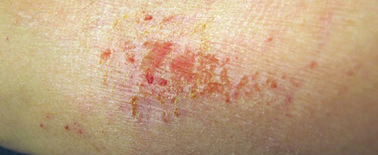
    Image of eczema rash.

    This tends to run in families. It is common in persons with asthma or allergies. Contact with irritants may worsen eczema.

    Signs & Symptoms

    Patches of skin that are dry, red, scaly, blistered, swollen, and sometimes thick, discolored, or oozing and crusting. Commonly occurs in the bend of the elbow or behind the knee.

    What To Do

    See doctor or health care provider if self- care measures don’t bring relief or if there are signs of infection (e.g., red streaks, fever, pus, increased redness, swelling, or pain).

    Self-Care

    Use an OTC hydrocortisone cream on the affected area. Don’t scratch. Don’t bathe too often. When you do, use warm (not hot) water and a mild soap (or no soap). Use a light, nongreasy, unscented lotion (without alcohol) after you wash. Avoid items that worsen the eczema.

    Heat Rash (Prickly Heat)

    Heat rash (prickly heat) or chafing. This occurs from too much sweating.

    Signs & Symptoms

    Rash with small red pimples, pink blotchy skin, and itching. Common sites are between skin folds (armpits, under the breasts, the groin).

    What To Do

    Use self-care.

    Self-Care

    Bathe in cool water without soap every couple of hours. Let your skin air dry. Put cornstarch in body creases or apply calamine lotion to very itchy spots. Don’t use ointments and creams that can block sweat gland pores. Stay in a cool, dry area.

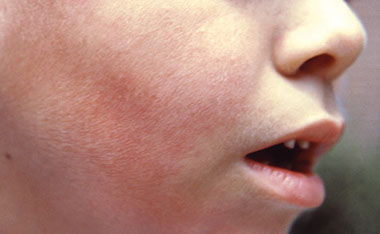
    Fifth Disease

    Image of fifth disease rash.

    This is caused by the Human parvovirus B19. This condition is contagious.

    Signs & Symptoms

    Red rash of varying shades that fades to a flat, lacy pattern. Rash comes and goes. It usually starts on the facial cheeks and then on the arms and legs. This is a mild disease, usually with no other symptoms.

    What To Do

    Use self-care, but no special treatment is required.

    Self-Care

    Avoid hot or even warm baths or showers. Keep cool.

    Hives

    Hives, usually due to an allergic reaction.

    Signs & Symptoms

    Red or pink, raised areas on the skin (weals) that can change shape, fade, then rapidly reappear. May come and go anywhere on the body. Itching.

    What To Do

    Call 9-1-1 if hives come with a hard time breathing or swallowing, wheezing, severe swelling all over or of the face, lips, tongue and/or throat (severe allergic reaction). {Note: If you have an emergency kit for an allergy, give the shot from the kit and follow other instructions before medical care.} For hives without a severe allergic reaction, see doctor for severe hives or for attacks of hives that recur.

    Self-Care

    Avoid substance that caused allergic reaction. Take an over-the-counter (OTC) antihistamine as advised by your doctor. Take a lukewarm (not hot) shower or bath. Add baking soda or an oatmeal bath product to bath water. Apply a cold compress or calamine lotion to itchy areas. Wear loose-fitting clothes. Don’t take aspirin, ibuprofen, ketoprofen, or naproxen sodium. Relax as much as you can.

    Impetigo

    This is caused by a bacterial infection. This condition is contagious.

    Signs & Symptoms

    In infants, pus-filled blisters and red skin. In older children, golden crusts on red sores. Areas affected are the arms, legs, face, and around the nose first, then most of body. Sometimes fever. Occasional itching.

    What To Do

    See doctor or health care provider, especially if self-care measures don’t bring relief, if blisters are larger than 1 inch across, or if a red streak runs from the infection. An antibiotic may need to be prescribed.

    Self-Care

    Clean the area with an antibacterial soap several times a day. Apply an OTC antibiotic ointment 3 times a day after the scab falls off. Wash your hands after contact with the rash area. Don’t share towels, etc.

    Lyme Disease

    This is caused by a deer tick bite.

    Signs & Symptoms

    A fever and red rash 3 days to 2 weeks after a deer tick bite. The rash has raised edges with pale centers. It fades after a few days. Joint pain may develop later.

    What To Do

    See doctor or health care provider for diagnosis. Can be treated with an antibiotic.

    Self-Care

    Follow your doctor’s advice.

    Measles

    This is caused by a virus. This condition is contagious. MMR vaccines prevent measles.

    Signs & Symptoms

    Blotchy red rash that starts on the face and spreads to the rest of the body. Rash lasts about 7 days. These signs come before the rash: Fever; runny nose; sneezing; cough; eyes that look red and are sensitive to light; and blue-white spots in the mouth.

    What To Do

    Call doctor right away to be sure the problem is measles. If it is, follow the doctor’s advice. Let the child’s school and the local health department know.

    Self-Care

    Rest until fever and rash go away. Drink lots of liquids. For fever, take acetaminophen. Treat cough. Avoid lights, TV, reading, etc. while eyes are sensitive to light. Usually okay to return to school about 7 to 10 days after rash and fever are gone.

    Meningococcemia

    Meningococcemia from a meningitis infection. These conditions are contagious.

    Signs & Symptoms

    Rash of deep red or purple spots that don’t fade when the skin is pressed. Other symptoms include high fever; stiff neck; severe headache that persists; vomiting; lethargy; seizure; sensitivity to light; and bulging of the fontanelle (soft spot of the skull) in an infant.

    What To Do

    Get medical care fast!

    Self-Care

    After medical care, follow your doctor’s advice.

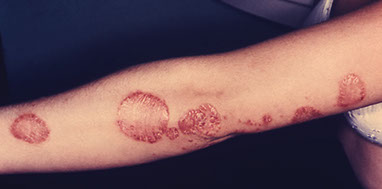
    Psoriasis

    Image of psoriasis.

    This is a chronic skin disease that tends to run in families. The exact cause is not known.

    Signs & Symptoms

    Itchy, red patches covered with silvery-white flaky skin. Common sites are the scalp, elbows, forearms, knees, and legs.

    What To Do

    See doctor or health care provider if psoriasis affects large areas of skin and/or if self-care measures don’t bring relief.

    Self-Care

    To prevent dryness, use a moisturizer. Use an OTC hydrocortisone or coal tar cream or ointment. If psoriasis affects your scalp, use an antidandruff shampoo. Take a bath with mineral salts or an oatmeal bath product.

    Ringworm

    This is caused by a fungal infection. This condition is contagious.

    Signs & Symptoms

    Redness, itchy, scaly patches on the skin or scalp that are round with distinct edges that grow outward as the infection spreads. Moistness in the folds of the skin (under the breasts or in the groin area). Bald spots may appear on the scalp.

    What To Do

    See doctor or health care provider for diagnosis and treatment, especially if you have not had this before or if ringworm occurs on the scalp or in several patches on the skin.

    Self-Care

    Follow your doctor’s advice.

    Rocky Mountain Spotted Fever

    Rocky mountain spotted fever, 1 to 14 days after a bite from an American dog tick or Rocky Mountain woodtick. These conditions are contagious.

    Signs & Symptoms

    Pink to red rash on the arms, legs, and palms of the hands. Often starts near the wrists and ankles, then spreads inward. Rash darkens in color, spreads, and can bleed. Sudden high fever with chills, severe headache, and delirium also occur.

    What To Do

    Contact doctor right away.

    Self-Care

    Follow your doctor’s advice.

    Rosacea (Adult Acne)

    The exact cause is not known. It may result from overuse of corticosteroid creams or alcohol use.

    Signs & Symptoms

    Red rash on the face. Red nose that looks swollen and puffy cheeks. May have pus-filled spots without blackheads or whiteheads.

    What To Do

    See doctor or health care provider if rosacea affects large areas of skin and/or if self-care measures don’t bring relief.

    Self-Care

    Avoid hot and/or spicy foods, alcohol, and caffeine. Don’t rub or massage the face. Avoid strong sunlight.

    Roseola

    This is caused by the Herpes type-6 virus.

    Signs & Symptoms

    Flat, rosy red rash on the chest and abdomen. A high fever occurs 2 to 4 days before the rash. The child feels only mildly ill when the fever is present.

    What To Do

    See doctor or health care provider if high fever causes febrile seizure.

    Self-Care

    Take acetaminophen for fever. Apply cool, wet washcloths or take baths with tepid (not cold) water.

    Scabies

    This is caused by skin parasites called itch mites. This condition is contagious.

    Signs & Symptoms

    Tiny red pimples that itch intensely, usually between the fingers, on the wrists and genitals; in the armpits; and along the belt line. Scabs and sores may form.

    What To Do

    See doctor or health care provider for diagnosis. Can be treated with a prescribed topical medicine.

    Self-Care

    Follow your doctor’s instructions. Wash clothing and bedding in hot water and detergent.

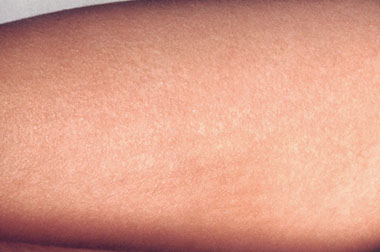
    Scarlet Fever

    Image of scarlet fever.

    This is caused by a bacterial infection. These conditions are contagious.

    Signs & Symptoms

    Rough, bright red rash (feels like sandpaper) on the face, neck, elbows, armpits, and groin. It spreads rapidly to entire body. A high fever and weakness occur before the rash. Other symptoms include sore throat, peeling of the skin, vomiting, and swollen tongue.

    What To Do

    See doctor or health care provider for diagnosis. Can be treated with an antibiotic.

    Self-Care

    Take acetaminophen for fever. Rest and drink plenty of fluids.

    Seborrhea

    This is a type of dermatitis. The glands in the skin make too much oil.

    Signs & Symptoms

    Scaly, oily rash with small, reddish-yellow patches. Areas affected are usually oily ones (the edge of the scalp, forehead, nose, and eyebrows) and the back and chest.

    What To Do

    See doctor or health care provider if self- care measures don’t bring relief or if there are signs of infection (e.g., red streaks, fever, pus, increased redness, swelling, or pain).

    Self-Care

    Use an OTC antidandruff shampoo with salicylic acid on the scalp area. Use OTC hydrocortisone cream on the affected skin areas. Handle the skin gently. Don’t scratch. Don’t use irritants like detergents.

    Shingles

    Image of the shingles.

    Shingles from the herpes zoster virus.* (Persons who have not had chicken pox or a vaccine for it can get chicken pox from exposure to shingles.) These conditions are contagious.

    Signs & Symptoms

    Rash of painful red blisters (most often on only one side and in only one area of the body). Pain, itching, burning, or tingling feeling before the rash appeared.

    What To Do

    See doctor or health care provider within 24 to 72 hours for an oral antiviral medicine. This can shorten the course of shingles and make symptoms less severe. {Note: All adults 60 years of age and older are advised to get a vaccine that can help prevent shingles and reduce the pain due to shingles.}

    Self-Care

    Take pain relievers as advised by your doctor. For itching, apply calamine lotion or a paste made of 3 teaspoons of baking soda mixed with 1 teaspoon of water to the affected area. Apply a cool, wet compress to blisters for 20 minutes at a time. Wash (don’t scrub) blisters until they crust over. Drink plenty of liquids.

    Syphilis

    This is a sexually transmitted disease caused by a specific bacterial infection. This condition is contagious.

    Signs & Symptoms

    Widespread red rash on the palms of the hands, soles of the feet, and sometimes around the mouth and nose. The small, red, scaly bumps do not itch. Other types of rashes, swollen lymph nodes, fever, and flu-like symptoms may also occur.

    What To Do

    See doctor or health care provider for diagnosis. Can be treated with an antibiotic.

    Self-Care

    Follow your doctor’s advice.

    West Nile Virus

    West Nile virus, 3 to 15 days after a bite from a mosquito infected with the virus.

    Signs & Symptoms

    Rash on the trunk of the body with fever, headache, bodyaches, and swollen lymph glands.

    What To Do

    See doctor right away.

    Self-Care

    Follow your doctor’s advice.
    Healthier at Home book by the American Institute for Preventive Medicine. www.HealthyLife.com. All rights reserved.

    © American Institute for Preventive Medicine

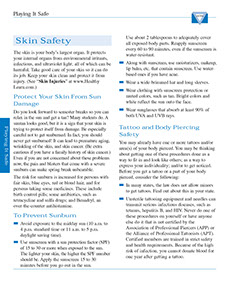
  • Skin Safety

    Skin Conditions

    The skin is your body’s largest organ. It protects your internal organs from environmental irritants, infections, and ultraviolet light; all of which can be harmful. Take good care of your skin so it can do its job. Keep your skin clean and protect it from injury.

    Tattoo and Body Piercing Safety

    You may already have one or more tattoos and/or area(s) of your body pierced. You may be thinking about getting one of these procedures done as a way to fit in and look like others; as a way to express your individuality; and/or to get noticed. Before you get a tattoo or a part of your body pierced, consider the following:

    *  In many states, the law does not allow minors to get tattoos. Find out about this in your state.

    *  Unsterile tattooing equipment and needles can transmit serious infectious diseases, such as tetanus, hepatitis B, and HIV. Never do one of these procedures on yourself or have anyone else do it that is not certified by the Association of Professional Piercers (APP) or the Alliance of Professional Tattooists (APT). Certified members are trained in strict safety and health requirements. Because of the high risk of infection, you cannot donate blood for one year after getting a tattoo.

    *  Tattoos and body piercings also carry the risk of less serious local infections. You will need to follow proper care procedures for weeks or months after the procedure to reduce the risk of getting an infection. You may also get large growths of scar tissues called keloids.

    *  Tattoos are not easily removed and in some cases may cause permanent discoloration. Keep a record of the dyes used in the tattoo you get. This includes the lot number of each pigment. If you choose to get a tattoo removed in the future, this information will be helpful. Think carefully before getting a tattoo and consider the possibility of an allergic reaction. Know that it is expensive, too, to get a tattoo removed. Don’t get a tattoo or body piercing done on an impulse. Wait at least 24 hours.

    *  Visit several tattoo parlors to see whether the tattooist follows recommended safety guidelines and sterilization techniques, such as using a heat sterilization machine regulated by the Food and Drug Administration (FDA).

    *  For body piercing, to avoid allergic reactions and infections, jewelry made from non- corrosive, non-toxic metals should be used. Examples are solid 14K gold (not gold-plated), niobium, surgical stainless steel, and titanium.

    *  After the procedure, follow the skin care guidelines provided by your skin piercer or tattooist. Care of the site will depend on its location and/or the procedure you had done.

    *  According to the APT guidelines, these practices should be followed:

    – The tattooist should have an autoclave (a heat sterilization machine regulated by the FDA) on the premises.

    – Consent forms (which the customer must sign) should be handed out before tattooing.

    – Immediately before tattooing, the tattooist should wash and dry his or her hands thoroughly and put on medical latex gloves, which should be worn at all times during application of the tattoo.

    – Needle bars and tubes should be autoclaved after each customer. Non-autoclavable surfaces, such as pigment bottles, drawer pulls, chairs, tables, sinks, and the immediate floor area, should be cleaned with a disinfectant, such as a bleach solution.

    – Used absorbent tissues should be placed in a special puncture-resistant, leak-proof container for disposal.

    Protect Your Skin From Sun Damage

    Do you look forward to semester breaks so you can relax in the sun and get a tan? Many students do. A suntan looks good, but it is a sign that your skin is trying to protect itself from damage. Be especially careful not to get sunburned. In fact, you should never get sunburned! It can lead to premature aging, wrinkling of the skin, and skin cancer. (Be extra cautious if you have a family history of skin cancer.) Even if you are not concerned about these problems now, the pain and blisters that come with a severe sunburn can make spring break unbearable.

    The risk for sunburn is increased for persons with fair skin, blue eyes, red or blond hair, and for persons taking some medicines. These include birth control pills; some antibiotics, such as tetracycline and sulfa drugs; and Benadryl, an over-the-counter antihistamine.

    To Prevent Sunburn

    *  Avoid exposure to the midday sun (10 a.m. to 4 p.m. standard time or 11 a.m. to 5 p.m. daylight saving time).

    *  Use sunscreen with a sun protection factor (SPF) of 15 to 30 or more when exposed to the sun. The lighter your skin, the higher the SPF number should be. Apply the sunscreen 15 to 30 minutes before you go out in the sun. Use about 2 tablespoons to adequately cover all exposed body parts. Reapply sunscreen every 60 to 90 minutes, even if the sunscreen is water-resistant.

    *  Along with sunscreen, use moisturizers, makeup, lip balm, etc. that contain sunscreen. Use water- based ones if you have acne.

    *  Wear a wide-brimmed hat and long sleeves.

    *  Wear clothing with sunscreen protection or muted colors, such as tan. Bright colors and white reflect the sun onto the face.

    *  Wear sunglasses that absorb at least 90% of both UVA and UVB rays.

    Student Self-Care book by the American Institute for Preventive Medicine. www.HealthyLife.com. All rights reserved.

    © American Institute for Preventive Medicine

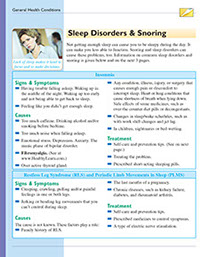
  • Sleep Disorders & Snoring

    General Health Conditions

    Not getting enough sleep can cause you to be sleepy during the day. It can make you less able to function. Snoring and sleep disorders can cause these problems, too.

    Insomnia

    Signs & Symptoms

    *  Having trouble falling asleep. Waking up in the middle of the night. Waking up too early and not being able to get back to sleep.

    *  Feeling like you didn’t get enough sleep.

    Causes

    *  Too much caffeine. Drinking alcohol and/or smoking before bedtime.

    *  Too much noise when falling asleep.

    *  Emotional stress. Depression. Anxiety. The manic phase of bipolar disorder.

    *  Fibromyalgia.

    *  Over active thyroid gland.

    *  Any condition, illness, injury, or surgery that causes enough pain or discomfort to interrupt sleep. Heart or lung conditions that cause shortness of breath when lying down. Side effects of some medicines, such as over-the-counter diet pills or decongestants.

    *  Changes in sleep/wake schedules, such as with work shift changes and jet lag.

    *  In children, nightmares or bed-wetting.

    Treatment

    *  Self-care and prevention tips.

    *  Treating the problem.

    *  Prescribed short-acting sleeping pills.

    Self-Care / Prevention

    *  Avoid caffeine for 8 hours before bedtime.

    *  Avoid long naps during the day.

    *  Have no more than 1 alcoholic drink with or after dinner.

    *  Avoid using electronic devices, such as a laptop computer before falling asleep and in the middle of the night. The type of light that emits from these devices makes it hard to fall asleep.

    *  Avoid nicotine. Don’t smoke. Stay away from secondhand smoke.

    *  Get regular exercise, but not within a few hours of going to bed.

    *  Before bedtime, take a warm bath or read a book, etc. Avoid things that hold your attention, such as watching a suspense movie.

    *  Keep your bedroom quiet, dark, and comfortable.

    *  Follow a bedtime routine. Lock or check doors and windows, brush your teeth, etc.

    *  Count sheep! Picture a repeated image. Doing this may bore you to sleep.

    *  Listen to recordings that help promote sleep.

    *  Take over-the- counter sleep aids, (e.g., melatonin, Tylenol PM, etc.) as advised by your doctor. Don’t take anyone else’s sleeping pills.

    *  If you wake up and can’t get back to sleep or can’t fall asleep, after 30 minutes, get out of bed. Read a relaxing book or sit quietly in the dark. In about 20 minutes, go back to bed. Do this as many times as needed.

    Restless Leg Syndrome (RLS) and Periodic Limb Movements in Sleep (PLMS)

    Signs & Symptoms

    *  Creeping, crawling, pulling and/or painful feelings in one or both legs.

    *  Jerking or bending leg movements that you can’t control during sleep.

    Causes

    The cause is not known. These factors play a role:

    *  Family history of RLS.

    *  The last months of a pregnancy.

    *  Chronic diseases, such as kidney failure, diabetes, and rheumatoid arthritis.

    Treatment

    *  Self-care and prevention tips.

    *  Prescribed medicines to control symptoms.

    *  A type of electric nerve stimulation.

    Self-Care / Prevention

    *  Take medications as prescribed. Let your doctor know if the medicine no longer helps.

    *  For relief, move the legs. Walk, rub, or massage them or do knee bends.

    *  Limit or avoid caffeine.

    *  Take a warm bath before bedtime.

    Sleep Apnea

    Signs & Symptoms

    *  Loud snoring and snorting sounds while sleeping on the back.

    *  Repeated periods when breathing stops 10 or more seconds during sleep.

    *  Waking up many times during the night. Excessive daytime sleepiness.

    *  Exhaustion. Hard time concentrating. Acting very cranky. Depression or other mental changes.

    *  Early morning headaches.

    Causes

    *  Too much muscle tissue is in the airway or the tissue relaxes and sags. These things narrow or block the airway. Persons who snore loudly and are overweight are more prone to these problems.

    *  A physical problem in the nose or upper airway.

    Treatment

    The goal is to keep the airway open during sleep. This is done with self-care measures and one of these treatments:

    *  A mouth guard dental device custom made by a dentist. This is worn during sleep. It pushes the lower jaw forward to open the air passage behind the tongue.

    *  A nasal continuous positive airway pressure (CPAP) device. Pressure from an air blower forces air through the nasal passages using a mask worn over the nose during sleep.

    *  Surgery to correct the cause of the airway obstruction.

    Self-Care / Prevention

    *  Lose weight, if you are overweight.

    *  Don’t drink alcohol. Don’t use tobacco products.

    *  Don’t take sleeping pills or sedatives.

    *  Use methods, such as those listed under Self-Care / Prevention – For Snoring to keep from sleeping on your back.

    Snoring

    Signs & Symptoms

    *  Loud sounds. Harsh breathing. Snorting sounds. These occur during sleep.

    Causes

    *  Sleeping on the back. The tongue falls back toward the throat and partly closes the airway.

    *  Nasal congestion from allergies or colds. Smoking. Drinking alcohol. Taking sedatives. Overeating (especially before bedtime).

    *  Sleep apnea or chronic respiratory disease.

    *  An obstructed airway. This can be due to enlarged tonsils or being overweight.

    *  Changes in hormones, such as during menopause or the last month of pregnancy.

    Treatment

    Self-care treats most cases. Other options are:

    *  Wearing a dental device that holds the jaw in a forward position.

    *  Surgery, if needed, to correct the problem.

    *  Treatment for sleep apnea, if needed.

    Self-Care / Prevention

    *  Sleep on your side. Prop an extra pillow behind your back so you won’t roll over. Sleep on a narrow sofa for a few nights to get used to staying on your side.

    *  Sew a large marble or tennis ball into a pocket on the back of your pajamas. This can help you stay on your side when you sleep.

    *  If you must sleep on your back, raise the head of the bed 6 inches on bricks or blocks. Or buy a wedge that is made to be placed between the mattress and box spring to elevate the head section.

    *  Lose weight, if you are overweight. Excess fatty tissue in the throat can cause snoring. Losing 10% of your body weight will help.

    *  Don’t smoke. If you do, quit. Limit or don’t have alcohol, sedatives, or a heavy meal within 3 hours of bedtime.

    *  To relieve nasal congestion, try a decongestant before you go to bed.

    *  Get rid of allergens in the bedroom. These include dust, down-filled (feathered) pillows, and down-filled bed linen.

    *  Try over-the-counter “nasal strips.” These keep the nostrils open and lift them up. This helps lessen congestion in nasal passages.

    Questions to Ask

    How Much Sleep is Needed?

    *  Adults need between 7 and 9 hours of sleep each night.

    *  Teens need at least 8-1/2 to 9-1/4 hours of sleep each night.

    *  After 6 months of age, most children sleep between 9 and 12 hours at night. Up to age 5, children may also take daytime naps for a total of 1/2 to 2 hours a day.

    Resources

    National Center on Sleep Disorders Research (NCSDR)

    301.435.0199

    www.nhlbi.nih.gov/about/ncsdr

    National Sleep Foundation

    703.243.1697

    www.sleepfoundation.org

    Healthier at Home book by the American Institute for Preventive Medicine. www.HealthyLife.com. All rights reserved.

    © American Institute for Preventive Medicine

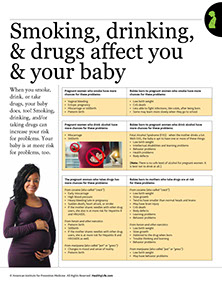
  • How Smoking, Drinking, & Drugs Affect You & Your Baby

    Pregnancy & Prenatal Care

    When you smoke, drink, or take drugs, your baby does, too! Smoking, drinking, and/or taking drugs can increase your risk for problems. Your baby is at more risk for problems, too.

    Smoking

    Pregnant women who smoke have more chances for these problems:

    *  Vaginal bleeding

    *  Ectopic pregnancy

    *  Miscarriage or stillbirth

    *  Preterm birth

    Babies born to pregnant women who smoke have more chances for these problems:

    *  Low birth weight

    *  Crib death

    *  Less able to fight infections, like colds, after being born

    *  Some may learn more slowly when they go to school

    Drinking Alcohol

    Pregnant women who drink alcohol have more chances for these problems:

    *  Miscarriage

    *  Stillbirth

    Babies born to pregnant women who drink alcohol have more chances for these problems:

    Fetal Alcohol Syndrome (FAS) – when the mother drinks a lot. With FAS, the baby is apt to have one or more of these things:

    *  Low birth weight

    *  Mental problems (the baby could be retarded)

    *  Behavior problems

    *  Learning problems

    *  Health problems

    *  Body defects

    {Note: No one knows a safe level of alcohol for pregnant women. It is best not to drink at all.}

    Taking Drugs

    From cocaine (also called “crack”):

    *  Early miscarriage

    *  High blood pressure

    *  Heavy bleeding late in pregnancy

    *  Sudden death, heart attack, or stroke

    *  If the mother shares needles with other drug users, she also is at more risk for Hepatitis B and HIV/AIDS.

    From heroin and other narcotics:

    *  Preterm birth

    *  Stillbirth

    *  If the mother shares needles with other drug users, she is at more risk for Hepatitis B and HIV/AIDS as well.

    From Marijuana – (also called “pot” or “grass”):

    *  Changes in mood and sense of reality

    *  Preterm birth

    From cocaine (also called “crack”):

    *  Low birth weight

    *  Slow growth

    *  Tend to have smaller than normal heads and brains

    *  May have brain injury

    *  Crib death

    *  Body defects

    *  Learning problems

    *  Behavior problems

    From heroin and other narcotics:

    *  Low birth weight

    *  Slow growth

    *  Addicted to the drug when born

    *  Trouble thinking and learning

    *  Behavior problems

    From Marijuana – (also called “pot” or “grass”):

    *  Low birth weight

    *  May have behavior problems

    Prenatal Self-Care book by the American Institute for Preventive Medicine. www.HealthyLife.com. All rights reserved.

    © American Institute for Preventive Medicine

  • Help For People Who Snore And Twitch

    Mature Health: Over Age 50

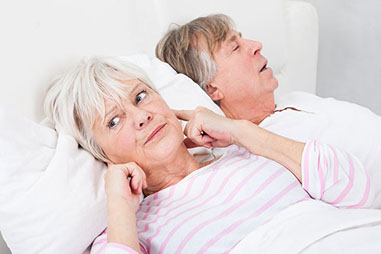
    Image of man snoring as spouse is awake plugging her ears.

    Does your bed partner snore or toss and turn during the night? Does he or she periodically twitch like a mackerel out of water for no reason at all? Are you faced with two alternatives: Sleeping in the guest room or not sleeping at all?

    Older adults-especially men-tend to develop two kinds of sleep disturbances. One is sleep apnea: Breathing stops for short periods of time and is followed by loud snoring. The other is nocturnal myoclonus, or restless legs-frequent jerking motions that sometimes awaken both the jerker and the person who shares the bed.

    Sleeping with the head of the bed elevated can make breathing easier and discourage snoring. Since being overweight and drinking alcohol seem to aggravate both sleep apnea and myoclonus, losing excess pounds and avoiding alcohol can help. Sleeping pills, too, can aggravate sleep apnea, so people who have this problem should use other ways to get a good night’s sleep.

    You may suffer one or both of these sleep disturbances and not even know it unless your partner complains-and you should take the complaints seriously.

    Sleep apnea may seem like nothing more than a nuisance, but it can be life-threatening if left untreated. So if you or your partner has this problem, see a doctor.

    A Year of Health Hints book by the American Institute for Preventive Medicine. www.HealthyLife.com. All rights reserved.

    © American Institute for Preventive Medicine

  • Sore Throats

    Ear, Nose & Throat Conditions

    Signs & Symptoms

    *  Dry, irritated throat.

    *  Soreness or pain in the throat, especially when you talk or swallow. Swollen neck glands.

    *  The back of the throat and/or the tonsils look bright red or have pus deposits or white spots.

    *  Enlarged tonsils that feel tender (tonsillitis).

    Fatigue, fever, postnasal drip, bad breath, headache, and/or earache can also occur.

    Causes

    *  Smoking

    *  Dry air

    *  Postnasal drip

    *  Cough

    *  Allergies

    *  Viruses, such as with a cold or the flu.

    *  Infection from bacteria, such as strep throat.

    Treatment

    Self-care treats most sore throats. Your doctor may take a throat culture to see if strep or another type of bacteria is the cause. If so, an antibiotic may be prescribed. Strep throat needs medical care to prevent other health problems. Sore throats caused by viruses do not need an antibiotic.

    Questions to Ask

    Self-Care / Prevention

    *  Don’t smoke. Avoid secondhand smoke.

    *  Gargle every few hours with a solution of 1/4 teaspoon of salt dissolved in 1 cup of warm water. Don’t eat spicy foods.

    *  Drink plenty of fluids like warm tea. For strep throat, have cold foods and liquids.

    *  Sit in the bathroom while hot water runs in the shower. Use a cool-mist vaporizer in the room where you spend most of your time.

    *  Suck on a piece of hard candy or throat lozenge every so often. (Don’t give to children under age 5.) Rest your voice, if this helps.

    *  Take an over-the-counter (OTC) medicine for pain as directed on the label. Take an OTC decongestant for postnasal drip, if okay with your doctor.

    Healthier at Home book by the American Institute for Preventive Medicine. www.HealthyLife.com. All rights reserved.

    © American Institute for Preventive Medicine

  • Sore Throat & Tonsillitis

    Children’s Health

    Tonsillitis is when the tonsils are swollen mostly due to infection. This can be viral or bacterial. Take your child to the doctor if he or she has a bad sore throat. Some sore throats that aren’t treated can lead to other problems like abscesses, kidney problems, or rheumatic heart disease. The doctor may take a throat culture to find out what is wrong. The doctor may give your child antibiotics if the sore throat is from strep or some other bacteria.

    Signs, Symptoms & Causes

    There are 2 kinds of sore throats:

    *  Bacterial sore throats usually cause a high fever, headaches, or swollen neck glands. But sometimes children with bacterial sore throats have no other problems. Strep throat is one kind of bacterial sore throat. Antibiotics can help cure a bacterial sore throat.

    *  Viral sore throats are more common. They may or may not cause the same problems as a bacterial sore throat. You can’t cure a viral sore throat with antibiotics.

    Questions to Ask

    Self-Care

    Try these tips for your child’s sore throat pain:

    *  Have your child gargle with 1/4 teaspoon of salt in 1/2 cup of warm water. Do this every few hours. Only do this with children over 6 years old.

    *  Give your child warm drinks like tea and soup. The tea can be plain or with honey. (Don’t give honey to a baby under 1 year old.)

    *  For strep throat, give cold foods and liquids, like popsicles and frozen yogurt.

    *  Keep your child away from secondhand smoke.

    *  Use a cool-mist vaporizer in the room where your child spends most of the time. Clean it every day. Use distilled (not tap) water.

    *  Feed your child foods that are soft and/or cold. The food should be easy to swallow. Don’t give your child spicy foods.

    *  Have your child suck on a piece of hard candy or a cough drop if he or she is 5 or more years old. You can give corn syrup to a younger child.

    *  For pain and fever give your child acetaminophen or ibuprofen. Make sure to give the right kind and dose for his or her weight. (Note: Do not give aspirin. Aspirin and other medicines that have salicylates have been linked to Reye’s Syndrome.)

    *  Don’t use throat sprays. Some throat sprays have benzocaine. Benzocaine bothers some children.

    Children's Self-Care book by the American Institute for Preventive Medicine. www.HealthyLife.com. All rights reserved.

    © American Institute for Preventive Medicine