Author: AIPM

  • Suicidal Thoughts

    Student Health

    For persons 15 to 24 years old, suicide is the third leading cause of death, behind unintentional injury and homicide. More teenagers and young adults die from suicide than from cancer, heart disease, AIDS, birth defects, stroke, pneumonia, influenza, and chronic lung disease combined. Young women attempt suicide 4 to 8 times more often than young men, but males are 4 times more likely than females to die from suicide.

    Signs & Symptoms

    A lot of people think about suicide or say things like, “I wish I was dead,” at times of great stress. For most people, these thoughts are a way to express anger and other emotions. They may not, in and of themselves, be a sign of a problem. The signs and symptoms that follow need medical care.

    *  Writing a suicide note.

    *  Suicidal threats, gestures, or attempts.

    *  Thoughts of suicide that don’t go away or that occur often.

    (Note: In some suicides, no warning signs are shown or noticed.)

    Causes

    *  Depression.

    *  Bipolar disorder.

    *  Schizophrenia.

    *  Grief. Loss of a loved one.

    *  A side effect of some medicines. One is isotretinoin. This is prescribed for severe acne. Some antidepressant medicines can increase the risk for suicidal thoughts and behaviors, too. This is especially noted in children and adolescents. This risk may be higher within the first days to a month after starting the medicine. Persons who take antidepressants should be closely monitored.

    *  A family history of suicide or depression.

    *  Money and relationship problems.

    Treatment

    Suicidal threats and attempts are a person’s way of letting others know that he or she needs help. They should never be taken lightly or taken only as a “bluff.” Most people who threaten and/or attempt suicide more than once usually succeed if they are not stopped. Emergency care and hospitalization are necessary after an attempted suicide. Persons with suicidal thoughts should seek medical treatment.

    Questions to Ask

    Self-Care / Prevention

    If You Are Having Thoughts of Suicide

    *  Let someone know. Talk to a trusted family member, friend, or teacher. If it is hard for you to talk directly to someone, write your thoughts down and let someone else read them.

    *  Call your school’s Mental Health Service, your local Crisis Intervention Center or the National Suicide Prevention Lifeline at 800.273.8255. Follow up with a visit to your health care provider or your school’s Mental Health Service.

    How to Help a Friend Who May Be Suicidal

    *  Take him or her seriously. If your friend informs you of suicidal intentions, believe the threats.

    *  Keep firearms, drugs, etc. away from persons at risk.

    *  Take courses that teach problem solving, coping skills, and suicide awareness.

    *  If you think the person is serious about suicide, get help. Watch and protect him or her until you get help. Keep the person talking. Ask questions, such as, “Are you thinking about hurting or killing yourself?”

    *  Urge the person to call for help. If he or she is already under the care of a health care provider, have the person contact that provider first. If not, other places to contact are listed in the box below. Make the call yourself if the person can’t or won’t.

    *  Express concern. The person needs to know that someone cares. Most suicidal persons feel alone. Tell the person how much he or she means to you and others. Talk about reasons to stay alive. Don’t judge. The person needs someone to listen, not to preach moral values.

    *  Tell the person that depression and suicidal tendencies can be treated. Urge him or her to get professional care. Offer help in seeking care.

    Resources

    Your school’s Student Counseling or Mental Health Service or Student Health Service

    American Foundation for Suicide Prevention

    888.333.AFSP (2377)

    www.afsp.org

    (This is not a crisis hotline.)

    Metanoia Communications

    www.metanoia.org/suicide

    National Suicide Prevention Lifeline

    800.273.TALK (273.8255)
    www.suicidepreventionlifeline.org

    Student Self-Care book by the American Institute for Preventive Medicine. www.HealthyLife.com. All rights reserved.

    © American Institute for Preventive Medicine
  • Sunburn

    Skin Conditions

    You should never get sunburned! It leads to premature aging, wrinkling of the skin, and skin cancer.

    Signs & Symptoms

    *  Red, swollen, painful, and sometimes blistered skin

    *  Headache

    *  Mild fever

    *  Chills, fever, nausea, and vomiting if the sunburn is extensive and severe

    Causes, Risk Factors & Care

    Sunburn results from too much exposure to ultraviolet (UV) light from: The sun, sunlamps, and workplace light sources, such as welding arcs. Severe sunburn can occur even when the skies are overcast.

    The risk for sunburn is increased for persons with fair skin, blue eyes, and red or blond hair and for persons taking some medicines. These include sulfa drugs, tetracyclines, some diuretics, and Benadryl, an over-the-counter antihistamine.

    Self-care treats most cases of sunburn. Medical treatment is needed for a severe case of sunburn. Immediate care is needed if dehydration and/or a heat stroke is also present with the sunburn.

    Prevention

    *  Avoid exposure to the midday sun (10 a.m. to 4 p.m. standard time or 11 a.m. to 5 p.m. daylight saving time).

    *  Use sunscreen with a sun protection factor (SPF) of 15 to 30 or more when exposed to the sun. The lighter your skin, the higher the SPF number should be. Make sure the sunscreen blocks both UVA and UVB rays. Reapply sunscreen every hour and after swimming.

    *  Use moisturizers, make-up, lip balm, etc. with sunscreen.

    *  Wear a wide-brimmed hat and long sleeves.

    *  Wear clothing with sunscreen protection or muted colors, such as tan. Bright colors and white reflect the sun onto the face.

    *  Wear sunglasses that absorb at least 90% of both UVA and UVB rays.

    Self-Care

    *  Cool the affected area with clean towels or gauze dipped in cool water. Take a cool bath or shower.

    *  Take an over-the-counter medicine for pain and/or fever.

    *  Apply aloe vera gel to the sunburned area 2 to 3 times a day.

    *  When you go in the sun again, wear sunscreen and cover sunburned skin so you don’t get burned more.

    *  Rest in a cool room. Find a position that doesn’t hurt the sunburn.

    *  Drink plenty of water.

    *  Don’t use local anesthetic creams or sprays that numb pain, such as Benzocaine or Lidocaine. If you must use them, use only a little, because they cause allergic reactions in some people.

    Signs & Symptoms

    Contact Doctor When:

    You have a fever of 102°F or higher and/or severe pain or blistering with a sunburn.

    Get Immediate Care When:

    You have signs of heat stroke.

    Health at Home Lifetime book by the American Institute for Preventive Medicine. www.HealthyLife.com. All rights reserved.

    © American Institute for Preventive Medicine
  • Swollen Glands In Children

    Children’s Health

    Signs, Symptoms & Causes

    There are many lymph glands in the body. They protect the body from infection. They make a white blood cell that kills germs in the body. Lymph glands also trap viruses, bacteria, and cancer cells.

    You can feel your child’s lymph glands when they swell up. When a lymph gland swells up from an infection, it usually hurts when you touch it. Sometimes the glands stay swollen for a long time after the infection is gone. They usually don’t hurt and are not dangerous.

    Watch out for swollen glands that are:

    *  Hard.

    *  “Rubbery.”

    *  Without pain.

    *  Getting bigger.

    These glands can be signs of lymphoma (cancer of the lymph glands), leukemia, or some other cancer.

    The salivary glands are another kind of gland. They are under the tongue, on the bottom of the mouth, and just below the ear. They are not lymph glands. They make saliva, or “spit.” The salivary glands in front of the ears swell up when your child has mumps.

    What Causes Swollen Glands?

    *  A throat or ear infection is a  common cause of swollen glands in the neck.

    *  An infection in the feet, legs, or groin can make the lymph glands in the groin swell.

    *  Mononucleosis can make neck glands swell. (High school and college students call this “mono” or “the kissing disease.”)

    *  Mumps.

    *  Cat scratch fever. A cat’s claws carry this sickness.

    *  Medicines, like Dilantin®. (This medicine is for epilepsy.)

    *  Dental work.

    *  Lymphoma, a cancer of the lymph glands, or leukemia.

    *  Tuberculosis (TB).

    How to Keep Your Child from Getting Swollen Glands

    *  Make sure your children’s measles, mumps, and rubella (MMR) shots are up-to-date.

    *  Keep your child away from people who have sicknesses they can catch.

    Questions to Ask

    Self-Care

    There isn’t much you can do for swollen glands. You have to treat the problem that made them swell. Watch to see if the glands get bigger. Watch to see if any other glands swell up. Call the doctor if the glands keep getting bigger, or if they last 3 or 4 weeks.

    Try these tips to make your child feel better:

    *  Tell your child to rest when they feel tired. Tell them not to “overdo it.”

    *  Give your child plenty to drink.

    *  Put warm, wet washcloths and antiseptic creams on scratches and other wounds.

    Children's Self-Care book by the American Institute for Preventive Medicine. www.HealthyLife.com. All rights reserved.

    © American Institute for Preventive Medicine
  • Syphilis

    Sexual Health

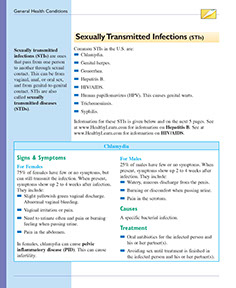
    Sexually transmitted infections (STIs) are ones that pass from one person to another through sexual contact. This can be from vaginal, anal, or oral sex, and from genital-to-genital contact. STIs are also called sexually transmitted diseases (STDs).

    Signs & Symptoms

    *  Primary stage. A large, painless, ulcer-like sore (chancre) appears around the area of sexual contact in 2 to 6 weeks.

    *  Secondary stage. A month later, a widespread skin rash appears on the palms of the hands, soles of the feet, and sometimes around the mouth and nose. The rash has small, red, scaly bumps that do not itch. Other types of rashes, swollen lymph nodes, fever, and flu-like symptoms may also occur. Small patches of hair may fall out of the scalp, beard, eyelashes, and eyebrows.

    *  Latent stage. The infection may go unnoticed for years, but damages the heart, muscles, and other organs and tissues.

    Causes

    A specific bacterial infection. It can lead to heart failure, blindness, dementia, or death if not treated. {Note: An elderly person with signs of dementia should be evaluated for syphilis. Men and women at an increased risk for syphilis should get screened. Talk to your doctor.}

    Treatment

    *  Antibiotics (usually Penicillin-G given by a shot into the muscle). All persons who have syphilis should be tested for HIV, as advised.

    *  After treatment, follow-up blood tests are needed in 6 and 12 (and possibly 3) months.

    *  Once treatment is complete, you’re no longer contagious, but you can get infected again.

    Questions to Ask

    Self-Care / Prevention

    Safer Sex To Help Prevent STIs

    *  The only sure way to avoid STIs is not having sex. This includes intercourse, oral sex, anal sex, and genital-to-genital contact. Caressing, hugging, dry kissing, and masturbation are no risk or extremely low-risk practices. So is limiting your sexual contact to one person your entire life. This is if your partner does not have an STI and has sex only with you.

    *  Latex and polyurethane condoms can help reduce the risk of spreading HIV and other STIs (i.e., chlamydia, gonorrhea, and trichomoniasis). To do this, they must be used the right way for every sex act. They do not get rid of the risk entirely. Barriers made of natural membranes, such as from lamb, do not give good protection against STIs.

    *  Females and males should use latex or polyurethane condoms every time they have genital-to-genital contact and/or oral sex. Use polyurethane condoms if either partner is allergic to latex. You don’t need condoms to prevent STIs if you have sex only with one partner and neither of you has an STI.

    *  For oral-vaginal sex and oral-anal sex, use latex dams (“doilies”). These are latex squares.

    *  Latex condoms with spermicides, such as nonoxynol-9 (N-9) are no better than other lubricated condoms for preventing HIV/STIs. Spermicides with N-9 do not prevent chlamydia, cervical gonorrhea, or HIV. on’t use spermicides alone to prevent HIV/STIs. Using spermicides with N-9 often has been linked with genital lesions which may increase the risk of spreading HIV. Also, N-9 may increase the risk of spreading HIV during anal intercourse.

    *  Use water-based lubricants, such as K-Y Brand Jelly. Don’t use oil-based or “petroleum” ones, such as Vaseline. They can damage latex barriers.

    *  To lower your risk for HPV, use latex or polyurethane condoms. These work best at covering areas of the body that HPV is most likely to affect. A diaphragm does not prevent the spread of HPV.

    *  Don’t have sex while under the influence of drugs or alcohol. You are less likely to use “safer sex” measures.

    *  Limit sexual partners. Sexual contact with many persons increases the risk for STIs, especially if no protection is used.

    *  Discuss a new partner’s sexual history with him or her before you start having sex. Know that persons are not always honest about their sexual past.

    *  Avoid sexual contact with persons whose health status and health practices are not known.

    *  Follow your doctor’s advice to check for STIs.

    Resources

    American Social Health Association (ASHA)

    www.ashastd.org

    CDC National STD Hotline

    800.CDC.INFO (232.4636)

    www.cdc.gov/STD

    Healthier at Home book by the American Institute for Preventive Medicine. www.HealthyLife.com. All rights reserved.

    © American Institute for Preventive Medicine

  • Take A Good Look At Your Gums

    Dental & Mouth Concerns

    Image of man at the dentist office looking at xrays.

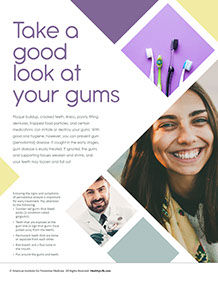
    Plaque buildup, crooked teeth, illness, poorly fitting dentures, trapped food particles, and certain medications can irritate or destroy your gums. With good oral hygiene, however, you can prevent gum (periodontal) disease. If caught in the early stages, gum disease is easily treated. If ignored, the gums and supporting tissues wither, and your teeth may loosen and fall out.

    Knowing the signs and symptoms of periodontal disease is important for early treatment. Pay attention to the following:

    *  Swollen red gums that bleed easily (a condition called gingivitis).

    *  Teeth that are exposed at the gum line (a sign that gums have pulled away from the teeth).

    *  Permanent teeth that are loose or separate from each other.

    *  Bad breath and a foul taste in the mouth.

    *  Pus around the gums and teeth.

    A Year of Health Hints book by the American Institute for Preventive Medicine. www.HealthyLife.com. All rights reserved.

    © American Institute for Preventive Medicine
  • Take Care Of Your Health

    General Health Conditions

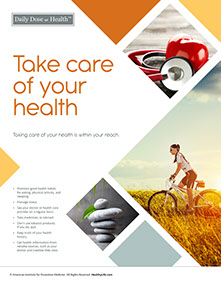
    Women riding bike in the fields.

    Taking care of your health is within your reach.

    *  Maintain good health habits for eating, physical activity, and sleeping.

    *  Manage stress.

    *  See your doctor or health care provider on a regular basis.

    *  Take medicines, as advised.

    *  Don’t use tobacco products. If you do, quit.

    *  Keep track of your health history.

    *  Get health information from reliable sources, such as your doctor and credible Web sites.

    Health at Home Lifetime book by the American Institute for Preventive Medicine. www.HealthyLife.com. All rights reserved.

    © American Institute for Preventive Medicine

  • Take Control Of Your Blood Pressure

    General Health Conditions

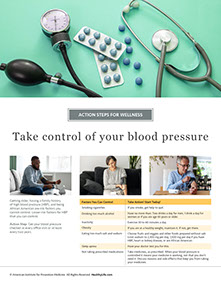
    Part of a blood pressure cuff and medications.

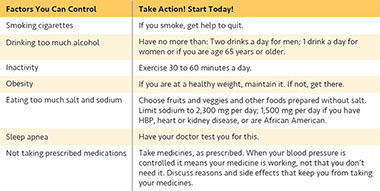
    Getting older, having a family history of high blood pressure (HBP), and being African American are risk factors you cannot control. Lower risk factors for HBP that you can control.

    Action Step:Get your blood pressure checked at every office visit or at least every two years.

    Health at Home Lifetime book by the American Institute for Preventive Medicine. www.HealthyLife.com. All rights reserved.

    © American Institute for Preventive Medicine
  • Take Control Of Your Health

    General Health Conditions

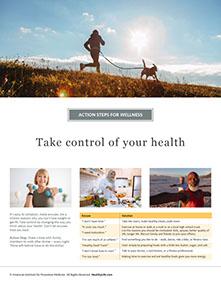
    Man jogging with his dog.

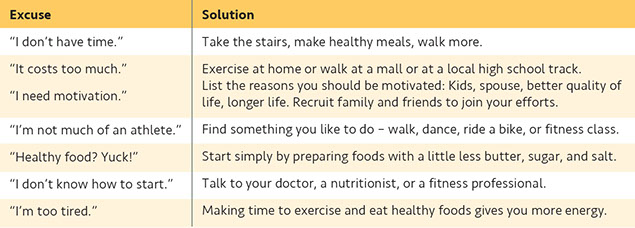
    It’s easy to complain, make excuses, list a million reasons why you can’t lose weight or get fit. Take control by changing the way you think about your health. Don’t let excuses hold you back.

    Action Step:Make a date with family members to walk after dinner – every night. Those left behind have to do the dishes.

    Health at Home Lifetime book by the American Institute for Preventive Medicine. www.HealthyLife.com. All rights reserved.

    © American Institute for Preventive Medicine

  • Take Everyday Steps To Add Years To Your Life

    General Health Conditions

    Couple jogging together.

    *  Choose mostly plant foods. Eat at least five servings of fruits and veggies a day. Choose ones of different colors. Eat a variety of whole grain foods, beans, and lentils.

    *  Limit red meat. Avoid meats with nitrates and nitrites and a lot of salt. Examples are ham, hot dogs, and smoked sausage.

    *  Be physically active for 30 or more minutes every day. You choose the way(s).

    *  Take medicines as prescribed. If needed, use pill containers or a daily checklist to remind you to do this.

    *  Wash your hands often.

    *  Brush your teeth twice a day. Floss every day.

    *  Get 7-9 hours of quality sleep.

    *  Stay connected to friends and family.

    *  Keep learning something new.

    *  Avoid or limit alcohol.

    – Men: Up to 2 drinks a day

    – Women and persons age 65 years and older: Up to 1 drink a day

    – One drink =

    4-5 ounces of wine

    1-1/2 ounces whiskey, gin, vodka

    12 ounces regular beer

    12 ounces wine cooler

    Health at Home Lifetime book by the American Institute for Preventive Medicine. www.HealthyLife.com. All rights reserved.

    © American Institute for Preventive Medicine
  • Teeth & Mouth Changes With Aging

    Dental & Mouth Concerns

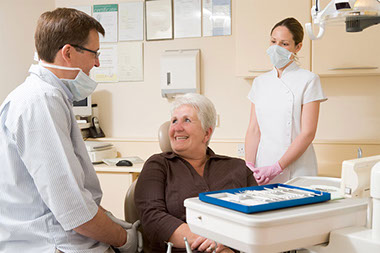
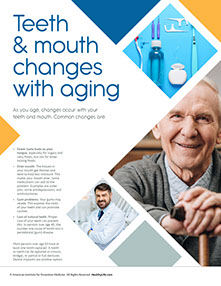
    Image of older women at the dentist office.

    As you age, changes occur with your teeth and mouth. Common changes are:

    *  Fewer taste buds on your tongue, especially for sugary and salty foods, but not for bitter tasting foods

    *  Drier mouth. The tissues in your mouth get thinner and tend to hold less moisture. This makes your mouth more dry. Some medications can add to the problem. Examples are water pills, some antidepressants, and antihistamines.

    *  Gum problems. Your gums may recede. This exposes the roots of your teeth and can promote cavities.

    *  Loss of natural teeth. Proper care of your teeth can prevent this. In persons over age 40, the number one cause of tooth loss is periodontal (gum) disease.

    More than half of persons over age 50 have at least one tooth replaced. A tooth or teeth can be replaced as crowns, bridges, partial or full dentures. Dental implants are another option.

    Health at Home Lifetime book by the American Institute for Preventive Medicine. www.HealthyLife.com. All rights reserved.

    © American Institute for Preventive Medicine