Author: AIPM

  • Put Your Tennis Elbow On Ice

    Bone & Muscle Problems

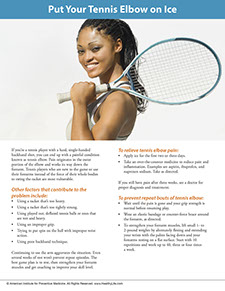
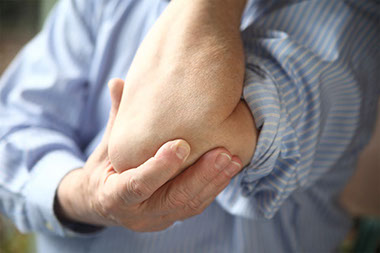
    Close up image of elbow.

    If you’re a tennis player with a hard, single-handed backhand shot, you can end up with a painful condition known as tennis elbow. Pain originates in the outer portion of the elbow and works its way down the forearm. Tennis players who are new to the game or use their forearms instead of the force of their whole bodies to swing the racket are most vulnerable.

    Other factors that contribute to the problem include:

    *  Using a racket that’s too heavy.

    *  Using a racket that’s too tightly strung.

    *  Using played out, deflated tennis balls or ones that are wet and heavy.

    *  Using an improper grip.

    *  Trying to put spin on the ball with improper wrist action.

    *  Using poor backhand technique.

    Continuing to use the arm aggravates the situation. Even several weeks of rest won’t prevent repeat episodes. The best game plan is to rest, then strengthen your forearm muscles and get coaching to improve your skill level.

    To relieve tennis elbow pain:

    *  Apply ice for the first two or three days.

    *  Take an over-the-counter medicine to reduce pain and inflammation. Examples are aspirin, ibuprofen, and naproxen sodium. Take as directed.

    If you still have pain after three weeks, see a doctor for proper diagnosis and treatment.

    To prevent repeat bouts of tennis elbow:

    *  Wait until the pain is gone and your grip strength is normal before resuming play.

    *  Wear an elastic bandage or counter-force brace around the forearm,  as directed.

    *  To strengthen your forearm muscles, lift small 1- to 2-pound weights by alternately flexing and extending your wrists with the palms facing down and your forearms resting on a flat surface. Start with 10 repetitions and work up to 40, three or four times a week.

    A Year of Health Hints book by the American Institute for Preventive Medicine. www.HealthyLife.com. All rights reserved.

    © American Institute for Preventive Medicine

  • Testicle Problems

    Men’s Health

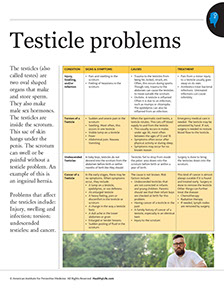
    The testicles (also called testes) are two oval shaped organs that make and store sperm. They also make male sex hormones. The testicles are inside the scrotum. This sac of skin hangs under the penis. The scrotum can swell or be painful without a testicle problem. An example of this is an inguinal hernia.

    Problems that affect the testicles include: Injury, swelling and infection; torsion; undescended testicles; and cancer.

    Signs & Symptoms

    For Injury, Swelling, and/or Infection

    *  Pain and swelling in the scrotum.

    *  Feeling of heaviness in the scrotum.

    For Torsion of a Testicle

    *  Sudden and severe pain in the scrotum.

    *  Swelling. Most often, this occurs in one testicle.

    *  Fever.

    *  Abdominal pain. Nausea. Vomiting.

    For Undescended Testicles

    *  In baby boys, testicles do not descend into the scrotum from the abdomen before birth or within months of birth like they should.

    For Cancer of a Testicle

    In the early stages, there may be no symptoms. When symptoms occur, they include:

    *  A lump on a testicle, epididymis, or vas deferens.

    *  An enlarged testicle.

    *  A heavy feeling, pain or discomfort in the testicle or scrotum.

    *  A change in the way a testicle feels.

    *  A dull ache in the lower abdomen or groin.

    *  Enlarged or tender breasts.

    *  Sudden pooling of fluid in the scrotum.

    Causes

    For Injury, Swelling, and Infection

    *  Trauma to the testicles from being hit, kicked, struck, etc. Often, this occurs during sports. Though rare, trauma to the abdomen can cause the testicles to move outside the scrotum.

    *  Orchitis. With this, a testicle is inflamed. Often it is due to an infection, such as mumps or chlamydia. The epididymis can also be inflamed from an infection.

    For Torsion of a Testicle

    When the spermatic cord twists, a testicle rotates. This cuts off blood supply to and from the testicle.

    *  This usually occurs in males under age 30, most often between the ages of 12 and 18.

    *  Symptoms often occur after physical activity or during sleep.

    *  Symptoms may occur for no known reason.

    For Undescended Testicles

    Testicles fail to drop from inside the pelvic area down into the scrotum before birth or within a year of birth.

    For Cancer of a Testicle

    The cause is not known. Risk factors include:

    *  Undescended testicles that are not corrected in infants and young children. Parents should see that their infant boys are checked at birth for this problem.

    *  Having cancer of a testicle in the past.

    *  A family history of cancer of a testicle, especially in an identical twin.

    *  Injury to the scrotum.

    Treatment

    For Injury, Swelling, and/or Infection

    *  Pain from a minor injury to a testicle usually goes away on its own.

    *  Antibiotics treat bacterial infections. Untreated infections can cause infertility.

    For Torsion of a Testicle

    Emergency medical care is needed. The testicle may be untwisted by hand. If not, surgery is needed to restore blood flow to the testicle.

    For Undescended Testicles

    Surgery is done to bring the testicles down into the scrotum.

    For Cancer of a Testicle

    This kind of cancer is almost always curable if it is found and treated early. Surgery is done to remove the testicle. Other things can further treat the disease:

    *  Chemotherapy.

    *  Radiation therapy.

    *  If needed, lymph nodes are removed by surgery.

    Questions to Ask

    Self-Care / Prevention

    To Avoid Injury to the Scrotum

    *  Wear protective gear and clothing during exercise and sports.

    *  Wear an athletic cup to protect the testicles.

    To Help Prevent Infections

    *  See that your children get vaccines for measles, mumps, and rubella (MMR) as advised by their doctor.

    *  To help prevent STDs, follow “Safer Sex” guidelines.

    To Treat Infections

    *  Take medication as prescribed.

    *  Take an over-the-counter medicine for pain and swelling, if needed. Follow directions.

    *  Rest.

    *  Apply cold compresses or an ice pack to painful, swollen area.

    Testicular Self-Exam

    Talk to your doctor about doing testicular self-exams (TSEs). If you choose to do TSEs, follow your doctor’s advice.

    The best time to do a TSE is after a warm bath or shower. This relaxes the scrotum, allows the testicles to drop down, and makes it easier to find anything unusual. Doing a TSE is easy and takes only a few minutes.

    1.  Stand in front of a mirror. Look for any swelling on the skin of the scrotum.

    2.  Examine each testicle with both hands. Place your index and middle fingers underneath the testicle and your thumbs on top. Gently roll one testicle then the other between your thumbs and fingers. One testicle may be larger. This is normal. Examine each testicle for any lumps. These are usually painless and about the size of a pea.

    3.  Find the epididymis. This is the comma-shaped cord behind the testicle. It may be tender to the touch. Check it for lumps.

    4.  Examine the vas deferens. This is the tubelike structure at the back of each testicle. Check it for lumps.

    Resources

    National Cancer Institute

    800.4.CANCER (422.6237)

    www.cancer.gov
    Healthier at Home book by the American Institute for Preventive Medicine. www.HealthyLife.com. All rights reserved.

    © American Institute for Preventive Medicine

  • Thyroid Awareness

    Ear, Nose & Throat Conditions

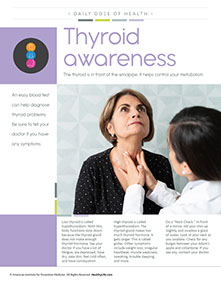
    Doctor examining women's neck.

    The thyroid is in front of the windpipe. It helps control your metabolism.

    An easy blood test can help diagnose thyroid problems. Be sure to tell your doctor if you have any symptoms.

    Low thyroid is called hypothyroidism. With this, body functions slow down because the thyroid gland does not make enough thyroid hormone. See your doctor if you have a lot of fatigue, are depressed, have dry, pale skin, feel cold often, and have constipation.

    High thyroid is called hyperthyroidism. The thyroid gland makes too much thyroid hormone. It gets larger. This is called goiter. Other symptoms include weight loss, irregular heartbeat, muscle weakness, sweating, trouble sleeping, and more.

    Do a “Neck Check:” In front of a mirror, tilt your chin up slightly and swallow a glass of water. Look at your neck as you swallow. Check for any bulges between your Adam’s apple and collarbone. If you see any, contact your doctor.

    Health at Home Lifetime book by the American Institute for Preventive Medicine. www.HealthyLife.com. All rights reserved.

    © American Institute for Preventive Medicine

  • Thyroid Problems

    General Health Conditions

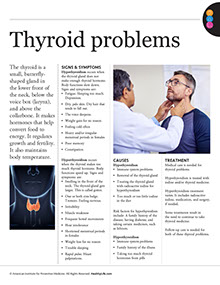
    The thyroid is a small, butterfly-shaped gland in the lower front of the neck, below the voice box (larynx), and above the collarbone. It makes hormones that help convert food to energy. It regulates growth and fertility. It also maintains body temperature.

    Signs & Symptoms

    Hypothyroidism occurs when the thyroid gland does not make enough thyroid hormone. Body functions slow down. Signs and symptoms are:

    *  Fatigue. Sleeping too much.

    *  Depression.

    *  Dry, pale skin. Dry hair that tends to fall out.

    *  The voice deepens.

    *  Weight gain for no reason.

    *  Feeling cold often.

    *  Heavy and/or irregular menstrual periods in females.

    *  Poor memory.

    *  Constipation.

    Hyperthyroidism occurs when the thyroid makes too much thyroid hormone. Body functions speed up. Two common forms are Graves’ disease and multinodular goiter. Signs and symptoms are:

    *  Swelling in the front of the neck. The thyroid gland gets larger. This is called goiter.

    *  One or both eyes bulge. Tremors. Feeling nervous.

    *  Mood swings.

    *  Weakness.

    *  Frequent bowel movements.

    *  Heat intolerance.

    *  Shortened menstrual periods in females.

    *  Weight loss for no reason.

    *  Fine hair or hair loss.

    *  Rapid pulse. Heart palpitations.

    {Note: In elderly persons, symptoms for this can be more like ones for hypothyroidism.}

    Causes

    For Hypothyroidism

    *  Immune system problems.

    *  Removal of the thyroid gland.

    *  Treating the thyroid gland with radioactive iodine for hyperthyroidism.

    *  Too much or too little iodine in the diet.

    Risk factors for hypothyroidism include: A family history of the disease; having diabetes; and taking certain medicines, such as lithium.

    For Hyperthyroidism

    *  Immune system problems.

    *  Family history of the illness.

    *  Taking too much thyroid hormones from pills.

    Treatment

    Medical care is needed for thyroid problems.

    Hypothyroidism is treated with iodine and/or thyroid medicine.

    Hyperthyroidism treatment varies. It includes radioactive iodine, medication, and surgery, if needed.

    Some treatments result in the need to continue to take thyroid medicine.

    Follow-up care is needed for both of these thyroid problems.

    Questions to Ask

    Self-Care / Prevention

    *  Take medication as directed.

    *  Tell your doctor if symptoms come back or still bother you.

    *  Follow your doctor’s advice for self-care measures.

    Neck Check

    To see if you have a lump on your thyroid gland or if it is enlarged, the American Association of Clinical Endocrinologists recommends this quick self-test:

    1.  Tilt your chin up slightly and swallow a glass of water in front of a mirror.

    2.  Look at your neck as you swallow.

    3.  Check for any bulges or protrusions between your Adam’s apple and collarbone. If you see any, contact your doctor.

    Resources

    American Thyroid Association

    www.thyroid.org

    Healthier at Home book by the American Institute for Preventive Medicine. www.HealthyLife.com. All rights reserved.

    © American Institute for Preventive Medicine

  • Tinnitus

    Ear, Nose & Throat Conditions

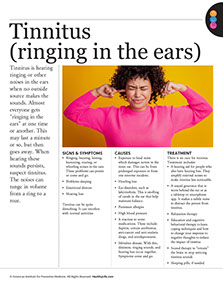
    Tinnitus is hearing ringing or other noises in the ears when no outside source makes the sounds. Almost everyone gets “ringing in the ears” at one time or another. This may last a minute or so, but then goes away. When hearing these sounds persists, suspect tinnitus. The noises can range in volume from a ring to a roar.

    Signs & Symptoms

    *  Ringing, buzzing, hissing, humming, roaring, or whistling noises in the ears. These problems can persist or come and go.

    *  Problems sleeping.

    *  Emotional distress.

    *  Hearing loss.

    Tinnitus can be quite disturbing. It can interfere with normal activities.

    Causes

    Exposure to loud noise which damages nerves in the inner ear is the most common cause. This can be from prolonged exposure or from one extreme incident.

    Other Causes

    *  Ear disorders, such as labyrinthitis. This is swelling of canals in the ear that help maintain balance.

    *  Persistent allergies.

    *  High blood pressure.

    *  A reaction to some medications. These include: Aspirin; levodopa (for Parkinson’s disease); quinidine (for irregular heartbeats); propranolol (for high blood pressure, etc.); and quinine (for leg cramps).

    *  Ménières disease. With this, dizziness, ringing sounds, and hearing loss occur together. Symptoms come and go.

    In some cases, no cause is found.

    Treatment

    There is no cure for tinnitus. Treatment includes:

    *  A hearing aid that plays a soothing sound to drown out the tinnitus.

    *  A tinnitus masker. This is worn behind the ear. It makes a subtle noise to distract the person from tinnitus. The masker does not interfere with hearing and speech.

    *  Relaxation therapy.

    *  Educational counseling or support groups for tinnitus.

    *  Sleeping pills, if needed.

    Questions to Ask

    Self-Care / Prevention

    *  Wear earplugs or earmuffs when exposed to loud noises. This can prevent noise-induced tinnitus.

    *  Treat an ear infection right away.

    *  For mild cases of tinnitus, play the radio or a white noise tape. White noise is a low, constant sound.

    *  Use biofeedback or other relaxation techniques.

    *  Limit your intake of caffeine, alcohol, nicotine, and aspirin.

    *  Talk to your doctor if you use the drugs listed in Causes on this page.

    *  If the noises started during or after traveling in an airplane, pinch your nostrils and blow through your nose. When you fly, chew gum or suck on hard candy to prevent ear popping and ringing sounds in the ear. If possible, avoid flying when you have an upper respiratory or ear infection.

    Benign Positional Vertigo (BPV)

    Vertigo is a feeling that you or the room around you is spinning or moving. This is due to a problem with the inner ear, nervous system, heart, or with blood pressure.

    The most common cause of vertigo is benign positional vertigo (BPV). With this, the feeling of spinning occurs quickly when you change the position of your head. (You turn over in bed, bend over, etc.).

    Resources

    The American Tinnitus Association

    800.634.8978

    www.ata.org

    Healthier at Home book by the American Institute for Preventive Medicine. www.HealthyLife.com. All rights reserved.

    © American Institute for Preventive Medicine

  • Tips For A Healthier, Easier Pregnancy

    Pregnancy & Prenatal Care

    Close up image of 4 pregnant bellies.

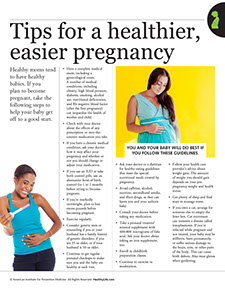
    Healthy moms tend to have healthy babies. If you plan to become pregnant, take the following steps to help your baby get off to a good start.

    *  Have a complete medical exam, including a gynecological exam. A number of medical conditions, including obesity, high blood pressure, diabetes, smoking, alcohol use, nutritional deficiencies, and Rh negative blood factor (after the first pregnancy) can jeopardize the health of mother and child.

    *  Check with your doctor about the effects of any prescription or over-the-counter medication you take.

    *  If you have a chronic medical condition, ask your doctor how it may affect your pregnancy and whether or not you should change or adjust your medication.

    *  If you use an IUD or take birth control pills, use an alternative form of birth control for 1 to 2 months before trying to become pregnant.

    *  If you’re markedly overweight, plan to lose excess pounds before becoming pregnant.

    *  Exercise regularly.

    *  Consider genetic tests or counseling if you or your husband has a family history of genetic disorders, if you are 35 or older, or if your husband is 50 or older.

    You and your baby will do best if you follow these guidelines.

    *  Ask your doctor or a dietitian to outline a meal plan that meets the special nutritional needs created by pregnancy.

    *  Avoid caffeine, alcohol, nicotine, and illicit drugs, as they can harm you and your unborn baby.

    *  Consult your doctor before taking any medication.

    *  Ask your doctor what prenatal vitamin/mineral supplement you should take.

    *  Follow your health care provider’s advice about weight gain. The amount of weight you gain should depend on your pre-pregnancy weight and health status, as well as your ethnic background. If you are very overweight, plan to lose excess pounds before you get pregnant.

    *  Continue to exercise in moderation.

    *  Practice relaxation and other stress management techniques. (Doctors think emotional stress may constrict the blood supply to the uterus and placenta, the baby’s only source of oxygen and nutrients.)

    *  Enroll in childbirth preparation classes.

    *  If you own a cat, arrange for someone else to empty the litter box. Cat excrement can transmit a disease called toxoplasmosis. If you’re infected while pregnant, your baby may be stillborn, born prematurely, or suffer serious damage to the brain, eyes, or other parts of the body.

    A Year of Health Hints book by the American Institute for Preventive Medicine. www.HealthyLife.com. All rights reserved.

    © American Institute for Preventive Medicine

  • Tips To Protect Your Eyes

    Eye Conditions

    Man smiling wearing dark sunglasses.

    Look cool and protect your eyes at the same time!

    *  Anytime your eyes are exposed to ultraviolet (UV) light, wear eyewear that protects your eyes. Do this when it is sunny and even on cloudy days. Choose sunglasses that block 99 to 100% of both UVA and UVB rays.

    *  Pick the color lenses you want, but make sure they have UV protection.

    *  Take sunglasses you already have to your eye doctor or to an optical shop. A UV meter can measure the amount of UV a lens can absorb.

    *  The sun’s UV rays are the most harmful between 11 a.m. and 3 p.m.

    *  Reflected glare from snow or ice doubles the risk of UV damage.

    *  If you wear contact lenses, choose ones with UV protection and wear sunglasses that have it, too. These protect eye tissue that the contact lenses do not cover.

    Health at Home Lifetime book by the American Institute for Preventive Medicine. www.HealthyLife.com. All rights reserved.

    © American Institute for Preventive Medicine

  • Temporomandibular Joint Syndrome

    Dental & Mouth Concerns

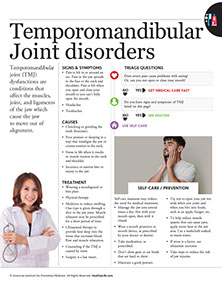
    Temporomandibular joint (TMJ) syndrome occurs when the muscles, joints, and ligaments of the jaw move out of alignment.

    Signs & Symptoms

    *  Pain is felt in or around an ear. Pain in the jaw spreads to the face or the neck and shoulders. Pain is felt when you open and close your mouth or you can’t fully open the mouth.

    *  Headaches. Toothaches.

    Causes

    *  Clenching or grinding the teeth (bruxism).

    *  Poor posture or sleeping in a way that misaligns the jaw or creates tension in the neck.

    *  Stress in life when it results in muscle tension in the neck and shoulder.

    *  Incorrect or uneven bite or injury to the jaw.

    Treatment

    *  Wearing a mouthguard or bite plate.

    *  Physical therapy.

    *  Medicine to reduce swelling. One type is given through a shot in the jaw joint. Muscle relaxants for a short period of time.

    *  Counseling if the TMJ is caused by stress.

    *  Surgery is a last resort.

    Questions to Ask

    Self-Care / Prevention

    Self-care measures may reduce the need for medical treatment.

    *  Massage the jaw area several times a day, first with your mouth open, then with it closed.

    *  Wear a mouth protector or mouth device, as prescribed by your doctor or dentist.

    *  Take medication, as prescribed.

    *  Don’t chew gum or eat foods that are hard to chew.

    *  Try not to open your jaw too wide when you yawn and when you bite into foods, such as an apple, triple-decker sandwich, etc.

    *  To help reduce muscle spasms that can cause pain, apply moist heat to the jaw area. Use a washcloth soaked in warm water.

    *  If stress is a factor, use relaxation exercises.

    *  Take steps to reduce the risk of jaw injuries.

    *  Maintain a good posture.

    Healthier at Home book by the American Institute for Preventive Medicine. www.HealthyLife.com. All rights reserved.

    © American Institute for Preventive Medicine

  • Seal Out Tooth Decay

    Dental & Mouth Concerns

    Image of older women smiling and pointing to her mouth.

    Even if you brush, floss, rinse with fluoride, and never eat a sticky sweet, decay-causing bacteria can invade the tiny pits and crevices in your molars, or chewing teeth. To head off that kind of decay, researchers have developed sealants-special plastic coatings that form an effective barrier between bacteria and the chewing surfaces of your teeth, where fluoride is less effective.

    Approximately 90 percent of the cavities in school-age children occur in crevices in the back teeth, so sealants are best applied when the permanent molars first emerge. (The American Dental Association reports a significant decrease in cavities in children who have sealants applied to their teeth.) But that doesn’t mean sealants aren’t useful or appropriate for adults who have cavity-prone teeth. So ask your dentist or dental hygienist about sealants the next time you have a dental checkup.

    The procedure is simple, pain-free, and won’t interfere with later dental work. Sealed teeth may need to be touched up periodically, though.

    A Year of Health Hints book by the American Institute for Preventive Medicine. www.HealthyLife.com. All rights reserved.

    © American Institute for Preventive Medicine

  • Toothaches

    Dental & Mouth Concerns

    Signs & Symptoms

    *  Pain in or around a tooth that throbs or occurs with a fever and/or general ill feeling. Tooth pain occurs after you eat or drink or have something hot, cold, or sweet.

    *  Gums are red, swollen, and/or bleed.

    *  Earache and/or swollen glands on one side of the face or neck.

    Causes

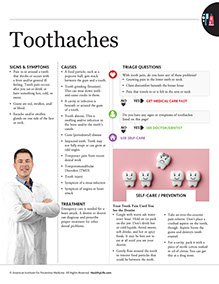
    *  A food particle, such as a popcorn hull, gets stuck between the gum and a tooth.

    *  Tooth grinding (bruxism). This can wear down teeth and cause cracks in them.

    *  A cavity or infection is beneath or around the gum of a tooth.

    *  Tooth abscess. This is swelling and/or infection in the bone and/or the tooth’s canals.

    *  Gum (periodontal) disease.

    *  Impacted teeth. Teeth may not fully erupt or can grow at odd angles.

    *  Temporary pain from recent dental work.

    *  TMJ.

    *  An injury to a tooth.

    *  A symptom of a sinus infection.

    *  A symptom of angina and a heart attack.

    Treatment

    Emergency care is needed for a heart attack. A dentist or doctor can diagnose and prescribe proper treatment for other problems.

    Questions to Ask

    Self-Care / Prevention

    To Treat Tooth Pain Until You See the Dentist

    *  Gargle with warm salt water every hour. Hold an ice pack on the jaw. Don’t drink hot or cold liquids. Avoid sweets, soft drinks, and hot or spicy foods. It may be best not to eat at all until you see your dentist.

    *  Gently floss around the tooth to remove food particles that could be between the teeth.

    *  Take an over-the-counter pain reliever. Don’t place a crushed aspirin on the tooth, though. Aspirin burns the gums and destroys tooth enamel.

    *  For a cavity, pack it with a piece of sterile cotton soaked in oil of cloves. You can get this at a drug store.

    Healthier at Home book by the American Institute for Preventive Medicine. www.HealthyLife.com. All rights reserved.

    © American Institute for Preventive Medicine