Author: AIPM

  • Help Your Refrigerator Help You

    Healthylife® Weigh

    Part 4
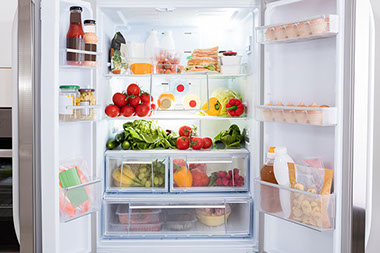
    Refrigerator filled with fresh fruits and vegetables.

    Once foods are right in front of you, it is harder to make a choice based on what your body needs. Instead, you are likely to choose foods based on these factors:

    *  If you can see it

    *  Color

    *  How fresh you think it is

    *  What you think it tastes like

    *  If you’ve thought about the food earlier or the reward you will get from having the food

    Tips for a Weight-Friendly Fridge

    *  Store chopped veggies and fruits on the middle shelf at eye-level. Use clear glass or plastic containers.

    *  Put less-healthy leftovers in the crisper or behind healthier options. Store healthy leftovers in clear containers or with clear plastic wrap.

    *  Avoid washing fruit (especially berries) until you are ready to eat (moisture invites mold).

    *  Wrap cake, pizza, and other less healthy leftovers in aluminum foil or use solid-colored containers.

    *  Use the produce drawer to hide sweets and less-healthy foods.

    *  Put washed grapes or cherry tomatoes in a colander.  Put this on a plate to allow liquid to drain.

    *  Keep hard-boiled eggs, string cheese, grilled turkey burger patties, and non-fat or Greek yogurts in front for easy,  high-protein snacks.

    *  Keep all un-opened sodas and sugar-sweetened drinks out of the fridge. Out of sight, out of mind!

    Plan Your Refrigerator Layout

    Plan where you are going to place healthy foods. Plan, too, where you are going to place less healthy foods. Use specific examples of foods you already have or that you plan to buy.
    © American Institute for Preventive Medicine

  • Help! I Just Ate Half A Cake!

    Healthylife® Weigh

    Part 6

    Cheesecake dessert with chocolate and coffee.

    Recover from Overeating

    1. Be kind to yourself. Practice self-care right away, both in what you say to yourself and what you do.

    Say something kind to yourself now. Write it down here:

    2. Drink water and get enough sleep. This supports your kidneys and liver, two organs in your body that help keep digestion going smoothly and filter out toxins.

    3. Get up and move. Perhaps go for a slow walk today. Then, get your heart pumping more tomorrow with a faster walk or an exercise class.

    4. Start the next day with a healthy breakfast. Get your metabolism revved and running early. This will help you use the extra energy you consumed the day before. Choose a food high in fiber for breakfast. This will help your body clear your digestive system of waste, especially from a large meal high in fatty and salty foods. Choose plant-based sources of protein to give your body extra fiber.

    5. Continue to follow your healthy eating plan. Avoid the “I blew it” approach that can cause one “off” meal or snack to spiral out of control.

    6. Plan for the future. Without a plan, this is likely to happen again.

    – Am I eating enough? Do I feel like I’m starving all the time?

    – Am I getting enough from each food group? Your body may need a nutrient that it isn’t getting.

    – Am I being too tough on myself? Making a lot of changes at once can be hard to stick with. Create a realistic plan for you to make changes gradually. Allow yourself some treats.

    – Learn healthy ways to cope with emotions in this section.

    © American Institute for Preventive Medicine
  • How Do You View Your Body?

    Healthylife® Weigh

    Part 5

    Young smiling man eating on diet.

    Body Ownership, Healthy Body Image

    *  My body is beautiful to me.

    *  My feelings about my body are not influenced by society’s concept of an ideal body shape.

    *  I know that the significant others in my life will always find me attractive.

    *  I nourish my body so it has the strength and energy to achieve my physical goals.

    *  I pay attention to my body and my appearance because it is important to me, but it only occupies a small part of my day.

    Body Pre-Occupied/ Distorted Body Image

    *  I spend a significant time in front of the mirror viewing my body.

    *  I spend a significant time comparing my body to others.

    *  I’d be more attractive if I was thinner, more muscular, etc.

    *  I have considered changing or have changed my body through surgery so that I can accept myself.

    *  I wish I could change the way I look.

    Body Hate/ Disassociation

    *  I often feel separated and distant from my body, as if it belongs to someone else.

    *  I hate my body and I often isolate myself from others.

    *  I don’t see anything positive or even neutral about my body shape and size.

    *  I don’t believe others when they tell me I look OK.

    *  I hate the way I look in the mirror.

    Move toward viewing your body in a healthy way. Use the healthy body image statements in the left column as affirmations. Repeat these to yourself. Make changing your attitude a goal.

    © American Institute for Preventive Medicine

  • How Much Energy Do I Need?

    Healthylife® Weigh

    Part 2

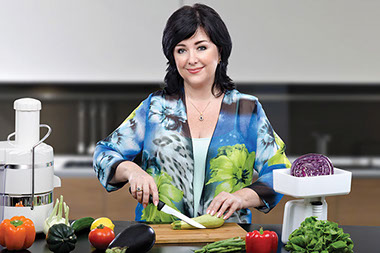
    Women cutting vegetables.

    Calories are units of energy that fuel your body for daily functions like breathing, eating, and thinking. Calories are also burned during physical activity. The more active you are, the more energy your body needs. Use the chart below to find your estimated daily energy needs. Calories needed vary by sex, age, and activity level. To determine your activity level, consider how you spend most of your day.

    *  Sedentary: You sit most of the day and do little to no physical activity (e.g., you walk once a week or do light gardening).

    *  Moderately Active: Your work involves movement, such as cleaning or light industrial work. You do some moderate-intensity physical activity a few times a week, like brisk walking or cycling.

    *  Active: Your work involves a lot of movement, such as heavy industrial work, construction work, or farming. You do physical activity most days during the week, such as jogging, swimming laps, intense walking, weight lifting, or sports.

    Chart showing calories needed per day by age, gender and activity level.

    These are roughly the calories you need per day to stay at your current weight.

    To lose 1 pound per week, you need to take in 500 fewer calories than you use/burn through daily activity. This guide encourages gradual, long-lasting weight loss.

    You can get your specific daily energy needs using the USDA’s SuperTracker online tool. Find this atwww.choosemyplate.gov/resources/MyPlatePlan.

    You can lose weight without severely restricting calories. Eating fewer than 1,200 calories per day can make it difficult for you to get all the nutrients you need. Eating this way can also be hard to follow long-term. A diet with fewer than 1,200 calories should be supervised by a doctor or dietitian.

    Special nutrition needs

    Talk to your doctor or dietitian before choosing an eating plan if you have special nutrition needs, such as:

    *  You are pregnant or breastfeeding

    *  You have a health condition or take medications

    © American Institute for Preventive Medicine
  • Identify Disordered Eating

    Healthylife® Weigh

    Part 5

    Sad young women.

    Disordered eating can be hard on your body and your mind. Follow the guidelines in this book to develop a realistic, patient approach to managing weight. Be self-kind, not   self-critical.

    Eating Disorders

    If you are concerned that you may have an eating disorder (e.g., anorexia nervosa, bulimia nervosa, or a binge eating disorder), contact your doctor immediately, as these are serious medical conditions. You can also find more information here:

    National Eating Disorders Association (NEDA)

    www.nationaleatingdisorders.org

    Helpline: 800-931-2237

    National Institute of Mental Health

    www.nimh.nih.gov/health/topics/eating-disorders/index.shtml

    © American Institute for Preventive Medicine
  • Identify Emotions That Prompt You To Eat

    Healthylife® Weigh

    Part 6

    Top view of woman on the sofa eating a healthy salad.

    Indicate how often the following scenarios apply to you.

    *  When I’m angry or upset, I think, “I don’t care what I eat or how much I eat.”

    *  When I see something tasty, I eat it but regret it later. I find myself saying, “Why did I just do that? I didn’t really want it.”

    *  When I have a craving for something, it is very difficult for me not to satisfy it right away. I may feel frustrated until I have it.

    *  When I’m stressed, I tell myself, “I can take a break from eating healthy so I can focus on the stressful things. I will get back on track later.”

    *  When I am eating with my friends or family, I can’t seem to stick to my healthy plans.

    *  Once I start eating something I really like, I have a hard time stopping, even when I want to.

    *  I find myself saying, “Oh, what the heck, I blew it anyway. I might as well eat whatever I want.”

    © American Institute for Preventive Medicine

  • Identify Your Values

    Healthylife® Weigh

    Part 1

    Chalk illustration of light blub and "Core Values" written.

    Understanding your values can help you see what motivates you. Having a clear set of values will also help you select the best tools and strategies later in this guide.

    Values are personal qualities and ways of living. They help you see who you are and who you want to be. When you act in a way that aligns with your values, you show yourself and/or others what is important to you and who you are. Which values are important to you now?

    *  Self-respect

    *  Sense of accomplishment

    *  Spirituality

    *  Having loving relationships

    *  Competition

    *  Self-control

    *  A simple life

    *  Personal responsibility

    *  Self-fulfillment

    *  Tradition

    *  Sense of belonging

    *  Being practical

    *  Self-care

    *  Having self-compassion

    *  Adventure

    *  Trying new things

    *  Being creative

    *  Being wise

    *  Enjoying life’s pleasures

    *  Being loving and caring

    *  Being authentic

    *  Being self-sufficient

    *  Being curious

    *  Feeling my best

    *  Engaging fully/being mindful

    *  Being in charge

    *  Being loyal

    *  Planning for the future

    *  Being competitive

    *  Connecting with nature

    *  Being helpful

    *  Enjoying stimulating activities

    *  Being a positive role model

    *  Influencing others

    © American Institute for Preventive Medicine
  • Improve A Packaged Meal

    Healthylife® Weigh

    Part 3

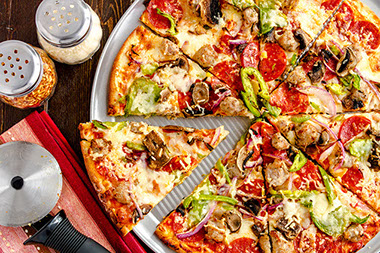
    Frozen pizza with added fresh vegetables.

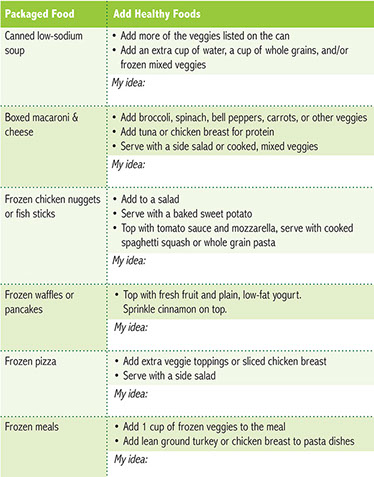
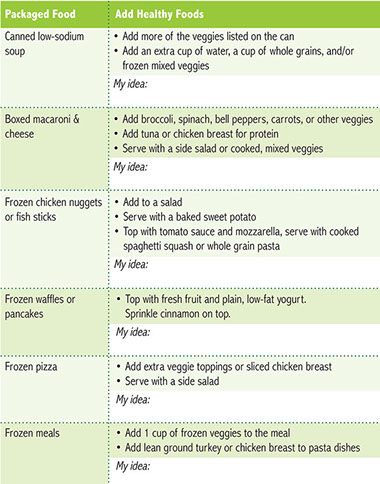
    Cooking from scratch is a great way to know what is in your food and to prepare it how you like it. You can also start with a pre-made, packaged food and make a healthy meal from it! The chart below gives examples of ways to add nutrients to packaged foods. Add your own ideas.

    Chart of ideas to improve packaged meals.

    © American Institute for Preventive Medicine

  • Improve A Packaged Meal 2

    Healthylife® Weigh

    Menus & Recipes

    Frozen pizza with added fresh vegetables.

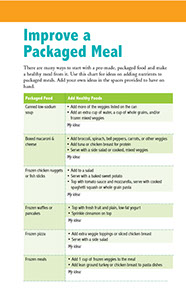
    There are many ways to start with a pre-made, packaged food and make a healthy meal from it. Use this chart for ideas on adding nutrients to packaged meals. Add your own ideas in the spaces provided to have on hand.

    Chart of ideas to improve packaged meals.

    © American Institute for Preventive Medicine

  • Ingredients List: What’s In This?

    Healthylife® Weigh

    Part 3

    Man reading food label in the grocery store.

    Ingredients are listed in descending order by weight. The most common ingredient is listed first, down to the least common ingredient.

    Follow these easy steps to compare foods:

    1. Look for a short list of ingredients. In general, better choices have fewer ingredients listed. Products with many ingredients often have more forms of sugar (including artificial sweeteners), artificial colors and dyes, and artificial starches/thickeners. These ingredients can add sugar and calories without adding nutrients. Learn more about these ingredients inPart 7of this guide.

    2. Avoid ingredients that your body can’t tolerate. Food allergies are serious. Talk to your doctor if you suspect you have a food allergy. You may also have an intolerance, such as to lactose in milk. Or, you may have a sensitivity, such as getting headaches after consuming artificial sweeteners.

    3. Choose real foods. The first item listed should be a food you recognize. If you are buying pre-made turkey burgers, the first ingredient should be turkey. If you are buying a whole grain cereal, the first ingredient should be a whole grain, such as whole wheat or oats. The second ingredient may also be a large part of the food. This should also be a food you recognize.

    4. Avoid added sugars. Avoid foods and drinks with sugar listed as one of the first 5 ingredients. Sugar can be listed in many forms. Be extra careful with ready-to-eat breakfast cereals, tomato sauce, salad dressings, and other foods you may not think of as “sweets.” Look for clues that sugar has been added.

    © American Institute for Preventive Medicine