Author: AIPM

  • Relaxation Reflex

    Healthylife® Weigh

    Part 6

    Man stretching at desk.

    This skill relaxes four basic muscle groups. Tightening and relaxing these muscles produces a soothing effect that helps you relax. Take slow, deep breaths, drop your head, and place your shoulders forward to add to the effect.

    Practice every day for about 5 to 10 minutes. Divide the body into 4 muscle groups. Tense each group for 5 seconds, then release.

    1.Arms and Hands– Lift your arms, bending them at your wrists and elbows. Make fists and tighten your upper arms.

    2.Face and Neck– Squinch your eyes, nose, cheeks, and brow. Stretch your mouth and grit your teeth. Point your chin down toward your chest.

    3.Middle Torso– Push your shoulders back. Tighten your stomach and the middle of your back.

    4.Legs and Feet– Lift your legs off the floor and hold them straight out. Point your toes toward your face. Tighten your thighs.
    © American Institute for Preventive Medicine

  • Find Reasons To Care About Physical Activity

    Healthylife® Weigh

    Part 5

    Elderly couple jogging.

    Being physically active helps you manage your weight. When you engage in physical activity, you burn calories. The more intense the activity, the more calories you burn. However, all exercise boosts your metabolism. Exercise builds muscle, the biggest fat burner in the body. Even in a state of rest, muscle burns calories efficiently (you’ll still be experiencing the benefits of your morning workout in the afternoon). Losing weight can slow your metabolism, but exercise can balance this effect.

    There are many other reasons to be active that may motivate you. Being physically active may help you live out the values you identified in Part 1.

    © American Institute for Preventive Medicine
  • Recognize When Something Is Bothering You

    Healthylife® Weigh

    Part 6

    Couple having dinner at restaurant.

    Identify what forces are at play. These may be positive or negative emotions that are pushing you to do something you don’t need or want to do.

    The following emotions that trigger less healthy eating.

    *  Anger

    *  Anxiety

    *  Boredom

    *  Depression

    *  Frustration

    *  Insecurity

    *  Stress

    *  Celebration

    Write other feelings you have that trigger feelings of hunger:

    *  Accept that you are having these feelings. Rather than trying to change how you feel, focus on changing your response to these feelings.

    *  Keep a journal to determine what triggers lead you to emotional eating.

    For negative emotions, did eating food solve the situation? Chances are it did not. Food does not solve emotional problems. It never has and it never will. Food simply keeps you from dealing with the issue at hand. When the last bite is eaten, the problem is still there.

    Positive emotions, like joy and comradery, may cause you to overeat. Think of a time when you were celebrating and over-ate.

    Avoid feeling guilty if you have overeaten or chosen less healthy foods. The feeling of guilt can make digestion difficult or lead to more overeating.

    © American Institute for Preventive Medicine

  • Reduce Sit-Time

    Healthylife® Weigh

    Part 5

    Business team with folders walking along office building and talking.

    Find ways to move more throughout the day.

    *  Set an alarm on your watch or phone to get up every hour, if sitting.

    *  Stretch and walk for a few minutes to get more oxygen flowing through your body.

    *  Drink water regularly so you need to use the bathroom at least once every few hours.

    *  Get up to use a drinking fountain.

    *  Get up during commercial breaks on TV to tidy up a room or dust.

    *  Walk outside for a few minutes. Take a deep breath of fresh air.

    *  Have walking meetings with co-workers and friends. Walk and talk.

    *  Walk to get lunch.

    © American Institute for Preventive Medicine

  • Relieve The Pressure

    Healthylife® Weigh

    Part 6

    Multi-generation family enjoying christmas meal at home.

    Avoiding all holiday food challenges is nearly impossible. Adjust your goals and your action plan for success during this time. Your goal may be to “maintain, don’t gain” during a holiday season.

    Celebration days throughout the year are likely a small fraction of your overall year. Of course, stretching celebration days into weeks and months as a “holiday season” can pose challenges to your healthy goals. Even during traditional “holiday seasons,” stick with your healthy habits on nearly all days.

    Healthy Holiday Strategies:

    *  Have a healthy snack (fiber-rich carbohydrate + protein & a healthy fat) before going to the event.

    *  Keep a drink in your hand (choose water most of the time) and sip throughout the event.

    *  Avoid tables with appetizers and food. Talk with others away from where snacks are served.

    *  Prioritize exercise. This will help you manage stress and keep your metabolism running hot.

    *  Focus on people, not food. Visit friends and relatives. Take non-food gifts, such as flowers.

    *  Modify meals to include less sugar, saturated fat, and sodium.

    *  Create new traditions that are not planned around food. Do volunteer work or plan a hike/outdoor adventure with friends and family.

    *  Use stress management tools in this guide.

    *  Get enough quality sleep.

    © American Institute for Preventive Medicine

  • Resistance Training

    Healthylife® Weigh

    Part 5

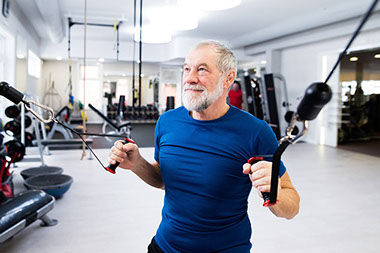
    Fit senior man in gym working out with weights.

    Make resistance training part of your exercise routine. Resistance training:

    *  Builds endurance. Your muscles can work longer before getting tired.

    *  Builds muscle. Muscle increases your resting metabolism. This means that even when your body is at rest, you are burning more fuel.

    *  Improves bone density. This helps prevent osteoporosis and fractures.

    *  Makes your body look more toned.

    *  Reduces the chance of injury while exercising.

    Tips for Resistance Training:

    *  Use free weights, a stretch band, or your body weight. Use the Dyna® Band and Exercise Guide if you received these with HealthyLife® Weigh.

    *  Follow guidelines on resistance machines for proper form. Ask a personal trainer to make sure you are doing exercises correctly.

    *  Work out with a friend. Have someone spot you.

    *  Warm up with 15 repetitions, using ½ to ¾ of your usual weight.

    *  Rest your muscles for a day in between workouts. If you want to work out every day, do the upper body one day; the lower body the next.

    *  Move slowly. Don’t jerk the weights up or drop them too fast.

    *  Breathe out when you are at the hardest part of the exercise. Breathe in when you return to the starting position. Don’t hold your breath.

    *  Work opposing muscles. For example, after you work the front of the arm (biceps), work the back of the arm (triceps).

    Examples of Resistance Training:

    Knee Push-Up: Rest on your knees and on the palms of your hands, about shoulder width apart. Push up. Keep your body straight from knees to shoulders. Push up and down slowly to the count of 4.

    Calf Raises: Stand with your feet about hip distance apart. Rise onto your toes. Hold for 1 count and lower. Try it on the edge of a step and let your heel drop below your toes for a wider range of motion.

    © American Institute for Preventive Medicine
  • Say Nice Things To Yourself

    Healthylife® Weigh

    Part 4

    Woman holding red heart shape.

    These nice things are called affirmations. What you say to yourself is powerful. You may not strongly believe it at first, but keep going.

    1. State your affirmation in the present tense.

    2. Say what you want, rather than what you don’t want.

    3. Include feeling words that add positive emotion.

    4. Be specific about what you want, rather than being vague.

    5. Make the words simple and easy to remember.

    Here are a few ideas.

    *  I am special and unique.

    *  I am proud to be me.

    *  I take care of my body.

    *  I trust myself.

    *  I am thankful for my life.

    *  I love to play and have fun.

    *  I am a good friend.

    *  I love to learn.

    *  I am courageous.

    *  I am lovable.

    *  I am gentle and strong.

    *  I am learning from this experience.

    *  I choose to respect myself.

    *  I choose to be in control.

    *  I am in control of many things, but not all things.

    Start today.Choose one or two affirmations. Write this statement on a sticky note and put it where you will see it, like the bathroom mirror or on your computer monitor. Say it out loud or repeat it silently to yourself.

    The Poisoned Parrot

    Imagine you have a parrot. This parrot repeats everything you say about yourself, over and over again. It comments on your life, especially the things that go wrong.

    For example, you come home with several bags of treats and soda. The parrot squawks, “There you go again. You’re never going to lose weight. You could have made a list, but you didn’t. You keep saying you’re going to change, but you aren’t. You’re never going to change your habits.”

    How do you feel? How long would you put up with this parrot? Don’t put up with a bully in your head. Notice this “parrot” and cover the cage.

    © American Institute for Preventive Medicine

  • Scramble Your Daily Behaviors

    Healthylife® Weigh

    Part 4

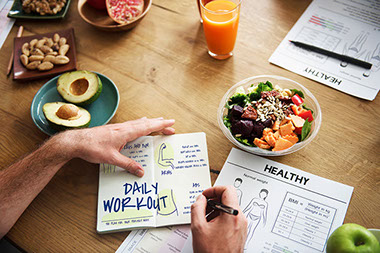
    Person writing in fitness notebook with healthy snacks on table.

    Changing how you go about your day can help get rid of eating cues and prepare you to establish new, healthy habits. Examples:

    *  Change the order of morning events: get up, shower, brush hair, eat breakfast, brush teeth, read paper, walk dog.

    *  Change the order of work events: take off coat, talk with co-workers, organize desk, review appointments or assignments, open email,  make calls.

    *  Alter driving routine: wear gloves, turn on/off radio, raise/lower volume, try listening to a new station, open/close windows, take a new route to work.

    *  Develop new telephone behavior. Stand instead of sit, hold phone with your opposite hand to your opposite ear, talk in a different room, walk as you talk.

    Be realistic.Allow time to establish a new habit. Some new habits are picked up quickly. Others may take several weeks or months of practice.

    Be consistent.Practice your new behaviors every day. This is how your new behavior will become a reliable habit.

    © American Institute for Preventive Medicine
  • Seek Downtime Daily

    Healthylife® Weigh

    Part 6

    Women on park bench reading and drinking coffee.

    Downtime is idle time between activities. Examples are the moments you have waiting at a red light, the time spent riding in an elevator, or the extra time you have during a lunch break.

    Idle time allows your brain to rest, process, and store information (how you learn and form memories). If you’ve ever had a great idea come to you in the shower, you know how creative your mind is during this time. Appreciate downtime to reduce feelings of boredom.

    Often, multi-tasking or a feeling that you must always be doing something steals this time away. The resulting “addiction to activity” does not let your mind rest during the day. The result can be a feeling of being busy all the time. You may feel like you need “time to think.” If you go all day without downtime, it can be harder to quiet your mind at night and go to sleep.

    Practice letting your mind rest every day. If you are used to filling   your time with multiple tasks at once, the following exercise may be  eye-opening!

    Try This: Sit in a room or outside for 15 minutes and do nothing. Don’t look at your phone or seek any other distractions. Let thoughts enter your mind.

    Reflect: How did you feel at the end of 15 minutes?

    Ways to Include Downtime Daily

    *  Turn off notifications on your phone. Set aside time for social media during the day-and avoid it at other times.

    *  Listen to music instead of the news or talk radio while driving. Or, sit in silence and let your mind wander.

    *  Set an alarm on your phone to remind you to take at least five minutes of “blank space” time during your day.

    © American Institute for Preventive Medicine
  • Self-Discovery: Hunger

    Healthylife® Weigh

    Part 6

    Smiling women with an apple.

    *  List the last meal or snack you ate. Write down everything you ate or drank.

    *  Was this a planned meal or snack? If no, what triggered you to have this meal or snack?

    *  How many hours had it been since you last ate?

    *  Did your meal or snack satisfy your hunger?

    *  Do you think this was physical or emotional hunger?

    *  List a situation that is an emotional eating trigger for you (e.g., boredom while watching TV or stress at work).

    © American Institute for Preventive Medicine