Author: AIPM

  • Anytime Pizza

    HEALTHY EATING

    Image of pizza.

    Ingredients

    1/2 loaf Italian or French bread (split lengthwise, or 2 split English muffins)

    1/2 cup pizza sauce

    1/2 cup mozzarella or cheddar cheese (low-fat, shredded)

    3 tablespoons green pepper (chopped)

    3 tablespoons mushrooms (fresh or canned, sliced)

    Vegetable toppings (other, optional)

    Italian seasoning (optional)

    Directions

    Toast the bread or English muffin until slightly brown. Top bread or muffin with pizza sauce, vegetables, and low-fat cheese. Sprinkle with Italian seasonings as desired. Return bread to toaster oven (or regular oven preheated to 350 degrees). Heat until cheese melts.

    Makes 2 servings: Per serving: 180 calories, 7 g total fat, 12 g protein, 21 g carbohydrates, 3 g fiber, 540 mg sodium.

    From the USDA What’s Cooking? Mixing Bowl, www.usda.gov/whatscooking

    © American Institute for Preventive Medicine

  • Apple Cider Vinegar: A Miracle Cure?

    HEALTHY EATING

    Image of apple cider vinegar.

    The belief that apple cider vinegar is a “cure-all” has been circulating in recent years on numerous websites and promoted by natural health groups. But, can it really cure diseases and keep you healthy?

    Some say apple cider vinegar helps you lose weight, control blood sugar and improve digestion. Unfortunately, these health claims have not been proven by any valid research study. And, using it in place of medications or healthy lifestyle changes can be downright dangerous.

    In addition, people with heartburn or gastroesophageal reflux disease (GERD) may find that vinegar actually makes their reflux worse. Drinking too much of it can also damage tooth enamel.

    The bottom line: Most healthy people can enjoy apple cider vinegar in food without any problems. But, don’t use it, or any natural remedy, to cure diseases. Always ask your doctor before you try any natural remedy or supplement to be sure it’s safe for you.

    © American Institute for Preventive Medicine

  • Apple Coffee Cake

    HEALTHY EATING

    Image of an apple coffee cake.

    Ingredients

    5 cups apple (tart, cored, peeled, and chopped)

    1 cup sugar

    1 cup raisins (dark)

    1/2 cup pecans (chopped)

    1/4 cup vegetable oil

    2 teaspoons vanilla

    1 egg (beaten)

    2-1/2 cups all-purpose flour (sifted)

    1-1/2 teaspoon of baking soda

    2 teaspoons cinnamon (ground)

    Directions

    Preheat oven to 350ºF. Lightly oil a 13-by-9 inch pan. In a large mixing bowl, combine apples with sugar, raisins, and pecans. Mix well, let stand 30 minutes. Stir in oil, vanilla, and egg. Sift together flour, soda, and cinnamon. Stir into apple mixture about a third at a time. Just enough to moisten dry ingredients. Turn batter into pan. Bake 35-40 minutes. Cool cake slightly before serving.

    Makes 20 servings. Per serving: 180 calories, 5 g total fat, 100 mg sodium, 33 g carbs, 1 g fiber, 3 g protein

    Used with permission from the US Department of Health and Human Services, A Healthier You, based on the Dietary Guidelines for Americans.

    © American Institute for Preventive Medicine

  • Are Fitness Trackers Worth The Hype?

    BE FIT

    Image of women with a fitness tracker.

    Fitness bands, also called wearable health trackers, have become a popular trend in the last few years. Millions of these devices have been sold, but can they help you get healthy?

    What they do

    Most fitness trackers have features that act like a pedometer, counting your steps and other physical activity. Their features vary widely, however. Some trackers simply tell you how many steps you take in a day. Others are designed to be worn during exercise, such as running, and may track your distance and show your route. Other trackers are waterproof and designed to be worn when swimming.

    Many trackers also record quality and length of sleep. Because they have a movement sensor, they can determine how many times you woke and when you were in deep sleep.

    Most of them are designed to be used with an app on your smartphone, where you can see how you’re doing and make improvements where needed.

    Improving health with a tracker

    It can be helpful to know how many steps you take and how well you’ve slept. But keep in mind that these devices aren’t perfect. For instance, if you walk while pushing a stroller, a tracker worn on your wrist may not count your steps because your arms aren’t swinging.

    Sleep tracking can also be helpful, but won’t be a magic fix. Some trackers assume you’re in a deep sleep because you don’t move around. But, some people just naturally move less during the night, even if their sleep quality isn’t great. This may lead to incorrect information that makes you think you’re sleeping better than you actually are.

    Your body may be the best gauge when it comes to your health. When you don’t sleep well, you’ll feel sluggish. And you can easily keep track of any exercise you do with a fitness diary or a simple notebook. As for step counting, these devices are helpful, but an old-fashioned pedometer can work just as well.

    Alternatives to fitness trackers

    If you don’t have – or want – one of these devices, there are still ways you can get healthy with technology. Many apps that work with a smartphone can help you track movements and sleep, and others help you manually record things like mood, stress levels, and menstrual cycles. These require you to carry your smartphone with you, but don’t use any wearable devices.

    © American Institute for Preventive Medicine

  • Are Natural Sleep Aids Safe?

    WELL-BEING

    Image of different supplements.

    Many herbal and “natural” sleep supplements are available in stores today. Although they claim to help you sleep without side effects, experts say you should use caution before taking one.

    The Food and Drug Administration (FDA) considers these natural remedies to be “dietary supplements.” This means they are not regulated as strictly as medicines. In fact, the companies that make these supplements don’t have to get FDA approval before selling them.

    Herbs and supplements can interact with medicines you already take. Be sure to talk with your doctor before taking any natural supplement. And parents should not give any natural supplements to children without first talking with the child’s pediatrician. These supplements can have effects on children’s growing bodies.

    © American Institute for Preventive Medicine

  • Are You Addicted To Shopping?

    WELL-BEING

    Image of couple holding shopping bags.

    Whether you like to look at clothing, housewares, tools, or electronics, shopping is a favorite pastime for many people. As the holidays approach, shopping becomes even more popular. Big sales, special deals, and promotions all seek to get more people to buy, buy, buy.

    But for some people, shopping is more than just fun around the holidays. It can actually be an addiction, according to the National Institute on Alcohol Abuse and Alcoholism.

    Signs of Shopping Addiction

    Many people think addiction is only for drugs and alcohol. But many behaviors including shopping can become an addiction. Access to online shopping can make the problem worse. You can buy whatever you want from the privacy of your home and just a few mouse clicks.

    It can be difficult to know if you just like to shop, or if it’s really a problem. If three or more of these statements apply to you, you may be addicted to shopping:

    *  You frequently buy things you don’t need.

    *  You have many unopened packages of items or clothing with the tags still on.

    *  You purchase things you can’t afford by using credit cards.

    *  You hide your purchases from your spouse or family.

    *  You feel a strong need to shop when you’re sad, angry, or anxious.

    *  You have secret credit cards or open new cards when others ones are maxed out.

    *  You think obsessively about shopping and money.

    *  You buy much more than planned, and feel guilty or ashamed afterward.

    *  Your relationships with family or friends have been affected by your shopping.

    © American Institute for Preventive Medicine

  • Are You Driving Yourself To Burnout?

    SUCCESS OVER STRESS

    Image of elevated train and cars on road.

    Commuting length, distance, and means are stress factors that can lead to burnout, said Annie Barreck of the University of Montreal’s School of Industrial Relations.

    By car:

    No surprises: the bigger the city, the more stressful the commute, at least for people traveling by car. Passengers are more likely to be stressed out than drivers because carpooling reduces the passenger commuters’ sense of control, which causes them more stress before they’ve even arrived at work.

    By public transit:

    People with long commutes from rural areas via bus or train connections are stressed about uncontrollable delays. The stress carries over into the workplace. But transit users in major urban areas are less likely to have symptoms of burnout.

    By bike or on foot:

    Biking is also a mixed bag that is determined by the area the commuter is working in. Commuting by bike in the suburbs is more stressful than biking in the city where cyclists and walkers have access to safety features such as cycle paths and pedestrian crossings, which increase their sense of control over their commute.

    Study findings show that the risk of burnout increases significantly when a commute lasts more than 20 minutes. Above 35 minutes, all employees are at increased risk of cynicism toward their job. Barreck believes this should lead employers to adopt flexible commuting arrangements.

    © American Institute for Preventive Medicine

  • Are You Washing Your Hands The Right Way?

    MEDICAL NEWS

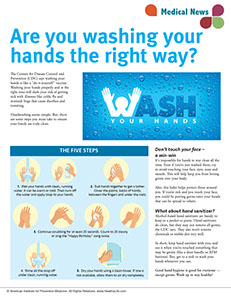
    Water drop illustration with the words "Wash your hand".

    The Centers for Disease Control and Prevention (CDC) says washing your hands is like a “do-it-yourself” vaccine. Washing your hands properly and at the right time will slash your risk of getting sick with illnesses like colds, flu and stomach bugs that cause diarrhea and vomiting.

    Handwashing seems simple. But, there are some steps you must take to ensure your hands are truly clean.

    The five steps

    1.  Wet your hands with clean, running water. It can be warm or cold. Then turn off the water and apply soap to your hands.

    2.  Rub hands together to get a lather. Cover the palms, backs of hands, between the fingers and under the nails.

    3.  Continue scrubbing for at least 20 seconds. Count to 20 slowly or sing the “Happy Birthday” song twice.

    4.  Rinse all the soap off under clean, running water.

    5.  Dry your hands using a clean towel. If one is not available, allow them to air dry completely.

    Don’t touch your face – a win-win

    It’s impossible for hands to stay clean all the time. Even if you’ve just washed them, try to avoid touching your face, eyes, nose and mouth. This will help keep you from letting germs into your body.

    Also, this habit helps protect those around you. If you’re sick and you touch your face, you could be putting germs onto your hands that can be spread to others.

    What about hand sanitizer?

    Alcohol-based hand sanitizers are handy to keep in a pocket or purse. Hand sanitizers do clean, but they may not remove all germs, the CDC says. They also won’t remove chemicals or visible dirt very well.

    In short, keep hand sanitizer with you, and use it when you’ve touched something that may be germy (like a door handle or ATM buttons). But, get to a sink to wash your hands whenever you can.

    Good hand hygiene is good for everyone – except germs. Wash up to stay healthy!

    © American Institute for Preventive Medicine