Author: AIPM

  • Halloween Candy Control

    HEALTHY EATING

    Image of halloween treats.

    Despite all your work to help your kids eat healthy, holidays like Halloween can quickly throw your efforts off track. Candy in the stores and at school, and, of course, while trick-or-treating means your kids have plenty of access to junk food. It might be downright scary.

    While a little candy isn’t harmful, it can be easy to overdo it when junk food seems to be everywhere. And the health problems associated with sugary snacks and unhealthy foods are real:

    *  The Centers for Disease Control and Prevention says 1 in 5 school-aged children has obesity. While candy alone isn’t to blame, experts know that eating too many foods high in calories and low in nutrition (such as candy and sugary treats) are part of the problem.

    *  Sugary treats can cause cavities. The American Dental Association says some of the worst offenders are sticky treats that cling to teeth and those that sit in the mouth for a long time like hard candies and suckers. But, any high-sugar snack can spell trouble for someone’s dental health.

    The good news is, even health-conscious families can enjoy the fun of Halloween (and a few treats) if they have a plan in place before the spooky day arrives:

    *Don’t leave candy out where it can be grabbed any time.Kids (and adults) tend to reach for whatever is available, and may mindlessly eat whatever is sitting out. Put candy and other goodies in a hard-to-reach cupboard instead. This requires more effort to get to it, so it is “out of sight, out of mind.”

    *Teach kids moderation.If you make candy and sweets off-limits, kids may want the forbidden food even more. Instead, allow them a small treat after they’ve eaten a healthy dinner.

    *Lead by example.If you have a hard time avoiding sweet treats, now is a great time to make healthy eating a family effort. Reserve your candy and other treats for after dinner. Make it a small amount, such as one fun-sized candy bar.

    *Buy what you don’t like.If you like to grab a piece here and there while the trick-or-treaters visit your house, buy candy you won’t be tempted to eat.

    *Donate your candy!Teach kids to do good by giving their candy to soldiers and charitable causes, such as for kids who are in the hospital. A variety of organizations accept candy, but check first. Try your local food bank, Operation Gratitude, the Halloween Candy Buy Back and Ronald McDonald House.

    © American Institute for Preventive Medicine

  • Happier Moods Mean Healthier Foods

    HEALTHY EATING

    Image of women holding a healthy salad in one hand and chocolate in the other.

    Looking to lose weight? Think a happy thought before you eat. A Cornell study has found that mood and food do more than just rhyme. Your mood impacts what kind and how much food you eat.

    “People use food to either maintain a good mood or regain a good mood, and if you’re already in a good mood, you tend to eat more healthfully than if you’re in a bad mood,” said Professor Brian Wansink, whose study was published in the Journal of Consumer Psychology.

    “The take away of this study is you can change your mood and eat better. Before a snack or meal, think of something that makes you happy or grateful, and you’ll eat less and better,” said Wansink.

    © American Institute for Preventive Medicine

  • Hard To Pronounce, Painful Foot Pain

    SELF-CARE CORNER

    Illustration of an inflammed plantar fascia.

    Ouch! That heel pain you feel when you first get up in the morning has a name.

    Plantar fasciitis(PLAN-ter fash-ee-EYE-tus). An inflammation of the fibrous band of tissue that connects your heel bone to the base of your toes along the bottom of your foot. The condition usually starts with pain the morning after a day of increased physical activity. You may not remember a specific injury.

    Ice the sore area for 20 minutes two times a day, after dinner and before bedtime, to relieve symptoms. Ask your doctor about taking nonsteroidal anti-inflammatory pain relievers, suggest experts at the American Orthopaedic Foot & Ankle Society.

    Stretching the plantar fascia with these exercises (www.aofas.org/footcaremd/conditions/ailments-of-the-heel/Pages/Plantar-Fasciitis.aspx) is the best treatment after the initial inflammation has gone down.

    For longer-term problems and pain that won’t go away, some injections are available, and shock wave therapy is an option. Surgery may be a final solution.

    © American Institute for Preventive Medicine

  • Harmful Hookahs

    WELL-BEING

    Image of a hookah.

    Despite warnings from the CDC that hookah smoking can be just as dangerous as cigarettes, many young adults believe that using the water pipes is not harmful to their health, according to a UCLA School of Nursing study.

    Researchers visited three Southern California hookah lounges and asked patrons between the ages of 18  and 30, “Do you believe smoking a hookah is harmful  to your health?”

    Fifty-seven percent said they thought that it was not. When asked why they thought hookahs were not harmful, 47% said they believed that the smoke gets filtered through water, and 35% said they thought that fruit used to flavor the tobacco would detoxify tobacco’s harmful chemicals. Still others, 16%, said they assumed hookahs are not harmful because the tobacco is not addictive and does not contain nicotine.

    Unfortunately, none of those beliefs is true.

    © American Institute for Preventive Medicine

  • Hassle-Free Screening Tips While Traveling

    WELL-BEING

    Image of airport check-in line.

    If you’re flying, make sure you familiarize yourself with the TSA screening process. You’ll have smooth flying if you do the following when passing through airport security:

    *Clothing:To maximize efficiency at the security checkpoint, avoid wearing clothing with metal and stow all metal items in carry-on luggage.

    *Zip it:Make sure any liquids are in 3-ounce bottles in a clear, quart-size, zip top plastic bag.

    *Footwear:Passengers are required to remove footwear for X-ray screening. Wearing footwear that can be easily removed helps speed the screening process.

    *Boarding pass and ID:When approaching the security checkpoint, passengers will be asked to present a boarding pass and a government-issued identification.

    *Electronics:Large electronics such as laptops should be removed from their cases for X-ray screening. E-readers and small electronics may stay in luggage.

    *Locking checked bags:When locking checked baggage, use a TSA recognized lock. A list of these locks can be found atwww.tsa.gov.

    © American Institute for Preventive Medicine

  • Healthier Super Bowl Snacks

    HEALTHY EATING

    Image of football.
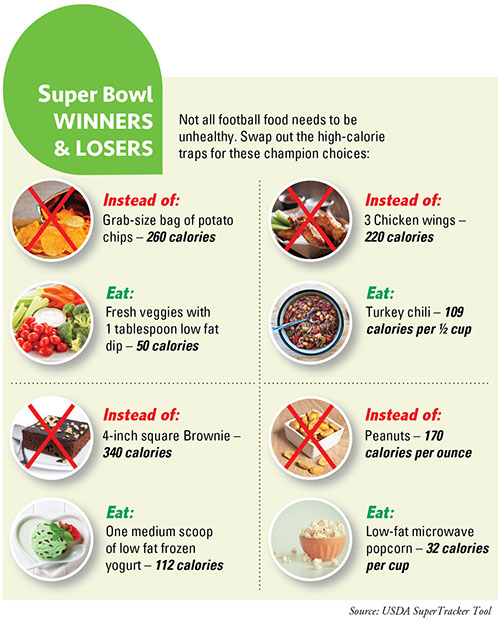
    Chart showing healthy options for super bowl snacks.

    On Super Bowl Sunday, people across the country will gather at homes, restaurants, and bars to watch the big game and enjoy game-day food. Sadly, traditional football fare tends to be high in fat and calories and low in nutrition. The Calorie Control Council says many Super Bowl fans will consume 2,000 calories or more during the game. That’s about a full day’s worth of calories in just a few hours.

    So how can you enjoy the game without the unhealthy side effects? Here are a few tips to help:

    *  Keep a zero-calorie drink like water in your hand, and sip on it throughout the day instead of snacking on food.

    *  Keep your distance from the kitchen or wherever the food is sitting out. If it’s out of sight, you’ll be less likely to mindlessly reach for snacks when you’re not hungry.

    *  If fresh fruit and veggies are available, fill your plate with those. This leaves little room for other choices.

    Be mindful of how much you’re eating, and stick to only a small serving of the high-calorie foods. If you’re cooking, take the opportunity to prepare a variety of healthy but fun choices for your guests.

    © American Institute for Preventive Medicine

  • ‘Healthy’ Foods That Aren’t So Healthy

    HEALTHY EATING

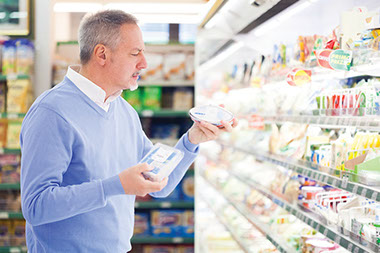
    Image of older man grocery shopping.

    Walking down the aisles at the store can feel like you’re in the middle of a commercial. Words like “low-fat,” “reduced calorie,” and “made with real fruit” appear on food packages, making them sound healthy. But how do you know if these foods are really good for you?

    No matter what claims are on the package, you can find out if a food is a good choice by looking at the nutrition facts panel. It may take some detective work, but there are ways to find out which foods you should put in your cart – and which ones are better left on the shelf.

    Count your sugar grams.

    Many processed foods contain lots of added sugar. This includes “healthy” foods, such as granola and dried fruit. Check out how many grams of sugar are included per serving size. The American Heart Association says women should not exceed 25 grams of sugar per day, and men should not exceed 37.5 grams.

    If the food contains 13 grams of sugar per serving, for instance, that’s about half of a woman’s daily sugar intake. Some yogurts, even ones labeled as “healthy” and “low-fat,” can have up to 12 grams of sugar in one serving.

    Look at the type of fat.

    Certain types of fat are good for you in moderate amounts. Monounsaturated and polyunsaturated fats can help lower cholesterol levels. These are found in vegetable oils, such as canola and olive, as well as avocados, nuts and fish.

    Many processed foods contain trans fats, which should be avoided whenever possible. Saturated fats, found in dairy, meat, and some processed foods, should be limited. The AHA says this type of fat should not exceed 5 to 6 percent of your total calories. Example: A person who eats 2,000 calories a day should not eat more than 13 grams of saturated fat. A person who eats 1,500 calories a day should not exceed 10g.

    Compare fiber content.

    When shopping for grains, such as bread, pay attention to the amount of fiber they contain. Processed, white breads often contain little to no fiber. Whole grain breads, by contrast, are often higher in nutrients and contain 2 to 5 grams of fiber per serving.

    Fiber is also found in fruits, vegetables, nuts and legumes, such as beans. Women should aim for 25 total grams per day, and men 38 grams.

    © American Institute for Preventive Medicine

  • ”Healthy” Foods That Don’t Help With Weight Loss

    HEALTHY EATING

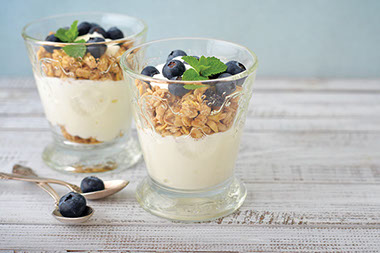
    Image of yogurt with granola and berries.

    Weight loss can be a difficult task. What works well for one person may not work for another. In addition, so many foods on store shelves claim they are “natural,” “reduced calorie”  or “light.” Does this mean you should eat them when you’re trying to lose some weight?

    Weight-loss or “diet” claims on food aren’t always a sign that you should eat them when you’re hoping to slim down. Some of these foods can be filled with unhealthy additives, sugar or salt. Beware of these “healthy” foods during your next trip to the store:

    Low-calorie or light breads

    While some lower calorie breads are nutritious, others are not. Some diet breads contain little to no fiber. Because fiber makes you feel full, these diet breads may make you feel hungry soon after eating them. Before buying any “light” or diet breads, check the nutrition label for fiber content. You may be better off eating a “whole grain” type of bread that contains more nutrition and fills you up.

    Light yogurt

    Yogurt can be a healthy choice, filled with calcium, friendly bacterial cultures and protein. But, many “light” yogurts have low protein and contain additives such as artificial sweeteners, leaving you feeling hungry again before your next meal. For a healthy yogurt, look for one that contains little to no added sugar or sweeteners, and at least 10 grams of protein. Many Greek varieties contain a good amount of protein. Sweeten your yogurt with fresh or frozen fruit.

    Light salad dressings

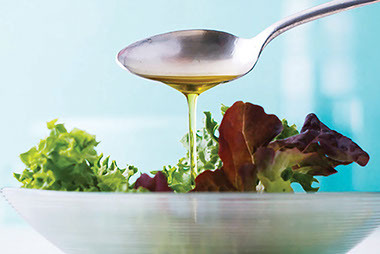
    Many salad dressings cut out extra fat from oils, replacing it with sugar, salt and flavorings. But, the healthy fats found in vegetable oils like olive oil don’t have to be avoided completely. In fact, small amounts can help you feel full and are heart-healthy. Add a splash of olive oil and your favorite vinegar to salad for a healthy dressing without unhealthy ingredients. The key is to limit the amount of oil to 1-2 teaspoons at a time.

    Granola

    This food seems so healthy, packed with whole grain oats, raisins and nuts. But, many granola cereals and snacks contain loads of sugar, making it easy to eat a few hundred calories in one portion. If you enjoy granola, measure out your serving size to see how much you are really eating. And, look for varieties with little to no added sugars and salt.

    Sources: Academy of Nutrition and Dietetics, Department of Health and Human Services, National Institute on Aging

    © American Institute for Preventive Medicine

  • Healthy Trail Mix

    HEALTHY EATING

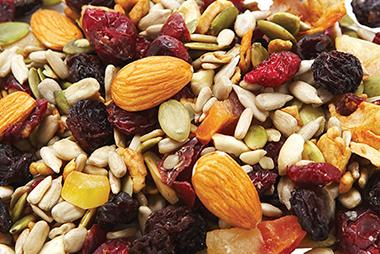
    Image of trail mix.

    Ingredients:

    1/2 cup cherries, dried, not packed

    1/2 cup apples, dried, pieces

    1/4 cup apricots, dried

    1/2 cup English walnuts, pieces

    1/4 cup sunflower seeds, raw

    1/2 cup raisins, not packed

    1/4 cup banana chips

    1/4 cup almonds, whole, raw

    Directions

    Mix all ingredients in a bowl and divide into small storage bags for portion control and portability. Makes 3 cups. One quarter cup is 180 calories, 3 g fiber, 24 carbs, 3 g protein, 10 grams fat.

    © American Institute for Preventive Medicine

  • Heart-Healthy Eating Made Easy

    HEALTHY EATING

    Image of a healthy salad.

    Simple, small changes in what you eat can make it easier to follow a heart-healthy diet. Experts in the Harvard Heart Letter made these suggestions to lower the amount of saturated fat, trans fat, sugar, sodium, and calories, and boost the amount of fiber and nutrients in a daily diet:

    Breakfast

    If you eat:Eggs

    Try:Scrambling eggs with vegetables from last night’s dinner or chopped fresh tomatoes and avocado

    Why:Adds nutrients and fiber; tomatoes add antioxidants, which help prevent fatty plaques; avocados add monounsaturated fat, which helps the body absorb nutrients

    Lunch

    If you eat:Salad with ranch or blue cheese dressing

    Try:A vinaigrette dressing made with garlic, Dijon mustard, fresh herbs, 1/3 cup vinegar, 2/3 cup extra-virgin olive oil, pepper, and a dash of salt shaken together in a jar

    Why:Reduces sodium and unhealthy fats

    Dinner

    If you eat:Pasta with meat and cheese

    Try:Whole-wheat spaghetti topped with fresh tomatoes and herbs or extra-virgin olive oil, grilled shrimp, and a small amount of freshly grated Parmesan cheese

    Why:Reduces saturated fat; adds fiber and health-protecting phytonutrients; shrimp adds omega-3 fatty acids, which may lower the risk of heart attack, stroke, and irregular heart beats

    © American Institute for Preventive Medicine