Author: AIPM

  • How Not To Get Sick When Traveling

    SELF-CARE CORNER

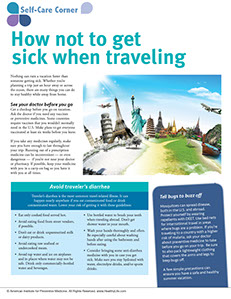
    Illustration of different city landmarks.

    Nothing can ruin a vacation faster than someone getting sick. Whether you’re planning a trip just an hour away or across the ocean, there are many things you can do to stay healthy while away from home.

    See your doctor before you go

    Get a checkup before you go on vacation. Ask the doctor if you need any vaccines or preventive medicines. Some countries require vaccines that you wouldn’t normally need in the U.S. Make plans to get everyone vaccinated at least six weeks before you leave.

    If you take any medicines regularly, make sure you have enough to last throughout your trip. Running out of a prescription medicine can be inconvenient – or even dangerous –  if you’re not near your doctor or pharmacy. If possible, keep your medicine with you in a carry-on bag so you have it with you at all times.

    Avoid traveler’s diarrhea

    Traveler’s diarrhea is the most common travel-related illness. It can happen nearly anywhere if you eat contaminated food or drink contaminated water. Lower your risk of getting it with these guidelines:

    *  Eat only cooked food served hot.

    *  Avoid eating food from street vendors, if possible.

    *  Don’t eat or drink unpasteurized milk or dairy products.

    *  Avoid eating raw seafood or undercooked meats.

    *  Avoid tap water and ice on airplanes and in places where water may not be safe. Drink only commercially-bottled water and beverages.

    *  Use bottled water to brush your teeth when traveling abroad. Don’t get shower water in your mouth.

    *  Wash your hands thoroughly and often. Be especially careful about washing hands after using the bathroom and before eating.

    *  Consider bringing some anti-diarrhea medicine with you in case you get sick. Make sure you stay hydrated with water, electrolyte drinks, and/or sports drinks.

    Tell bugs to buzz off

    Mosquitoes can spread disease, both in the U.S. and abroad. Protect yourself by wearing repellents with DEET. Use bed nets for international travel in areas where bugs are a problem. If you’re traveling to a country with a higher risk of malaria, ask your doctor about preventive medicine to take before you go on your trip. Be sure to also pack lightweight clothing that covers the arms and legs to keep bugs off.

    A few simple precautions can ensure you have a safe and healthy summer vacation.
    © American Institute for Preventive Medicine

  • How Physical Activity Works

    BE FIT

    Image of couple using dumb bells.

    No, this is not another article about why you should be active. This information tells you how exercise works to keep you healthier.

    The concept to understand is called overload. And according to the government’s Physical Activity Guidelines for Americans, overload is the physical stress placed on your body when your physical activity is greater in amount or intensity than usual.

    The body responds and adapts to these stresses (say, a Zumba class). For example, aerobic activity places stress on your heart and lungs and muscles. Your lungs are required to move more air and the heart pumps more blood and delivers it to working muscles. This increase in demand increases the efficiency of your lungs, heart, your entire circulatory system, and your muscles.

    Muscle-strengthening exercise overloads muscles and bones in the same way-making them stronger.

    Also tied to the idea of overload is the principle of progression. Once you reach a certain fitness level, you progress to higher levels of physical activity by continued overload and adaptation. These small and progressive changes help your body adapt to the additional stresses while minimizing your risk of injury.

    © American Institute for Preventive Medicine

  • How Sweet It Is

    HEALTHY EATING

    Image of different types of sweeteners.

    Is sugar really bad for us? How about artificial or low-calorie sweeteners?

    Our bodies need one type of sugar, called glucose, to survive. “Glucose is the number one food for the brain, and it’s an extremely important source of fuel throughout the body,” said Dr. Kristina Rother, pediatrician with the National Institute on Health and expert on sweeteners.

    But there’s no need to add glucose to your diet, because your body can make the glucose it needs by breaking down food molecules like carbohydrates, proteins, and fats. Some sugars are found naturally in foods such as fruits, vegetables, and milk.

    Much of the sugar we eat isn’t found naturally in food but is added during processing or preparation.

    Although sugar itself isn’t bad, said Dr. Rother, “Sugar has a bad reputation that’s mostly deserved because we consume too much of it. It’s now in just about every food we eat.”

    You can cut down on added sugars. NIH in Health offers these suggestions:

    *  Choose water, fat-free milk, or unsweetened tea or coffee instead of sodas, sports drinks, energy drinks, and fruit drinks.

    *  Reduce sugar in recipes. If a recipe says 1 cup, use 2/3 cup.

    *  To enhance flavor, add vanilla, cinnamon, or nutmeg.

    *  Eat fresh, canned, frozen, and dried fruits without added sugar. Choose fruits canned in their own juice rather than in syrup.

    *  Use fruits to top foods like cereal and pancakes rather than sugars, syrups, or other sweet toppings.

    *  Read the ingredients list to pick food with little or no added sugar.

    © American Institute for Preventive Medicine
  • How To Be A Team Player At Work

    WORK LIFE

    Concept drawing on table to being a team palyer at work.

    You’re bound to run into many different personality types at the workplace. And when you’re working as a team, it can be challenging to adjust to different work styles.

    The American Management Association says teamwork leads to better problem solving and productivity. But it’s not as simple as just saying you’re part of a team. Here are some tips to help you achieve the best possible outcome with your group:

    *Use your strengths.People have different talents and skills that make them who they are. Offer to use your unique strengths to help get things done. Don’t wait to be asked; volunteer to help when you can.

    *Don’t place blame.When things don’t go well, it’s usually not helpful to blame someone else. Instead, look at the problem and work together to find ways to solve it.

    *Listen without talking.When others have ideas or opinions, listen to their side before jumping in with your thoughts. Listen with the goal of understanding their point, not adding your own.

    *Be aware of different work styles.You may be on a team with someone who does things differently than you. Instead of trying to correct them, see if you can learn something from their way of doing things.

    *Be dependable.The best team players are those who get things done on time. Missing deadlines could cause trouble for others on your team or jeopardize your project.

    *Communicate.If you’re running into problems or have too much on your plate, tell your team about it. Someone else may be able to help so you can keep the project running smoothly. People may have no idea you’re struggling – unless you speak up and tell them.

    © American Institute for Preventive Medicine

  • How To Choose A Quality Hospice

    FAMILY LIFE

    Image of male nurse and elderly man on a laptop.

    When a loved one is diagnosed with a serious or life-limiting illness, the questions facing an individual or a family can be overwhelming. The National Hospice and Palliative Care Organization recommends that people learn more about hospice as an important option before they are faced with a medical crisis.

    Hospice is not a place but a kind of care for people who have a life-limiting illness and are making the choice to focus on quality and comfort if more conventional treatments have become burdensome.

    Hospices provide high-quality care that is tailored to your loved one’s needs and that supports family caregivers.

    Your doctor and other health care providers or your company’s EAP may recommend hospice providers in your area. You can also get a list of hospice providers and more information about hospice from the National Hospice and Palliative Care Organization atwww.nhpco.org.

    Important questions in choosing a quality hospice include:

    *  Is the hospice Medicare certified?

    *  What services should I expect from the hospice?

    *  How are services provided after hours?

    *  How and where does hospice provide short-term inpatient care?

    *  What services do volunteers offer?

    *  How long does it typically take the hospice to enroll someone once the request for services is made?

    When should hospice care begin?

    Every patient and family must decide that based upon their unique needs. Professionals encourage people to learn about care options long before they think they may need them.

    © American Institute for Preventive Medicine

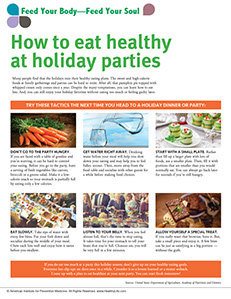
  • How To Eat Healthy At Holiday Parties

    HEALTHY EATING

    Image of holiday treat on small plate.

    Many people find that the holidays ruin their healthy eating plans. The sweet and high-calorie foods at family gatherings and parties can be hard to resist. After all, that pumpkin pie topped with whipped cream only comes once a year. Despite the many temptations, you can learn how to eat less. And, you can still enjoy your holiday favorites without eating too much or feeling guilty later.

    Try these tactics the next time you head to a holiday dinner or party:

    Don’t go to the party hungry.If you are faced with a table of goodies and you’re starving, it can be hard to control your eating. Before you go to the party, have a serving of fresh vegetables like carrots, broccoli or a greens salad. Make it a low-calorie snack so your stomach is partially full by eating only a few calories.

    Get water right away.Drinking water before your meal will help you slow down your eating and may help you to feel fuller, sooner. Then, move away from the food table and socialize with other guests for a while before making food choices.

    Start with a small plate.Rather than fill up a larger plate with lots of foods, use a smaller plate. Then, fill it with portions that are smaller than you would normally eat. You can always go back later for seconds if you’re still hungry.

    Eat slowly.Take sips of water with every few bites. Put your fork down and socialize during the middle of your meal. Chew each bite well and enjoy how it tastes before you swallow.

    Listen to your belly.When you feel almost full, that’s the time to stop eating. It takes time for your stomach to tell your brain that you’re full. Chances are, you will be very full in a few minutes.

    Allow yourself a special treat. If you really want that brownie, have it. But, take a small piece and enjoy it. A few bites can be just as satisfying as a big portion – without the guilt.

    If you do eat too much at a party this holiday season, don’t give up on your healthy eating goals. Everyone has slip-ups on diets once in a while. Consider it as a lesson learned or a minor setback. Come up with a plan to eat healthier at your next party. You can start fresh tomorrow!

    Sources: United States Department of Agriculture, Academy of Nutrition and Dietetics

    © American Institute for Preventive Medicine

  • How To Keep “Airport Anxiety” From Flying Out Of Control

    WELL-BEING

    Image of mom with 3 children at the airport.

    Traveling Americans are finding stricter airport screening, long waits, security checks, random searches-and you’re not even off the ground yet. Prepare yourself mentally and physically for the added stress. The Pennsylvania Medical Society offers these tips for avoiding airport anxiety:

    Know what to expect.Get information about airport rules from your travel agent, the airline, or online travel sites.

    Don’t prime the anxiety pump.Why work yourself into a frazzle before you even reach the airport? Give yourself plenty of time to get there. Allow for normal delays, like traffic jams and road closings, and for new ones such as restricted airport access.

    Come equipped to wait it out.Bring a folding canvas seat or arrange with the airport for a wheelchair. Pack snacks in your carryon. Also carry your prescription medications with you along with any special dietary snacks you might need.

    Kid-proof your planning.Check what your kids put in their bags if they packed them so the Scout knife or water gun doesn’t cause a scare at the security gate. Make sure you bring extra batteries for the games and CD players.

    Get physical.Instead of sitting at the gate the whole time, get up and walk around. Keep the blood flowing, and you’ll feel more relaxed and less confined.

    Learn and practice relaxation techniques.If you can’t cope with anxiety, ask your doctor about prescribing a medication instead of using alcohol to relieve your fears. Try the drug at home first to prepare for reactions such as grogginess or impaired coordination. Same with drugs for airsickness.

    © American Institute for Preventive Medicine

  • How To Make Fewer Mistakes At Work

    WORK LIFE

    Image of clock with person sleeping.

    Do you want to be your best at your job and avoid mistakes? There’s a healthy and simple way to do this: GET ENOUGH SLEEP.

    The National Sleep Foundation (NSF) says almost half of Americans said poor quality sleep affected their lives in the past seven days. And, many people report getting poor sleep on a regular basis.

    This poor sleep adds up to poor job performance, says the NSF. In one poll, up to a third of people admitted to falling asleep or feeling very sleepy at work in the last month. This can lead to minor errors, such as a typo in a letter to major mistakes that affect your career.

    When your body isn’t rested, it affects your brain and thinking in ways that could hurt your job performance and even hurt others. One study showed that when on-call resident doctors work overnight, they report 300 percent more medical errors that led to death than those who worked a 16-hour shift.

    Experts at the NSF say you should get at least seven to eight hours of sleep a night. Try to go to bed and get up at the same time each day, and create a relaxing bedroom environment for sleep. If you have chronic sleep problems, see your doctor for help.

    © American Institute for Preventive Medicine

  • How To Make The Grade This School Year

    FAMILY LIFE

    Image of a group of school children.

    Start talking about the upcoming school year. Listen closely for fears or concerns, advises Dr. Amie Duncan of Cincinnati Children’s Hospital. “It is important that parents listen to and respond to their child’s potential anxieties about the new school year, especially if they are making a big transition such as from an elementary school to a middle school. It is perfectly normal to experience first day jitters,” she said. These feelings can be relieved with some of these suggestions.

    Preschoolers and kindergartners need to know what will happen.

    *  Visit the school together. Let them play on the playground, walk through the classroom, and meet new teachers.

    *  Go on a school shopping trip for a backpack and supplies. Assign a school prep area at home for supplies and lunchboxes.

    *  Tuck a small family picture in a backpack or lunch.

    *  Set bedtime and wake-up routines 4 weeks before school starts.

    *  Be positive and excited for the new school year.

    Elementary and middle-school children will need to adjust to new beginnings.

    *  Expect that your child may want trendy or “cool” school supplies.

    *  Take a quick trip to school before classes start to help find classrooms, lockers, the cafeteria, and the bus drop-off location.

    *  Right from the start, help your child get and stay organized. Choose places to store their backpack and a distraction-free area to complete homework.

    *  Talk to your child about high-risk behaviors, such as drinking, drug use, and sexual activity. Have this talk early and often.

    *  Encourage your child to choose to take part in at least one school club, sport, or other activity outside of school hours.

    *  Don’t hesitate to make an appointment with the school counselor right away if you have concerns about how your child is adjusting to school. Keep the lines of communication open.

    High schoolers need and thrive on positive reinforcement.

    *  Help your teen set realistic goals on how to earn the best grades and complete assignments.

    *  Stay organized. Buy a daily planner and teach your teen how to use it correctly or teach them how to organize their schedule with a tablet computer or laptop.

    *  Encourage your teen to get involved in at least one extracurricular activity or sport because it will help them meet people.

    *  Continue to support and encourage good study habits with regular homework/study times. Search for ways to offer positive support.

    *  Ask about what’s going on in your child’s life. (Use open-ended questions, rather than those that require only a “yes” or “no” response). Be an active listener without judging your child.

    *  Stay involved in your child’s school life and you will know what is going on, and how they are doing.

    © American Institute for Preventive Medicine