Author: AIPM

  • I Resolve …

    WELL-BEING

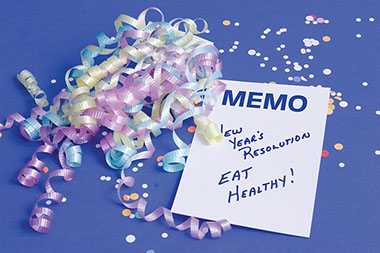
    Image of a memo with the note saying 'New year's resolution eat healthy!'

    Have your New Year’s resolutions to maintain a healthy weight started out strong? Only to fizzle about now?

    Get back on track with these points from the University of Houston Texas Obesity Research Center:

    *Document the evidence.Write down what and how much you eat of everything. Writing things down helps you to stay in control and remember what you are eating and doing every day.

    *Keep on moving.Get at least 30 minutes of physical activity every day. Daily physical activity significantly improves your body functioning, on a cellular level, and your body is better able to lose and avoid gaining weight.

    *Preempt the tempt.Avoid situations where you are going to be hungry and at risk for making high-calorie choices. Eat a small snack every 3 hours. The snack should include some protein such as a small piece of reduced calorie cheese or a small handful of nuts.

    *Tell a friend.Enlist the help and support of your friends and family. They may serve as a kind ear when you need to vent, or may have similar physical activity and eating goals as you.

    *Busy hands.Keep your hands and mind busy. The key is to keep busy and not spend too much time thinking about eating. Try knitting, wood crafts or card games.

    *Plan ahead.Anticipate and make a plan for what you will do in high-risk situations. Decide whether you are going to decline the chocolate pecan torte, have a bite or have a piece. If you decide to have a piece, plan in advance to eat a little less of something else.

    *Talk yourself into it.You have talked yourself into plenty of things before, why should this be any different? Tell yourself you can do it. Every day, think to yourself, “I am doing great,” “I can stick to my plan,” “I am maintaining a healthy weight,” and “I can stay on track.”

    *Practice relaxing.Stress is a prime cause of overeating. Prioritize time to reflect and relax every day.

    *Keep it real.Don’t expect dramatic weight loss immediately-not a realistic goal. Stay on track, keep focused and make small sustainable steps toward your goal.

    *Don’t despair.If you have fallen off the wagon, forgive yourself. And get back on again.

    © American Institute for Preventive Medicine

  • If At First You Don’t Succeed, Try, Try Again

    SELF-CARE CORNER

    Image of young women crushing a cigarette in her hand.

    According to the U.S. Surgeon General, more than 51 million Americans have had success at quitting smoking. Many smokers did not quit on their first try and needed several attempts to have success to quit for good. If you smoke, keep trying to quit.

    “Quitting smoking is one of the single most effective things someone can do to improve their health,” said Harold P. Wimmer, National President and CEO of the American Lung Association.

    It may not be easy to, but the benefits are well worth it:

    *  Within 20 minutes, your heart rate and blood pressure drop.

    *  Within 12 hours, the carbon monoxide level in your blood stream drops to normal.

    *  Within 3 days, the nicotine leaves your body.

    *  Within 3 months, your circulation and lung function improves.

    *  After 9 months, you will cough less and breathe easier.

    *  After 1 year, your risk of coronary heart disease is cut in half.

    *  After 5 years, your risk of cancer of the mouth, throat, esophagus, and bladder are cut in half.

    *  After 10 years, you are one-half as likely to die from lung cancer, and your risk of larynx or pancreatic cancer decreases.

    *  After 15 years, your coronary heart disease risk is the same as a non-smoker’s.

    Get help to quit smoking

    *  Talk to your doctor. He or she can recommend counseling or coaching plus over-the-counter nicotine patches, gum, or lozenges or FDA-approved medications. If you are a Veteran, talk to your health care team about VA tobacco cessation programs and services that are available to you.

    *  Call 1-800-QUIT-NOW (1-800-784-8669). This is the national number to access state-based quitline services.

    *  Smokefree.gov atwww.smokefree.govor text QUIT to 47848, answer a few questions, and you’ll start receiving messages

    *www.cdc.gov/tips

    *  Smokefree Apps: quitSTART and QuitGuide. Download these from your Smartphone’s  App Store or Google Play.

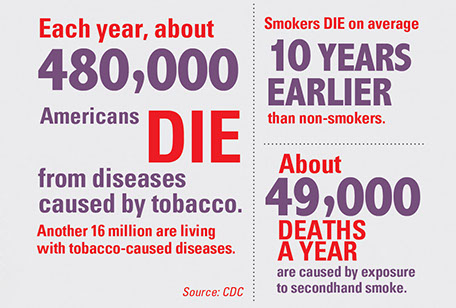
    Chart with tobacco facts from the CDC.

    © American Institute for Preventive Medicine
  • If At First You Don’t Succeed

    WELL-BEING

    Image of man crushing a cigarette.

    Anyone who has tried to quit smoking knows it doesn’t always happen on the first try. But what many smokers don’t realize is that they are not alone in their failed quit attempts. A quit attempt is defined as not smoking for at least one day with the intent of not starting again.

    A survey from the American Lung Association (ALA) found that 6 out of 10 former smokers were not able to successfully quit on their first try and required many attempts to quit smoking for good.

    “The American Lung Association wants every smoker to know that they are not alone in their unsuccessful quit attempts, and that with each quit attempt they become one step closer to becoming smoke-free,” said ALA National President and CEO, Harold P. Wimmer.

    The ALA’s Quitter in You campaign (www.QuitterInYou.org) acknowledges that multiple quit attempts are normal and are necessary steps along the way to quitting for good.

    © American Institute for Preventive Medicine

  • If You Have A Cold, Should You Exercise?

    BE FIT

    Image of women sick in bed.

    Yes and no. Moderate exercise (30 minutes a day, on most, if not all, days of the week) actually lowers your risk for respiratory infections, said David C. Nieman from the American College of Sports Medicine. But prolonged, intense exercise, on the other hand, can weaken your immune system and allow viruses to gain a foothold and spread. If you’re already sick with a respiratory infection (common cold or flu), approach exercise cautiously during your illness. To help you decide whether to hit the gym or stay in bed, Dr. Nieman says this:

    DOexercise moderately if your cold symptoms are confined to your head. If you’re dealing with a runny nose or sore throat, moderate exercise is okay. Intense exercise can be continued a few days after symptoms go away (in cases of the common cold).

    DON’tsweat out your illness. Exercise during an illness does NOT help cure it.

    DOstay in bed if your illness has spread beyond your head. Respiratory infections, fever, swollen glands, and extreme aches and pains all indicate that you should rest up, not work out.

    DON’tjump back in too soon. If you’re recovering from a more serious bout of cold or flu, gradually ease back into exercise after at least 2 weeks of rest.

    “In general, if your symptoms are from the neck up, go ahead and take a walk,” said Dr. Nieman. “But if you have a fever or general aches and pains, rest up and let your body get over the illness.”

    © American Institute for Preventive Medicine

  • If You Help Others, You’Ll Be Healthier

    WELL-BEING

    Image of a group of volunteers.

    The benefits of volunteering or helping other people seem to pay off for the giver and not necessarily the receiver.

    Providing tangible help to others protects your health and may lengthen your life, according to a 5-year study by researchers at 3 universities.

    The lead researcher Dr. Michael J. Poulin, assistant professor of psychology at the University of Buffalo, says, “Giving assistance to others may offer health benefits to the giver by buffering the negative effects of stress.” The study was published in the American Journal of Public Health.

    Here’s why giving works. The study subjects were people from Detroit. They told researchers they had experienced stressful events during the past year such as serious illness, burglary, job loss, financial troubles, or death of a family member. They also reported the amount of time they had spent in the past year helping friends, neighbors or relatives who did not live with them. They did errands, shopping and housework. They also provided transportation, child care and other tasks.

    The researchers concluded that helping others reduced the risk of illness and death by protecting the givers, even though they themselves had significant life stress. The social interaction was an important factor.

    © American Institute for Preventive Medicine

  • Immunize Your Child

    MEDICAL NEWS

    Image of child receiving a shot by a doctor.

    As summer comes to a close, it’s time to think about going back to school. One of the most important things you can do for your child’s health is to make sure he or she is up-to-date on vaccines, which can protect against many dangerous diseases.

    Vaccine requirements

    Many states require that kids have certain vaccines (shots or immunizations) before they can come to school. The best way to ensure your child is fully protected is to talk to your child’s doctor. You can also find information about vaccines on the Centers for Disease Control website atwww.cdc.gov/vaccines.

    Some diseases, such as mumps and polio, have become very rare thanks to vaccines. But outbreaks of some diseases are still happening, and immunization is the best way to protect your child from a serious illness. For instance, 2014 had a record number of measles cases and many outbreaks of whooping cough have been occurring in schools across the U.S.

    Start vaccines on time

    Babies, toddlers and preschoolers get a number of vaccines early in life to help protect them from 14 life-threatening illnesses. This includes measles, mumps, whooping cough and more, which used to be common – and very dangerous – for young children.

    But vaccines aren’t just for little ones. As children get older, they may need “boosters” to help protect them as the first vaccine begins to wear off. And, certain vaccines like the flu shot need to be given every year for protection.

    Vaccines protect everyone

    When disease outbreaks happen, a vaccinated person is much less likely to get sick. If they do get it, they usually get a much milder case.

    Getting all vaccines on time means you are protecting your own child and others around them. This is known as “herd immunity.” When 90 to 95 percent of people in a community are vaccinated, it’s almost impossible for these dangerous diseases to spread. But when vaccine rates go below 90 percent, diseases can take hold and spread. This weakens the immunity of an entire community.

    If you’re not sure if your child needs vaccines, call your child’s doctor today and beat the back-to-school rush. Catch-up vaccines can be given, if needed, even if your child missed some shots before.

    Concerned about vaccines?

    The U.S. supply of vaccines is extremely safe and effective. When reading something about vaccines, be sure the information comes from a credible source with data to prove the statements. Many false claims have been made about vaccines. Some of these false claims can be found on the Internet even after they’ve been proven wrong. If you have questions, ask your child’s doctor or visithttps://ivaccinate.org

    to get answers to many common concerns.

    © American Institute for Preventive Medicine

  • The Importance Of Portions: Size Matters

    HEALTHY EATING

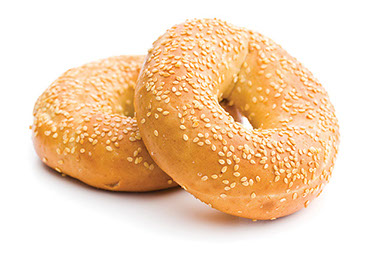
    Image of 2 bagels.

    If it seems like food portions are bigger today than they were years ago, it’s not your imagination. Health experts say that food sizes – and obesity rates – have grown in the last 20 years. Focusing on healthy foods is important. But portion sizes are also an important factor to think about when you eat. Whether it’s a cookie or a plate of spaghetti, how much you eat is just as important as what you eat. After all, the total calories you consume each day can mean the difference between gaining weight and losing it.

    Reality check: Portions are bigger today

    Take a look at these food comparisons, and find out what you need to do to burn off those extra calories.

    Bagel

    20 years ago: 140 calories, 3-inch diameter

    Today: 350 calories, 6-inch diameter

    Calorie difference: 210 calories

    You have to rake leaves for 50 minutes to burn the extra 210 calories. (Based on 130-pound person)

    Cheeseburger

    20 years ago: 330 calories

    Today: 590 calories

    Calorie difference: 260 calories

    You have to lift weights for 1.5 hours to burn the extra 260 calories. (Based on 130-pound person)

    Soda

    20 years ago: 85 calories, 6.5 ounces

    Today: 250 calories, 20 ounces

    Calorie difference: 165 calories

    You have to work in the garden for 35 minutes to burn 165 calories. (Based on 160-pound person)

    Source: National Heart, Lung, and Blood Institute Obesity Education Initiative

    © American Institute for Preventive Medicine

  • Important Health Screenings For Men

    WELL-BEING

    Image of male doctor.

    Even if you feel fine, you should see your doctor for regular health screenings. Many health conditions cause no symptoms in their earliest stages. Screenings can help you get earlier treatment and a better outcome. The National Institutes of Health recommends the following tests for men:

    Abdominal aortic aneurysm:

    Adults ages 65 to 75 who have smoked may need this screening once. Others should consult with their doctor.

    Blood pressure:

    Every one to two years, depending on your risk factors or health conditions.

    Cholesterol:

    Beginning at age 35, every five years if levels are normal. Men with high blood pressure, other risk factors for heart disease or certain health conditions may need to get screened sooner or more often.

    Colon cancer:

    Screening may begin at age 50, or earlier, if you have a family history of the disease, certain risk factors or certain health conditions.

    Diabetes:

    Every three years beginning at age 45. Earlier and/or more frequent testing may be advised if you have certain risk factors.

    Eyes:

    Every one to two years, or more often if you have glaucoma, have certain eye conditions or if your doctor recommends it.

    Hearing:

    Adults over age 65 may need a hearing test if signs of hearing loss are present.

    Lung cancer:

    Annual screening may be recommended for adults aged 55 to 80 years who have a 30 pack-year (smoke one pack per day for 30 years) smoking history AND currently smoke or have quit within the past 15 years.

    Osteoporosis:

    Discuss screening with your doctor if you are over age 50.

    Physical exam:

    Height, weight and Body Mass Index (BMI) should be measured at well visits.

    Prostate cancer:

    Discuss screening with your doctor. Men with certain risk factors may need screenings beginning at age 45.

    Sexually transmitted infections:

    Depending on age, lifestyle and medical history, you may need to discuss with your doctor about getting tested for chlamydia, syphilis, HIV and other infections.

    Men of all ages and health statuses need regular health screenings. Call your doctor to schedule your well visit!

    © American Institute for Preventive Medicine
  • Improve Your Mood With Exercise

    BE FIT

    Image of older women walking on bridge along a lake.

    You probably know that exercise has many health benefits. It can reduce your risk of heart disease, type 2 diabetes, and even cancer. But, did you know it can also help your mental health?

    Studies have shown that regular exercise such as walking can improve your mood, according to the American Psychological Association. And it doesn’t take long to feel the effects. Within just a few minutes of starting that walk, many people report more positive mental health. It has also been shown to improve mild to moderate depression.

    If that’s not enough, the APA also says exercise can help people who have anxiety. Regular exercise can help your body calm the “fight-or-flight” feelings that occur when someone gets anxious or overly stressed. And, it can help combat everyday stress by releasing chemicals called endorphins. These effects also help you sleep better, which can help you feel better mentally.

    With all the benefits of exercise, get moving!

    © American Institute for Preventive Medicine

  • Ipad Pain

    WELL-BEING

    Image of man using a tablet.

    When your iPad or other tablet causes pain in the neck and shoulders –

    *  Use a case that positions the device at a comfortable viewing angle.

    *  Routinely shift hands and weight. Stand up if seated, or sit down if standing.

    When using a laptop or desktop computer, follow the same tips for a tablet plus:

    *  Use an external keyboard.

    *  Keep shoulders relaxed and elbows close to the body.

    *  Keep hands, wrists, forearms, and thighs parallel to the floor.

    *  Take a break and change position every 15 minutes.

    Holding a tablet computer too low, say on the lap, forces the neck to bend forward too much, straining and possibly even injuring muscles, nerves, tendons, ligaments, or spinal discs. Simply placing a tablet on a table propped at an angle in a tablet case can reduce neck strain and potential pain, according to research conducted at the Harvard School of Public Health.

    © American Institute for Preventive Medicine