
Author: AIPM

  • Is Your Desk Dining Making You Sick?

    SELF-CARE CORNER

    Image of business man eating lunch at his desk.

    A whopping 83% of Americans typically eat in their office or cubicle in an effort to save time and money. But you’re “out to lunch” if you don’t practice safe food handling.

    According to a new survey by the American Dietetic Association* and ConAgra Foods’ Home Food Safety program, many working Americans eat breakfast and lunch and snack throughout the day at their desks. Best defense:

    *  Wash your hands and clean the desktop. Only half of all Americans say they always wash their hands before eating lunch. In order to reduce the risk of foodborne illness, wash your hands with soap and warm water before and after handling food and keep your desk stocked with moist towelettes or a hand sanitizer for those times you can’t get to the sink. A University of Arizona study found that the average desktop has 100 times more bacteria than a kitchen table and 400 times more than the average toilet seat.

    *  Clean the office fridge. Even though virtually all workplaces now have a refrigerator, is it ever cleaned? Take turns and have a sign-up sheet. And stick a refrigerator thermometer in it to ensure food is safely stored below 40ºF. (Don’t let perishable foods sit out for more than 2 hours.)

    *  And that office microwave? Leftovers and frozen meals are easy, quick, and inexpensive lunch options. But make sure you zap them long enough to kill harmful bacteria. Reheat leftovers to 165ºF.

    *The American Dietetic Association* is now known as the National Academy of Nutrition and Dietetics.

    © American Institute for Preventive Medicine
  • Is Your Heart Older Than You?

    MEDICAL NEWS

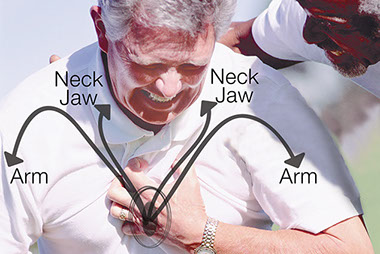
    Image of man suffering a heart attack.

    The year you were born reveals your age. It’s part of your identity. But despite the number on your driver’s license, your heart may be telling a different story.

    According to the Centers for Disease Control and Prevention, 75 percent of Americans have hearts that are older than their actual age. For men, the average heart age is 8 years older, and for women, it’s 5 years. This means many people are at high risk of heart attacks and strokes – even if they don’t know it.

    Your “heart age” is based on certain risk factors you may have for heart disease. This includes lifestyle habits, your body mass index, and certain health problems. You can lower your heart age by adopting heart-healthy habits such as a healthy diet, regular exercise, and not smoking.

    Signs of a heart attack

    *  Pressure, squeezing, or pain in the chest

    *  Pain in the jaw, neck, upper back, arms, or abdomen

    *  Trouble breathing

    *  Feeling dizzy or nauseated

    *  Cold sweats

    If you experience these symptoms, call 911 or have someone take you to the emergency room.

    Source: American Heart Association

    © American Institute for Preventive Medicine

  • Is Your Home Safe From Radon?

    MEDICAL NEWS

    Image of hand holding an illustration of a home.

    Indoor radon is the second leading cause of lung cancer in the U.S. Breathing it over long periods can present a significant health risk to families all over the country.

    Radon is an invisible radioactive gas that seeps into homes undetected through foundation cracks. It can reach harmful levels if trapped indoors. It travels up from underground sources of uranium in the earth’s crust.

    The radon threat is preventable with some simple steps. In existing homes, families can begin protecting themselves by buying an easy-to-use radon test kit to find out if a high level exists. If so, a high level might be lowered simply with a straight-forward radon venting system installed by a contractor.

    In new homes, builders can easily and economically include radon-resistant features during construction. Home buyers should ask for these. The EPA also recommends that home buyers ask their builder to test for radon gas before they move in.

    According to the EPA, 1 in every 15 homes nationwide has a high radon level. Test your home for radon every 2 years. Retest for it any time you move, make structural changes to your home, or occupy a previously unused level of a house.

    © American Institute for Preventive Medicine

  • Is Your Job A Pain In The Neck?

    WORK LIFE

    Image of business man holding his neck.

    No, really, if you sit all day in front of a computer at work, your computer workstation may be the cause of your nagging neck and shoulder pain. And not surprising, said Dr. Vincent Fortanasce, a rehab specialist and author of End Back & Neck Pain, “The setup of your computer workstation can play a large factor in your ability to stay symptom free.” He and his coauthors point out 3 common workstation mistakes people make that lead to pain.

    *  Overreaching injuries occur because items on your desktop such as your keyboard or mouse, phone, documents, and other desk items are not on the same level surface. So you reach to grab that stapler or strain to pick up files.The solution: rearrange the desktop, adjust your chair, put the keyboard and mouse on the same surface, put things you use the most closest to you.

    *  Use of incorrect heights refers to the up and down motions and placement of items. Incorrect height occurs as a result of the positioning of the chair, including the armrests, seat back, seat pan, desktop where work is placed, monitor, and the surface holding the keyboard and mouse. Incorrect height may also refer to furniture and features of the work area that are not adjustable.The solution: a proper chair is of critical importance. Can you adjust it? Do you have to reach above your head to get items in shelves above your desk? Is the top line of the text displayed on your monitor at eye level?

    * Unbalanced work area refers to twisting motion you do to reach items. If you’re right handed, and you use your right hand for all desktop activities such as answering the phone, you may have pain on your right side. Do you twist to see your monitor?The solution: Place your monitor right in front of you. Are items you use directly ahead of you?

    Back, neck, and arm pain are often the result of repeated actions, over and over, over time. Assess what’s causing your pain and adjust your workstation.

    © American Institute for Preventive Medicine

  • Is Your Relationship In Trouble?

    SUCCESS OVER STRESS

    Image of couple not getting along.

    Is your relationship stormy? Indifferent? One-sided? According to Pennsylvania psychologist, Dr. Michael S. Broder, these are the three types of troubled relationships. They account for the high divorce rate, as well as the much higher percentage of non-married relationships that end.

    Stormy Relationship:

    This type has plenty of passion, but it may not be the positive kind. Positive passion is a relationship at its best. Too much negative passion results in a great amount of anger and discomfort. At the extreme, these relationships can become abusive and even dangerous. A relationship with a lot of passion and little or no comfort can still be highly charged romantically and sexually. In some cases the most passionate sex actually occurs after the meanest and volatile arguments. The sad part is that the cause of the anger is never dealt with or resolved. Thus, the pattern can continue indefinitely.

    Indifferent Relationship:

    With this type, most-if not all-of the passion is missing. There can be a very comfortable living arrangement, but partners may have little feeling or sexual desire for each other. Sometimes partners simply grow apart without anger, or there can be as much anger as there is in the typical stormy relationship. The main difference is that there’s just not the tendency to argue or do battle with each other. This may be a result of the partners’ personality styles, or the absence of passion-including negative passion. Instead, the relationship merely begins to die a slow and quiet death. In other words, it may be brain alive but heart dead.

    One-Sided Relationships:

    In this type, one person usually puts out much more effort and energy to maintain and nurture the relationship than does the other. One partner can be quite content, having all the passion and comfort he or she needs. Yet the other partner feels somewhat to totally unfulfilled.

    In all types of troubled relationships it is important to ask: “What is the potential for change?” If the answer is none, the next question to ask yourself is, “Is this where I still want to be?”

    Adapted from Can Your Relationship Be Saved? How to Know Whether to Stay or Go by Dr. Michael S. Broder.

    © American Institute for Preventive Medicine

  • Is Your Teen Depressed? How To Tell

    FAMILY LIFE

    Image of teenage boy with counselor.

    Teenagers go through a lot of hormonal and social changes that can cause high stress levels and “the blues.” But, sometimes it’s more than that. Some teens actually have depression, which is a real mental health disorder that needs treatment.

    These are some signs of depression in teens:

    *  Being angry or irritable a lot

    *  Feeling sad all the time

    *  Unexplained headaches, stomach aches or other health problems

    *  Avoiding family and friends

    *  Not finding enjoyment in things they like

    *  Being tired all the time

    *  Sleeping a lot or sleeping very little

    *  Change in eating habits or appetite

    *  Drop in grades or missing school

    *  Using alcohol or drugs

    If you notice your teen is acting different, reach out to them. Try to find out if they need some help from a counselor or a doctor. Some teens have depression without any obvious symptoms.

    Always take any threats of suicide seriously. If your teen talks about hurting themselves or suicide, get them medical help right away. Or, call the National Suicide Prevention Lifetime at 1-800-273-8255.

    Risk factors for depression in teens

    These factors may increase the risk of depression:

    *  A family history of depression or anxiety

    *  Stressful life events like a death in the family, a breakup or a move to a new place

    *  Low self-esteem or being very critical  of themselves

    *  Having a learning disability or a  chronic illness

    Try to talk with your teen often. Ask how they are feeling and how things are going at school or work. If you’re concerned, talk to them about seeing a doctor to get screened for depression.

    © American Institute for Preventive Medicine

  • It’s All Your Fault

    SUCCESS OVER STRESS

    Image of business man covering his face as fingers are pointed at him.

    Do you feel as if you’re the target of blame, whether it’s an unreasonable dispute among family members or neighbors or a situation at work with coworkers, bosses, or employees.

    Bill Eddy, an attorney, mediator, and therapist, and president of the High Conflict Institute in San Diego, says blaming others is increasing in societies and there is a pattern in this blaming behavior. This is driven by people with certain personalities (1 of every 7 people can make your  life miserable).

    “If you haven’t been someone’s ‘target of blame,’ you will soon be,” he said. “Though it is a growing problem, it is also a predictable one, and a problem that can be managed in most cases with more understanding-and doing the opposite of what you feel like doing.”

    In his book It’s All Your Fault: 12 Tips for Managing People Who Blame Others for Everything, Eddy’s first tip is not to take personal attacks personally. Instead, he recommends this:

    *  Recognize the signs of taking it personally. Examples are feeling you have to defend yourself, feeling emotionally hooked with fear or anger, thinking the other person is knowingly getting away with something or taking advantage of you.

    *  Remind yourself that it’s unconscious. The high conflict person is not knowingly getting away with anything. His or her actions are driven by unconscious personality patterns.

    *  There’s always a target of blame. If not you, then someone else. It’s not about you.

    *  Maintain your own mental and physical health. You’re less likely to be triggered if you’re feeling good about yourself.

    *  Get support and consultation. Trusted friends or a therapist can see what you can’t see and may suggest positive responses you might not be able to think of when you are under stress.

    *  Don’t engage in a personal battle. If you already are, disengage now.

    © American Institute for Preventive Medicine

  • It’s Just A Cold (But When To See A Doctor)

    SELF-CARE CORNER

    Image of a child having her temperature checked.

    See a doctor if you aren’t getting any better or if your symptoms worsen, say medical experts from the FDA. With children, be alert for high fevers and for abnormal behavior such as unusual drowsiness, refusal to eat, crying a lot, holding the ears or stomach, and wheezing.

    Signs of trouble for all people can include:

    *  A cough that disrupts sleep

    *  A fever that won’t go down

    *  Increased shortness of breath

    *  Face pain caused by a sinus infection

    *  Worsening of symptoms, high fever, chest pain, or a difference in the mucus you’re producing, all after feeling better for a short time

    Cold and flu complications may include bacterial infections (such as bronchitis, sinusitis, ear infections, and pneumonia) that could require antibiotics.

    Remember: While antibiotics are used against bacterial infections, they don’t help against viral infections such as the cold or flu.

    © American Institute for Preventive Medicine

  • Just A Little Exercise Helps With Arthritis

    BE FIT

    Image of couple jogging.

    Regular exercise can help with the joint pain and stiffness of arthritis. But, many older adults with arthritis aren’t getting the recommended 150 minutes per week of exercise. Exercise can be painful for those who aren’t used to being active. But over time, not exercising can cause even more pain and stiffness, creating a vicious cycle.

    A recent study shows that even a little exercise can help. Older adults who exercised for just 45 minutes per week saw benefits over those who didn’t exercise at all. Overall, they had better physical ability than the non-exercisers. If you’re not sure how to get started, ask your doctor.

    Though 150 minutes per week is still ideal, some exercise is better than none. Get moving – even just a little – to start feeling better.

    © American Institute for Preventive Medicine

  • Just Baby & You

    FAMILY LIFE

    Image of mother and baby.

    Get outside and walk with your baby. But exercise caution and good judgment, advises the American Chiropractic Association.

    *  A backpack-style or front-side carrier decreases a parent’s stability when walking or hiking. It is critical that a parent get into shape before attempting to use one of these products.

    *  If using a backpack-style or front-side baby carrier, make sure to select one with wide straps for your shoulders and waist. This will help distribute the carrier’s weight evenly. The shoulder straps should fit comfortably over the center of your collarbone.

    *  Don’t forget about your own health and comfort. Bring yourself as close to the baby as possible before lifting. You don’t want to lift with your arms outstretched. Bend from the knees and hips and keep your back straight. Use a two-stage lift that consists of pulling the child up to your chest and then lifting straight up with your leg muscles.

    *  Once you place the child in the carrier, check to make sure there is no bunching of material against the child’s body, particularly on the back, buttocks, and spine. Isolated, uneven pressure like this can produce pain.

    If you wish to use a baby sling, keep in mind that it is intended only for infants, and be sure to follow these tips:

    *  A baby can become very hot inside the sling, so be mindful of the temperature around you. Also, make certain the baby’s breathing is clear and unobstructed by the sling’s material.

    *  Switch sides when wearing the sling to balance the positional stress on you and your baby.

    *  Never run or jog while carrying a baby in any backpack-style carrier, front-side carrier, or baby sling. A baby’s body is not adjusted to the cyclic pattern that is a part of running and jogging. This motion can do damage to the baby’s neck, spine, and brain. It is better to use a jogging stroller.

    © American Institute for Preventive Medicine