Author: AIPM

  • Dealing With Difficult Personalities

    WORK LIFE

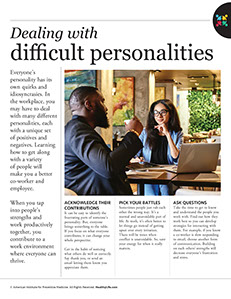
    Two coworkers sitting with laptop, talking and drinking coffee.

    Everyone’s personality has its own quirks and idiosyncrasies. In the workplace, you may have to deal with many different personalities, each with a unique set of positives and negatives. Learning how to get along with a variety of people will make you a better co-worker and employee.

    When you tap into people’s strengths and work productively together, you contribute to a work environment where everyone can thrive.

    Acknowledge their contributions

    It can be easy to identify the frustrating parts of someone’s personality. But, everyone brings something to the table. If you focus on what everyone contributes, it can change your whole perspective.

    Get in the habit of noticing what others do well or correctly. Say thank you, or send an email letting them know you appreciate them.

    Pick your battles

    Sometimes people just rub each other the wrong way. It’s a normal and unavoidable part of life. At work, it’s often better to let things go instead of getting upset over every irritation. There will be times when conflict is unavoidable. So, save your energy for when it really matters.

    Ask questions

    Take the time to get to know and understand the people you work with. Find out how they work best so you can develop strategies for interacting with them. For example, if you know a co-worker is slow responding to email, choose another form of communication. Building on each others’ strengths will decrease everyone’s frustration and stress.
    © American Institute for Preventive Medicine

  • Debt-To-Income Ratio: Faqs

    FINANCIAL HEALTH

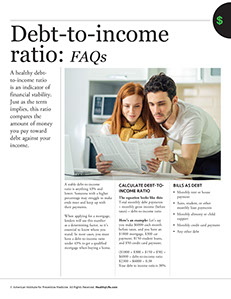
    Young couple looking over bills together.

    A healthy debt-to-income ratio is an indicator of financial stability. Just as the term implies, this ratio compares the amount of money you pay toward debt against your income.

    A stable debt-to-income ratio is anything 43% and lower. Someone with a higher percentage may struggle to make ends meet and keep up with their payments.

    When applying for a mortgage, lenders will use this number as a determining factor, so it’s essential to know where you stand. In most cases, you must have a debt-to-income ratio under 43% to get a qualified mortgage when buying a home.

    Calculate debt-to-income ratio

    The equation looks like this: Total monthly debt payments ÷ monthly gross income (before taxes) = debt-to-income ratio

    Here’s an example: Let’s say you make $6000 each month before taxes, and you have an $1800 mortgage, $300 car payment, $150 student loans, and $50 credit card payment.

    ($1800 + $300 + $150 + $50) ÷ $6000 = debt-to-income ratio

    $2300 ÷ $6000 = 0.38

    Your debt to income ratio is 38%.

    Bills as debt

    *  Monthly rent or house payment

    *  Auto, student, or other monthly loan payments

    *  Monthly alimony or child support

    *  Monthly credit card payment

    *  Any other debt

    © American Institute for Preventive Medicine
  • Different Shoes For Different Sports

    BE FIT

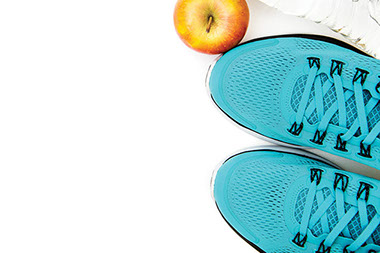
    Pair of shoes with apple and water bottle.

    If you play sports, shoes are important. Wearing the wrong shoes can sideline you with foot injuries and pain. Follow these guidelines to keep feet happy.

    Basketball, tennis and volleyball shoes should have:

    *  A thick, stiff sole that absorbs impact

    *  High ankle construction for quick changes in direction

    *  Lighter weight with a sole designed for quick starts and stops

    Soccer shoes should have:

    *  A good quality footbed to support your arch type

    *  The correct stud type for the ground you play on: soft, hard, firm or turf

    *  Molded rubber cleats

    Football and lacrosse shoes should have:

    *  High ankle support, especially for linemen and players who move side to side

    *  Good traction on a grassy field in wet and dry conditions

    *  Proper fit – don’t use hand-me-downs

    Baseball and softball shoes should have:

    *  Support to prevent arch pain

    *  No metal baseball spikes for athletes younger than 13

    *  Multi-cleats for children ages 11-15

    Running shoes should have:

    *  Good shock absorption for high-impact forward motion (not side motion)

    *  The right arch type for you (high, medium, low)

    Source: American Podiatric Medical Association

    © American Institute for Preventive Medicine
  • Do You Live With A Sleepwalker?

    SELF-CARE CORNER

    Young women sleepwalking.

    If you or a family member sleepwalks, you may know the signs well. It often involves doing some of the following during sleep:

    *  Sitting up

    *  Walking around

    *  Talking

    *  Getting food or eating

    When a person is sleepwalking, it can be confusing or even frightening for others in the house. They look like they’re awake. They may say or do things that don’t make sense. But the person won’t remember saying or doing anything when they wake up.

    Sleepwalking happens during deep sleep. This is often early in the night. It can happen to children and adults.

    Is it dangerous?

    Many people feel alarmed when a family member starts sleepwalking. Sleepwalking itself isn’t usually dangerous. The best thing to do is to make sure the sleepwalker can’t get hurt. Here’s how to do it:

    *  Keep the home – and especially their room – picked up. Make sure things like electrical cords are out of the way. Have children pick up their toys, books or other objects.

    *  Keep exterior doors locked. If you can, use extra locks that are difficult to open, such as a chain lock or a dead bolt.

    *  Close and lock all windows at night.

    *  Never yell at or shake someone who is sleepwalking. Instead, guide them safely back to their bed.

    *  Consider putting a gate across stairways. Use gates that are designed for this purpose.

    How to avoid it

    Some people may be more prone to sleepwalking. However, there are ways to lower the chances of it happening. They include:

    *  Don’t drink alcohol.

    *  If you are taking anti-depressant medicine, talk to your doctor about it. Some of these medicines can cause sleep problems. There may be a different medicine that works for you.

    *  Go to bed at the same time every night.

    *  Make sleep a priority. Adults should get at least seven hours. Children often need much more than this. Ask a doctor how much sleep you or your child should get.

    Seeing a doctor

    If sleepwalking happens a lot, talk to a doctor. There is no test for sleepwalking. But your doctor can check for other sleep problems or health conditions that may be causing sleep problems.

    Source: American Academy of Family Physicians

    © American Institute for Preventive Medicine
  • Don’t Get Scammed

    FINANCIAL HEALTH

    Money locked in chains.

    Banks, government and companies will not ask you to pay a bill on the phone. Don’t send money or give out personal information over the phone or by text.

    Scammers can put up fake caller ID information. It may look like it’s from someone you know when it’s not. Don’t believe caller ID.

    These methods of payment don’t provide fraud protection. Real companies won’t ask you to do this. Know the risks of wiring money and gift cards.

    © American Institute for Preventive Medicine

  • Easy Food Swaps For A Healthy Heart

    HEALTHY EATING

    Image of a healthy vegetable wrap.

    Eating better for your heart doesn’t have to be complicated. In fact, making some small substitutions in your diet each day can add up to better health. It doesn’t require a big investment of time or money to make these changes:

    Instead of: Crackers or chips

    Try: Unsalted nuts and seeds

    Crackers and chips are processed foods with few vitamins and minerals. They’re often loaded with salt, sugar or excess fat.

    Nuts and seeds, on the other hand, contain heart healthy unsaturated fats that can improve blood cholesterol levels. They also contain fiber, which can help lower cholesterol and fight constipation. They’re convenient to take on the go and offer a satisfying crunch.

    Instead of:  White dinner rolls or pasta

    Try: Whole grain breads and pasta

    White “refined” breads and pastas have much of the natural nutrients stripped out during processing. They usually have little to no fiber. This means they don’t help you feel full and they can cause a drop in blood sugar a short time after they are eaten.

    Instead of white pasta and bread, try a whole grain option. Whole wheat pasta, quinoa and brown rice contain fiber, nutrients and even protein that’s great for your heart. Eating whole grains instead of refined grains may lower the risk of heart attack, stroke and obesity.

    Instead of: Cheesy pasta or sandwiches

    Try: Avocado sliced or spread

    Cheese can be eaten in moderation as part of a healthy diet. But many processed cheeses contain saturated fat, salt and artificial ingredients.

    Instead of processed cheese, try creamy avocado. Diced avocado pairs well with cherry tomatoes and herbs as a pasta topping. Try ripe avocado on a sandwich in place of sliced cheese. Avocado contains monounsaturated fats, which are heart health superstars. It also has antioxidants to help fight heart disease.

    Instead of:  Lunch meat sandwiches

    Try: Hummus and vegetable wraps

    Most deli meats contain a large amount of salt. A diet high in salt can lead to high blood pressure, which increases the risk of heart disease and stroke. They may also contain saturated fat, which may raise the risk of heart problems.

    Skip the meat and try a plant-based sandwich that still offers protein without the extra salt and unhealthy fat. Almond butter and peanut butter taste great on whole grain bread. Hummus offers protein and fiber, and pairs well with vegetables on whole grain wrap bread.

    Source: American Heart Association

    © American Institute for Preventive Medicine
  • Eat Your Vitamins For Good Health

    HEALTHY EATING

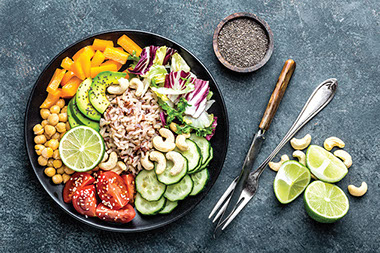
    Bowl of vegetables with rice and chickpeas.

    Vitamins play a powerful role in supporting the immune system. These three vitamins are some of the best for immune system support:

    *  Vitamin D: Eat foods like fortified milk, cereal and fatty fish, like salmon. Spend 15 minutes a day in the sun to get a good dose of vitamin D. Or take a daily 1,000-4,000 IU supplement.

    *  Vitamin C: Eat citrus fruits, tomatoes, potatoes, strawberries, peppers, broccoli, Brussels sprouts and kiwifruit.

    *  Zinc: Eat red meat, poultry, fortified cereal, whole grains, beans and nuts.

    Dietary supplements can also be a good option, but be sure you talk to your doctor first. Dietary supplements can cause undesirable side effects, especially if taken with other medications or if taken in large doses.

    © American Institute for Preventive Medicine

  • Enjoy Thanksgiving Without Weight Gain

    HEALTHY EATING

    Family and friends sitting around the table having dinner.

    Most of us think of Thanksgiving as a huge meal where we enjoy our favorite foods. But you don’t have to feel guilty afterward. You can truly enjoy your holiday meal and hang on to your healthy habits.

    Don’t “save your appetite”

    Many people think that they should skip breakfast and lunch so they can be extra hungry for Thanksgiving dinner. This usually leads to extreme hunger and  overeating. In fact, you’ll probably eat much more than you would have done if you had eaten lunch!

    Instead of skipping meals, focus on eating very healthy meals early in the day to avoid feeling too hungry. This helps you make smart choices and control portion sizes when you show up for dinner.

    Enjoy every bite

    Start with smaller portions, and eat slowly while smelling and tasting each bite. We often overeat when we gobble food down quickly. We don’t truly enjoy it and experience how delicious it is. You can get just as much satisfaction and enjoyment from eating smaller portions.

    Small, slow and steady is key

    The appearance of food makes a difference in how much we eat. If you use a big plate, you may be more tempted to fill it up and eat more. It helps to start with a smaller plate.

    Put down your fork and wait a few minutes before getting second helpings. Give your stomach time to tell your brain that it’s full. You may find that you don’t need more food after all.

    Focus on colorful fruits and vegetables

    The fall harvest can be a great way to enjoy the season. Make your dish “to pass” a healthy plate of winter squash or baked apples (without added sugar). Or try roasted broccoli or cauliflower.

    If you’re hosting the meal, make sure you have lots of vegetables and fruits on the menu. For example, appetizers can be cut-up veggies, rather than chips.

    Don’t put healthy habits on “hold”

    The holidays are busy, but a 15-minute walk will help lower stress levels and burn a few calories. Keep exercise and healthy habits in mind, even if you decide to indulge in a few treats.

    Remember that one holiday slip-up doesn’t mean you have to give up your healthy eating or exercise plan! Get back on track tomorrow.

    Sources: Academy of Nutrition and Dietetics, American Heart Association

    © American Institute for Preventive Medicine

  • Ergonomics For The Home Office

    WORK LIFE

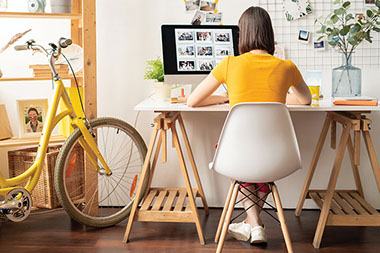
    Women sitting at desk working on computer.

    If you are working from home, either full or part-time, you should ensure your home office is set up ergonomically. A set-up that is not designed for efficiency and comfort can lead to wasted time and poor posture.

    Do a quick assessment of your work space and see if it meets ergonomic standards.

    Things to check when seated at your desk:

    *  Are your head and neck balanced and in line with your spine?

    *  Can you sit upright in your chair with your lower back fully supported?

    *  Are your shoulders relaxed and forearms parallel to the floor?

    *  Are your wrists straight when using the mouse or keyboard?

    *  Is your monitor an arm’s length away and in direct line of sight?

    Home office considerations:

    *  Are you working in a comfortable location?

    *  Can you alternate between sitting and standing?

    *  Do you move regularly to stretch and change position?

    *  Are your most used items within easy reach?

    © American Institute for Preventive Medicine
  • Exercise To Lower Blood Sugar

    BE FIT

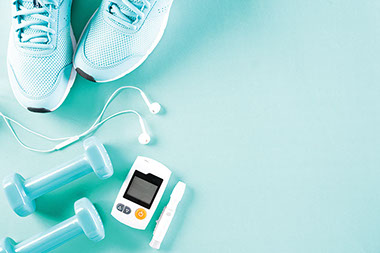
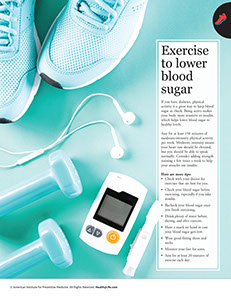
    Gym shoes, dumb bells, headphones, glucose meter.

    If you have diabetes, physical activity is a great way to keep blood sugar in check. Being active makes your body more sensitive to insulin, which helps lower blood sugar to healthy levels.

    Aim for at least 150 minutes of moderate-intensity physical activity per week. Moderate intensity means your heart rate should be elevated, but you should be able to speak normally. Consider adding strength training a few times a week to help your muscles use insulin.

    Here are more tips:

    *  Check with your doctor for exercises that are best for you.

    *  Check your blood sugar before exercising, especially if you take insulin.

    *  Recheck your blood sugar once you finish exercising.

    *  Drink plenty of water before, during, and after exercise.

    *  Have a snack on hand in case your blood sugar gets low.

    *  Wear good-fitting shoes and socks.

    *  Monitor your feet for sores.

    *  Aim for at least 20 minutes of exercise each day.

    © American Institute for Preventive Medicine