Author: AIPM

  • Positive Parenting Hacks

    FAMILY LIFE

    Parents with son, smile.

    Don’t focus on mistakes or bad behavior. Catch your child doing good things and point them out.

    Chores don’t have to be a punishment. Chores at home can help children learn life skills and independence.

    Spend a little time connecting each day. Take a few minutes to talk to your child without phones or screens.

    © American Institute for Preventive Medicine

  • Pros & Cons Of Beef

    HEALTHY EATING

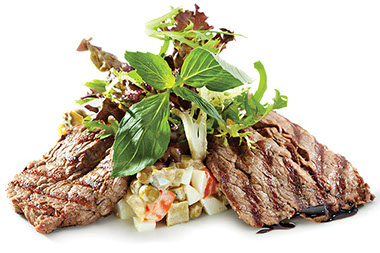
    Two pieces of beef with garnish.

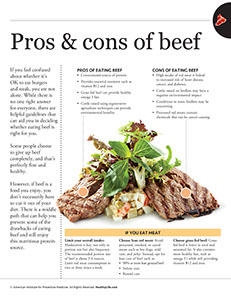
    If you feel confused about whether it’s OK to eat burgers and steak, you are not alone. While there is no one right answer for everyone, there are helpful guidelines that can aid you in deciding whether eating beef is right for you.

    Some people choose to give up beef completely, and that’s perfectly fine and healthy.

    However, if beef is a food you enjoy, you don’t necessarily have to cut it out of your diet. There is a middle path that can help you prevent some of the drawbacks of eating beef and still enjoy this nutritious protein source.

    Pros of eating beef

    *  Concentrated source of protein

    *  Provides essential nutrients such as vitamin B12 and iron

    *  Grass-fed beef can provide healthy omega 3 fats

    *  Cattle raised using regenerative agriculture techniques can provide environmental benefits

    Cons of eating beef

    *  High intake of red meat is linked to increased risk of heart disease, cancer, and diabetes.

    *  Cattle raised on feedlots may have a negative environmental impact

    *  Conditions in some feedlots may be concerning

    *  Processed red meats contain chemicals that can be cancer-causing

    If you eat meat

    Limit your overall intake: Moderation is key, not only in portion size but also frequency. The recommended portion size of beef is about 3-4 ounces. Limit red meat consumption to two or three times a week.

    Choose lean red meat: Avoid processed, smoked, or cured meats such as hot dogs, cold cuts, and jerky. Instead, opt for lean cuts of beef such as:

    *  90% or more lean ground beef

    *  Sirloin cuts

    *  Round cuts

    Choose grass-fed beef: Grass-fed beef is lower in total and saturated fat. It also contains more healthy fats, such as omega 3’s while still providing vitamin B12 and iron.

    Source: Centers for Disease Control and Prevention

    © American Institute for Preventive Medicine

  • Questions About Metabolism

    MEDICAL NEWS

    Women flexing arm while holding a fork in the other hand, with the word "Metabolism".

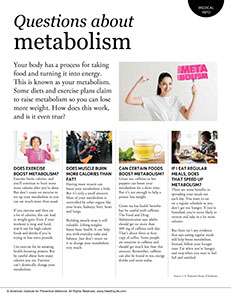
    Your body has a process for taking food and turning it into energy. This is known as your metabolism. Some diets and exercise plans claim to raise metabolism so you can lose more weight. How does this work, and is it even true?

    Does exercise boost metabolism?

    Exercise burns calories, and you’ll continue to burn some more calories after you’re done. But don’t count on exercise to rev up your metabolism so you can eat much more than usual.

    If you exercise and then eat a lot of calories, this can lead to weight gain. Even if your workout is long and hard, watch out for high-calorie foods and drinks if you’re trying to lose extra pounds.

    Use exercise for its amazing health-boosting powers. But be careful about how many calories you eat. Exercise can’t drastically change your metabolism.

    Does muscle burn more calories than fat?

    Having more muscle can boost your metabolism a little. But it’s only a small amount. Most of your metabolism is controlled by other organs like your brain, kidneys, liver, heart and lungs. Building muscle mass is still valuable. Lifting weights boost bone health. It can help you with everyday tasks and balance. Just don’t count on it to change your metabolism very much.

    Can certain foods boost metabolism?

    Green tea, caffeine or hot peppers can boost your metabolism for a short time. But it’s not enough to help a person lose weight.

    Green tea has health benefits but be careful with caffeine. The Food and Drug Administration says adults should get no more than 400 mg of caffeine each day. That’s about three or four cups of coffee. Some people are sensitive to caffeine and should get much less than this amount. Remember, caffeine can also be found in tea, energy drinks and some sodas.

    If I eat regular meals, does that speed up metabolism?

    There are some benefits to spreading your meals out each day. You want to eat on a regular schedule so you don’t get too hungry. If you’re famished, you’re more likely to overeat and take in a lot more calories.

    But there isn’t any evidence that says eating regular meals will help boost metabolism. Instead, follow your hunger cues. Eat when you’re hungry and stop when you start to feel full and satisfied.

    Source: U.S. National Library of Medicine

    © American Institute for Preventive Medicine

  • Recipe: 2-Step Chicken

    HEALTHY EATING

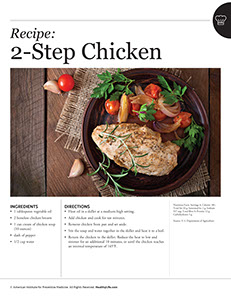
    Plate with cooked chicken breast with a side of cooked tomatos and onion.

    Ingredients

    *  1 tablespoon vegetable oil

    *  2 boneless chicken breasts

    *  1 can cream of chicken soup (10 ounces)

    *  dash of pepper

    *  1/2 cup water

    Directions

    *  Heat oil in a skillet at a medium-high setting.

    *  Add chicken and cook for ten minutes.

    *  Remove chicken from pan and set aside.

    *  Stir the soup and water together in the skillet and heat it to a boil.

    *  Return the chicken to the skillet. Reduce the heat to low and simmer for an additional 10 minutes, or until the chicken reaches an internal temperature of 165°F.

    Nutrition Facts: Servings 4; Calories 181; Total fat 10 g; Saturated fat 2 g; Sodium 537 mg; Total fiber 0; Protein 12 g; Carbohydrates 5 g.

    Source: U.S. Department of Agriculture

    © American Institute for Preventive Medicine

  • Recipe: Chicken Curry

    HEALTHY EATING

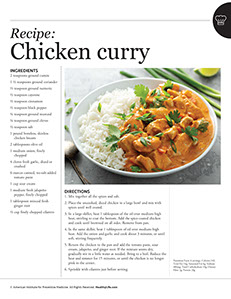
    A plate of chicken curry with rice.

    Ingredients

    2 teaspoons ground cumin

    1 ½ teaspoons ground coriander

    ½ teaspoon ground turmeric

    ½ teaspoon cayenne

    ½ teaspoon cinnamon

    ½ teaspoon black pepper

    ¼ teaspoon ground mustard

    ¼ teaspoon ground cloves

    ½ teaspoon salt

    1 pound boneless, skinless chicken breasts

    2 tablespoons olive oil

    1 medium onion, finely chopped

    4 cloves fresh garlic, diced or crushed

    6 ounces canned, no-salt-added tomato paste

    1 cup sour cream

    1 medium fresh jalapeño pepper, finely chopped

    1 tablespoon minced fresh ginger root

    ½ cup finely chopped cilantro

    Directions

    1.  Mix together all the spices and salt.

    2.  Place the uncooked, diced chicken in a large bowl and mix with spices until well coated.

    3.  In a large skillet, heat 1 tablespoon of the oil over medium-high heat, swirling to coat the bottom. Add the spice-coated chicken and cook until browned on all sides. Remove from pan.

    4.  In the same skillet, heat 1 tablespoon of oil over medium-high heat. Add the onion and garlic and cook about 3 minutes, or until soft, stirring frequently.

    5.  Return the chicken to the pan and add the tomato paste, sour cream, jalapeño, and ginger root. If the mixture seems dry, gradually stir in a little water as needed. Bring to a boil. Reduce the heat and simmer for 15 minutes, or until the chicken is no longer pink in the center.

    6.  Sprinkle with cilantro just before serving.

    Nutrition Facts: 6 servings, Calories 242; Total Fat 14g; Saturated Fat 6g; Sodium 486mg; Total Carbohydrate 10g; Dietary Fiber 2g; Protein 20g


    © American Institute for Preventive Medicine

  • Recipe: Salad With Pears

    HEALTHY EATING

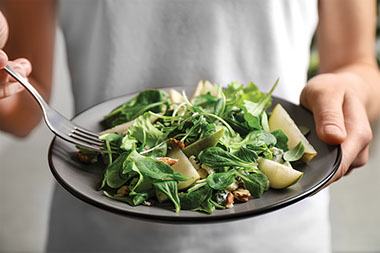
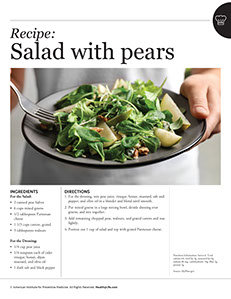
    Plate of salad with pears.

    Ingredients

    For the Salad:

    *  2 canned pear halves

    *  6 cups mixed greens

    *  1/2 tablespoon Parmesan cheese

    *  1-1/3 cups carrots, grated

    *  3 tablespoons walnuts

    For the Dressing:

    *  1/4 cup pear juice

    *  1/4 teaspoon each of cider vinegar, honey, dijon mustard, and olive oil

    *  1 dash salt and black pepper

    Directions

    1.  For the dressing, mix pear juice, vinegar, honey, mustard, salt and pepper, and olive oil in a blender and blend until smooth.

    2.  Put mixed greens in a large mixing bowl, drizzle dressing over greens, and mix together.

    3.  Add remaining chopped pear, walnuts, and grated carrots and toss lightly.

    4.  Portion out 1 cup of salad and top with grated Parmesan cheese.

    Nutrition Information: Serves 6: Total calories 64, total fat 3g, saturated fat 0g, sodium 86 mg, carbohydrates 10g, fiber 2g, protein 2g.

    Source: MyPlate.gov

    © American Institute for Preventive Medicine

  • Reevaluate Your Budget

    FINANCIAL HEALTH

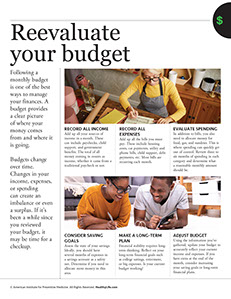
    Women working on a budget.

    Following a monthly budget is one of the best ways to manage your finances. A budget provides a clear picture of where your money comes from and where it is going.

    Budgets change over time. Changes in your income, expenses, or spending can create an imbalance or even a surplus. If it’s been a while since you reviewed your budget, it may be time for a checkup.

    Record all income

    Add up all your sources of income in a month. These can include paychecks, child support, and government benefits. The total of all money coming in counts as income, whether it came from a traditional paycheck or not.

    Record all expenses

    Add up all the bills you must pay. These include housing costs, car payments, utility and phone bills, child support, debt payments, etc. Most bills are recurring each month.

    Evaluate spending

    In addition to bills, you also need to allocate money for food, gas, and sundries. This is where spending can quickly get out of control. Review three to six months of spending in each category and determine what a reasonable monthly amount should be.

    Consider saving goals

    Assess the state of your savings. Ideally, you should have several months of expenses in a savings account as a safety net. Determine if you need to allocate more money in this area.

    Make a long-term plan

    Financial stability requires long-term thinking. Reflect on your long-term financial goals such as college savings, retirement, or big expenses. Is your current budget working?

    Adjust budget

    Using the information you’ve gathered, update your budget to accurately reflect your current income and expenses. If you have extra at the end of the month, consider increasing your saving goals or long-term financial plans.

    © American Institute for Preventive Medicine

  • Save On Prescriptions

    FINANCIAL HEALTH

    Pills and bottle on top of a money.

    Whether you have insurance or not, the cost of filling prescriptions can be high. Here are some ways to save big on the medicine you need.

    Go generic

    Ask your doctor if there is a cheaper generic option they can prescribe.

    Talk to your insurance

    Some insurance companies have options to make your medicine cheaper, such as direct buying programs.

    Get a 90-day supply

    Often it’s cheaper to get more at once than to refill a prescription multiple times.

    Apply for assistance

    Check with state and local governments to see if you qualify for financial assistance with prescriptions.

    Compare prices

    Call around to different pharmacies to find which one is the cheapest for your specific medicines.

    Ask for a higher dose

    Ask your doctor if they can prescribe a higher dose and let you cut the pills. Not all pills can be cut, but if it’s possible, it can save you money.

    © American Institute for Preventive Medicine