Author: AIPM

  • Tea Time: Is Tea Good For You?

    HEALTHY EATING

    A tea pot with two cups of tea and lemons.

    Many people drink tea every day. The most popular teas are black, green and oolong. Matcha tea is also becoming more popular.

    Black, green, oolong and matcha teas come from a plant known as Camellia sinensis. Each of these teas looks and tastes different because of how they are processed.

    Caffeine content

    Tea, like coffee, naturally contains caffeine and can be different in each cup. If you steep your tea longer, it will have more caffeine than a quick steep.

    Estimates of the caffeine content per 8-ounce cup:

    *  Coffee: 95 milligrams

    *  Black tea: 48 milligrams

    *  Oolong tea: 38 milligrams

    *  Green tea: 29 milligrams

    *  Decaffeinated tea: Very small amounts

    Some tea packages will tell you how much caffeine it contains. Look for this on the product label.

    Watch your caffeine intake

    You can still drink too much caffeine from tea if you’re not careful. Too much caffeine can make you feel nervous or shaky. It can also make it hard for you to sleep.

    Most healthy adults can tolerate up to 400 milligrams of caffeine each day. People who are more sensitive to caffeine may need to consume much less than this amount.

    Decaf teas are a good option if you love tea but want to cut back on caffeine. They still contain only small amounts of caffeine.

    Are herbal teas really “tea”?

    Herbal teas are not made from the tea plant Camellia sinensis. Instead, they are made from the roots, leaves, flowers and other parts of certain plants.

    For instance, chamomile tea is made from chamomile flowers. Peppermint and spearmint teas are made from the plant’s leaves.

    Herbal teas don’t contain any caffeine. They are usually safe in regular amounts. But ask a doctor before you consume herbal tea if you are taking medicine or have any health conditions. These teas can interfere with some medications or cause side effects in some people.

    © American Institute for Preventive Medicine

  • The Causes Of Coughing

    SELF-CARE CORNER

    Man holding his throat and head.

    It’s the season for colds and flu – and that means coughing. Coughing is an important function in your body. It helps clear your airways. Many times, a mild cough will go away on its own. But when should you see a doctor about a cough?

    Common cold

    A common cold may cause some coughing. When you have a runny nose, the fluids drain down your throat. This causes your cough reflex to kick in. It’s a way your body protects your lungs. Although a cough from a cold can be annoying, it usually goes away quickly. Antibiotics won’t help with a cough related to a cold.

    Bronchitis

    Bronchitis is an inflammation in the tiny tubes in the lungs. These tubes are called bronchioles. Viruses and bacteria can get into the bronchioles and make you sick. Chemicals and toxins like tobacco smoke can also invade the bronchioles and lead to bronchitis.

    Symptoms of bronchitis include:

    *  Coughing, especially with mucus

    *  Wheezing or feeling short of breath

    *  Low fever

    *  Chest pain

    Bronchitis is most often caused by a virus so antibiotics will not help. Rest, drinking more fluids and a humidifier can help you feel better.

    Pneumonia

    Pneumonia is an infection in the air sacs inside the lungs. These sacs are called alveoli. Pneumonia can range from mild to serious. If you have pneumonia, you may notice:

    *  Cough with greenish, yellow or bloody mucus

    *  Fever, sweating and chills

    *  Trouble breathing

    *  Stabbing chest pain that hurts when you cough or take a deep breath

    *  Loss of appetite

    *  Feeling weak or tired

    *  Nausea and vomiting (common in small children)

    Many times, a doctor will give you antibiotics for pneumonia. Be sure to take them exactly as your doctor tells you. Pneumonia can be life-threatening if it is not treated effectively.

    Pertussis (Whooping cough)

    Pertussis is very contagious. It may seem like a cold at first. People may have a runny nose or mild cough.

    As it gets worse, pertussis causes a severe cough that can last weeks or even months. The cough makes a high-pitched “whoop” sound. It’s especially dangerous for babies and people with weak immune systems.

    The best way to protect against pertussis is to get vaccinated. If you aren’t sure whether you’re vaccinated, ask your doctor. Pertussis is treated with antibiotics.

    Sources: American Lung Association, Centers for Disease Control and Prevention, National Heart, Lung, and Blood Institute

    © American Institute for Preventive Medicine

  • The Mighty Cruciferous

    HEALTHY EATING

    Different colored cauliflower in bowl, surrounded by bok choy, cabbage, kale.

    Cruciferous vegetables are among the most well-studied, cancer-fighting foods. This incredible group of vegetables is packed with nutrients that support good health and may prevent cancer growth.

    Cruciferous vegetables

    The name “cruciferous” comes from the cross-like shape (crucifer) of the four-petaled flowers these plants produce. They include:

    *  Broccoli

    *  Cauliflower

    *  Cabbage

    *  Brussel sprouts

    *  Kale

    *  Collard greens

    *  Bok choy

    Key nutrients

    Cruciferous vegetables are nutrient-dense, meaning they provide lots of nutrition in a low amount of calories. Some of their most important nutrients include:

    *  Vitamins C, E, and K

    *  Folate

    *  Carotenoids

    *  Fiber

    *  Potassium

    *  Selenium

    *  Glucosinolates, which are sulfur-containing compounds that are central to their cancer-fighting benefits.

    Cancer-fighting benefits

    While more research is needed, cruciferous vegetables may provide these benefits:

    *  Protect cellular DNA from damage

    *  Neutralize carcinogens

    *  Have anti-inflammatory effects

    *  Inhibit tumor blood vessel formation and metastasis

    *  Induce tumor cell death

    © American Institute for Preventive Medicine

  • The Teen Driver ‘Danger Zones’

    FAMILY LIFE

    Teen sitting in driver seat of car.

    Every day, six teens are killed in car crashes. But many of these injuries and deaths can be prevented. Know the eight “danger zones” of teen driving to help keep them safe.

    1.Inexperience.Make sure your teen gets at least 30 to 50 hours of driving practice with an adult. Practice at different times and in different places.

    2.Teen passengers.Limit your teen’s passengers for at least the first six months. Keep the number of passengers at zero or one.

    3.Nighttime driving.Limit their nighttime driving for at least the first six months.

    4.Not using seat belts.Tell them everyone buckles up. Always.

    5.Distracted driving.Don’t play with the radio or eating while driving. And absolutely NO cell phones.

    6.Drowsy driving.Don’t let them drive when they might be tired. Make sure they get enough sleep.

    7.Reckless driving.Teach them to leave space between cars and obey speed limits and traffic laws.

    8.Impaired driving.Stress that alcohol and driving don’t mix. Even one drink is too many.

    What is distracted driving?

    Anything that takes your attention away from driving is a distraction. This includes:

    *  Looking at a map or directions

    *  Eating

    *  Talking on the phone

    *  Sending a text message or looking at email

    When you send or read a text message, you take your eyes off the road for about 5 seconds. This is long enough to go the length of a football field at 55 mph.

    Source: Centers for Disease Control and Prevention

    © American Institute for Preventive Medicine

  • Tips For Filing Taxes

    FINANCIAL HEALTH

    Image of paper work for taxes.

    April 15 is Tax Day. Everyone must file their taxes by this day or file for an extension. Don’t get overwhelmed. These tips can help you get started.

    Get all your papers together

    You’ll need all your income records. This may include a W-2 from each employer, a 1099 for other income you made, and records of any other revenue even if you don’t have a form. You’ll also need all the paperwork that supports your tax deductions. Try to gather all these papers early so you have more time to get them in order before you file your taxes.

    Check IRS.gov

    The IRS website has help for people filing their taxes. There are FAQ’s, forms you may need, and helpful interactive tools.

    Double check

    If there’s a mistake on your taxes, your refund may be delayed. Double check social security numbers. The IRS says this is one of the most common mistakes.

    If you owe taxes, but can’t pay it all right now, don’t panic. Go toIRS.gov/payments. You may be able to set up a payment plan or ask the IRS to delay tax collection.

    © American Institute for Preventive Medicine

  • Tips To Quit Smoking

    WELL-BEING

    Cigarette broken in half.

    If you’re ready to quit, here are some ways to take the first steps.

    Make a plan

    Going cold turkey is rarely successful. Instead, put together a plan that anticipates obstacles and brainstorm solutions.

    Practice quitting

    Go longer between smokes and try techniques to get through cravings. Find what works and what doesn’t.

    Talk to a healthcare professional

    They may have resources such as helpful tips, referrals, and medications. Working with a counselor increases your chance of success.

    Find a safe substitute

    Keep your mouth and hands busy with something else. Toothpicks, straws, or cinnamon sticks are safe substitutes.

    Be active

    Quitting smoking can leave you feeling jittery and irritable. Plan activities that get your body moving to release your jitters.

    Stay busy

    Plan activities or gatherings with non-smoking friends to keep you distracted in the early days of quitting.

    © American Institute for Preventive Medicine

  • Understanding Crohn’s Disease

    MEDICAL NEWS

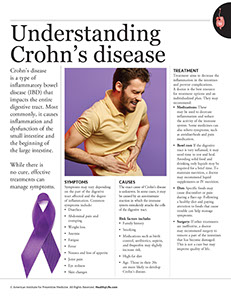
    Man holding abdomen in pain.

    Crohn’s disease is a type of inflammatory bowel disease (IBD) that impacts the entire digestive tract. Most commonly, it causes inflammation and dysfunction of the small intestine and the beginning of the large intestine.

    While there is no cure, effective treatments can manage symptoms.

    Symptoms

    Symptoms may vary depending on the part of the digestive tract affected and the degree of inflammation. Common symptoms include:

    *  Diarrhea

    *  Abdominal pain and cramping

    *  Weight loss

    *  Anemia

    *  Fatigue

    *  Fever

    *  Nausea and loss of appetite

    *  Joint pain

    *  Eye redness

    *  Skin changes

    Causes

    The exact cause of Crohn’s disease is unknown. In some cases, it may be caused by an autoimmune reaction in which the immune system mistakenly attacks the cells of the digestive tract.

    Risk factors include:

    *  Family history

    *  Smoking

    *  Medications such as birth control, antibiotics, aspirin, and ibuprofen may slightly increase risk.

    *  High-fat diet

    *  Age. Those in their 20s are more likely to develop Crohn’s disease.

    Treatment

    Treatment aims to decrease the inflammation in the intestines and prevent complications. A doctor is the best resource for treatment options and an individualized plan. They may recommend:

    *Medications:These may be used to decrease inflammation and reduce the activity of the immune system. Some medicines can also relieve symptoms, such as antidiarrheals and pain medication.

    *Bowl rest:If the digestive tract is very inflamed, it may need time to rest and heal. Avoiding solid food and drinking only liquids may be required for a brief time. To maintain nutrition, a doctor may recommend liquid supplements or IV nutrition.

    *Diet:Specific foods may cause discomfort or pain during a flare-up. Following a healthy diet and paying attention to foods that cause trouble can help manage symptoms.

    *Surgery:If other treatments are ineffective, a doctor may recommend surgery to remove a part of the intestines that has become damaged. This is not a cure but may improve quality of life.

    © American Institute for Preventive Medicine

  • Understanding Multiple Sclerosis

    MEDICAL NEWS

    Women in wheel chair.

    Multiple sclerosis (MS) is a common condition affecting millions of people across the world.

    What is MS?

    MS is an autoimmune disease. Your immune system is designed to fight off invaders like viruses and bacteria. Autoimmune means the immune system attacks healthy tissue by mistake.

    With MS, the immune system attacks a protective coating on the nerves in the brain and spinal cord. When this coating, called the myelin sheath, is damaged, the nerves have trouble sending signals.

    Types of MS

    Most people with MS have relapsing-remitting MS (RRMS). RRMS causes MS symptoms over a few days or weeks, known as a relapse. Then, MS symptoms go away for months or even years. When symptoms go away, this is called remission. The relapse and remission cycle repeats itself over time.

    Other people may have symptoms that slowly get worse. They don’t have periods of remission. This is known as primary progressive or secondary progressive MS.

    Symptoms of MS

    MS symptoms are very different from person to person. They can also change over time. Symptoms include:

    *  Feeling tired (fatigue)

    *  Weakness

    *  Loss of balance

    *  Numbness or tingling

    *  Stiff muscles or spasms

    *  Blurry vision

    *  Dizziness

    *  Loss of control of bladder or bowels

    *  Trouble with memory, learning or attention

    *  Speech problems

    *  Shaking

    *  Seizures

    If you have one or more of these symptoms, it doesn’t mean you have MS. However, you should see your doctor to find out the cause.

    How is MS treated?

    If you have MS, see your doctor regularly. Treatment can help slow the disease and manage symptoms. There are different medications available to treat MS, and physical therapy is helpful for some people. A doctor who specializes in treating MS can recommend the best treatment for you.

    While there is no cure, treatments for MS continue to improve. With a doctor’s help, many people with MS can manage their symptoms and feel their best.

    © American Institute for Preventive Medicine

  • Vaccines & Autism: The Facts

    MEDICAL NEWS

    Young child and teacher.

    Autism spectrum disorder (ASD) is a brain disorder that happens while the brain is developing. It can cause challenges with social, communication and behavioral skills.

    Although experts don’t know all the causes of autism, they do know one thing: vaccines and autism are not linked. Vaccines are safe.

    Still, some people believe that vaccines cause autism. This may be due to a report from 1998 that said there was a link between them. However, the doctor who was responsible for the report used a study that was small and flawed. The study had errors and problems. The doctor’s license was later revoked.

    The causes of autism

    Sometimes, a child gets diagnosed with autism around the time of getting vaccines. This can make it seem like the vaccines caused autism.

    Medical experts say there is no link to vaccines and autism. Numerous studies found that children who get vaccines are not more likely to get autism than children who don’t get vaccines. Although experts have spent years looking for a link between the two, they have not found one.

    There is no single cause of autism. Experts think that genetics and things in the environment might combine to increase a child’s risk.

    Thimerosal and safety

    Some vaccines contain a preservative called thimerosal. Thimerosal contains small amounts of mercury. Some people thought thimerosal could be causing autism.

    Experts removed thimerosal from most childhood vaccines just to be safe. However, even after thimerosal was removed from vaccines, cases of autism did not go down. Experts found that kids who had vaccines which contained thimerosal did not have a higher risk of autism.

    Ask your doctor

    If you ever have questions about your child’s vaccines, ask your doctor. They can give you the facts and evidence about vaccines so you can make an informed choice. Don’t rely on information on the Internet, which may not be true. It could even put your child’s health at risk.

    Source: Autism Speaks, Centers for Disease Control and Prevention

    © American Institute for Preventive Medicine