Author: AIPM

  • Move For Mental Health

    BE FIT

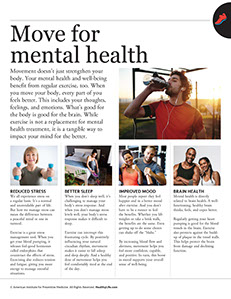
    Man in workout clothes, drinking water with headphones on.

    Movement doesn’t just strengthen your body. Your mental health and well-being benefit from regular exercise, too. When you move your body, every part of you feels better. This includes your thoughts, feelings, and emotions. What’s good for the body is good for the brain. While exercise is not a replacement for mental health treatment, it is a tangible way to impact your mind for the better.

    Reduced stress

    We all experience stress on a regular basis. It’s a normal and unavoidable part of life. But how we manage stress can mean the difference between a peaceful mind or one in turmoil.

    Exercise is a great stress management tool. When you get your blood pumping, it releases feel-good hormones called endorphins that counteract the effects of stress. Exercising also reduces tension and fatigue, giving you more energy to manage stressful situations.

    Better sleep

    When you don’t sleep well, it’s challenging to manage your body’s stress response. And when you don’t manage stress levels well, your body’s stress response makes it difficult to sleep.

    Exercise can interrupt this frustrating cycle. By positively influencing your natural circadian rhythm, movement makes it easier to fall asleep and sleep deeply. And a healthy dose of movement helps you feel comfortably tired at the end of the day.

    Improved mood

    Most people report they feel happier and in a better mood after exercise. And you don’t have to be a runner to feel the benefits. Whether you lift weights or take a brisk walk, the benefits are the same. Even getting up to do some chores can shake off the “blahs.”

    By increasing blood flow and alertness, movement helps you feel more confident, capable, and positive. In turn, this boost in mood supports your overall sense of well-being.

    Brain Health

    Mental health is directly related to brain health. A well-functioning, healthy brain thinks, feels, and copes better.

    Regularly getting your heart pumping is good for the blood vessels in the brain. Exercise also protects against the build-up of plaque in the vessel walls. This helps protect the brain from damage and declining function.

    © American Institute for Preventive Medicine

  • Refinancing Pros & Cons

    FINANCIAL HEALTH

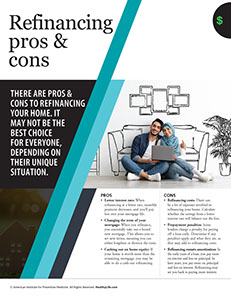
    Couple sitting on floor with laptop.

    There are pros & cons to refinancing your home. It may not be the best choice for everyone, depending on their unique situation.

    Pros

    *  Lower interest rate: When refinancing at a lower rate, monthly payment decreases, and you’ll pay less over your mortgage life.

    *  Changing the term of your mortgage: When you refinance, you essentially take out a brand new mortgage. This allows you to set new terms, meaning you can either lengthen or shorten the term.

    *  Cashing out on home equity: If your home is worth more than the remaining mortgage, you may be able to do a cash-out refinancing.

    Cons

    *  Refinancing costs: There can be a lot of expenses involved in refinancing your home. Calculate whether the savings from a lower interest rate will balance out the fees.

    *  Prepayment penalties: Some lenders charge a penalty for paying off a loan early. Determine if any penalties apply and what they are, as that may add to refinancing costs.

    *  Refinancing restarts amortization: In the early years of a loan, you pay more on interest and less on principal. In later years, you pay more on principal and less on interest. Refinancing may set you back to paying more interest.

    © American Institute for Preventive Medicine

  • Stroke Faq’s

    MEDICAL NEWS

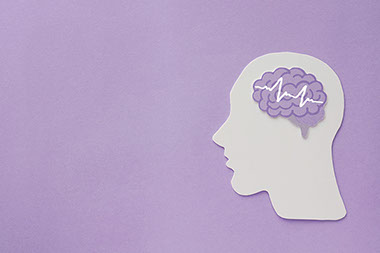
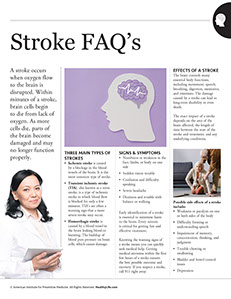
    Purple background with paper cut out of head and brain.

    A stroke occurs when oxygen flow to the brain is disrupted. Within minutes of a stroke, brain cells begin to die from lack of oxygen. As more cells die, parts of the brain become damaged and may no longer function properly.

    Three main types of strokes

    *  Ischemic stroke is caused by a blockage in the blood vessels of the brain. It is the most common type of stroke.

    *  Transient ischemic stroke (TIA), also known as a mini-stroke, is a type of ischemic stroke in which blood flow is blocked for only a few minutes. TIA’s are often a warning sign that a more severe stroke may occur.

    *  Hemorrhagic stroke is caused by a blood vessel in the brain leaking blood or bursting. The buildup of blood puts pressure on brain cells, which causes damage.

    Signs & Symptoms

    *  Numbness or weakness in the face, limbs, or body on one side

    *  Sudden vision trouble

    *  Confusion and difficulty speaking

    *  Severe headache

    *  Dizziness and trouble with balance or walking

    Early identification of a stroke is essential to minimize harm to the brain. Every minute is critical for getting fast and effective treatment.

    Knowing the warning signs of a stroke means you can quickly seek medical help. Getting medical attention within the first few hours of a stroke ensures the best possible outcome and recovery. If you suspect a stroke, call 911 right away.

    Effects of a stroke

    The brain controls many essential body functions, including movement, speech, breathing, digestion, memories, and emotions. The damage caused by a stroke can lead to long-term disability or even death.

    The exact impact of a stroke depends on the area of the brain affected, the length of time between the start of the stroke and treatment, and any underlying conditions.

    Possible side effects of a stroke include:

    *  Weakness or paralysis on one or both sides of the body

    *  Difficulty forming or understanding speech

    *  Impairment of memory, concentration, thinking, and judgment

    *  Trouble chewing or swallowing

    *  Bladder and bowel control issues

    *  Depression

    © American Institute for Preventive Medicine

  • 10 Action Steps For Healthy Eating

    Nutrition

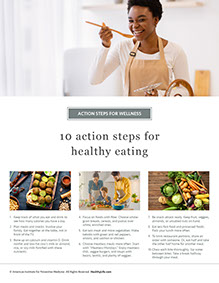
    Women trying food from pot.

    1.  Keep track of what you eat and drink to see how many calories you have a day.

    2.  Plan meals and snacks. Involve your family. Eat together at the table, not in front of the TV.

    3.  Bone up on calcium and vitamin D. Drink nonfat and low-fat cow’s milk or almond, rice, or soy milk fortified with these nutrients.

    4.  Focus on foods with fiber. Choose whole-grain breads, cereals, and pastas over white, enriched ones.

    5.  Eat less meat and more vegetables. Make kebobs with green and red peppers, onions, and salmon or chicken.

    6.  Choose meatless meals more often. Start with “Meatless Mondays.” Enjoy meatless chili, veggie burgers, and soups with beans, lentils, and plenty of veggies.

    7.  Be snack-attack ready. Keep fruit, veggies, almonds, or unsalted nuts on hand.

    8.  Eat less fast food and processed foods. Pack your lunch more often.

    9.  To limit restaurant portions, share an order with someone. Or, eat half and take the other half home for another meal.

    10. Chew each bite thoroughly. Sip water between bites. Take a break halfway through your meal.

    Page from HealthyLife Weigh book by the American Institute for Preventive Medicine. www.HealthyLife.com. All rights reserved.

    © American Institute for Preventive Medicine

  • 10 Action Steps To Tame Stress

    Stress Management

    Wooden tray with stacked rocks and a candle.

    1.  Take deep breaths. Hold it in for four seconds. Then blow the breath out. Repeat several times.

    2.  Accept the things you cannot change in yourself and others.

    3.  Meditate. Practice yoga or tai chi.

    4.  Exercise and move your body for fitness and to relax your mind.

    5.  Set realistic goals. Don’t bite off more than you can chew.

    6.  Try to eat at regular times during the day to keep blood sugar levels steady.

    7.  Request help from others when you need it. Delegate tasks.

    8.  Escape to a place (or picture a scene) where you feel calm, happy, and secure.

    9.  Set time aside for 100% relaxation, such as a vacation.

    10. Spend time with cheerful people. Laugh a lot. Keep a sense of humor. Try to stay positive and see the silver lining in a negative situation.

    Page from HealthyLife Weigh book by the American Institute for Preventive Medicine. www.HealthyLife.com. All rights reserved.

    © American Institute for Preventive Medicine

  • 3 Ways To Tone Your Stomach

    Fitness

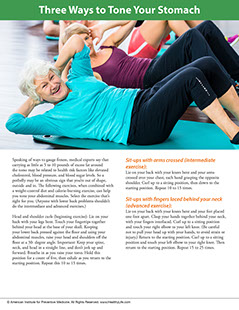
    Image of women doing sit-ups.

    Speaking of ways to gauge fitness, medical experts say that carrying as little as 5 to 10 pounds of excess fat around the torso may be related to health risk factors like elevated cholesterol, blood pressure, and blood sugar levels. So a potbelly may be an obvious sign that you’re out of shape, outside and in. The following exercises, when combined with a weight-control diet and calorie-burning exercise, can help you tone your abdominal muscles. Select the exercise that’s right for you. (Anyone with lower back problems shouldn’t do the intermediate and advanced exercises.)

    Head and shoulder curls (beginning exercise): Lie on your back with your legs bent. Touch your fingertips together behind your head at the base of your skull. Keeping your lower back pressed against the floor and using your abdominal muscles, raise your head and shoulders off the floor at a 30-degree angle. Important: Keep your spine, neck, and head in a straight line, and don’t jerk up and forward. Breathe in as you raise your torso. Hold this position for a count of five, then exhale as you return to the starting position. Repeat this 10 to 15 times.

    Sit-ups with arms crossed (intermediate exercise): Lie on your back with your knees bent and your arms crossed over your chest, each hand grasping the opposite shoulder. Curl up to a sitting position, then down to the starting position. Repeat 10 to 15 times.

    Sit-ups with fingers laced behind your neck (advanced exercise): Lie on your back with your knees bent and your feet placed one foot apart. Clasp your hands together behind your neck, with your fingers interlaced. Curl up to a sitting position and touch your right elbow to your left knee. (Be careful not to pull your head up with your hands, to avoid strain or injury.) Return to the starting position. Curl up to a sitting position and touch your left elbow to your right knee. Then return to the starting position. Repeat 15 to 25 times.

    Page image from A Year of Health Hints book by the American Institute for Preventive Medicine. www.HealthyLife.com. All rights reserved.

    © American Institute for Preventive Medicine