Author: AIPM

  • Read Food Labels

    Nutrition

    Information on food labels can help you choose healthy foods. What do you look for?

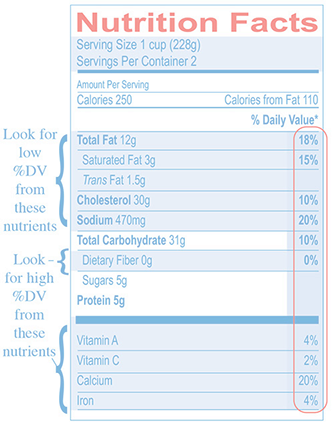
    A. Read the “Nutrition Facts”

    Look at serving size and how many servings are in the product. Serving sizes are given in familiar units, such as cups or pieces. This is followed by the metric amount (e.g., the number of grams). Serving sizes are often based on the amount of food people typically eat.

    B. Read calories per serving

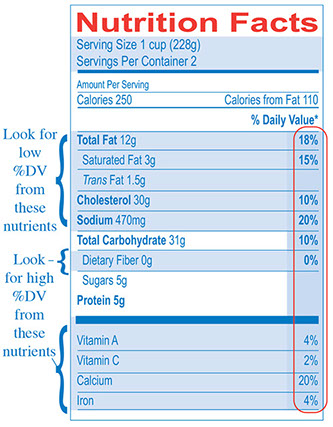
    Calories tell you how much energy you get from a serving of this food. The label also tells you how many of the calories in one serving come from fat. In the example, there are 250 calories in a serving of this macaroni and cheese; 110 calories are from fat. This means almost half of the calories come from fat.

    C. Look at the nutrients per serving

    The nutrients listed first are the ones people eat enough, or too much of. Eating too much saturated and trans fats or too much sodium may increase your risk of heart disease, some cancers, and high blood pressure.

    Most people don’t get enough dietary fiber, vitamin A, vitamin C, calcium, and iron in their diets. Eating enough of these nutrients can improve your health and help reduce the risk of some diseases and conditions. For example, getting enough calcium can reduce the risk of osteoporosis, in which bones become brittle and break as one ages.

    D. Look at Percent Daily Value (%DV)

    Daily Values (DVs) are a way to tell if a food is high or low in nutrients. In general 5% DV or less is low in a nutrient; 20% or more is high in a nutrient.

    The Percent Daily Value (%DV) on food labels is based on a 2000 calorie diet. This means that they are not exact for what Daily Values are for 1200-1300, 1500-1600, and 1800 calorie diets. So, use food label %DVs as a general guide to see if a food gives any nutrients for the calories it has.

    Quick Tip

    In general, look for foods that have low %DV for total fat, saturated fat, cholesterol, and sodium. Balance foods that have 20% or more of these with ones that have 5% DV or less.

    In general, look for foods that have 20% or more for fiber and/or at least one of the vitamins and iron or other minerals that can be listed.

    Compare Nutrition Facts for Three Cereals

    After comparing these three labels, which cereal would you choose?

    One advantage for all three is that they are a set portion (a small box that is one serving size). Overall, the wheat squares may be the best choice based on the nutrients you get for the calories it has. It would even be better to choose wheat squares that are not sweetened. The same serving size would have less added sugar and calories. Corn flakes is also a good choice. One serving has 70 calories. This is close to the amount of calories in 1 serving of grains & starches (80 calories).

    Can These Meals Be Part of a Healthy Daily Diet?

    Besides looking at saturated fat, of the two choices, the Deluxe Combo Pizza has more dietary fiber (6g) and less sodium (550mg).

    Four Cheese Pizza:

    This choice is harder to fit into a healthy diet. One serving (the whole pizza) uses 50% of a daily saturated fat allowance, leaving only 50% for all other foods and drinks that day.

    Deluxe Combo Pizza:

    This meal is easier to fit into a healthy diet. One serving (the whole pizza), gives 18% of a daily saturated fat allowance. This leaves 82% for all other foods and drinks that day.

    Is this a Healthy Snack Food?

    Answer: The good thing about this snack food is that it does not have trans fat. This is because it has vegetable oil, not “hydrogenated” vegetable oil. It does, though, have 250 calories and 12 grams of fat. That is a lot for a snack. Eat foods like this less often. Make 2 or 3 servings out of this individual snack bag, too.

    Ingredient List

    This lists what’s in the food from most to least by weight. There is more of the first ingredient than the second and so on. Choose foods that list acceptable ingredients first, second, and third. Also, check the list for ingredients that you may be allergic or sensitive to, such as milk, eggs, peanuts, and wheat.

    Preparation Instructions

    Look at the instructions on package directions. You can change the way the food is prepared to lower total fat, saturated fat, and sodium, as well as to increase nutrients, such as fiber and vitamin C.

    Open Dating

    Look at this so you won’t buy food items that are spoiled or will spoil before you use them. Buy them before “sell by” or “expiration date,” which is the last date the product should be used.

    Resources

    Food and Drug Administration (FDA)
    www.fda.gov

    Page from HealthyLife Weigh book by the American Institute for Preventive Medicine. www.HealthyLife.com. All rights reserved.

    © American Institute for Preventive Medicine
  • Be A Smart Meat Eater

    Nutrition

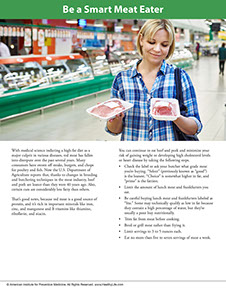
    Image of meat being grilled.

    With medical science indicting a high-fat diet as a major culprit in various diseases, red meat has fallen into disrepute over the past several years. Many consumers have sworn off steaks, burgers, and chops for poultry and fish. Now the U.S. Department of Agriculture reports that, thanks to changes in breeding and butchering techniques in the meat industry, beef and pork are leaner than they were 40 years ago. Also, certain cuts are considerably less fatty than others.

    That’s good news, because red meat is a good source of protein, and it’s rich in important minerals like iron, zinc, and manganese and B vitamins like thiamine, riboflavin, and niacin.

    You can continue to eat beef and pork and minimize your risk of gaining weight or developing high cholesterol levels or heart disease by taking the following steps.

    *  Check the label or ask your butcher what grade meat you’re buying. “Select” (previously known as “good”) is the leanest. “Choice” is somewhat higher in fat, and “prime” is the fattiest.

    *  Limit the amount of lunch meat and frankfurters you eat.

    *  Be careful buying lunch meat and frankfurters labeled as “lite.” Some may technically qualify as low in fat because they contain a high percentage of water, but they’re usually a poor buy nutritionally.

    *  Trim fat from meat before cooking.

    *  Broil or grill meat rather than frying it.

    *  Limit servings to 3 to 5 ounces each.

    *  Eat no more than five to seven servings of meat a week.

    Page from A Year of Health Hints book by the American Institute for Preventive Medicine. www.HealthyLife.com. All rights reserved.

    © American Institute for Preventive Medicine
  • Be Mindful Of…How You Eat

    Weight Control

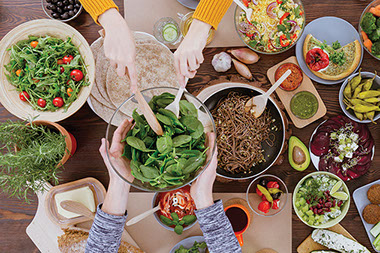
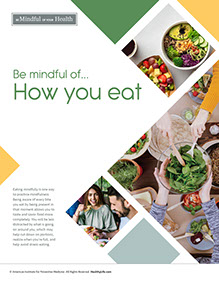
    Table filled with healthy foods.

    Eating mindfully is one way to practice mindfulness. Being aware of every bite you eat by being present in that moment allows you to taste and savor food more completely. You will be less distracted by what is going on around you, which may help cut down on portions, realize when you’re full, and help avoid stress-eating.

    Page from HealthyLife Weigh book by the American Institute for Preventive Medicine. www.HealthyLife.com. All rights reserved.

    © American Institute for Preventive Medicine
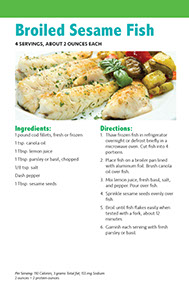
  • Broiled Sesame Fish

    Nutrition

    4 Servings, about 2-1/2 ounces each

    Ingredients:

    1 pound cod fillets, fresh or frozen

    1 tsp. margarine, melted

    1 Tbsp. lemon juice

    1 tsp. dried tarragon leaves

    1/8 tsp. salt

    Dash pepper

    1 Tbsp. sesame seeds

    1 Tbsp. parsley, chopped or 12 sprigs of dill

    Directions:

    1.  Thaw frozen fish in refrigerator overnight or defrost briefly in a microwave oven. Cut fish into 4 portions.

    2.  Place fish on a broiler pan lined with aluminum foil. Brush margarine over fish.

    3.  Mix lemon juice, tarragon leaves, salt, and pepper. Pour over fish.

    4.  Sprinkle sesame seeds evenly over fish.

    5.  Broil until fish flakes easily when tested with a fork, about 12 minutes.

    6.  Garnish each serving with parsley or dill.

    Per Serving:

    Calories – 110

    Total fat – 3 grams

    Sodium – 155 mg

    Page from HealthyLife Weigh Recipe book by the American Institute for Preventive Medicine. www.HealthyLife.com. All rights reserved.

    © American Institute for Preventive Medicine

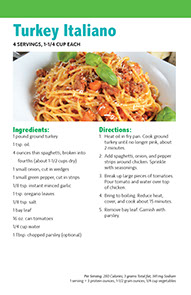
  • Chicken (Or Turkey) Italiano

    Nutrition

    4 Servings, 1 chicken breast half and 3/4 cup spaghetti mixture each

    Ingredients:

    4 chicken breast halves, skinned, boned (Or 1 pound ground turkey)

    1 tsp. oil

    4 ounces thin spaghetti, broken into fourths (about 1-1/2 cups dry)

    1 small onion, cut in wedges

    1 small green pepper, cut in strips

    1/8 tsp. instant minced garlic

    1 tsp. oregano leaves

    1/8 tsp. salt

    1 bay leaf

    16 oz. can tomatoes

    1/4 cup water

    1 Tbsp. chopped parsley, if desired

    Directions:

    1.  Pound chicken breasts with a metal meat mallet between sheets of plastic wrap until about 1/2 inch thick.

    2.  Heat oil in fry pan. Brown chicken breasts on each side.

    3.  Add spaghetti, onion, and pepper strips around chicken. Sprinkle with seasonings.

    4.  Break up large pieces of tomatoes. Pour tomato and water over top of chicken.

    5.  Bring to boiling. Reduce heat, cover, and cook until chicken and spaghetti are done, about 15 minutes.

    6.  Remove bay leaf. Garnish with parsley.

    Per Serving:

    Calories – 280

    Total fat – 3 grams

    Cholesterol – 68 milligrams

    Sodium – 341 mg

    Page from HealthyLife Weigh Recipe book by the American Institute for Preventive Medicine. www.HealthyLife.com. All rights reserved.

    © American Institute for Preventive Medicine
  • Choose Water Instead Of Sugar-Sweetened Beverages

    Nutrition

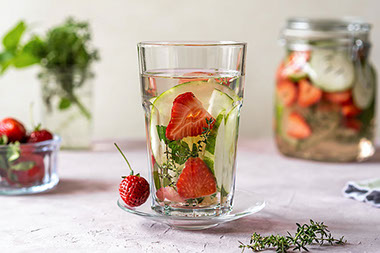
    Glass of water flavored with strawberries and cucumbers.

    *  Excess sugar increases the risk for overweight, diabetes, and heart disease.

    *  On average, an adult in the U.S. consumes 60 pounds of sugar and sweeteners each year. This about 17 teaspoons per day! Nearly half of this is from soda and other sugar-sweetened drinks.

    *  Read food labels. Choose beverages and foods without added sugar sources. These include sugar, honey, fructose, corn syrup, corn syrup solids, and high-fructose-corn syrup.

    Dos

    *  Choose a 16 oz. black coffee with 1 oz. reduced fat milk. This has 2 g of sugar and less than 25 calories.

    *  Enjoy unsweetened iced tea with lemon. It has no sugar and no calories.

    *  Drink fruit-flavored water or fizzy water with no added sugar and minimal calories.

    Don’ts

    *  Don’t select the 16 oz. French vanilla cappuccino. It has 42 g of sugar and 320 calories.

    *  Don’t choose regular soft drinks. A 12-oz. serving has about 10 teaspoons (38 g) of sugar and 150 empty calories.

    Page from HealthyLife Weigh book by the American Institute for Preventive Medicine. www.HealthyLife.com. All rights reserved.

    © American Institute for Preventive Medicine