Author: AIPM

  • Drink Your Fill

    Nutrition

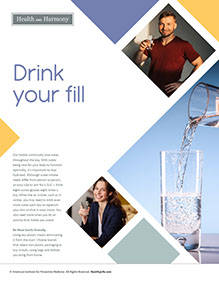
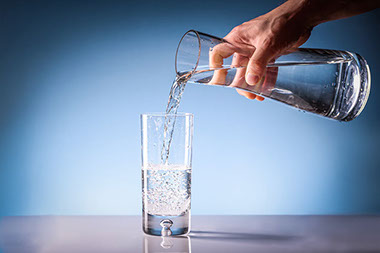
    Hand pouring water into a glass.

    Our bodies continually lose water throughout the day. With water being vital for your body to function optimally, it’s important to stay hydrated. Although water-intake needs differ from person to person, an easy rule to aim for is 8×8 – drink eight-ounce glasses eight times a day. When the air is drier, such as in winter, you may need to drink even more water each day to replenish your skin so that it stays moist. You also need more when you do an activity that makes you sweat.

    Be More Earth-Friendly

    Using less plastic means eliminating it from the start. Choose brands that select non-plastic packaging or buy in bulk, using bags and bottles you bring from home.

    Page from HealthyLife Weigh book by the American Institute for Preventive Medicine. www.HealthyLife.com. All rights reserved.

    © American Institute for Preventive Medicine

  • Drugs & Drug Safety

    Substance Use & Abuse

    After alcohol, the most common drugs used are tobacco and marijuana. Other drugs used are amphetamines (uppers); barbiturates (downers); hallucinogens, such as LSD; inhalants; and narcotics, such as cocaine. On the increase is the use of substances known collectively as “club drugs.” These are used at all-night dance parties, such as “raves” or “trances,” dance clubs, and bars. Examples are MDMA (Ecstasy), GHB, Rohypnol, Ketamine, methamphetamine, and LSD.

    The safest use of drugs is no use of drugs!

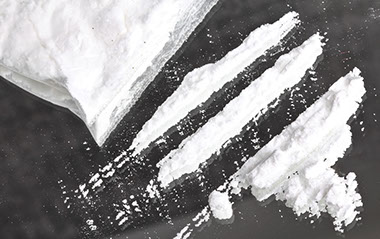
    Cocaine

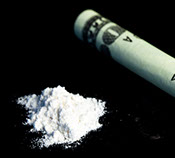
    Image of cocaine.

    This drug is also called blow, crack, crank, “C”, coke, nose candy, rock, and white girl.

    Dangers of Use

    Increases pulse rate and blood pressure. Causes insomnia, irritability, and paranoia. Can result in severe depression, convulsions, heart attack, lung damage, hallucinations, brain damage, risk of infection (hepatitis, HIV from using contaminated needles), coma, and death.

    Depressants

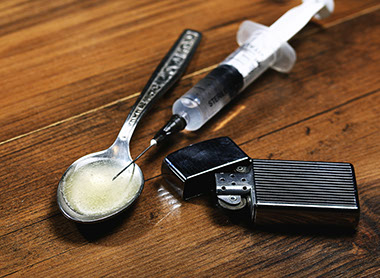
    Image of depressants.

    Examples are alcohol, barbiturates, sedatives, tranquilizers, downers, ludes, reds, and yellow jackets.

    Dangers of Use

    Causes drowsiness, slurred speech, drunkenness, memory loss, sudden mood shifts, depression, and lack of coordination. Can result in shallow breathing, dilated pupils, clammy skin, weak pulse, coma, and death.

    Ecstasy

    Image of ecstasy.

    This is MDMA. Other names are Adam, Clarity, Lover’s Speed, and K.

    Dangers of Use

    Euphoric state initially, but depression can occur after taking the drug. Also carries the risk of a heat stroke from lack of fluids and sweating from dancing too long, especially in the hot environment of a club. May lead to a heart attack, seizure, and stroke.

    GHB and GLB

    GLB is a similar drug that turns into GHB in the body. Other names are: Grievous Bodily Harm; Liquid Ecstasy, Liquid Sex, Georgia Home Boy, and Scoop.

    Image of GHB.

    Dangers of Use

    Common date rape drug that results in nausea, vomiting, a feeling of intoxication, and amnesia-like symptoms. The drug slows the heartbeat, reduces blood pressure, and can cause the user’s breathing to stop. Overdose results in unconsciousness, coma, and eventual death. There is little difference in the dose that can get someone high and one that can cause death.

    Inhalants

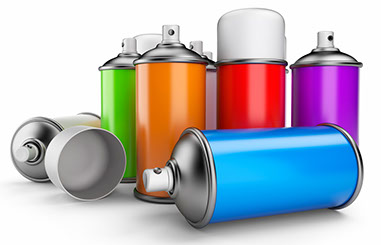
    Image of unmarked inhalants.

    Examples are vapors from: Solvents, such as gasoline; aerosols, such as hair sprays; anesthetics, such as ether, chloroform, nitrous oxide; and spray paints, especially gold and silver.

    Dangers of Use

    Slows heart rate, breathing and brain activity. Can cause headaches, dizziness, nausea, lack of coordination, slurred speech, blurred vision. Can result in suffocation, heart failure, unconsciousness, seizures, brain damage, and even death.

    Ketamine

    This drug is also called: Special K, K, Vitamin K, and Cat Valium.

    Image of ketamine.

    Dangers of Use

    Causes dream-like states and hallucinations. Can cause delirium, amnesia, impaired motor functions, high blood pressure, depression, and breathing problems that can result in death.

    LSD

    Image of LSD.

    This is also called acid, bloomers, and yellow sunshines.

    Dangers of Use

    Causes hallucinations, dilated pupils, increased heart rate and blood pressure, sweating, sleeplessness, dry mouth, and tremors. Nausea, weakness, numbness or trembling are common. Long term use can cause persistent psychosis and what used to be called “flashbacks” – re-experiencing symptoms of past hallucinogen use even though not taking the drug at the present time.

    Marijuana

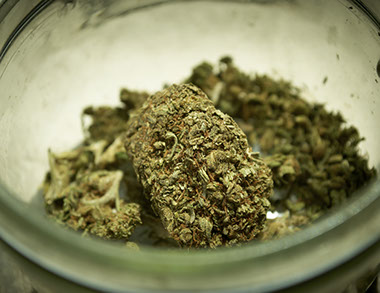
    Image of marijuana.

    This is also called pot, grass, reefer, herb, jay, joint, smoke, weed, and AMP (marijuana with formaldehyde).

    Dangers of Use

    Can result in feelings of panic, impaired short term memory, decreased ability to concentrate, fatigue, paranoia, and possible psychosis. Also causes lung damage. Synthetic marijuana, such as K2 can have serious side effects, such as extremely high blood pressure, very fast heartbeat, paranoia, delusions, seizure, and hallucinations.

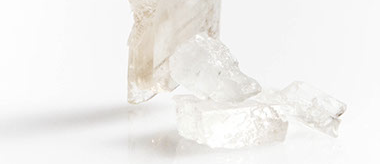
    Methamphetamine

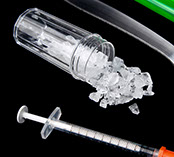
    This drug is also called speed, ice, chalk, crystal meth, crack, fire, and glass.

    Image of methamphetamine.

    Dangers of Use

    Can result in memory loss, agitation, aggression, and violent or psychotic behavior and potential cardiac and neurological damage. Can contribute to higher rates of transmission of hepatitis and HIV, if injected. Can result in heart attacks, seizures, and death from overdose.

    Rohypnol

    This is also called R-2, Rib, Roofies, Rope, and Forget-Me Pill.

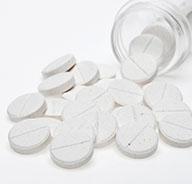
    Image of rohypnol.

    Dangers of Use

    Common date rape drug. Used in sexual assaults. Results in decreased blood pressure, drowsiness, visual disturbances, confusion, nausea, and vomiting. When mixed with alcohol or other drugs, this clear, odorless, and tasteless drug can cause death.

    Signs of a Drug Overdose

    Signs of an overdose depend on the type of drug used. Call 9-1-1 or get emergency care for one or more of the following:

    *  Unconsciousness. This means the person is hard to rouse and can’t be made aware of his or her surroundings. This can be brief, such as with fainting or blacking out. It can put a person into a coma.

    *  No breathing or slow and shallow breathing. This means 10 or fewer breaths per minute or time lapses of more than 8 seconds between breaths.

    *  Slow pulse rate (40 or fewer beats per minute).

    *  Suicidal gestures.

    *  Seizures.

    *  Tremors.

    *  Sudden hostile personality or violent behavior.

    *  Very rapid pulse rate (140 or more beats per minute) and/or extreme anxiety or paranoia.

    Resources

    Alcoholics Anonymous (AA) World Services

    Gives names and phone numbers for local AA groups. Gives materials on the AA program.

    www.aa.org

    Al-Anon/Alateen World Service Office

    A self-help program for families and friends of alcoholics. Also a referral line.

    888.4AL-ANON (425.2666)

    www.al-anon.org

    American Council for Drug Education

    A substance abuse prevention and education agency for youth, college students, parents, employers, educators, and health professionals.

    800.488.DRUG (488.3784)

    www.acde.org

    Cocaine Anonymous (CA) World Services

    Gives names and numbers for local self-help meetings.

    310.559.5833

    www.ca.org

    Narcotics Anonymous (NA) World Services Inc.

    Gives names and phone numbers for local self-help meetings and mails out literature on narcotics to hospitals and individuals.

    818.773.9999

    www.na.org

    Substance Abuse and Mental Health Services Administration (SAMHSA)

    Provides a free treatment referral service to link people with community-based substance abuse services they need.

    800.662.HELP (662.4357)

    www.findtreatment.samhsa.gov

    Page from the Student Self-Care book by the American Institute for Preventive Medicine. www.HealthyLife.com. All rights reserved.

    © American Institute for Preventive Medicine

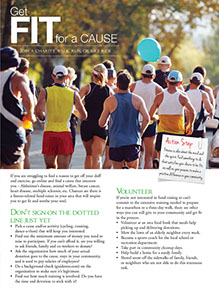
  • Get Fit For A Cause

    Fitness

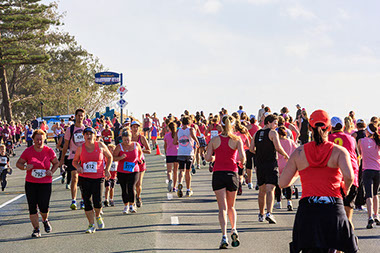
    People running a marathon for charity.

    Join a charity walk, run, or bike ride.

    If you are struggling to find a reason to get off your duff and exercise, go online and find a cause that interests you – Alzheimer’s disease, animal welfare, breast cancer, heart disease, multiple sclerosis, etc. Chances are there is a fitness-related fund-raiser in your area that will inspire you to get fit and soothe your soul.

    Don’t sign on the dotted line just yet.

    *  Pick a cause and/or activity (cycling, running, dance-a-thon) that will keep you interested.

    *  Find out the minimum amount of money you need to raise to participate. If you can’t afford it, are you willing to ask friends, family and co-workers to donate?

    *  Ask the organization how much of your actual donation goes to the cause, stays in your community, and is used to pay salaries of employees?

    *  Do a background check (www.guidestar.com) on the organization to make sure it’s legitimate.

    *  Find out how much training is involved. Do you have the time and devotion to stick with it?

    Volunteer.

    If you’re not interested in fund-raising or can’t commit to the extensive training needed to prepare for a marathon or a three-day walk, there are other ways you can still give to your community and get fit in the process.

    *  Volunteer at an area food bank that needs help picking up and delivering donations.

    *  Mow the lawn of an elderly neighbor every week.

    *  Become a sports coach for the local school or recreation department.

    *  Take part in community cleanup days.

    *  Help build a home for a needy family.

    *  Shovel snow off the sidewalks of family, friends, or neighbors who are not able to do this strenuous task.

    Action Step

    Fitness is also about the mind and the spirit. Find something to do that satisfies your desire to be fit, as well as your passion to make a positive difference in your community.

    Page image from Ways to Well-Being book by the American Institute for Preventive Medicine. www.HealthyLife.com. All rights reserved.

    © American Institute for Preventive Medicine

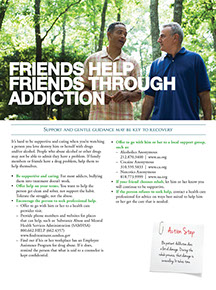
  • Friends Help Friends Through Addiction

    Substance Use & Abuse

    Image of 2 friends walking and talking.

    Support and gentle guidance may be key to recovery.

    It’s hard to be supportive and caring when you’re watching a person you love destroy him or herself with drugs  and/or alcohol. People who abuse alcohol or other drugs may not be able to admit they have a problem. If family members or friends have a drug problem, help them to help themselves.

    Be supportive and caring.

    For most addicts, bullying them into treatment doesn’t work.

    Offer help on your terms.

    You want to help the person get clean and sober, not support the habit. Tolerate the struggle, not the abuse.

    Encourage the person to seek professional help.

    *  Offer to go with him or her to a health care provider visit.

    *  Provide phone numbers and websites for places that can help, such as: Substance Abuse and Mental Health Services Administration (SAMHSA) – 800.662.HELP (662.4357)www.findtreatment.samhsa.gov

    *  Find out if his or her workplace has an Employee Assistance Program for drug abuse. If it does, remind the person that what is said to a counselor is kept confidential.

    If your friend chooses rehab, let him or her know you will continue to be supportive. If the person refuses to seek help, contact a health care professional for advice on ways best suited to help him or her get the care that is needed.

    Offer to go with him or her to a local support group.

    Alcoholics Anonymous

    212.870.3400

    www.aa.org

    Cocaine Anonymous

    310.559.5833

    www.ca.org

    Narcotics Anonymous

    818.773.9999

    www.na.org

    Action Step

    Be patient. Addiction does a lot of damage. During the rehab process, that damage is unraveling. It takes time.

    Page from Ways to Well-Being book by the American Institute for Preventive Medicine. www.HealthyLife.com. All rights reserved.

    © American Institute for Preventive Medicine

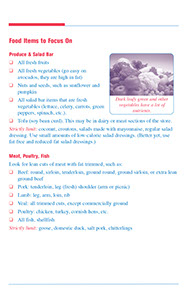
  • Food Items To Focus On

    Nutrition

    Produce & Salad Bar

    Image of a women in grocery store weighing salad from a salad bar.

    *  All fresh fruits

    *  All fresh vegetables (go easy on avocados, they are high in fat)

    *  Nuts and seeds, such as sunflower and pumpkin

    *  All salad bar items that are fresh vegetables (lettuce, celery, carrots, green peppers, spinach, etc.).

    *  Tofu (soy bean curd). This may be in dairy or meat sections of the store.

    Strictly limit: coconut, croutons, salads made with mayonnaise, regular salad dressing. Use small amounts of low-calorie salad dressings. (Better yet, use fat-free and reduced-fat salad dressings.)

    Meat, Poultry, Fish

    Image of a hand picking up a package of meat.

    Look for lean cuts of meat with fat trimmed, such as:

    *  Beef: round, sirloin, tenderloin, ground round, ground sirloin, or extra lean ground beef

    *  Pork: tenderloin, leg (fresh) shoulder (arm or picnic)

    *  Lamb: leg, arm, loin, rib

    *  Veal: all trimmed cuts, except commercially ground

    *  Poultry: chicken, turkey, cornish hens, etc.

    *  All fish, shellfish

    Strictly limit: goose, domestic duck, salt pork, chitterlings

    Delicatessen

    *  Sliced lean meats, such as turkey, ham, chicken, lean beef

    *  Ready-to-eat broiled or rotisserie chicken and turkey breast

    *  Fresh fruit salads

    Strictly limit: mayonnaise-dressed salads, sausage, frankfurters, high-fat luncheon meats, such as bologna, salami, and bacon

    Freezer Section

    Image of the freezer section of a grocery store.

    *  Frozen fruits and vegetables. Buy these frozen loosely in bags so it is easy to make 1 portion.

    *  Juice concentrates

    *  Frozen dinners-preferably ones with less than 300 calories and 1000 mg. of sodium or less/serving

    *  Frozen fish fillets – look for fresh-frozen ones that can be reapportioned when you take them home instead of solid packed ones that you would have to thaw out.

    *  Sugar-free or low calorie frozen treats, such as sugar-free and regular popsicles and fudgesicles, frozen yogurt, lite tofutti, fruit ices, etc.

    Dairy Section

    Image of a women picking up a gallon of milk from the dairy section.

    *  Skim milk, 1/2% low fat milk, buttermilk

    *  Soy milk (with added calcium)

    *  Plain, nonfat yogurt

    *  Low-fat, soft cheeses, like cottage and farmers

    *  Reduced fat and other cheeses labeled no more than 2 to 6 grams fat per ounce

    *  Margarine: soft tub (regular and diet), Benecol® and Take Control® margarines

    *  Orange and other fresh juices (not fruit drinks)

    *  English muffins

    *  Whole wheat, corn, and flour tortillas

    *  Eggs, egg substitute

    Strictly limit: Biscuits, croissants, cream, sour cream, half and half, cheeses other than above, whole milk, 2% low-fat milk, butter

    Breads, Cereals

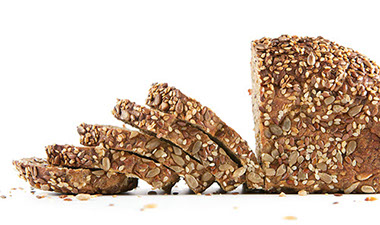
    Image of wheat bread.

    *  Whole wheat bread, regular or lite (40 calories/slice)

    *  Whole wheat and plain dinner rolls

    *  Whole wheat and regular pita breads

    *  English muffins

    *  Bagels (also stocked in freezer section)

    *  Breadsticks

    *  Sandwich buns (“lite” are also available)

    *  Rice cakes

    *  Cereal mixes for cooked cereals: oatmeal, Cream of Wheat, etc.

    *  Ready-to-eat cereals. Look for ones with at least 2 grams of fiber and less than 2 grams of fat per one ounce serving. Limit sugar-sweetened ones.

    Staples

    *  Canned entrees/main dishes (8 grams of fat or less, per 1 cup serving)

    *  Canned fish, such as tuna in water, salmon

    *  Rice, brown or white, barley, bulgar

    *  Pastas, like plain noodles, macaroni, spaghetti

    *  Dried or canned beans and peas like split peas, black-eyed peas, chick peas, kidney beans, lentils, soybeans

    *  Canned fruits packed in water or their own juices

    *  “Old-fashioned” style peanut butter (oil can be seen at the top of the jar)

    *  Low-fat crackers, such as matzos, bread sticks, rye krisp, saltines (with unsalted tops), graham crackers, zwieback

    *  Popcorn (regular or microwave-packaged, if less than 2 grams of fat per serving)

    *  Spices, seasonings, herbs, butter flavor sprinkles, vanilla, other flavor extracts

    *  Salad dressings – “Lite,” “reduced-calorie,” “no oil” or “fat free” varieties

    *  Vinegar

    *  Condiments, such as ketchup, mustard, worcestershire sauce, horseradish, etc. Use small amounts. These are high in sodium.

    *  Reduced-sodium bouillon, unsweetened pickles, canned soups

    *  Flour; whole wheat, all purpose, whole wheat and all purpose combination

    *  Cornstarch

    *  Vegetable cooking sprays

    *  Liquid vegetable oils, such as olive and canola

    *  Coffee, tea, cocoa mixes with nonfat dry milk

    *  Sugar-free gelatin and drink mixes

    *  Wine, dry for cooking

    *  Nonfat dried milk

    *  Canned evaporated skim milk

    *  Bottled water

    Strictly limit: Potato chips and other high fat, high salt snacks, regular canned vegetables (because they are high in salt), and seasonings and foods with monosodium glutamate (MSG).

    Page from HealthyLife Weigh book by the American Institute for Preventive Medicine. www.HealthyLife.com. All rights reserved.

    © American Institute for Preventive Medicine

  • Fitness Basics

    Fitness

    When you are fit, you are at a healthy body weight. You have energy. Exercise and a healthy diet are a regular part of your life.

    Fitness has four parts:

    *  Heart and Lung Fitness. This is how well your heart pumps blood and sends oxygen through your body.

    *  Muscle Fitness. This is about your muscle strength and endurance. Muscle strength is how much weight you can lift safely. Endurance is how many times you can lift something or how long you can hold it without getting tired.

    *  Flexibility. This is being able to move your joints easily and without pain through a wide range of motion. This helps you reach, twist, turn, and move things without straining.

    *  Body Make-Up. This is how much of your body is fat and how much is muscle. Too much body fat puts extra strain on your joints and increases your risk for heart disease and other diseases. Too little body fat is not good either.

    Fitness Goals

    To set your goals, consider these points:

    *  Activities you’ve been good at before and things you think you will enjoy doing

    *  Equipment you have or can use

    *  Goals you want to achieve and your current fitness level.

    Ways to Get More Fit

    * Exercise.

    * Recreation, such as golfing, dancing, etc.

    * Active hobbies, such as working in the garden

    * Chores, such as mowing the grass, walking the dog, etc.

    Time to Set Your Goals

    *  Write down your goals. Record the date.

    *  Your goals should be clear and measurable. “To get stronger” is vague. “To advance from 5 to 10 push-ups by the end of the month” is clear.

    *  Make short term goals. Plan what you want to do by the end of the month; not a year from now.

    *  From time to time, review and change your goals.

    Before You Begin an Exercise Program

    Start slowly. Build up gradually. This gives your body time to adjust to exercise. It also helps you avoid soreness and injury. Check with your doctor before you begin an exercise program if:

    *  You have one or more chronic health problems (e.g., heart disease, diabetes, arthritis, etc.).

    *  You are overweight.

    *  You are a man over age 40 or a woman over age 50 and you plan to begin very active physical activity.

    *  You are over age 65 and are not active.

    *  You feel faint or very dizzy at times or you have chest pains.

    *  You take prescription medicine (e.g., high blood pressure pills, etc.).

    *  You are not sure how exercise will affect any physical problem you have.

    Aerobic Exercises

    Aerobic exercise makes the heart get stronger. It also helps your body make natural substances called endorphins that give a natural “high.”

    A. Warm Up

    Spend 5 to 10 minutes doing the activity at a slower pace or stretch all major muscle groups and parts of the body. This includes your:

    *  Head and neck. Shoulders, upper back, arms, and chest

    *  Rib cage, waist, and lower back

    *  Thighs (front and back). Inner thighs.

    *  Calves and Achilles’ tendons, which connect the calf muscles to the backs of the heels. Ankles and feet.

    Extend each body part and hold it for 15 to 30 seconds. This should not cause any pain, but be a flowing, rhythmic motion that raises your heart rate a bit.

    B. Aerobic Activity

    Some popular aerobic activities are walking, bike riding, running, low-impact aerobics, and swimming. To be aerobic, the activity you choose should:

    *  Be steady and nonstop.

    *  Last a minimum of 10 minutes. You can start out for shorter periods of time, many times a day (e.g., do 5 minutes, twice a day). Progress to more minutes each time.

    *  Use large muscles of the lower body (the legs and buttocks).

    *  Result in a heart rate of 60 to 80% of your maximum heart rate.

    *  Allow you to talk without gasping for breath.

    C. Cool Down

    Choose a slower pace of the activity you were doing. If you were walking briskly, walk slowly. Or, stretch for about 5 minutes. Stretch all muscle groups. Stretch to the point of mild tension (not pain or burn). Hold for 10 to 30 seconds. Breathe out when you begin to stretch. Breathe in when the stretch is released.

    Target Heart Rate

    Target heart rate is 60% to 80% of your maximum heart rate (MHR). To find your MHR:

    A. Subtract your age from 220:

    220 – ______ (age)  =  ______ (MHR)

    B. Multiply your MHR   x .60 =

    Multiply your MHR   x .80 =

    C. Your 60-second (target) heart rate should fall somewhere between these two numbers during the aerobic activity.

    Guidelines for Aerobic Activity

    *  Each week, adults should:

    – Do at least 2 hours and 30 minutes of moderate aerobic activity, such as brisk walking or ballroom dancing… OR

    – Do 1 hour and 15 minutes of vigorous aerobic activity, such as jogging, aerobic dancing, and jumping rope… OR

    – A combination of activities from the 2 listed above.

    *  For increased fitness or to lose weight or keep lost weight off, do 5 hours of moderate physical activity or 2 hours and 30 minutes of vigorous aerobic physical activity a week.

    *  Warm up for 5 to 10 minutes before each aerobic session.

    *  Do the aerobic activity for at least 10 minutes at a time.

    *  Slow down at the end, little by little. Then stretch for 5 to 10 minutes.

    Stretch & Strengthen

    Stretching Exercises

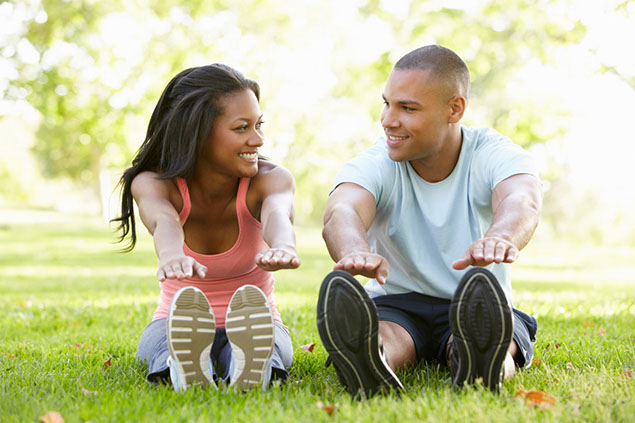
    These exercises make your body more flexible. This helps you prevent injury during sports, exercise, and everyday activities. Stretching exercises should be done before and after every strengthening or aerobic workout.

    *  Stretch only to the point of comfort. You should feel mild tension, not pain.

    *  Never bounce.

    *  Breathe slowly and rhythmically.

    *  When women are pregnant, joints loosen. Pregnant women need to be extra careful not to stretch muscles too far.

    Sample Exercises

    A. Shoulder Shrug

    Shrug your shoulders up toward your head. Then lower them. Repeat 4 times. Slowly circle your shoulders forward 8 times and then backward 8 times.

    B. Hamstring Stretch

    Sit on the floor with your right leg straight. Bend your left leg and touch your foot against your straight leg. Stretch forward to touch the toes of your right foot. Hold for 4 counts. Then, do this on the other side.

    Strengthening Exercises

    Benefits of Strength Training

    *  There is less chance of injury.

    *  Your muscles can work longer before getting tired (endurance).

    *  You build muscle. Muscle burns more calories than fat. This occurs even when your body is at rest.

    *  You have more lean tissue and less fat in the body.

    *  You improve your bone density. This helps prevent osteoporosis and fractures.

    *  Your body looks more toned.

    Strengthening Guidelines

    *  Use weights or a stretch band. Try out different ones to find what’s right for you. For strengthening, you should be able to do at least 2 sets and repeat these 8 times. If you can’t, the weight is too heavy. If you can easily do more than 3 sets, and repeat them 12 times, use a heavier weight.

    *  For toning, try to do 2 sets. Repeat 15 to 20 times.

    *  Warm up with 15 repetitions using about half to three-quarters your usual weight.

    *  Give muscles a day to rest in between workouts. If you want to work out every day, do the upper body one day; the lower body the next day.

    *  Move slowly. Don’t jerk the weights up or drop them too fast.

    *  Keep your knees and elbows slightly bent.

    *  Breathe out when you are at the hardest part of the exercise. Breathe in when you return to the starting position. Don’t hold your breath.

    *  Work opposing muscles. For example, after you work the front of the arm (biceps), work the back of the arm (triceps).

    *  Talk to your doctor, health care provider, or a fitness consultant for a complete exercise program.

    Sample Strengthening Exercises

    A. Biceps Curl

    Stand with your knees a bit bent, hip distance apart. Or, sit on the edge of a chair or bench. Hold one weight in each hand with your arms down the front of your thighs. Your forearms should face out. Lift the weight slowly (4 times) until it almost touches your upper arm. Keep your upper arm still. At the top of your movement, tighten the biceps muscles. Hold for 2 counts. Lower the weight to the count of 4.

    B. Triceps Press

    Stand with your knees bent. Keep your feet about hip distance apart. Lean forward a bit with a weight in each hand. Hold them right next to your hips. Bend your elbows. Hold them close to your sides. Don’t move your upper arms or elbows. Extend the weights as high as you can in back to the count of 4. Tighten the triceps to a count of 2. Lower your arms to the count of 4. You can do this with one arm at a time. If you do, rest the other arm on your knee.

    C. Knee Push-Up

    Lie face down on the floor. Rest on your knees and on the palms of your hands, about shoulder width apart. Push up. Keep your body straight from knees to shoulders. Push up and down slowly to counts of 4.

    D. Shoulder Curl-Up

    Lie on your back. Bend your knees. Lift your upper back off the floor with your hands crossed over your shoulders. Lift and lower slowly to counts of 4.

    E. Calf Raises

    Stand with your feet about hip distance apart. Rise onto your toes. Hold for 1 count and lower. Try it on the edge of a step and let your heel drop below your toes for a wider range of motion.

    Prevent Sports Injuries

    *  Ease into any exercise program. Start off easy and build up gradually.

    *  Before you exercise, warm up your muscles with slow easy stretches. Do this for all sports. Don’t bounce.

    *  Don’t overdo it. “No pain, no gain” is not true.

    *  Wear the proper shoes and the right protective gear and clothing for the exercises you do. Items to wear include a helmet, shoulder, knee and wrist pads, a mouth guard, etc.

    *  Don’t run on hard surfaces, such as asphalt and concrete.

    *  Run on flat surfaces instead of uphill. Running uphill aggravates the stress put on the Achilles tendon.

    *  Train in the sport so you learn how to avoid injury. “Weekend athletes” are prone to injury.

    *  Follow the rules that apply to the sport.

    *  Cool down after hard exercise. Do the activity at a slower pace for 5 minutes.

    Treat Sports Injuries

    *  If the injury does not appear serious, use RICE:

    – Rest the injured area for 24 to 48 hours.

    – Ice the area for 10 minutes every 2 hours for the next 48 hours during the times you are not sleeping. (After 48 hours, apply heat. Note: For achilles tendinitis and plantar fasciitis, some sports trainers advise using moist heat, not ice.)

    – Compress the area. Wrap with an elastic bandage. Do not cut off circulation. Remove the bandage every 3 or 4 hours and leave it off for 15 to 20 minutes each time you do so.

    – Elevate the area above heart level, if possible.

    *  If you sprain your finger or hand, remove rings right away. If you don’t and your fingers swell up, the rings may have to be cut off.

    *  Use crutches only when it is too painful to bear weight.

    *  Take an over-the-counter medicine for pain, if needed. Take the medicine your doctor or health care provider prefers you use.

    Note: Many sports medicine providers do not advise taking aspirin-like medicines at first because these can make bleeding and bruising worse.

    Benefits of Fitness

    *  It improves heart function and breathing.

    *  It makes muscles and bones stronger.

    *  It lowers the risk of getting some cancers, heart disease, osteoporosis, and type 2 diabetes.

    *  It lowers cholesterol.

    *  It helps keep blood pressure under control.

    *  It helps to control your weight.

    *  It relieves stress and lowers the risk of depression and anxiety. It helps you sleep better.

    *  It gives you more energy and can improve your job performance.

    *  It improves your sex drive.

    *  It can help you live longer.

    Resources

    American Council on Exercise (ACE)

    888.825.3636

    www.acefitness.org

    Centers for Disease Control and Prevention

    www.cdc.gov/physicalactivity/everyone/guidelines
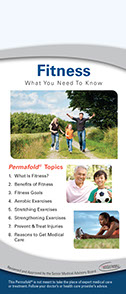
    Cover image to the Fitness brochure by the American Institute for Preventive Medicine. www.HealthyLife.com. All rights reserved.

    © American Institute for Preventive Medicine

  • Face Up To Your Drinking Habits

    Substance Use & Abuse

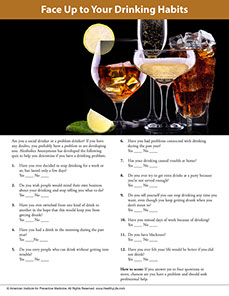
    Are you a social drinker or a problem drinker? If you have any doubts, you probably have a problem or are developing one. Alcoholics Anonymous has developed the following quiz to help you determine if you have a drinking problem.

    1.  Have you ever decided to stop drinking for a week or so, but lasted only a few days?  Yes ____ No ____

    2.  Do you wish people would mind their own business about your drinking and stop telling you what to do?  Yes ____ No ____

    3.  Have you ever switched from one kind of drink to another in the hope that this would keep you from getting drunk?  Yes ____ No ____

    4.  Have you had a drink in the morning during the past year?  Yes ____No ____

    5.  Do you envy people who can drink without getting into trouble?  Yes ____ No ____

    6.  Had problems connected with drinking during the past year?  Yes ____ No ____

    7.  Has your drinking caused trouble at home?  Yes ____ No ____

    8.  Do you ever try to get extra drinks at a party because you’re not served enough?

    Yes ____      No ____

    9.  Do you tell yourself you can stop drinking any time you want, even though you keep getting drunk when you don’t mean to?  Yes ____ No ____

    10. Have you missed days of work because of drinking?  Yes ____ No ____

    11. Do you have blackouts?  Yes ____ No ____

    12. Have you ever felt your life would be better if you did not drink?  Yes ____ No ____

    How to score: If you answer yes to four questions or more, chances are you have a problem and should seek professional help.

    Page from A Year of Health Hints book by the American Institute for Preventive Medicine. www.HealthyLife.com. All rights reserved.

    © American Institute for Preventive Medicine

  • Exercise Smart

    Fitness

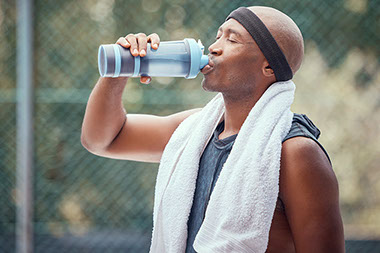
    Man with towel behind neck while drinking out of a water bottle.

    Weekend athletes are more prone to injuries than persons who exercise on a regular basis. To help lower the risk of injury, warm up your muscles with light activity or walking. Cool down at the end of exercising and stretch afterward.

    Each week, adults need 150 minutes of moderate intensity exercise, plus 2 days of muscle strengthening activity.

    Schedule physical activities into your day. Exercise while you watch TV. Take brief walks during lunchtime or breaks at work.

    Poor-fitting athletic shoes can cause pain in your feet and other areas of the body. Choose a shoe for the activity (e.g., running, walking, and tennis). Try new shoes on after a workout or at the end of the day when your feet tend to be their largest.

    Water is the best fluid to drink before, during and after you exercise. Drink 1 to 2 cups of water 15 minutes before you exercise. During exercise, drink about 1/2 cup every 10 to 20 minutes. Taking in large amounts all at once could cause a bloated feeling.

    Page from HealthyLife Weigh book by the American Institute for Preventive Medicine. www.HealthyLife.com. All rights reserved.

    © American Institute for Preventive Medicine

  • Eating For Peak Performance

    Fitness

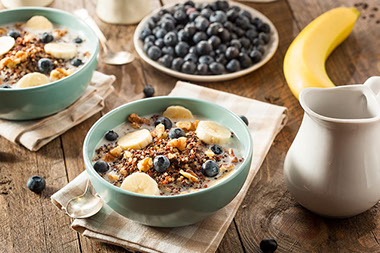
    Image of oat cereal with fresh fruit.

    No pill or magic formula can instantly turn you into a super-athlete. But eating right can help you perform at your best.

    Carbohydrates-from bread, pasta, potatoes, and fruit-provide energy for vigorous activity. So active people need to replenish this fuel frequently.  Don’t expect to get a quick energy boost from a snack you eat just before starting out, though.  Instead, consuming a high-carbohydrate food like skim milk and a banana, whole wheat bread, or an orange an hour or two before a workout acts like a time-release capsule of energy.

    Because you lose electrolytes (potassium, sodium, magnesium, and calcium) in sweat during vigorous activity, drink plenty of water and eat foods that are rich in these minerals. Almost all fruits and vegetables are rich in potassium, but potatoes, bananas, orange juice, winter squash, cantaloupe, sweet potatoes, and cooked beans are especially high. Sodium is rarely lost in quantities greater than amounts you would normally consume, so you don’t need to worry about getting extra.

    Page image from the A Year of Health Hints book by the American Institute for Preventive Medicine. www.HealthyLife.com. All rights reserved.

    © American Institute for Preventive Medicine

  • Eat The Rainbow With Soup

    Nutrition

    Soup with a variety of color.

    Soup is a great way to pack a lot of colorful veggies into one meal! Soups that feature vegetables, beans, or brown rice add fiber and nutrients to your diet. Soup is a great option if you are looking to add more fiber to your diet. It also increases your water intake and helps prevent constipation as you increase how much fiber you are eating.

    Be More Earth-Friendly

    Eating sustainably is one way you can give the earth a hand. Buy your fruits and vegetables from local producers. Try eating more sustainably caught seafood. Get more of your protein from non-meat sources, like beans, lentils, nuts, and seeds.

    Page from HealthyLife Weigh book by the American Institute for Preventive Medicine. www.HealthyLife.com. All rights reserved.

    © American Institute for Preventive Medicine