Author: AIPM

  • Go For The Good Oils

    Nutrition

    Image of olive oil and olives.

    Polyunsaturated or monounsaturated oils are often called the good fats because small amounts may actually help to reduce cholesterol levels. They include:

    *  Canola or rapeseed oil (monounsaturated).

    *  Corn oil (polyunsaturated).

    *  Olive oil (monounsaturated).

    *  Peanut oil (monounsaturated).

    *  Safflower oil (polyunsaturated).

    *  Sesame oil (polyunsaturated).

    *  Soybean oil (polyunsaturated).

    Monounsaturated oils are preferred because they lower LDL cholesterol (bad cholesterol) without lowering HDL cholesterol (good cholesterol). Polyunsaturated fats tend to lower both.

    Page from A Year of Health Hints book by the American Institute for Preventive Medicine. www.HealthyLife.com. All rights reserved.

    © American Institute for Preventive Medicine

  • Remember:Kids Are People, Too

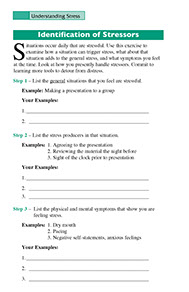
    Stress Management

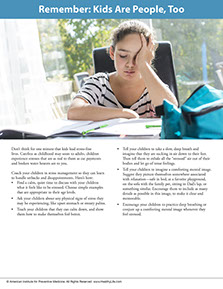
    Image of young child stressed.

    Don’t think for one minute that kids lead stress-free lives. Carefree as childhood may seem to adults, children experience stresses that are as real to them as car payments and broken water heaters are to you.

    Coach your children in stress management so they can learn to handle setbacks and disappointments. Here’s how:

    *  Find a calm, quiet time to discuss with your children what it feels like to be stressed. Choose simple examples that are appropriate to their age levels.

    *  Ask your children about any physical signs of stress they may be experiencing, like upset stomach or sweaty palms.

    *  Teach your children that they can calm down, and show them how to make themselves feel better.

    *  Tell your children to take a slow, deep breath and imagine that they are sucking in air down to their feet. Then tell them to exhale all the “stressed” air out of their bodies and let go of tense feelings.

    *  Tell your children to imagine a comforting mental image. Suggest they picture themselves somewhere associated with relaxation-safe in bed, at a favorite playground, on the sofa with the family pet, sitting in Dad’s lap, or something similar. Encourage them to include as many details as possible in this image, to make it clear and memorable.

    *  Encourage your children to practice deep breathing or conjure up a comforting mental image whenever they feel stressed.

    Page from A Year of Health Hints book by the American Institute for Preventive Medicine. www.HealthyLife.com. All rights reserved.

    © American Institute for Preventive Medicine

  • Immunizations: Your Best Shot Against Infectious Diseases

    Healthy Travel

    Image of mother comforting young daughter as she gets a shot.

    Polio, yellow fever, cholera, malaria, and typhoid are not typical problems in the United States and most developed countries. But outbreaks are common in certain rural or undeveloped parts of the world.

    Here’s what to do if you plan to travel outside the United States.

    *  Be sure you’ve been immunized against diphtheria, pertussis (whooping cough), tetanus, polio, measles, rubella, and mumps. Most people are routinely immunized against these diseases in childhood. You should have a booster shot for tetanus every ten years, however.

    *  Ask your doctor if he or she recommends medicine to prevent malaria or immunizations against influenza, pneumonia, or hepatitis.

    *  Contact your doctor or local health department to determine if you need to receive additional immunizations for your trip. Vaccination requirements for specific countries are also listed in the booklet, Health Information for International Travel-The Yellow Book, available from the Centers for Disease Control and Prevention (CDC).

    For information, call the CDC Travelers’ Information Line at 1.800.CDC.INFO (232.4636). Or accesswww.cdc.gov/travelon the Internet and select “Travelers’ Health.” You can find out what immunizations are advised for the places you are planning to go to. You can also find out about specific notices and outbreak advisories.

    Most immunizations are not required, but are recommended to protect the health of the traveler. Under the International Health Regulations adapted by the World Health Organization (WHO), a country may, under certain conditions, require an International Certificate of Vaccination against yellow fever from international travelers. A copy of the International Certificate of Vaccination, CDC 731 (formerly PHS-731), may be purchased from the U.S. Government Printing Office, Washington, DC 20402,http://bookstore.gpo.gov, 1.866.512.1800.

    Page image from A Year of Health Hints book by the American Institute for Preventive Medicine. www.HealthyLife.com. All rights reserved.

    © American Institute for Preventive Medicine

  • How To Survive A Dieting Setback

    Weight Control

    Image of women in front of a cupcake and apple on a scale.

    Everyone experiences occasional setbacks, especially people on diets. The trick is to prevent a minor slip from becoming a major disaster that thwarts your long-term weight-loss goals.

    The most determined dieter cheats once in a while-it’s only human. Don’t chastise yourself or give up because you’ve had a slip-up in your eating plans. Remember, a temporary setback does not equal a permanent failure!

    Here’s what to remember when you go astray.

    *  Setbacks are a natural part of learning self-control.

    *  Acknowledge your mistake and plan how you’ll respond to a similar situation the next time. Make it work to your advantage.

    *  Remember, long-term success is still quite possible.

    *  Give yourself positive feedback. If you eat half of a candy bar, for instance, praise yourself for not eating the whole thing.

    Page from A Year of Health Hints book by the American Institute for Preventive Medicine. www.HealthyLife.com. All rights reserved.

    © American Institute for Preventive Medicine

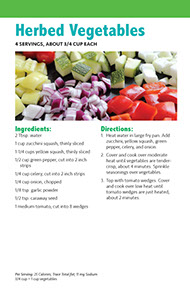
  • Herbed Vegetable Combo

    Nutrition

    4 Servings, about 3/4 cup each

    Ingredients:

    2 Tbsp. water

    1 cup zucchini squash, thinly sliced

    1-1/4 cups yellow squash, thinly sliced

    1/2 cup green pepper, cut into 2 inch strips

    1/4 cup celery, cut into 2 inch strips

    1/4 cup onion, chopped

    1/2 tsp. caraway seed

    1/8 tsp. garlic powder

    1 medium tomato, cut into 8 wedges

    Directions:

    1.  Heat water in large fry pan. Add squash, green pepper, celery, and onion.

    2.  Cover and cook over moderate heat until vegetables are tender-crisp, about 4 minutes. Sprinkle seasonings over vegetables.

    3.  Top with tomato wedges. Cover and cook over low heat until tomato wedges are just heated, about 2 minutes.

    Per Serving:

    Calories – 25

    Total fat – Trace

    Sodium – 11 mg

    Page from HealthyLife Weigh Recipe book by the American Institute for Preventive Medicine. www.HealthyLife.com. All rights reserved.

    © American Institute for Preventive Medicine

  • Healthy Travel Basics

    Healthy Travel

    Travel Tips

    *  Leave your trip’s itinerary with someone.

    *  Do not look like a tourist. Wear plain clothes and little, if any, jewelry.

    *  Walk at night with others and in well-lit, safe areas. Ask hotel staff for advice.

    *  Take healthy snacks or buy them at a nearby grocery.

    *  Use the hotel stairs as a stair stepper.

    *  Stretch using a bath towel or exercise with a jump rope.

    Traveler’s First-Aid Kit

    *  Rubbing alcohol or alcohol wipes

    *  Antibacterial cream or spray

    *  Bandages and gauze pads

    *  Elastic bandages

    *  Mild pain reliever (e.g., acetaminophen, ibuprofen). Before your trip, ask your doctor what you should take.

    *  Antacids

    *  Cough and cold remedies

    *  Diarrhea medication

    *  Broad-spectrum antibiotic (requires a doctor’s prescription)

    Reducing Travel Stress

    *  Prepare for your trip well in advance. Make a list of things to do each day.

    *  Finish packing your bags at least one full day before you leave. Devote the remaining time to getting organized, i.e. plants watered.

    *  Allow plenty of time to reach your destination or flight.

    *  Don’t over-schedule activities.

    *  Sleep enough, exercise, and don’t overeat.

    *  Schedule your return so you have a day to “decompress”.

    Airplane & Car

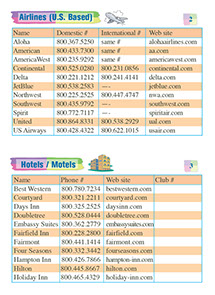
    Airlines (US only)

    Aloha

    800.367.5250  *www.alohaaircargo.com

    American

    800.433.7300  *www.aa.com

    Delta

    800.221.1212  *www.delta.com

    JetBlue

    800.538.2583  *www.jetblue.com

    Southwest

    800.435.9792  *www.southwest.com

    Spirit

    800.772.7117  *www.spiritair.com

    United

    800.864.8331  *www.ual.com

    US Airways

    800.428.4322  *www.usair.com

    Jet Lag

    *  Three nights before you leave, change your bedtime. If traveling to a different time zone and going east, go to bed 1 hour earlier for each time zone you cross; if you’re traveling west, go to bed one hour later for each time zone you cross.

    *  Once on the plane, change your watch to match the time where you are going. Act according to that time. For example, if it is time to sleep in the place you are going, try to sleep on the plane. If it is daytime, do activities that keep you awake.

    *  Ask your doctor about using melatonin, an OTC product that may help “reset” your natural awake/sleep cycle. Also ask about taking vitamin B12 and vitamin C supplements.

    *  During the flight, avoid sleeping pills, alcohol, and caffeine. Drink plenty of fluids to avoid dehydration.

    *  If you arrive at your destination during the day, plan to spend some time outdoors. Try to expose yourself to as many hours of daylight as the number of time zones you crossed.

    *  Don’t go to bed until evening.

    In-Flight Ear Pops

    Note: Consult your physician if you have an acute ear infection, a severe head cold, or sinusitis before flying.

    *  Swallow frequently, yawn, or gently blow through your nose while pinching the nostrils shut to equalize pressure within your ears. (Don’t do this if you have a head cold as it will promote an ear infection.)

    *  If you have a mild head cold, use a nasal spray to keep the nasal passages open. You can also take a decongestant if okay with your doctor.

    Infants and Young Children

    *  Have your infant suck on a pacifier or bottle during the takeoff and landing. (Nursing a baby also helps.)

    *  Ask your doctor about giving children a mild decongestant and antihistamine 1 hour before takeoff and 1 hour before landing.

    Fitness in Flight

    *  Tense your feet for 5 seconds, then relax them. Repeat with each muscle group, including your calves, thighs, buttocks, shoulders, neck, forearms, and hands.

    *  Drop your head forward. Then slowly move it to your right and continue rotating your head to the back, to the left, and to the front again. Repeat four times. Then reverse direction and repeat five times.

    *  Raise both shoulders, then move them back, down, and forward in a circular motion.

    *  Reaching toward the ceiling, stretch your right arm. Then repeat with your left arm.

    To promote leg circulation

    *  Flex and extend your feet, pointing your toes up and down.

    *  Try to get up and walk at least once every 2 hours, if possible. You should also make an effort to breathe slowly and deeply. Aircraft air is lower in oxygen than outdoor air. Deep breathing helps you to get enough oxygen into your blood and avoid fatigue or sluggishness.

    Alamo:  800.462.5266  *www.alamo.com

    Avis:  800.230.4898  *www.avis.com

    Budget:  800.527.0700  *www.budgetrentacar.com

    Dollar:  800.800.3665  *www.dollar.com

    Enterprise:  800.736.8222  *www.enterprise.com

    Hertz:  800.654.3131  *www.hertz.com

    National:  800.227.7368  *www.nationalcar.com

    Payless:  800.237.2804  *www.paylesscar.com

    Thrifty:  800.847.4389  *www.thrifty.com

    Auto Europe: 888.223.5555  *www.autoeurope.com

    Hotel

    Hotel Safety

    *  When you enter your room, prop the door open, turn on the lights, and check all areas before you close the door.

    *  Make sure that windows and connecting doors are locked.

    *  Avoid first floor rooms and those with doors facing outside.

    *  Lock your door using the safety chain.

    *  When you are not in your room, turn the TV on and hang the “Do Not Disturb” sign.

    *  Study the emergency exit map to prepare for an escape.

    Best Western:  800.780.7234  *www.bestwestern.com

    Courtyard:  800.321.2211  *www.courtyard.com

    Days Inn:  800.325.2525  *www.daysinn.com

    Doubletree:  800.528.0444  *www.doubletree.com

    Embassy Suites:  800.362.2779  *www.embassysuites.com

    Fairmont:  800.441.1414  *www.fairmont.com

    Four Seasons:  800.332.3442  *www.fourseasons.com

    Hampton Inn:  800.426.7866  *www.hampton-inn.com

    Hilton:  800.445.8667  *www.hilton.com

    Holiday Inn:  800.465.4329  *www.holiday-inn.com

    Howard Johnson:  800.654.2000  *www.hojo.com

    Hyatt:  800.233.1234  *www.hyatt.com

    LaQuinta:  800.531.5900  *www.laquinta.com

    Le Meridien:  800.543.4300  *www.lemeridien.com

    Marriott:  800.228.9290  *www.marriott.com

    Motel 6:  800.4motel6  *www.motel6.com

    Omni:  800.843.6664  *www.omnihotels.com

    Radisson:  800.333.3333  *www.radisson.com

    Ramada:  800.228.2828  *www.ramada.com

    Red Lion:  800.733.5466  *www.redlion.com

    Red Roof: 800.843.7663  *www.redroof.com

    Residence Inn:  800.331.3131  *www.residenceinn.com

    Ritz Carlton:  800.241.3333  *www.ritzcarlton.com

    Sheraton:  800.325.3535  *www.sheraton.com

    Super8:  800.848.8888  *www.super8.com

    Travel Lodge:  800.255.3050  *www.travelodge.com

    Westin:  888.625.5144  *www.westin.com

    Wyndham:  800.822.4200  *www.wyndham.com

    Motel Sickness

    Preventing Motion Sickness

    Aboard a ship

    *  Spend as much time as you can on deck in the fresh air.

    *  If you’re going to be spending nights on a boat, try to get a cabin near the middle and close to the waterline where there’s less pitching and rolling.

    On a plane

    *  Request a seat over the wings. Avoid sitting in the tail section as it’s the bumpiest.

    *  Open the overhead vents and direct air at your face.

    On a train or car

    *  Fix your gaze on the scenery straight ahead, not to the side.

    *  Sit by an open window for fresh air unless in a polluted area.

    *  If you’re traveling by car, offer to drive. The driver doesn’t usually get motion sickness.

    Other Tips

    *  Get plenty of rest before setting out. Fatigue makes you more vulnerable to motion sickness.

    *  Avoid drinking alcohol before or during travel and don’t overindulge the night before.

    *  Take an OTC medication (i.e., Dramamine®) 30 minutes before travel begins.

    *  If OTC products don’t bring relief, ask your doctor about a prescription medication with scopolamine (a patch).

    *  Don’t read while traveling and don’t try to focus on any other stationary object. Aboard a ship, lie down on your back and close your eyes.

    *  If any of your traveling companions get motion sickness, move away, otherwise you may get sick.

    Page from the Travel CareKit book by the American Institute for Preventive Medicine. www.HealthyLife.com. All rights reserved.

    © American Institute for Preventive Medicine