Author: AIPM

  • Reduce Flight Risks

    Healthy Travel

    Don’t let motion and a long flight ruin your trip.

    Flying can trigger more than anxiety in airplane travelers. Sitting for hours in narrow, cramped seats can cause a decrease in blood flow and poor circulation in the legs. These problems can lead to “economy-class syndrome” which refers to a deep vein thrombosis – a blood clot in the leg. Even if you sit in first class or business class, there are things you can do to help avoid this problem. If your seatmates stare, suggest they join you!

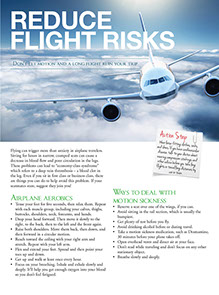
    Image of flying airplane.

    Airplane aerobics:

    *  Tense your feet for five seconds, then relax them. Repeat with each muscle group, including your calves, thighs, buttocks, shoulders, neck, forearms, and hands.

    *  Drop your head forward. Then move it slowly to the right, to the back, then to the left and the front again.

    *  Raise both shoulders. Move them back, then down, and then forward in a circular motion.

    *  Reach toward the ceiling with your right arm and stretch. Repeat with your left arm.

    *  Flex and extend your feet. Spread and then point your toes up and down.

    *  Get up and walk at least once every hour.

    *  Focus on your breathing. Inhale and exhale slowly and deeply. It’ll help you get enough oxygen into your blood so you don’t feel fatigued.

    To deal with motion sickness:

    *  Reserve a seat over one of the wings, if you can.

    *  Avoid sitting in the tail section, which is usually the bumpiest.

    *  Get plenty of rest before you fly.

    *  Avoid drinking alcohol before or during travel.

    *  Take a motion sickness medication, such as Dramamine, 30 minutes before your plane takes off.

    *  Open overhead vents and direct air at your face.

    *  Don’t read while traveling and don’t focus on any other stationary object.

    *  Breathe slowly and deeply.

    Action Step

    Wear loose-fitting clothes, socks, and shoes. If you have cardiovascular disease, talk to your doctor about wearing compression stockings and other advice before you take long flights or travel long distances by car or train.
    Page image from Ways to Well-Being book by the American Institute for Preventive Medicine. www.HealthyLife.com. All rights reserved.

    © American Institute for Preventive Medicine

  • Set A Weight Loss Goal You Can Reach

    Weight Control

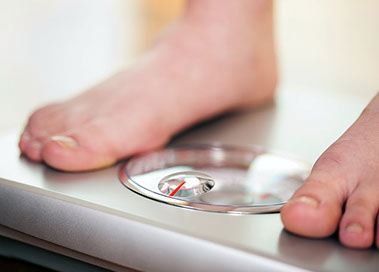
    Image of feet on a scale.

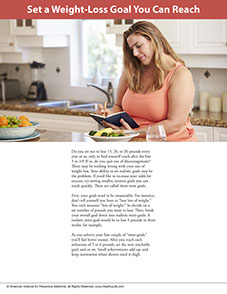
    Do you set out to lose 15, 20, or 30 pounds every year or so, only to find yourself stuck after the first 5 or 10? If so, do you quit out of discouragement?

    There may be nothing wrong with your rate of weight loss. Your ability to set realistic goals may be the problem. If you’d like to increase your odds for success, try setting smaller, interim goals you can reach quickly. These are called short-term goals.

    First, your goals need to be measurable. For instance, don’t tell yourself you have to “lose lots of weight.” You can’t measure “lots of weight.” So decide on a set number of pounds you want to lose. Then, break your overall goal down into realistic mini-goals. A realistic mini-goal would be to lose 5 pounds in three weeks, for example.

    As you achieve your first couple of “mini-goals,” you’ll feel better sooner. After you reach each milestone of 5 or 6 pounds, set the next reachable goal, and so on. Small achievements add up, and keep motivation where dieters need it-high.

    Page from A Year of Health Hints book by the American Institute for Preventive Medicine. www.HealthyLife.com. All rights reserved.

    © American Institute for Preventive Medicine
  • Save Time. Be Organized.

    Stress Management

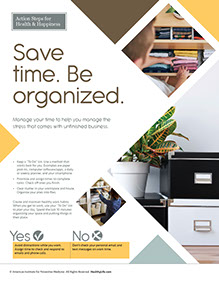
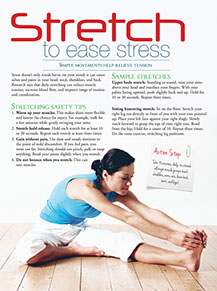
    Women organizing linens in baskets.

    Manage your time to help you manage the stress that comes with unfinished business.

    *  Keep a “To Do” list. Use a method that works best for you. Examples are paper post-its, computer software/apps, a daily or weekly planner, and your smartphone.

    *  Prioritize and assign times to complete tasks. Check off ones you finish.

    *  Clear clutter in your workspace and house. Organize your piles into files.

    Create and maintain healthy work habits. When you get to work, use your “To Do” list to plan your day. Spend the last 10 minutes organizing your space and putting things in their place.

    Avoid distractions while you work. Assign time to check and respond to emails and phone calls.

    Don’t check your personal email and text messages on work time.

    Page from HealthyLife Weigh book by the American Institute for Preventive Medicine. www.HealthyLife.com. All rights reserved.

    © American Institute for Preventive Medicine
  • Safe Travel For Pregnant Women

    Healthy Travel

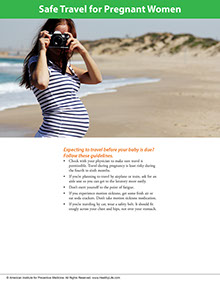
    Image of pregnant women on vacation.

    Expecting to travel before your baby is due? Follow these guidelines.

    *  Check with your physician to make sure travel is permissible. Travel during pregnancy is least risky during the fourth to sixth months.

    *  If you’re planning to travel by airplane or train, ask for an aisle seat so you can get to the lavatory more easily.

    *  Don’t exert yourself to the point of fatigue.

    *  If you experience motion sickness, get some fresh air or eat soda crackers. Don’t take motion sickness medication.

    *  If you’re traveling by car, wear a safety belt. It should fit snugly across your chest and hips, not over your stomach.

    Page image from A Year of Health Hints book by the American Institute for Preventive Medicine. www.HealthyLife.com. All rights reserved.

    © American Institute for Preventive Medicine
  • Reward Yourself For Weight Loss

    Weight Control

    When a behavior is followed by a reward, the behavior is more likely to be repeated. So the more you are rewarded for your weight-loss efforts, the more likely you’ll continue to succeed.

    But you don’t have to wait until you lose weight to reward yourself Rewards should begin the very first day of your diet. (Of course, food should not be a reward.)

    Here are just a few examples of the kinds of rewards that can help you to adhere to your weight-control plan.

    *  Buy yourself a bouquet of flowers.

    *  Call a friend long-distance.

    *  Give yourself some special “me” time.

    *  Try a new cologne.

    *  Get your car washed.

    *  Have a low-calorie picnic. (The picnic is the reward, not the food.)

    *  Treat yourself to a movie.

    *  Keep a diary of all the improvements you notice while dieting (more stamina, feeling attractive, fitting into smaller-size clothing).

    Page from A Year of Health Hints book by the American Institute for Preventive Medicine. www.HealthyLife.com. All rights reserved.

    © American Institute for Preventive Medicine

  • “Rehearse” For Stressful Events

    Stress Management

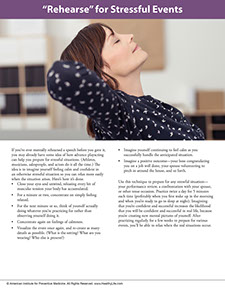
    Image of women giving a business proposal in front of co-workers.

    If you’ve ever mentally rehearsed a speech before you gave it, you may already have some idea of how advance playacting can help you prepare for stressful situations. (Athletes, musicians, salespeople, and actors do it all the time.) The idea is to imagine yourself feeling calm and confident in an otherwise stressful situation so you can relax more easily when the situation arises. Here’s how it’s done.

    *  Close your eyes and unwind, releasing every bit of muscular tension your body has accumulated.

    *  For a minute or two, concentrate on simply feeling relaxed.

    *  For the next minute or so, think of yourself actually doing whatever you’re practicing for rather than observing yourself doing it.

    *  Concentrate again on feelings of calmness.

    *  Visualize the event once again, and re-create as many details as possible. (What is the setting?  What are you wearing? Who else is present?)

    *  Imagine yourself continuing to feel calm as you successfully handle the anticipated situation.

    *  Imagine a positive outcome-your boss congratulating you on a job well done, your spouse volunteering to pitch in around the house, and so forth.

    Use this technique to prepare for any stressful situation-your performance review, a confrontation with your spouse, or other tense occasion. Practice twice a day for 5 minutes each time (preferably when you first wake up in the morning and when you’re ready to go to sleep at night). Imagining that you’re confident and successful increases the likelihood that you will be confident and successful in real life, because you’re creating new mental pictures of yourself. After practicing regularly for a few weeks to prepare for various events, you’ll be able to relax when the real situations occur.

    Page from A Year of Health Hints book by the American Institute for Preventive Medicine. www.HealthyLife.com. All rights reserved.

    © American Institute for Preventive Medicine