Author: AIPM

  • Traveling

    Healthy Travel

    Smiling women standing in front of the Leaning Tower of Pisa, holding a camera.

    The best of travel plans can be ruined if you get sick or aren’t able to deal with health problems on your trip. Discuss your travel plans with your doctor.

    Make sure to take enough medicines you need for the whole trip.

    Depending on your destination, this may include insect repellant, sunscreen (SPF 30 or higher), hand sanitizer (60% alcohol or higher), and face masks.

    Find out if and what your health insurance covers if you need medical care during your trip. You may consider purchasing additional travel health insurance. Find out where to go for care, if needed.

    Certain vaccines may be required by some countries before you visit them. Find out if and what vaccines are required for places that you plan to travel from the CDC Travelers’ Health Web site atcdc.gov/travel.

    Page from HealthyLife Weigh book by the American Institute for Preventive Medicine. www.HealthyLife.com. All rights reserved.

    © American Institute for Preventive Medicine

  • Tired Of Doing The Same Exercises?

    Fitness

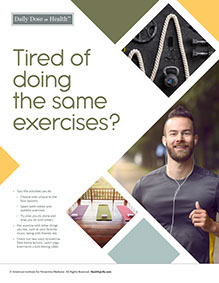
    Man jogging outside.

    *  Vary the activities you do.

    –  Choose ones unique to the four seasons.

    –  Select both indoor and outdoor exercises.

    –  Try ones you do alone and ones you do with others.

    *  Pair exercise with other things you like, such as your favorite music, being with friends, etc.

    *  Check out new ways to exercise. Take dance lessons. Learn yoga. Exercise to a kick-boxing video.

    Page from HealthyLife Weigh book by the American Institute for Preventive Medicine. www.HealthyLife.com. All rights reserved.

    © American Institute for Preventive Medicine

  • Time Management

    Systematic Stress Management Program

    Step 6: Time Management

    Step 6: Time Management Section

    Introduction

    Does Time Get the Best of You?

    Defining Your Life Goals

    Activity Worksheet

    Activity Log

    Time Management Techniques

    Action Plan for Improving Time Usage

    Procrastination Quiz

    How Do I Procrastinate?

    One Dozen Ways to Overcome Procrastination

    Should You Delegate?

    Delegation Caddy

    Read the following suggestions on how to manage your time more effectively. Concentrate on correcting those areas that waste the most time for you.

    Decreasing Time Wasters

    1. Learn to say “no.”

    This technique helps to prioritize the people and tasks in your life. Lower priority people and tasks require a “no” response. Use assertiveness. Learn to say “no” to unwanted interruptions, invitations, and requests.

    2. Put perfectionism in its proper place.

    Perfectionism is often a poor use of time. Not everything requires perfection. High priority items require more perfection than low priority items. By demanding perfection of yourself and others, you may be wasting time in unnecessary effort.

    3. Avoid or manage interruptions.

    Interruptions are one of the biggest time wasters. Common time wasters are emails, instant messages (IMs), text messages, phone calls, and uninvited guests. Follow these guidelines and gain some control over daily interruptions.

    Technology Tools

    *  Make and return calls and send and return emails, Instant Messages (IMs), and texts at times that allow the most efficient use of your time.

    *  Screen calls. Send them to voicemail, as needed.

    *  Keep IMs work-related and brief. Keep email responses to four sentences or less.

    *  Monitor lengths of calls. Limit chit chat.

    *  Use “do not disturb” technology, as needed.

    *  Send and accept personal calls, texts, etc. on non-work times.

    Uninvited Visitors

    *  Close your door.

    *  Face desk away from office traffic.

    *  Establish quiet time – no guests.

    *  Plan regular visiting time.

    *  Remain standing when a visitor is present.

    *  Don’t add to chatter.

    *  Let the visitor know how you honestly feel about interruptions.

    4. Delegate when possible.

    Try assigning some low priority tasks to others. This can free up your time for more important things. Delegation is also a good option for tasks that do not require perfection.

    5. Remember: Handle each piece of paper or mail only once.

    Immediately make your decisions about what attention it requires. Don’t stack papers that you will look at again and again. Deal with emails efficiently, too. Delete ones you do not need. Unsubscribe to mailing lists not relevant to your work or that you do not read. Use your email server’s “Tools” menu to create “Action” and “Archive” folders, labels, and filters to organize emails. Set aside specific times to read and respond to emails.

    6. Transform commuting and waiting time.

    Listen to books, language programs, and education materials on audio cassettes while commuting, exercising, or waiting in line.

    7. Have assigned places and systems for routine items and tasks.

    Always store keys, purse, briefcase, tools, and utensils in the same place. Often used clothing and grooming items also need a special place. This reduces the time wasted searching for routine items.

    Increase Productive Activities

    1. Think of the 80/20 Principle.

    Carefully choose where you will concentrate your efforts. The 80/20 principle states that 80% of the most valuable results come from 20% of the tasks you do. Concentrate your working time on just these important tasks. Avoid the trivial.

    2. Distinguish between activity and productivity.

    Are you wasting time on busy work (activity) that may not lead to a goal or are you spending time productively in a way that will produce results? Concentrate on productive time. Ask yourself often, “Am I just keeping busy or am I really being productive?”

    3. Ask the question: “What is the best use of my time right now?”

    Ask this question when you are uncertain about your use of time. Use this question to get you back on track in the following situations:

    *  after an interruption

    *  when distracted

    *  when procrastinating

    *  when you run out of steam

    4. Make a “To Do” list.

    Make this list every day! Write it down! Keep it at your fingertips! Having a list of activities that can be checked off is gratifying. It also gives you some idea of progress. Don’t list routine items, such as brushing teeth and commuting to work. However, do allow time for these activities.

    5. Follow the ABC Priority System.

    Categorize your activities under A, B, C priorities with “A” being the top priority. Focus your energies on completing the A’s. Perhaps B’s and C’s could be delegated to others. Some C’s may never even have to be done.

    6. Avoid over-commitment.

    This can be caused by inflexible scheduling or over-booking. Know your personal limits and time frames and have realistic expectations.

    7. Schedule quiet time.

    Establish a regular quiet time for yourself. Inform key interrupters and don’t take telephone calls. Allow yourself quiet time to restore your energy.

    8. Balance quiet time and activity time.

    Too much quiet time can reduce the productivity of those around you. They may depend upon your input – emotional and otherwise. Ask your co-workers/family if your quiet time is a problem for them.

    Page from the Systematic Stress Management book by the American Institute for Preventive Medicine. www.HealthyLife.com. All rights reserved.

    © American Institute for Preventive Medicine

    Step 1: Understanding Stress

    Step 3: Type A & B Behavior Patterns

    Step 5: Thinking Differently

    Step 7: Communication & Stress

    Step 2: Stress Management at Work

    Step 4: Biofeedback Training & Relaxation

    Step 6: Time Management

    Steps to Systematic Stress Management™

    RELATED ARTICLES

    © American Institute for Preventive Medicine  –  All Rights Reserved.Disclaimer|www.HealthyLife.com

  • Teach Your Kids Not To Drink

    Substance Use & Abuse

    Underage drinking is a growing problem. All too often, teenage drinking leads to:

    *  Traffic accidents (many of them fatal).

    *  Destruction of property.

    *  Violent or antisocial behavior.

    *  Poor academic performance.

    *  Disciplinary problems.

    *  Withdrawal from social activities.

    *  Problems coping with stress.

    If you suspect (or know) your teenager drinks, don’t ignore it. To discourage or prevent underage drinking:

    *  Be a good role model. The best example you can set is to not drink. But if you choose to drink, drink responsibly. Children of alcoholics are four times as likely to develop a drinking problem as children of nonalcoholic parents.

    *  Show your children that you love them. Be affectionate, and show them you care and are interested in them.

    *  Make an effort to organize family activities. It may be hard to compete with your son’s or daughter’s peers for their attention at times, but make the effort anyway. Shared hobbies and sports can create bonds and strengthen a teen’s resistance to outside influences.

    *  Discuss the potential risks and consequences of alcohol use before it becomes a problem. Answer questions honestly and let your children know how you feel about them drinking before the situation arises.

    *  Tell your children to never get into a car with a drunk driver. Promise you’ll pick them up anytime, anywhere, no questions asked, if they call you instead of putting themselves at risk.

    Page from A Year of Health Hints book by the American Institute for Preventive Medicine. www.HealthyLife.com. All rights reserved.

    © American Institute for Preventive Medicine

  • Take That First Step

    Fitness

    Smiling women walking with walking sticks.

    Walking is one of the most beneficial, and safest, exercises you can do. That makes walking a great way to start if you’re just beginning an exercise routine. It’s also ideal for weight loss. And, it’s a great way to exercise with friends! Set a target for the number of steps you want to walk each day or week. Over time, you can increase the number of steps, or the intensity, by walking faster or including hills. Aim for at least 150 minutes of exercise each week.

    Be More Earth-Friendly

    Motor vehicles are responsible for significant amounts of greenhouse gas emissions in the U.S. Choose to walk rather than drive to help reduce air pollution and greenhouse gases.

    Page from HealthyLife Weigh book by the American Institute for Preventive Medicine. www.HealthyLife.com. All rights reserved.

    © American Institute for Preventive Medicine

  • Success Over Stress Basics

    Stress Management

    Stress is the way you react to any change (good, bad, real, or even imagined).

    What is Stress?

    These are ways the body responds to stress:

    *  Pupils dilate (get wider).

    *  Breathing speeds up.

    *  Heart rate speeds up.

    *  Oxygen increases in the blood.

    *  Blood moves to major muscles.

    *  Blood pressure rises.

    *  Muscles tense.

    *  Sweating occurs.

    *  Blood sugar increases.

    *  Abstract thinking goes down.

    Stress can make you more productive. It can also help you respond to threats to your safety, such as being near a fire.

    High levels of stress, though, can make you less productive. When left unchecked, stress can lead to health problems. These include:

    *  Heartburn

    *  Back or neck pain

    *  High blood pressure

    *  Heart disease

    *  A lowering of the body’s immune system

    In fact, the American Academy of Family Physicians states that about two-thirds of all visits to the family doctor are stress-related.

    Prevent Burnout

    You can get burnout from work or anything that takes more energy than you can give. Burnout is not a one-time event. It builds over time. The saying, “An ounce of prevention is worth a pound of cure,” applies to burnout.

    Tips to Help Prevent Burnout

    *  Set career and personal goals that can be achieved. Attempt to do well, but don’t try to be perfect.

    *  Follow good health habits.

    *  Try not to spread yourself too thin. Delegate tasks at work and at home to lessen your load. Learn to say, “No.”

    *  Prioritize what you need to get done in a day, a week, etc.

    *  Reduce long work or study hours, if you can. The more you do and the less you rest, the more likely burnout will occur.

    *  If you feel overwhelmed with your workload, discuss this with your boss.

    *  Discuss feelings and problems you are having with your family, friends, and coworkers. Talking helps to ease feelings of frustration that feed burnout. If things don’t get better, get help.

    *  Take regular 5 to 10 minute relaxation breaks. Take mental breaks from stressful situations, too. Learn to meditate and to practice relaxation techniques.

    *  Make time for leisure activities that you enjoy. Do these daily or at least every week.

    *  Plan one or more vacations during the year. Don’t work on your vacation.

    Relaxation Exercises

    Breathing Exercises

    Breathing exercises promote relaxation in 4 ways.

    1.  They tense and relax muscles. Taking a deep breath tenses muscles used for breathing. A deep exhale relaxes them.

    2.  They allow more oxygen to be absorbed. This assists the body’s response to stress. It also helps the body recover from stress.

    3.  They increase the amount of oxygen, which allows the heart to slow down. This helps calm you.

    4.  They give you the chance to pause and plan your response to something that causes stress.

    Deep Natural Breathing Steps

    1.  Sit in a chair, arms at your sides, legs uncrossed.

    2.  Note any tension in your muscles.

    3.  Put one hand on your chest and the other on  your abdomen.

    4.  Take in a breath slowly and deeply through your nose. Allow your abdomen to expand and push up your hand. After your abdomen is full of air, allow your chest to expand pushing up your other hand. This is one long, steady breath.

    5.  Hold the air in for 3 seconds.

    6.  Purse your lips and exhale through your mouth. Make a relaxing, whooshing sound.

    7.  Keep taking long, slow, deep inhales through  your nose and let out long, slow exhales through your mouth.

    8.  Focus on the sound and feeling of deep breathing. Continue for 3 to 5 minutes.

    Purifying Sighing Steps

    1.  Keep your shoulders erect.

    2.  Let out a big sigh, making a sound of relief as the air leaves your mouth.

    3.  Continue to sigh 10 to 15 times, one after the other.

    Note: If you are prone to hyperventilating, do not do this breathing exercise.

    Relaxation Exercises

    1.  Choose a quiet place that is free of distraction. Turn off the telephone. Ask for privacy.

    2.  Sit in a comfortable position so there is no extra tension in your muscles. Your chin may drop a bit as you choose to relax. Your feet should touch the floor. Do not lie down. You may fall asleep.

    3.  Close your eyes gently. Don’t squeeze them closed. Expect to feel very relaxed.

    4.  Repeat a word like “one” or any other one-syllable word. Say it silently over and over for 15 minutes. There is no right or wrong way to do this. You can repeat the word quickly or slowly. Do whatever comes naturally.

    5.  When thoughts distract you, ignore them. Return to the word “one.” These other thoughts are supposed to occur. Let them go. This shows the release of stress.

    Progressive Relaxation Steps

    1.  Sit in a chair and close your eyes. Rest your forearms on the sides of the chair. Place your palms downward.

    2.  Take a few slow, deep breaths.

    3.  Focus on any muscle tension you feel, but do nothing about it.

    4.  “Tense” and tighten a muscle group (as listed below) for 5 seconds. Then tell yourself to “relax” and let the tension dissolve for 30 seconds. Do this for each body part.

    – Bend both arms at the elbows and wrists. Make a fist with each hand. Relax.

    – Press your back against the chair. Relax.

    – Tighten your abdomen. Relax.

    – Lift and extend your lower legs. Relax.

    – Tighten your jaw. Relax.

    – Squinch your eyes. Relax.

    – Tuck your chin against your chest. Relax.

    Note: Don’t hold your breath during the tensing phase. Don’t tighten any body region that is weak or injured.

    5.  Keep breathing slowly and deeply.

    6.  Focus on the overall feeling of relaxation. Let your body go limp. Let your head and shoulders drop forward.

    7.  Imagine that you feel an energizing warmth flowing through your body.

    8.  Slowly open your eyes. Note how refreshed  you feel.

    Biofeedback

    Biofeedback uses special machines to monitor stress responses, such as heart rate, sweating, etc. While hooked up to biofeedback devices, you learn to control your body’s automatic responses to stress. Then you learn to do the same thing without the machines. Biofeedback is taught at centers that specialize in this technique.

    There are also biofeedback machines for home use. One example is a relaxometer. It is the size of a transistor radio. You attach two small electrodes to the palm of your hand. Sounds are relayed through earphones to gauge your relaxation level.

    Taking your own pulse is also a biofeedback method. Feel your pulse at your wrist or on the side of your neck. Count how many times you feel your pulse beat in 10 seconds. Multiply that number by 6. This is your 1-minute pulse rate. Take your pulse before and after doing a relaxation technique. Your pulse rate should be lower after you do relaxation exercises.

    Thought Control

    Thought Stopping

    Use this when you are obsessed with negative thoughts. If work problems dominate your thoughts, picture an “off duty” sign for the stop sign.

    1.  Isolate the stressful thought.

    2.  Close your eyes. Briefly focus on the stressful thought.

    3.  Count to three.

    4.  Shout “Stop!” (Or, if others are in earshot, picture a stop sign, a flashing red light, or the word “Stop” in bold letters.)

    5.  If the thought returns, repeat steps 2 to 4.

    6.  Go back to your normal activity. You should feel better.

    “Rehearse” for Stressful Events

    Stage actors rehearse their lines before a play. You can rehearse how you want to feel during events, etc. that cause stress for you. Doing this can help you relax when the stressful event really takes place. Follow these steps:

    1.  Close your eyes and unwind. Release all the tension in your muscles.

    2.  For a minute or two, focus on feeling relaxed.

    3.  For the next minute or so, think that you are really taking part in the event that causes stress for you.

    4.  Focus again on feeling relaxed.

    5.  Picture the event once again. Picture as many details as you can. (What is the setting? What are you wearing? Who else is there?)

    6.  Imagine feeling calm as you handle the stress-causing event with success.

    7.  Imagine a positive outcome. See your boss tell you that you did a good job, etc.

    Tips to Manage Stress

    *  Count to ten when you’re so upset you want to scream. It buys you time so you can think about what’s bothering you. This helps to calm you down.

    *  Own a pet. Studies show that having a pet, such as a dog or cat, appears to cut down the effects of stress on health.

    *  Have a cup of warm herbal tea. Sip it slowly and savor its soothing warmth and aroma.

    *  Change things around you to get rid of or manage your exposure to things that cause stress.

    *  Budget your time. Make a “to do” list. Rank order daily tasks. Don’t commit to doing too much.

    *  View changes as positive challenges.

    *  Sometimes a problem is out of control. When this happens, accept it until changes can be made.

    *  Talk out troubles. Talk with a friend, relative, or member of the clergy. Someone else can help you see a problem from another point of view.

    *  When you feel you are getting nowhere with a problem, escape for a little while. Take a walk, read a book, visit a museum, or take a drive. Leaving a situation for a short time helps you develop new attitudes.

    *  Laugh a lot. Laughter releases tension. It’s hard to feel stress in the middle of a belly laugh.

    *  Take a shower or bath with warm water. This will soothe and calm your nerves and muscles.

    *  Listen to soothing music in a quiet, calm place. Focus on the calmness of the music. When the music ends, you should feel more relaxed.

    *  Reward yourself with things that make you feel good. Add to your stamp collection. Buy flowers. Picnic in the park. Give yourself some “me” time.

    *  Help others. This takes the focus off of you and puts it on the needs of others.

    *  Have a good cry. Tears can help cleanse the body of substances that form under stress. Tears also release a natural pain-relieving substance from the brain.

    Reasons to Contact Doctor

    Reasons to Call Your Doctor or Provider

    For any of the problems listed below, call your doctor or health care provider. You will get advice on what to do.

    *  Anxiety

    *  Nervousness

    *  Crying spells

    *  Confusion about how to handle your problems

    *  You abuse alcohol and/or drugs (illegal or prescription) to deal with stress.

    *  You have been a part of a traumatic event in the past (e.g., armed combat, airplane crash, rape, or assault) and you now have any of these problems:

    – Flashbacks (you relive the stressful event)

    – Painful memories

    – Nightmares

    – Feeling easily startled and/or cranky

    – Feeling “emotionally numb” and detached from others and the outside world

    – Trouble falling asleep and/or staying asleep

    – Anxiety and/or depression

    *  You suffer from a medical illness that you are unable to cope with or that leads you to neglect proper treatment.

    *  You withdraw from friends, relatives, and coworkers and/or yell at them even when you are only slighty annoyed.

    Cover image to the Success Over Stress brochure by the American Institute for Preventive Medicine. www.HealthyLife.com. All rights reserved.

    © American Institute for Preventive Medicine