Author: AIPM

  • Your Pre-Vacation Checklist

    Healthy Travel

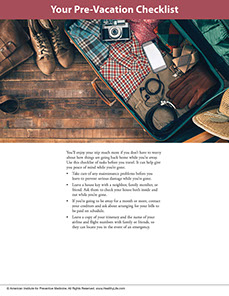
    Image of couple looking at passport and map.

    You’ll enjoy your trip much more if you don’t have to worry about how things are going back home while you’re away. Use this checklist of tasks before you travel. It can help give you peace of mind while you’re gone.

    *  Take care of any maintenance problems before you leave to prevent serious damage while you’re gone.

    *  Leave a house key with a neighbor, family member, or friend. Ask them to check your house both inside and out while you’re gone.

    *  If you’re going to be away for a month or more, contact your creditors and ask about arranging for your bills to be paid on schedule.

    *  Leave a copy of your itinerary and the name of your airline and flight numbers with family or friends, so they can locate you in the event of an emergency.

    Page image from A Year of Health Hints book by the American Institute for Preventive Medicine. www.HealthyLife.com. All rights reserved.

    © American Institute for Preventive Medicine

  • Bike Safety

    BE FIT

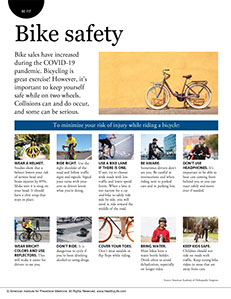
    Bike up against a yellow wall.

    Bike sales have increased during the COVID-19 pandemic. Bicycling is great exercise! However, it’s important to keep yourself safe while on two wheels. Collisions can and do occur, and some can be serious.

    To minimize your risk of injury while riding a bicycle:

    *Wear a helmet.Studies show that a helmet lowers your risk of serious head and brain injuries by 85%. Make sure it is snug on your head. It should have a chin strap that stays in place.

    *Ride right.Use the right shoulder of the road and follow traffic signs and signals. Signal your turns with your arm so drivers know what you’re doing.

    *Use a bike lane if there is one.If not, try to choose wide roads with less traffic and lower speed limits. When a lane is too narrow for a car and bike to safely ride side by side, you will need to ride toward the middle of the road.

    *Be aware.Sometimes drivers don’t see you. Be careful at intersections and when riding next to parked cars and in parking lots.

    *Don’t use headphones.It’s important to be able to hear cars coming from behind you so you can react safely and move over if needed.

    *Wear bright colors and use reflectors.This will make it easier for drivers to see you.

    *Don’t ride.It is dangerous to cycle if you’ve been drinking alcohol or using drugs.

    *Cover your toes.Don’t wear sandals or flip flops while riding.

    *Bring water.Most bikes have a water bottle holder. Drink often to avoid dehydration, especially on longer rides.

    *Keep kids safe.Children should not ride on roads with traffic. Keep young bike riders in areas that are away from cars.

    Source: American Academy of Orthopaedic Surgeons

    © American Institute for Preventive Medicine

  • Alternative Medicine Systems

    Alternative Medicine

    Image of leaf with tag that has the word "Ayurveda"

    These are complete systems of theory and practice. Often, these systems have been used in other countries for centuries. They can be very different from mainstream medicine that is used in the U.S.

    1.  Ayurveda (“ah-yur-VAY-dah”). This system of diagnosis and treatment has been used in India for more than 5,000 years. It includes yoga, meditation, herbs, massage, specific diets, and controlled breathing.

    2.  Homeopathy This method is based on the idea that “like cures like.” Things that cause certain symptoms in a healthy person can also cure those symptoms in someone who is sick. They must be given in small, highly diluted amounts.

    3.  Naturopathy. This uses methods to allow the body to heal itself rather than treat disease. It uses diet, herbal medicine, acupuncture, homeopathy, body manipulation, etc.

    4.  Reiki  (“RAY-kee”). This Japanese word stands for Universal Life Energy. With Reiki, spiritual energy is channeled through a Reiki practitioner to heal a patient’s spirit. Healing the spirit heals the physical body.

    Page from the Healthier at Home book by the American Institute for Preventive Medicine. www.HealthyLife.com. All rights reserved.

    © American Institute for Preventive Medicine

  • Advance Directives

    Medical Care

    Hospitals and nursing homes are required to give you information about your rights as a patient under their care. Advance directives are a legal way for you to declare your wishes to choose or refuse medical treatment.

    {Note: If you live in or get medical care in more than one state, have advance directives for all states involved.}

    Two Types of Advance Directives

    *  Living Will. This written document states what medical treatment you would want or not want if you were unable to state it yourself. A living will applies when you can’t express your wishes on your own and you have a terminal illness or condition from which you aren’t expected to survive. In writing, you may choose or refuse:

    – Measures to Support Life, such as a respirator (a machine to breathe for you).

    – Measures to Sustain Life, such as tube feedings and kidney dialysis (a machine that does the work of your kidneys).

    – Measures to Enhance Life. These keep you comfortable, but don’t prolong life. Examples are pain medications and hospice care.

    *  Durable Power of Attorney for Health Care. This written document names a person who would make treatment decisions for you if you are not able to make them yourself. This person would state your wishes. Your condition does not have to be terminal or irreversible to have someone speak on your behalf.

    Each state has its own laws on advance directives. Get forms for them from your lawyer, local hospital or library, or from your state’s Web site. Other places for forms and information:

    *  Caring Connection:www.caringinfo.org– Click on “Planning Ahead” and “State-Specific Advance Directives.”

    *  U.S. Living Will Registry:www.uslivingwillregistry.com

    After you complete advance directives, discuss them with your family and close friend(s). Give your doctor a copy, too.

    Page from the Healthier at Home book by the American Institute for Preventive Medicine. www.HealthyLife.com. All rights reserved.

    © American Institute for Preventive Medicine

  • A To Z Guide To Help Kids Be Healthy & Safe

    Child Safety

    A is for Always use car safety.

    *  When riding in a car, always use seat belts. Use an approved child-safety seat that is right for your child’s age and weight. Install and use it as directed.

    *  Children should ride in the back seat until they are older than age 12 years.

    B is for Back to sleep.

    To lower the risk for sudden infant death syndrome (SIDS):

    *  Place a baby (up to 12 months old) on his or her back to sleep. The mattress should be firm and fit tightly in the crib.

    *  Make sure the baby’s face is not covered during sleep. Do not have pillows, quilts, stuffed toys and other soft products in the crib.

    C is for Cross the street safely.

    *  Teach your child to cross at street corners and obey safety signs.

    *  Look left, then right, then left again before crossing the street. Look straight and left and right while crossing the street.

    D is for Dental health.

    Don’t lay a baby down with a bottle left in the mouth.

    Start brushing your child’s teeth when his or her first tooth appears. Brush the teeth 2 or more times a day. At age 3 or 4, teach your child how to brush. A child younger than 7 years old may need your help to do a thorough job.

    Take your child for dental checkups every 6 months. Follow the dentist’s advice for flossing and how to get enough fluoride.

    Limit sticky, chewy, and sweet food and drinks.

    E is for Exercise.

    *  Make exercise a family activity. Walk. Bike. Dance. Swim. Play basketball and other sports. Include children in household activities like cleaning, dog-walking, and lawn work.

    *  Experts suggest at least 60 minutes of moderate physical activity a day for most children.

    *  Limit TV and computer time.

    F is for Feed your child healthy foods.

    G is for Give positive feedback.

    *  Praise good behaviors.

    *  Hug, read, and play together.

    H is for Hand washing.

    Teach your child to wash his or her hands often. Show them how to do it the right way. Use soap and running water. Take at least 20 seconds to wash the hands. This is the amount of time it takes to sing “Happy Birthday” two times. Dry the hands with clean paper towels that can be thrown away.

    Hand washing is important before your child eats and after he or she goes to the bathroom, plays, handles pets, and sneezes or coughs.

    I is for Install.

    *  Install smoke alarms. Install carbon monoxide detectors, too.

    *  Follow the rules of the city you live in.

    *  Check to see that they work well. Do this every month.

    *  Ask your local fire department for help, if you need it.

    J is for Join.

    Join your child in being physically active and in eating healthy foods. Join group activities as a family.

    K is for Keep harmful things out of children’s reach. These include:

    *  Medicines and vitamins. Store these in “child- safe” bottles.

    *  Bleach and other household products. Read labels to find out which ones can harm a child and for first aid information.

    *  Matches, lighters, guns and bullets.

    *  All knives and sharp utensils.

    L is for Listen and Learn.

    Listen to your child.

    Learn about your child’s interests. Learn who their friends are, too.

    Learn child first aid and CPR.

    M is for Medicine safety.

    *  When you give medicine to your child, make sure it is the right kind and dose for your child’s weight.

    *  Give medicine as advised by your child’s doctor.

    *  Do not give aspirin to anyone under 19 years of age due to its link to Reye’s Syndrome.

    N is for Never leave a baby, toddler, or young child unattended.

    *  Never leave a baby alone on a bed or table.

    *  It takes only seconds for a toddler or curious children to get into something they should not be into.

    *  Never leave a child alone in a bathtub or baby bath.

    *  Never leave a child alone in a car and around cars.

    O is for Obey traffic laws and other rules.

    *  Laws and rules are made to keep people safe. Teach your child to obey them.

    *  Set rules that your child needs to follow.

    P is for Poison Control Center hotline.

    This number is 800.222.1222. Keep it by each phone. Program it in your cell phone.

    Q is for Quit Smoking!

    *  Smoking and secondhand smoke are very harmful to you and your child.

    *  Don’t smoke. Don’t let your child smoke.

    *  Do not allow smoking in your home.

    *  If needed, get help to quit smoking. Get help from your doctor or from 800.QUIT.NOW (784.8669) andwww.smokefree.gov.

    R is for Role model.

    *  Children copy what they see.

    *  Eat healthy foods. Do regular exercise.

    S is for Safety-proof the house.

    *  Set the thermostat on your water heater to 120ºF or less.

    *  Put safety plugs in outlets.

    *  Teach your child to stay away from the stove.

    *  Keep guard rails around space heaters. Gate off unsafe areas.

    *  Do not let young children get toys or other things with small parts. They could choke on them.

    *  Never leave a child alone near water. Wear life jackets when boating or near a lake. Empty buckets with water, etc. right away after use.

    *  Get more safety tips from Safe Kids Worldwide atwww.usasafekids.org.

    T is for Talk to your child.

    Talk about ways to be healthy and safe. Tell your child what you expect of him or her. Tell your child often that you love him or her.

    U is for Use products that are safety approved for kids.

    *  These include: Car seats, cribs, playpens, toys, and sleepwear.

    *  Find out if a product is safe or has been recalled from The U.S. Consumer Product Safety Commission atwww.cpsc.gov.

    V is for Vaccines.

    W is for Wear protective gear.

    *  Wear a helmet when riding a bike, rollerblading, skating, etc.

    *  Wear the right gear when practicing and playing team sports.

    *  Wear clothes or material that reflects the light when outdoors in the dark.

    X is for eXams from a health care provider.

    Children age 3 years and older should get a yearly checkup. Children under age 3 years need checkups when they are 1, 2, 4, 6, 9, 12, 15, 18, and 24 months old.

    Y is for Yearly flu vaccine.

    A yearly flu vaccine is the single best way to prevent getting the flu. All children ages 6 to 59 months should get a flu vaccine. So should others as advised by their doctors.

    Z is for ZZZZs (sleep).

    Get enough sleep each night:

    *  Adults need at least 7 to 9 hours.

    *  Teens need at least 8-1⁄2 to 9-1⁄2 hours.

    *  After 6 months of age, most children need 9 to 12 hours. Up to age 5 years, children may also take daytime naps for a total of 1⁄2 to 2 hours a day.

    Children's Self-Care book by the American Institute for Preventive Medicine. www.HealthyLife.com. All rights reserved.

    © American Institute for Preventive Medicine

  • 4 Financial Health Steps

    Financial Health

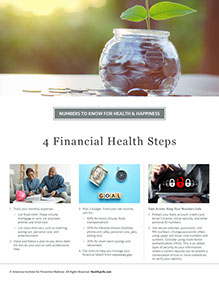
    Couple going over finances.

    1.  Track your monthly expenses.

    –  List fixed costs. These include mortgage or rent, car payment, phones and child care.

    –  List costs that vary, such as clothing, eating out, personal care, and entertainment.

    2.  Make and follow a plan to pay down debt. Do this on your own or with professional help.

    3.  Plan a budget. From your net income, aim for:

    –  50% for basics (house, food, transportation)

    –  30% for lifestyle choices (hobbies, phone and cable, personal care, pets, eating out)

    –  20% for short-term savings and retirement

    4.  Get tools to help you manage your financial health frommymoney.gov.

    Take Action: Keep Your Numbers Safe

    1.  Protect your bank account, credit card, driver’s license, social security, and other personal ID numbers.

    2.  Use secure websites, passwords, and PIN numbers. Change passwords often, using upper and lower case numbers and symbols. Consider using multi-factor authentication (MFA). This is an added layer of security to your information where a system requires you to present a combination of two or more credentials to verify your identity.

    ays to Well-Being book by the American Institute for Preventive Medicine. www.HealthyLife.com. All rights reserved.

    © American Institute for Preventive Medicine

  • 10 Action Steps For Safe & Healthy Holidays

    Personal Safety

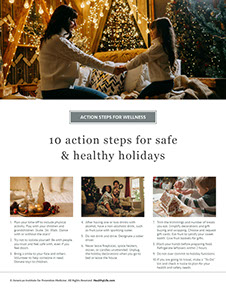
    Mother and daughter holding hands with lights hund all around.

    1.  Plan your time off to include physical activity. Play with your children and grandchildren. Skate. Ski. Walk. Dance with or without the stars!

    2.  Try not to isolate yourself. Be with people you trust and feel safe with, even if you feel down.

    3.  Bring a smile to your face and others. Volunteer to help someone in need. Donate toys to children.

    4.  After having one or two drinks with alcohol, have a non-alcoholic drink, such as fruit juice with sparkling water.

    5.  Do not drink and drive. Designate a sober driver.

    6.  Never leave fireplaces, space heaters, stoves, or candles unattended. Unplug the holiday decorations when you go to bed or leave the house.

    7.  Trim the trimmings and number of treats you eat. Simplify decorations and gift buying and wrapping. Choose and request gift cards. Eat fruit to satisfy your sweet tooth. Give fruit baskets for gifts.

    8.  Wash your hands before preparing food. Refrigerate leftovers within 2 hours.

    9.  Do not over commit to holiday functions.

    10. If you are going to travel, make a “To-Do” list and check it twice to plan for your health and safety needs.

    A Year of Health Hints book by the American Institute for Preventive Medicine. www.HealthyLife.com. All rights reserved.

    © American Institute for Preventive Medicine

  • You’re Built For Moving

    Fitness

    Father playing soccer with his young son.

    Good health starts at home. Put away the smartphone and laptop, turn off the TV, and make dinnertime “together” time. Play with your kids. Take nightly walks. Spend quality time with your partner.

    Americans spend a lot of time sitting – and it’s not doing us any favors! About one in four adults sit for more than 8 hours a day. For many full-time employees, much of that time is spent sitting in front of a computer. This sedentary behavior raises nearly all of our health risks. Start reversing this damage by getting up more often throughout your day. Aim for the 20-8-2 rule: For every 20 minutes of sitting at home or at work, stand for 8 minutes and move for 2 minutes.

    Page from HealthyLife Weigh book by the American Institute for Preventive Medicine. www.HealthyLife.com. All rights reserved.

    © American Institute for Preventive Medicine