Author: AIPM

  • Collecting Unclaimed Funds

    FINANCIAL HEALTH

    Young couple holding a jar with money in it.

    Could you have money waiting for you? Learn about unclaimed money or property from bank accounts, tax refunds, insurance policies or wages and pensions.

    You can find your unclaimed money for free. Here’s how:

    *  Search in every state where you have lived. Look up each state’s unclaimed property office. You can also try contacting the state treasurer’s office.

    *  Search the FDIC database. If your bank or credit union closed, you could have unclaimed deposits. You can also check out the National Credit Union Administration (NCUA) atwww.ncua.gov/support-services.

    *  Current or former VA life insurance holders can check for unclaimed life insurance funds. Go toinsurance.va.gov/UnclaimedFunds.

    *  Look for tax refunds from an FHA-insured mortgage. If you earned income but your wages were below the tax filing requirement, you might have a refund waiting. Go toirs.gov/refunds to check. If you bought mortgage insurance from the Federal Housing Administration (FHA), you might have a refund. Go toentp.hud.gov/dsrs/refunds.

    *  Do you have unclaimed back wages or pension money from a past employer? Go to the Workers Owed Wages (WOW) website atwebapps.dol.gov/wow. You can also check the Pension Benefit Guaranty Corporation atpbgc.gov.

    Notice that these websites include “gov.” They don’t have a “com” or “org.” The “gov” means it’s an official U.S. Government website. You should never have to pay any money to find or claim your unclaimed money. It’s FREE. Watch out for scammers and people who want to charge you for this service.

    Source: usa.gov

    © American Institute for Preventive Medicine
  • Cataracts Can Be Treated

    MEDICAL NEWS

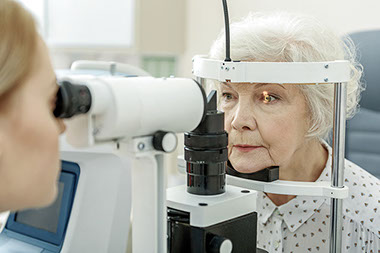
    Elderly women getting her eyes checked by a doctor.

    The eye has a clear lens inside that allows you to focus on things. But, as we get older, the lens may not be clear anymore. Proteins inside the lens stick together, causing a cloudy spot. This is a cataract.

    Cataracts are common. More than half of people age 80 and over have cataracts or had cataract surgery.

    What causes cataracts?

    Cataracts cannot always be prevented. Many people get them simply from getting older. This is because proteins in the eye’s lens start to break down with time.

    But there are some things you can do to reduce your risk of getting cataracts:

    *  Get regular eye exams.

    *  Don’t smoke – or quit if you do smoke.

    *  Limit or avoid alcohol.

    *  Protect your eyes with proper sunglasses and hats that shield the sun.

    *  Eat a healthy diet and get exercise. This can help prevent diabetes and high blood pressure, which may cause cataracts.

    Do I have cataracts?

    Many people don’t realize they have cataracts. This is because changes in vision happen very slowly over time.

    People who have cataracts may notice:

    *  Colors look faded or yellowed; things look blurry or cloudy

    *  Seeing a “halo” around lights

    *  It’s harder to read without a very bright light

    *  Trouble with night vision

    *  Double vision in one eye

    What can I do about cataracts?

    While cataracts may take away your clear vision, there is good news. Many cataracts can be corrected with surgery.

    The operation usually takes less than an hour. The doctor will replace the cloudy lens with a clear artificial lens. Usually, no stitches are needed. You may also have the surgery without general anesthesia, or being put to sleep. The doctor will numb the eye area so you won’t feel anything.

    People usually have only minor pain afterward. You may need to use eye drops after surgery to help the eye heal, or wear a protective eye shield when you sleep. Your doctor can let you know when it is safe for you to drive and do other activities.

    In most cases, the eye is totally healed within a few weeks and vision is much better.

    Sources: American Academy of Ophthalmology, National Eye Institute

    © American Institute for Preventive Medicine
  • Caring For Family From Afar

    FAMILY LIFE

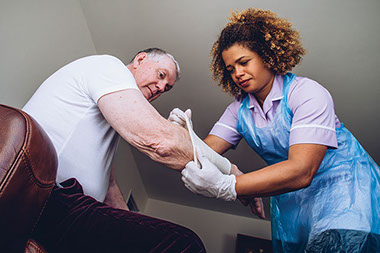
    Nurse helping patient at home.

    Anyone, anywhere can help care for a loved one. You don’t have to live in the same town, or even the same state. If you live far away from an older relative, you may wonder how you can help. Long-distance caregiving is possible.

    Before you start

    Does your loved one already have a primary caregiver? Talk to that person about how you can help. It’s usually best to coordinate your efforts with the person who sees your loved one most often.

    If they don’t yet have a caregiver but need one, you can help with that too. Talk to other family members and discuss the options. You may be able to help with finding and hiring a nurse or aide if family members can’t do it.

    Even if you can’t visit often, know that your visits are valuable. It’s time to not only catch up, but to take on some caregiving duties. Maybe you can give the primary caregiver a break while you are there. You can also find out what kinds of things you can do to help when you’re away.

    Options for helping out

    Some ideas for helping your long-distance loved one include:

    *  Helping them manage their finances or bill paying, which often can be done online

    *  Arranging for in-home care such as home health or nursing aides

    *  Ordering medical equipment that they need

    *  Making calls to the pharmacy for medication when they need it

    *  Researching skilled nursing or assisted living facilities

    *  Calling them often to check in and provide emotional support

    *  Contacting their insurance company if there are questions about coverage

    *  Keeping other family members informed about their health and needs

    *  Creating paperwork for an emergency that lists their health conditions and medicines they take

    Finding local resources

    There may be many resources close to home that can help your relative. You can get started online with these websites:

    *  Eldercare Locator:www.eldercare.acl.gov

    *  National Institute on Aging:www.nia.nih.gov

    *  Family Caregiver Alliance:www.caregiver.org

    Source: National Institute on Aging

    © American Institute for Preventive Medicine
  • Can Food Prevent Cancer?

    HEALTHY EATING

    A variety of baskets filled with fruits and vegetables.

    Studies have shown that eating healthy foods, especially plants, can help prevent certain health problems. It can help you avoid type 2 diabetes, heart disease and stroke. Some research also shows that a healthy diet can help prevent cancer.

    There is no single food or diet that will always prevent cancer. Many times, cancer is caused by things we cannot control. But there is promising research that says a healthy diet can lower your risk of some cancers. Here is what researchers have found.

    Fruits and vegetables

    We already know fruits and vegetables are good for you. They are full of vitamins, fiber and other nutrients. Eating lots of fruits and vegetables may lower the chances of getting lung, colorectal, oral, esophagus, stomach and colon cancer. The Mediterranean Diet, which includes lots of fruits and vegetables, is one diet plan that seems to have anti-cancer ability.

    In addition to fruits and vegetables, people should get enough calcium and vitamin D. These nutrients may play a role in lowering the risk of getting colorectal cancer.

    Phytochemicals – a health booster

    Phytochemicals are special chemicals found in plants. Some studies suggest that they can lower your cancer risk. Phytochemicals may:

    *  Boost your immune system

    *  Help block cancer-causing substances called carcinogens

    *  Lower inflammation that can lead to cancer

    *  Help your DNA repair itself

    *  Slow down the growth of cancer cells

    *  Get rid of damaged cells in the body

    Phytochemicals are found in fruits, vegetables, legumes and whole grains. Foods that have bright colors or strong flavors tend to have the most phytochemicals.

    What not to eat

    Some foods may increase the risk of some cancers. Avoid or limit:

    *  Heavily processed meats like ham, bacon, sausage and salami

    *  Alcohol, which may increase the risk of mouth, throat, esophagus, breast, colorectal and liver cancer

    *  Foods that cause indigestion and heartburn. Long-term heartburn can increase the risk of esophagael cancers

    Most experts agree that nutritional supplements have not been shown to fight cancer. Stick to eating healthy foods for more cancer-fighting power.

    Your doctor is your partner in helping to prevent cancer and other health problems. Be sure to discuss your cancer risk and the best diet for you.

    Sources: American Academy of Family Physicians, American Institute for Cancer Research, National Institute of Diabetes and Digestive and Kidney Diseases

    © American Institute for Preventive Medicine
  • Burn Calories Without Trying

    BE FIT

    Image of women holding up tablet with calorie tracking.

    When you’re not exercising, you can still burn extra calories! Use little ways to get more fit every day.

    Don’t make things convenient.

    Take the stairs instead of the elevator. Park farther away from your destination and walk. Use your bike instead of a car for quick grocery store runs. Put your favorite snack foods in the basement, rather than on the main floor near the TV.

    Get up.

    Take a short break every hour if you sit at a desk. Get up, move your arms and legs or even do a few jumping jacks. Use a hands-free headset so you can get up and walk or lift weights while you’re on the phone. Have a meeting? See if you can stand during part of it or even have a walking meeting.

    Sneaky exercises.

    Do some isometric exercises if you sit a lot. Try squeezing your glute muscles and knees together for eight counts, holding for five seconds then release. Do this every couple of hours.

    Move whenever you can. Walk in place instead of standing still.

    © American Institute for Preventive Medicine

  • Brown Rice Pilaf

    HEALTHY EATING

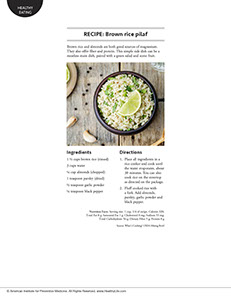
    Image of brown rice in a bowl.

    Brown rice and almonds are both good sources of magnesium. They also offer fiber and protein. This simple side dish can be a meatless main dish, paired with a green salad and some fruit.

    Ingredients

    1 ½ cups brown rice (rinsed)

    3 cups water

    ¼ cup almonds (chopped)

    1 teaspoon parsley (dried)

    ½ teaspoon garlic powder

    ¼ teaspoon black pepper

    Directions

    1.  Place all ingredients in a rice cooker and cook until the water evaporates, about 30 minutes. You can also cook rice on the stovetop as directed on the package.

    2.  Fluff cooked rice with a fork. Add almonds, parsley, garlic powder and black pepper.

    Nutrition Facts: Serving size: 1 cup, 1/4 of recipe. Calories 320; Total Fat 8 g; Saturated Fat 1 g; Cholesterol 0 mg; Sodium 53 mg; Total Carbohydrate 56 g; Dietary Fiber 5 g; Protein 8 g

    Source: What’s Cooking? USDA Mixing Bowl

    © American Institute for Preventive Medicine

  • Brca Gene For Breast Cancer

    MEDICAL NEWS

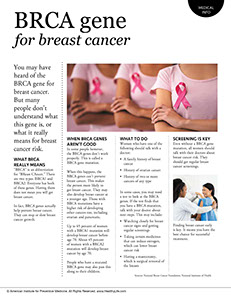
    Women wearing pink shirts with pink ribbons.

    You may have heard of the BRCA gene for breast cancer. But many people don’t understand what this gene is, or what it really means for breast cancer risk.

    What BRCA really means

    “BRCA” is an abbreviation for “BReast CAncer.” There are two types: BRCA1 and BRCA2. Everyone has both of these genes. Having them does not mean you will get breast cancer.

    In fact, BRCA genes actually help prevent breast cancer. They can stop or slow breast cancer growth.

    When BRCA genes aren’t good

    In some people however, the BRCA genes don’t work properly. This is called a BRCA gene mutation.

    When this happens, the BRCA genes can’t prevent breast cancer. This makes the person more likely to get breast cancer. They may also develop breast cancer at a younger age. Those with BRCA mutations have a higher risk of developing other cancers too, including ovarian and pancreatic.

    Up to 65 percent of women with a BRCA1 mutation will develop breast cancer before age 70. About 45 percent of women with a BRCA2 mutation will develop breast cancer by age 70. People who have a mutated BRCA gene may also pass this along to their children.

    What to do

    Women who have one of the following should talk with a doctor:

    *  A family history of breast cancer

    *  History of ovarian cancer

    *  History of two or more cancers of any type

    In some cases, you may need a test to look at the BRCA genes. If the test finds that you have a BRCA mutation, talk with your doctor about next steps. This may include:

    *  Watching closely for breast cancer signs and getting regular screenings

    *  Taking certain medicines that can reduce estrogen, which can lower breast cancer risk

    *  Having a mastectomy, which is surgical removal of the breasts

    Screening is key

    Even without a BRCA gene mutation, all women should talk with their doctors about breast cancer risk. They should get regular breast cancer screenings. Finding breast cancer early is key. It means you have the best chance for successful treatment.

    Sources: National Breast Cancer Foundation, National Institutes of Health

    © American Institute for Preventive Medicine

  • Bike Safety

    BE FIT

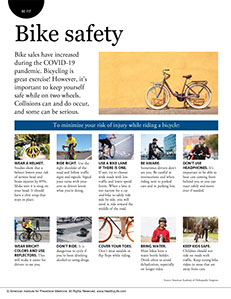
    Bike up against a yellow wall.

    Bike sales have increased during the COVID-19 pandemic. Bicycling is great exercise! However, it’s important to keep yourself safe while on two wheels. Collisions can and do occur, and some can be serious.

    To minimize your risk of injury while riding a bicycle:

    *Wear a helmet.Studies show that a helmet lowers your risk of serious head and brain injuries by 85%. Make sure it is snug on your head. It should have a chin strap that stays in place.

    *Ride right.Use the right shoulder of the road and follow traffic signs and signals. Signal your turns with your arm so drivers know what you’re doing.

    *Use a bike lane if there is one.If not, try to choose wide roads with less traffic and lower speed limits. When a lane is too narrow for a car and bike to safely ride side by side, you will need to ride toward the middle of the road.

    *Be aware.Sometimes drivers don’t see you. Be careful at intersections and when riding next to parked cars and in parking lots.

    *Don’t use headphones.It’s important to be able to hear cars coming from behind you so you can react safely and move over if needed.

    *Wear bright colors and use reflectors.This will make it easier for drivers to see you.

    *Don’t ride.It is dangerous to cycle if you’ve been drinking alcohol or using drugs.

    *Cover your toes.Don’t wear sandals or flip flops while riding.

    *Bring water.Most bikes have a water bottle holder. Drink often to avoid dehydration, especially on longer rides.

    *Keep kids safe.Children should not ride on roads with traffic. Keep young bike riders in areas that are away from cars.

    Source: American Academy of Orthopaedic Surgeons

    © American Institute for Preventive Medicine

  • Be Safe – Prevent Falls Checklist

    Home Safety

    *  Do regular exercise to improve strength and balance.

    *  Ask your care team if conditions you have or medications you take raise your risk for falls. Ask how to lower the risk.

    *  Install handrails on both sides of the stairs.

    *  Keep stair areas well lit. Install a switch at the top and bottom of the stairs.

    *  Make sure that carpet on stairs is nailed down securely.

    *  Keep stairs clear of clutter.

    *  Install grab bars in the shower, tub, and toilet area.

    *  Use a shower bench that has rubber tips on the legs.

    *  Before getting in the tub, test the bath water. Make sure it is not too hot.

    *  Use a bath mat with suction cups or use nonslip adhesive strips in the tub/shower.

    *  Don’t use any loose area rugs.

    *  Keep lamp switches within easy reach.

    *  Arrange furniture so there is a clear path for walking.

    *  Test if furniture is sturdy enough to lean on.

    *  Clear away phone or electrical wires from walk paths.

    *  Use night lights.

    *  Only use step stools with handrails.

    *  Have snow and icy patches cleared from the sidewalk and steps.

    Note: Let your health care team know if you have had a fall.

    Other Home Safety Tips

    *  Keep emergency phone numbers posted.

    *  Stock first aid supplies.

    *  Never smoke in bed or when you feel drowsy. Better yet, don’t smoke at all!

    *  Install smoke alarms. Check them every 6 months. Keep a fire extinguisher in the kitchen and garage.

    *  Install carbon monoxide detectors in your home and garage.

    *  If you use a space heater, make sure it has an emergency shut off.

    *  Plan an escape route in case of fire.

    Health at Home Lifetime book by the American Institute for Preventive Medicine. www.HealthyLife.com. All rights reserved.

    © American Institute for Preventive Medicine