Category: SleepWell® Program

  • Review & Prepare 6

    SleepWell® Program

    Week 3

    Image of man sleeping.

    Look at your pattern of sleep over the past week. Compare it to your sleep patterns over the past few weeks of tracking.

    Answer the following:

    *  I fall asleep more quickly now.

    *  I have more daytime energy.

    *  I wake up fewer times during the night.

    *  If or when I do wake up, I am able to fall asleep again more quickly.

    *  Changes I made to my bedtime and waking routines.

    *  Changes I made to what I do in bed or in the bedroom.

    *  Are you ready for another week of attention to your sleep?

    Shift Your Bedtime

    If you think your sleep has improved during the past week, you can begin to shift your bedtime earlier. Do this gradually. Only make a shift when your sleep quality is high. This means:

    *  You are able to fall asleep within 15 minutes of getting into bed.

    *  You are rarely waking up during sleep.

    *  If you do wake up, you are able to go back to sleep within 15 minutes.

    *  You stay asleep until your planned wake time.

    *  You wake feeling refreshed.

    If your sleep quality has not improved, maintain the original schedule for another week. When you are ready, shift your bedtime 15 minutes earlier. Keep the same wake time. This will give you more time to sleep as your body becomes trained to sleep in bed.
    © American Institute for Preventive Medicine

  • Biofeedback

    SleepWell® Program

    Week 4

    Chalk illustratiion of a heartbeat diagram.

    Biofeedback is the process of getting information (feedback) about your biological (body) functions. Simple examples of everyday biofeedback devices include a thermometer, a scale, and a mirror. A thermometer provides feedback on your body temperature. A scale gives you feedback on weight loss or gain. A mirror can show you if you are pale or flushed.

    Training with biofeedback tools teaches voluntary control over some bodily responses which are linked to stress.

    Personal Biofeedback Tools

    Pulse Rate. On your wrist, gently trace with two or three fingers from the base of your palm toward your thumb where a bone generally protrudes. Your fingers will gently slide into a slight groove where you should feel a pulse beat.

    1. Count the number of beats in 10 seconds.

    2. Multiply that figure times six to get your pulse rate per minute.

    3. Take your pulse before and after practicing a relaxation technique. You should have a lower pulse rate after you successfully complete a relaxation exercise.

    Stress Control Card or Stress Dot. This card that you hold or a dot that sticks to your skin measures the temperature of your hand.

    1. The colors black, brown, and red report cold temperatures and indicate moderate to high levels of stress.

    2. When you are more relaxed, the circulation to your hands and feet returns to normal and your hands should be warmer. Green, blue, or violet colors report low levels of stress.

    3. Using this card before and after a relaxation technique can give you feedback on how well the technique is working for you.

    4. The exact colors are not as important as being able to modify a color. This shows you have made a connection between your mind and your body.

    Perceived Muscle Tension (PMT). This is a self-measurement of muscle tension using a subjective scale.

    1. Ask yourself, “Where do I feel tension?” and “Where do I feel relaxation?”

    2. This tension and relaxation inventory lets you know the difference between tension and relaxation in your body. It links a bodily feeling to the words tension and relaxation. The answer you give to the questions in step 1 above is your feedback.

    3. You may even use a number to describe how relaxed or tense a body part feels.

    © American Institute for Preventive Medicine
  • Keep A Sleep Journal

    SleepWell® Program

    Week 1

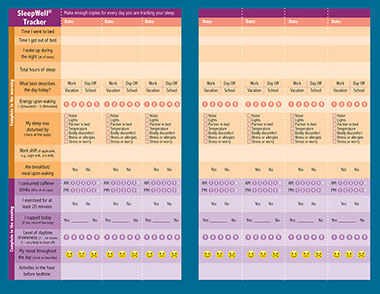
    Image of the SleepWell Tracker.

    Use the SleepWell® Tracker (click above image to download a copy) to help you monitor and better understand your own sleep habits. With this information, you can make changes to improve the quality of your sleep.

    Start now! The sooner you can understand your own sleep patterns, the sooner you can start to make changes to enhance your sleep and improve daytime energy.

    Use your SleepWell® Tracker throughout the program. If you do not have a separate SleepWell® Tracker booklet, make copies of the SleepWell® Tracker and “Sleep Trends”.

    How to Use the SleepWell® Tracker

    *  Recording each day’s sleep and activities on the SleepWell®Tracker takes only a few moments of your day. Complete the top half of each day in the morning. Complete the bottom half of each day before you go to bed.

    *  This tracker has places to record eight weeks of your sleep habits. If you would like to do this beyond eight weeks make additional copies.

    *  Review your completed SleepWell®Tracker to notice any trends or patterns in your sleep or daily practices. At the end of each week, there is a “Sleep Trends” to record your common habits related to sleep. Use these to identify factors that help, as well as hinder your sleep.

    *  Compare your habits with those described in the SleepWell®guide. Use the “Sleep Trends” to define measurable goals for the upcoming week. Make gradual changes to your habits as you work towards healthier sleep.

    © American Institute for Preventive Medicine
  • Set Goals 2

    SleepWell® Program

    Week 2

    Image of wood blocks with letters spelling "smart."

    View sleep improvement as a long-term project, especially if you have had poor sleep for a long time. First, define small steps you want to take. Continue to reflect on your efforts.

    Small Steps

    Think of the actions you take on a daily basis as small steps towards your bigger goal. This guide has already given you many ideas for small steps. Examples are limiting caffeine and dimming the lights one hour before bedtime. Identify your next change and use the following guidelines to improve your goal. All goals should be:

    Chart on S.M.A.R.T.

    Stay motivated with the small successes you achieve along the way. Use your SleepWell® Tracker every day for feedback on the effect your actions have on your sleep.

    Reminder:If your sleep issues are chronic (last longer than three weeks), your primary goal should be to schedule an appointment with your doctor or a sleep specialist.

    Practice Goal-Setting

    Strengthen your goal using the S.M.A.R.T. tool. Start with a simple statement about what you want to accomplish. Next, write how your goal will be specific, measurable, attainable, relevant, and timely.

    Barriers to Change

    As you think more about your goal, roadblocks may appear. You may need tools or skills to achieve your goal. Identify what is making it difficult for you to change. Barriers do not mean you can’t make the change. Identify challenges that must be overcome to succeed.

    © American Institute for Preventive Medicine
  • Train Yourself To Sleep

    SleepWell® Program

    Week 3

    Image of a happy women waking up in the morning.

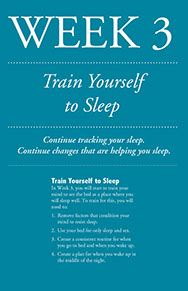
    In Week 3, you will start to train your mind to see the bed as a place where you will sleep well. To train for this, you will need to:

    1. Remove factors that condition your mind to resist sleep.

    2. Use your bed for only sleep and sex.

    3. Create a consistent routine for when you go to bed and when you wake up.

    4. Create a plan for when you wake up in the middle of the night.

    SleepWell® Program

    QUICK LINKS: WEEK 3

    Stimulus Control

    Create a Bedtime Routine

    Create a Waking Routine

    Restrict Time in Bed

    Stop Hitting the Snooze!

    Trouble Staying Asleep

    Can I Have a Nap?

    Manage Risks of Shift Work

    Review and Prepare

    © American Institute for Preventive Medicine

  • Blue Light & Electronics

    SleepWell® Program

    Week 2

    Image of laptop.

    How far are you from your cell phone right now? If you are like many people, your phone is probably within arm’s reach. Not only is digital overload a problem during the day, but taking your phone to bed with you or using it right before bedtime can cause problems for sleep.

    Melatonin, the sleep hormone in the brain, is naturally released in the body when natural light dims. The light from a screen (cell phone, tablet, laptop, PC, etc.) can interfere with this production of melatonin. Using a device in bed or close to bedtime can delay going to sleep and make it more difficult to do so.

    Tips for Reducing Blue Light Exposure Before Sleep:

    *  Keep your phone out of the bed.

    *  Turn off as many notification sounds as possible. Keep only your main ringer on for emergencies.

    *  Turn your phone over to avoid the front light waking you up, especially if it is charging.

    *  Set boundaries with media. Consider a media curfew. After a certain time, avoid looking at any screen device. Make this at least an hour before bed. A quick peek at your phone just before bed may not have a big effect, but staring at it before bed for more than a few minutes may interfere with sleep.

    *  Don’t watch TV or use the computer within 30 minutes of going to bed.

    *  Looking at news stories or skimming social media can also be stressful and keep your mind alert when you are trying to wind down.

    © American Institute for Preventive Medicine

  • Learn To Relax

    SleepWell® Program

    Week 4

    Image of relax sign decorated with various flowers and candle.

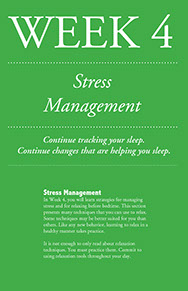
    Improving sleep will help you manage stress. Managing stress will help you improve your sleep.

    Relaxation Techniques

    *  Help the body to relax when under stress. This minimizes the physical wear and tear from stress.

    *  Help the mind relax. Where the mind goes, the body follows.

    *  Help you to recognize body tension and work to reduce it. The more these techniques are practiced, the easier they are to do.

    *  Help you resist stress. The more you practice, the more relaxed your natural state will become.

    Plan Relaxing Activities

    Do leisure activities during your week. Plan a variety of activities. Include both short and long ones. Try to make at least one activity something you plan to do regularly.

    Here are a few ideas of activities you can try. For activities that are not part of your routine, write if and when you would like to try them.

    Leisure & Recreation Activities

    *  Take a warm bath

    *  Read a book

    *  Look through photo albums

    *  Listen to music

    *  Write in your journal or a notebook

    *  Get a massage

    *  Swim or play in a pool or lake

    *  Knit, sew, or do another hobby

    *  Watch a movie, especially a comedy

    *  Do yoga

    *  Meditate

    *  Take a few deep breaths

    *  Get a manicure or pedicure

    *  Ride a bike

    *  Go for a walk

    *  Play with your pet

    *  Play with animals at a pet store or pet shelter

    *  Go to a park

    *  Sit near water

    *  Sketch what you see

    *  Volunteer at a soup kitchen, shelter, or other place in the community

    *  Write a letter or a card

    © American Institute for Preventive Medicine
  • Show You Care

    SleepWell® Program

    Week 5

    Image of family enjoying dinner together in the backyard.

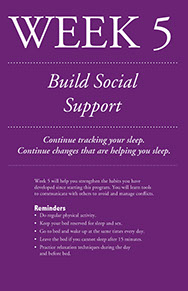
    Plan blocks of time to be with family and friends. Plan moments of closeness with your partner and/or children.

    *  Eat meals together.

    *  Do physical activities together. Walk after dinner. Go to a park as a couple or as a family.

    *  Play board games together.

    *  Let your kids know about your job and what you do. Ask them about their day and their interests.

    *  Help your kids with their homework. Tuck them into bed.

    Stay Connected in the “Real World”

    Connect with people in person, by phone, video/web-chat, or other interactive methods. These conversations can be more meaningful and fulfilling than text messages. Texting can be used to ask short questions or to relay simple information. But, texting isn’t talking and does not reveal body language, tone of voice, or emotions very well. Conversations through texts or emails can be misinterpreted. This can cause anxiety, confusion, and loneliness.

    *  Have important conversations in person or over the phone.

    *  Show affection with your voice and physical actions.

    *  Use texts for short information (e.g. confirm that your child is home from school or let your partner know you need something from the store).

    Reflect & Review

    *  Two ways I plan to strengthen my home team.

    *  People who know that I am trying to improve my sleep and ways they support my change.

    © American Institute for Preventive Medicine

  • Review & Prepare 7

    SleepWell® Program

    Week 4

    Image of man thinking at desk.

    Look at your pattern of sleep over the past week. Compare it to your sleep patterns over the past few weeks of tracking. Answer these:

    *  I fall asleep more quickly now.

    *  I have more daytime energy.

    *  I wake up fewer times during the night.

    *  If or when I do wake up, I am able to fall asleep again more quickly.

    *  Relaxation techniques I practiced this past week.

    *  How I responded to racing thoughts when I tried to sleep.

    *  Are you ready for another week of attention to your sleep?

    Shift Your Bedtime Again

    Has your sleep continued to improve? If yes, you are ready to adjust your bedtime. Remember, only make a shift when your sleep quality is high.

    © American Institute for Preventive Medicine

  • Can I Have A Nap?

    SleepWell® Program

    Week 3

    Image of man napping on coach.

    Naps during the day can take away from the sleep drive your body builds up when you are awake. Think of sleep drive like hunger-you would not want to eat a big meal in the afternoon if you knew you were having a feast for dinner! Avoid taking long naps during the day or avoid the naps altogether. It will be easier to fall asleep at bedtime if you have not napped during the day. If you do nap, do so for less than one hour. The best time for the body to nap, if needed, is between 1:00 and 4:00 p.m. Your body temperature naturally drops during this time period and your body is ready to sleep.

    If you do not feel tired at bedtime, limit napping until your sleeping habits are more regular.

    Things to Do When You Feel Like Taking a Nap

    *  Take a walk.

    *  Drink a cold glass of water.

    *  Take 10 slow, deep breaths.

    *  Step outside in the sunshine (if during daylight hours).

    *  Stretch your back, neck, and legs.

    *  Splash cold water on your face.

    *  Watch or read something funny.

    *  Massage your hands together.

    *  Have a mint or chew mint gum.

    Napping for Shift Workers

    Before your shift starts, a 20-30 minute nap may help you feel more alert. A longer nap may leave you feeling groggy. Find what helps you be the most alert.

    Nap during your “lunch hour” if possible. Allow 10-15 minutes to wake up and be fully alert after your nap. Napping may not be a good idea if you work in a job that requires you to have quick reactions or make decisions under pressure.

    A 30-45 minute nap at the end of a shift may help you to be more alert for the drive home.

    © American Institute for Preventive Medicine