Category: Systematic Stress Management Program – Step 7: Communication & Stress

  • What Is Your Ear-Q?

    Systematic Stress Management Program

    Step 7: Communication & Stress Section

    Introduction

    What is Your Ear-Q?

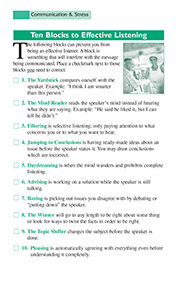
    Ten Blocks to Effective Listening

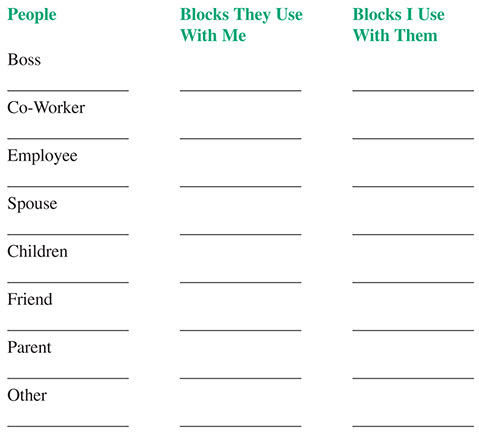
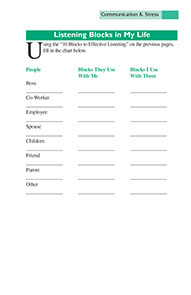
    Listening Blocks in My Life

    Skills for Active Listening

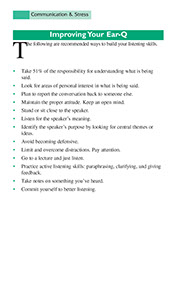
    Improving Your Ear-Q

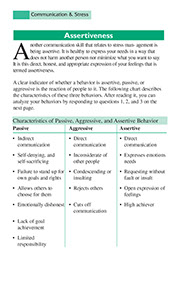
    Assertiveness

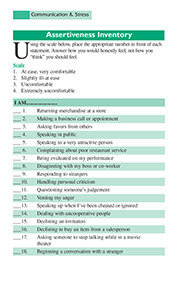
    Assertiveness Inventory

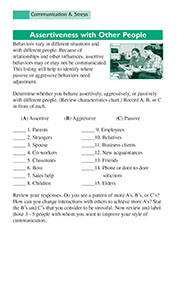
    Assertiveness with Other People

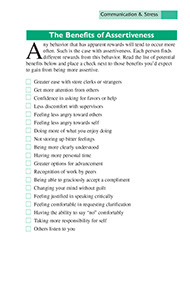
    The Benefits of Assertiveness

    Assertiveness Training – The L.A.D.D.E.R. Technique

    My Practice L.A.D.D.E.R.

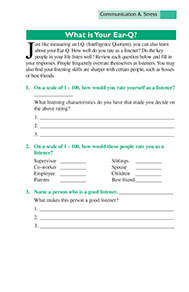
    Just like measuring an I.Q. (Intelligence Quotient), you can also learn about your Ear-Q. How well do you rate as a listener? Do the key people in your life listen well? Review each question below and fill in your responses. People frequently overrate themselves as listeners. You may also find your listening skills are sharper with certain people, such as bosses or best friends.

    1. On a scale of 1 – 100, how would you rate yourself as a listener?

    What listening characteristics do you have that made you decide on the above rating?

    2. On a scale of 1 – 100, how would these people rate you as a listener?

    *  Supervisor

    *  Siblings

    *  Co-worker

    *  Spouse

    *  Employee

    *  Children

    *  Parents

    *  Best friend

    3. Name a person who is a good listener.

    What makes this person a good listener?
    Page from the Systematic Stress Management book by the American Institute for Preventive Medicine. www.HealthyLife.com. All rights reserved.

    © American Institute for Preventive Medicine

    Step 1: Understanding Stress

    Step 3: Type A & B Behavior Patterns

    Step 5: Thinking Differently

    Step 7: Communication & Stress

    Step 2: Stress Management at Work

    Step 4: Biofeedback Training & Relaxation

    Step 6: Time Management

    Steps to Systematic Stress Management™

    RELATED ARTICLES

    © American Institute for Preventive Medicine  –  All Rights Reserved.Disclaimer|www.HealthyLife.com
  • Assertiveness Training – The L.A.D.D.E.R. Technique

    Systematic Stress Management Program

    Step 7: Communication & Stress Section

    Introduction

    What is Your Ear-Q?

    Ten Blocks to Effective Listening

    Listening Blocks in My Life

    Skills for Active Listening

    Improving Your Ear-Q

    Assertiveness

    Assertiveness Inventory

    Assertiveness with Other People

    The Benefits of Assertiveness

    Assertiveness Training – The L.A.D.D.E.R. Technique

    My Practice L.A.D.D.E.R.

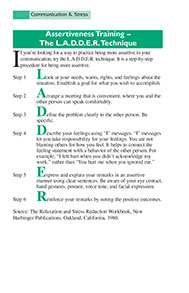
    If you’re looking for a way to practice being more assertive in your communication, try the L.A.D.D.E.R. technique. It is a step-by-step procedure for being more assertive.

    Step 1

    Look at your needs, wants, rights, and feelings about the situation. Establish a goal for what you wish to accomplish.

    Step 2

    Arrange a meeting that is convenient, where you and the other person can speak comfortably.

    Step 3

    Define the problem clearly to the other person. Be specific.

    Step 4

    Describe your feelings using “I” messages. “I” messages let you take responsibility for your feelings. You are not blaming others for how you feel. It helps to connect the feeling statement with a behavior of the other person. For example, “I felt hurt when you didn’t acknowledge my work.” rather than “You hurt me when you ignored me.”

    Step 5

    Express and explain your remarks in an assertive manner using clear sentences. Be aware of your eye contact, hand gestures, posture, voice tone, and facial expression.

    Step 6

    Reinforce your remarks by noting the positive outcomes.

    Page from the Systematic Stress Management book by the American Institute for Preventive Medicine. www.HealthyLife.com. All rights reserved.

    © American Institute for Preventive Medicine

    Step 1: Understanding Stress

    Step 3: Type A & B Behavior Patterns

    Step 5: Thinking Differently

    Step 7: Communication & Stress

    Step 2: Stress Management at Work

    Step 4: Biofeedback Training & Relaxation

    Step 6: Time Management

    Steps to Systematic Stress Management™

    RELATED ARTICLES

    © American Institute for Preventive Medicine  –  All Rights Reserved.Disclaimer|www.HealthyLife.com
  • Improving Your Ear-Q

    Systematic Stress Management Program

    Step 7: Communication & Stress Section

    Introduction

    What is Your Ear-Q?

    Ten Blocks to Effective Listening

    Listening Blocks in My Life

    Skills for Active Listening

    Improving Your Ear-Q

    Assertiveness

    Assertiveness Inventory

    Assertiveness with Other People

    The Benefits of Assertiveness

    Assertiveness Training – The L.A.D.D.E.R. Technique

    My Practice L.A.D.D.E.R.

    Image of friends sitting and talking to eachother.

    The following are recommended ways to build your listening skills.

    *  Take 51% of the responsibility for understanding what is being said.

    *  Look for areas of personal interest in what is being said.

    *  Plan to report the conversation back to someone else.

    *  Maintain the proper attitude. Keep an open mind.

    *  Stand or sit close to the speaker.

    *  Listen for the speaker’s meaning.

    *  Identify the speaker’s purpose by looking for central themes or ideas.

    *  Avoid becoming defensive.

    *  Limit and overcome distractions. Pay attention.

    *  Go to a lecture and just listen.

    *  Practice active listening skills: paraphrasing, clarifying, and giving feedback.

    *  Take notes on something you’ve heard.

    *  Commit yourself to better listening.

    Listening Exercises

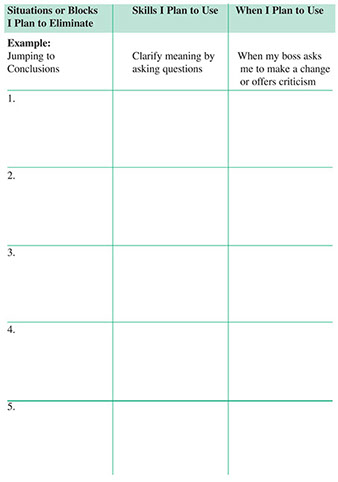
    Exercise #1: List 3 new skills you’d like to try to become a more effective listener.

    Exercise #2: Ask someone to tell you a 3 – 5 minute story. Use the three skills of active listening (paraphrasing, clarifying, and feedback) as well as the skills listed in “Improving Your Ear-Q.” Ask the storyteller to rate you as a listener afterward.

    Scoring – The score is based on the speaker’s assessment of the 3 – 5 minute exchange.

    3 = Used the skill well

    2 = Made an effort to use the skill

    1 = Needs improvement

    Page from the Systematic Stress Management book by the American Institute for Preventive Medicine. www.HealthyLife.com. All rights reserved.

    © American Institute for Preventive Medicine

    Step 1: Understanding Stress

    Step 3: Type A & B Behavior Patterns

    Step 5: Thinking Differently

    Step 7: Communication & Stress

    Step 2: Stress Management at Work

    Step 4: Biofeedback Training & Relaxation

    Step 6: Time Management

    Steps to Systematic Stress Management™

    RELATED ARTICLES

    © American Institute for Preventive Medicine  –  All Rights Reserved.Disclaimer|www.HealthyLife.com