Category: Respiratory conditions

  • Hiccups

    Respiratory conditions

    Image of women drinking a glass of water.

    Hiccups are simple to explain. The diaphragm (the major muscle which sits like a cap over the stomach) goes into spasms. The vocal cords close rapidly. This causes the “hiccup” sound.

    Causes

    *  Eating too fast. Swallowing air with the food.

    *  Drinking carbonated beverages. Drinking too much alcohol.

    *  Doing things to make the stomach full enough to irritate the diaphragm, such as eating a lot of fatty foods in a short period of time.

    Treatment

    Hiccups seldom cause harm. Usually, they don’t last very long. Self-Care treats most cases of hiccups. Hiccups that persist could be a sign of a nervous system problem. A doctor needs to diagnose and treat this.

    Questions to Ask

    Self-Care / Prevention

    Common Remedies for Hiccups

    *  Swallow 1 teaspoon of dry table sugar. If this doesn’t stop the hiccups right away, repeat it 3 times, at 2-minute intervals. {Note: For young children (that do not have diabetes), use a teaspoon of corn syrup.}

    *  Hold your tongue with your thumb and index finger and gently pull it forward.

    *  Drink a glass of water rapidly. {Note: Young children should drink a glass of milk slowly.}

    Healthier at Home book by the American Institute for Preventive Medicine. www.HealthyLife.com. All rights reserved.

    © American Institute for Preventive Medicine

  • Improve Ventilation To Limit Covid-19 Spread

    Respiratory conditions

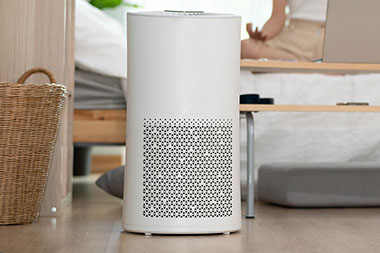
    Air purifier sitting on floor.

    One important way to limit the spread of COVID-19 (COVID) in your home is to improve ventilation or air flow. This helps prevent virus particles from building up in the air if virus particles are present. Increasing ventilation can be part of a plan to protect you and your family from COVID. Here are five ways to improve ventilation in your home to help clear out virus particles.

    1. Fresh is Best

    Bring as much fresh outdoor air into your home as possible.

    *  Open doors and windows if it is safe to do so. Use screens when possible. Even having them opened a crack can help. Open more than one to move more outside air inside.

    *  If it is unsafe to open windows, consider other options. Unsafe conditions may include having young children and pets, risk of falling or triggering asthma symptoms, and high levels of air pollution.

    *  Caution: Avoid ventilation with outdoor air when it makes your home too cold, hot, or humid.

    2. Filter for Trapping

    If your home has a central heating, ventilation, and air conditioning system (HVAC system) that has a filter, it can be used to help trap virus particles.

    *  If your HVAC fan can be controlled by a thermostat, set the fan to the “on” position instead of “auto” when you have visitors. The fan will run continuously, even if the heat or air conditioning is not on.

    *  Use pleated furnace filters, which are more efficient than ordinary furnace filters. Every three months, change the filter according to the manufacturer’s instructions.

    *  Have the ventilation system inspected and adjusted yearly.

    *  If you don’t have a HVAC system, or you just want extra filtration, consider using a portable high-efficiency particulate air (HEPA) cleaner. They are the most efficient filters available to trap virus particles. Check that its Clean Air Delivery Rate (CADR) meets or exceeds the square footage of the room where it will be used. For more information, see EPA’s Guide to Air Cleaners in the Home.

    3. Use Fans for Better Air Flow

    Fans help improve air flow inside your home, even if you don’t have windows open.

    *  Use a window exhaust fan that fits securely in the window. Some window air conditions have an outdoor air intake or vent to bring more outside air in.

    *  Place a box fan or tower fan as close as possible to an open window or door. Use ceiling fans as well.

    *  Operate a whole house fan or an evaporative cooler (or “swamp cooler”) if your home has one.

    *  Always point fans away from people to avoid blowing air directly at them.

    4. Turn On Exhaust Fans

    Other exhaust fans in your house can also help move air outside.

    *  Turn on exhaust fans located above your stovetop and in your bathroom when you have visitors. Even if they don’t vent to the outside, they can still help keep virus particles from being concentrated in one place.

    *  Keep exhaust fans turned on for an hour after visitors leave to help clear out virus particles that may have accumulated in the air.

    5. Limit Visitors

    *  When you have visitors, try to gather in larger rooms where you can stay 6 feet apart.

    *  When you have visitors, have everyone wear a mask, including the people who usually live in your home. Do not put a mask on children younger than 2 years old.

    *  Try to keep visits as short and as small as possible.

    *  Learn more ways to stay safe while doing indoor and outdoor activities with others and safer ways for hosting gatherings at:cdc.gov/coronavirus/2019-ncov/daily-life-copingandcdc.gov/coronavirus/2019-ncov/daily-life-coping/holidays/celebrations.

    Remember, the more ways you use to ventilate, the faster you can clear out COVID virus particles from your home if they are present.

    Healthier at Home book by the American Institute for Preventive Medicine. www.HealthyLife.com. All rights reserved.

    © American Institute for Preventive Medicine

  • Lung Cancer

    Respiratory conditions

    Lung cancer is the leading cause of death from cancer in men and women. The rich network of blood vessels that deliver oxygen from the lungs to the rest of the body can spread cancer very quickly. By the time it is diagnosed, other organs may be affected. The lungs are also a frequent site that cancer from other areas of the body spreads to.

    Signs & Symptoms

    When it first develops, lung cancer does not usually cause symptoms. When symptoms occur, they include:

    *  A cough that doesn’t go away. This could be a “smoker’s cough” that gets worse.

    *  Constant chest pain. Back pain can occur.

    *  Hoarseness.

    *  Shortness of breath. Wheezing.

    *  Recurring pneumonia or bronchitis.

    *  Weakness in a shoulder, arm, or hand.

    *  Fatigue. Appetite loss and weight loss.

    Causes

    Cigarette smoking is the major cause. The risk increases with the  more you smoke, the longer you smoke, and the more deeply you inhale cigarette smoke.

    Other causes are exposure to secondhand smoke, asbestos, radon, and other cancer causing agents.

    Treatment

    Tests are done to find out the type of lung cancer and the stage of the disease. There are two types of lung cancer: small cell lung cancer and non-small cell lung cancer. Treatment is aimed at the specific type and includes:

    *  Lung surgery.

    *  Respiratory therapy.

    *  Radiation therapy.

    *  Chemotherapy.

    *  Clinical trials.

    Questions to Ask

    Self-Care / Prevention

    Follow your medical treatment plan.

    *  Do not smoke or use tobacco products. If you smoke, quit! Avoid secondhand smoke.

    *  Avoid exposure to asbestos and/or radon. If these are found in your house, get them removed by an expert.

    *  Follow workplace safety rules for preventing exposure to diesel exhaust and other chemicals that can cause lung cancer.

    Healthier at Home book by the American Institute for Preventive Medicine. www.HealthyLife.com. All rights reserved.

    © American Institute for Preventive Medicine

  • Pneumonia

    Respiratory conditions

    Pneumonia is lung inflammation. It is one of the leading causes of death in the U.S., especially in the elderly.

    Signs & Symptoms

    *  Chest pain when breathing in.

    *  Fever and chills.

    *  Cough, often with bloody, dark yellow, green, or rust-colored sputum.

    *  Shortness of breath. Rapid breathing.

    *  Appetite loss.

    *  Fatigue. Headache. Nausea. Vomiting.

    *  Bluish lips and fingertips, if severe.

    Causes

    Viral or bacterial infections are the most common causes. Other causes are fungal infections and chemical irritants like inhaled poisonous gases.

    Risk Factors

    *  Having had pneumonia before.

    *  Being in the hospital for other problems.

    *  A suppressed cough reflex after a stroke.

    *  Smoking.

    *  Very poor diet, alcoholism, or drug use.

    *  A recent respiratory infection.

    *  Emphysema. Chronic bronchitis.

    *  Radiation treatments, chemotherapy, and any medication or illness that wears down the immune system.

    Treatment

    Treatment depends on its type (viral, bacterial, or chemical) and location. Treatment includes:

    *  Medications.

    *  Oxygen therapy. Hospitalization. Removing fluid from the lungs, if needed.

    Questions to Ask

    Self-Care / Prevention

    *  Get vaccines for influenza and pneumonia.

    *  Don’t smoke. If you smoke, quit. Avoid secondhand smoke.

    *  Get plenty of rest.

    *  Use a cool-mist vaporizer in the room(s) in which you spend most of your time.

    *  Drink plenty of fluids.

    *  Take medicines as prescribed by your doctor. Take the medicine for pain and/or fever that your doctor advises. Over-the-counter pain relievers should be avoided for some types of bacterial pneumonia.

    Healthier at Home book by the American Institute for Preventive Medicine. www.HealthyLife.com. All rights reserved.

    © American Institute for Preventive Medicine

  • Asthma

    Respiratory conditions

    Asthma is a chronic disease that causes the airways to narrow. Airflow is limited due to inflammation in the airways.

    General Information

    Symptoms

    *  A cough lasts more than a week. Coughing may be the only symptom. It often occurs at night or early in the morning.

    *  Shortness of breath. Breathing gets harder and may hurt. It is harder to breathe out than in.

    *  Wheezing (high pitched whistling sound)

    *  Tightness in the chest

    Causes & Risk Factors

    *  Genetic Factors. You are more likely to have asthma if other members of your family have or had it.

    *  Environmental Factors. Being exposed to certain things can set off an immune system response for asthma to develop. Examples are house-dust mites and viral respiratory infections.

    Diagnosis

    A doctor diagnoses asthma from:

    *  Your medical history

    *  Your family’s medical history

    *  Your symptoms

    *  A physical exam

    *  Lung function tests in persons age 5 years and older

    *  Other tests to check for conditions that have symptoms of asthma, but are not asthma

    Asthma Attack Triggers

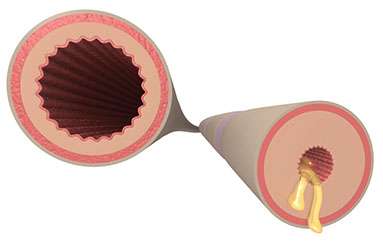
    People with asthma have very sensitive airways. Exposure to triggers causes a response in the airways called an asthma attack or an asthma episode.

    With an asthma attack:

    *  Air becomes trapped in the lungs.

    *  The lining of the airways becomes inflamed.

    *  The muscles around the air tubes tighten.

    *  Thick mucus clogs the airways.

    Illustration of airway.

    (The last three things cause the airways to narrow.)

    Problems That Make It Harder to Manage Asthma

    *  Reflux of stomach acids which cause heartburn, belching, or spitting up

    *  Being overweight or obese

    *  Allergic rhinitis or sinusitis

    *  Sleep apnea that obstructs breathing

    *  Stress and depression

    Treating these problems may help improve asthma control.

    Common Asthma Attack Triggers

    *  Respiratory infections (colds, flu, bronchitis, etc.)

    *  Tobacco smoke

    *  Dust mites

    *  Animal dander (small pieces of skin, hair, or feathers from warm-blooded animals, such as dogs, cats, birds, etc.)

    *  Cockroach droppings

    *  Molds (indoor and outdoor)

    *  Strong odors and sprays from paints, new carpet, perfumes, etc.

    *  Air pollution

    *  Cold air and changes in temperature and humidity. Weather changes can also affect how much pollen and mold are in the air.

    *  Having strong feelings (laughing, crying, etc.)

    *  Sulfites. These are additives in wine and some foods, such as processed potatoes and dried fruits. Shellfish packed in ice that has sulfites can pick up the sulfites from the ice.

    *  Aspirin and other nonsteroidal anti-inflammatory drugs (NSAIDs), such as ibuprofen

    *  Beta blocker medicines. These are prescribed for heart disease, high blood pressure, and migraine headaches.

    When to Seek Medical Care

    Reasons to Call Doctor

    Call your doctor when you feel the first change in your asthma status. Deal with a problem early to help prevent a severe problem.

    *  You have asthma and have a cold or a fever.

    *  You cough up mucus that is bloody-colored, green, or yellow.

    *  An asthma attack does not respond to your medication.

    *  Medication is not helping like it used to.

    *  Your peak expiratory flow (PEF) numbers are in the yellow zone.

    *  You have a harder time breathing or you are short of breath more often than before.

    *  You breathe faster than usual.

    *  Your asthma attacks are coming more often or are getting worse.

    *  You use your rescue medication more than 2 times a week.

    Reasons to Get Medical Care Fast

    *  Your peak expiratory flow (PEF) numbers are in the red zone.

    *  You have a fever with heavy breathing.

    *  You have extreme shortness of breath. It may feel as if you can’t breathe at all. Or, you can’t say 4 or 5 words because you are so short of breath. Call 911!

    *  You cough so much that you can’t take a breath. Call 911!

    *  Your lips or fingernails are bluish in color. Call 911!

    Focus on breathing slow and easy until you get medical care. Sit upright. Try to remain as calm and relaxed as you can.

    Peak Flow Meters

    These devices measure peak expiratory flow (PEF). PEF is the amount of air blown out after taking a deep breath. Your PEF readings can tell you and your health care provider:

    *  About asthma triggers

    *  If an asthma attack is starting. PEF is decreased with an asthma attack.

    *  If your medicine plan is working

    *  When to add or stop medicine

    *  How severe your asthma is

    Use your peak flow meter, as directed by your doctor or health care provider.

    Find Your Personal Best Peak Flow Number

    Your personal best peak flow number is the highest peak flow number you can get over a 2-week period when your asthma is under good control. Good control is when you feel good and do not have any asthma symptoms.

    Take peak flow readings:

    *  Twice a day for 2 weeks – when you wake up and  about 10 to 12 hours later

    *  Before and after taking an inhaled beta2-agonist (if you take this medicine)

    *  As advised by your doctor or health care provider

    The Peak Flow Zone System

    Once you know your personal best peak flow number, your health care provider will give you the numbers that tell you what to do. The peak flow numbers are put into zones that are set up like a traffic light.

    Green Zone (80 to 100 percent of your personal best number). This signals all clear. No asthma symptoms are present, and you may take your medicines as usual.

    Yellow Zone (50 to 80 percent of your personal best number). This signals caution. You may need to take more of your asthma medicine(s) to treat your asthma. Or, your overall asthma may not be under control, and the doctor may need to change your asthma action plan.

    Red Zone (below 50 percent of your personal best number). This signals a medical alert. You must take an inhaled beta2-agonist right away and call your doctor without delay if your peak flow number does not return to the Yellow or Green Zone and stay in that zone.

    Treatment

    The goals of treatment are to:

    A. Prevent asthma attacks and control or treat asthma symptoms as they occur

    B. Allow normal daily activities, including exercise

    C. Promote restful sleep, free from waking up with asthma symptoms

    D. Do A, B, and C with few or no side effects from asthma medications

    E. Have no need for emergency medical care or to be hospitalized due to asthma

    Treatment for asthma varies on how severe it is and how well it is controlled. Since a person’s asthma can change over time and the response to medications may be age-related, asthma treatment guidelines are given for three different age groups:

    *  0-4 years

    *  5-11 years

    *  12 years and older

    A good way to help you manage your asthma is to follow a written action management plan that you develop with your doctor or health care provider. Your plan should include:

    *  What to do daily to avoid and deal with your asthma triggers and what to do when you have an asthma attack

    *  Names and doses of medicines to take daily and when you have specific symptoms

    *  Reasons to contact your doctor or to get medical care fast

    *  Your plan should be tailored for your needs.

    Keep a journal of your asthma symptoms. Include:

    *  When you had symptoms and what may have caused them. What you did to treat the symptoms. List the medicines you took, how you took them, and how much you took.

    *  Your peak flow meter readings. Record these before and after treatment steps.

    *  Results of the treatment steps you took

    Self-Care

    *  Know your warning signs and peak flow zones so you can begin treatment early. Monitor your peak expiratory flow rates. (See “Peak Flow Meters”.)

    *  Keep your asthma rescue medicine handy.

    *  Get a yearly flu vaccine, as advised.

    During an asthma attack:

    *  Sit up. Don’t lie down.

    *  RELAX. Keep calm. Focus on breathing slow and easy. Remove yourself from any stressors.

    *  Take the right amount of medicine, as prescribed in your asthma control plan. Call your doctor if you need to take more medicine than prescribed.

    Avoid your asthma triggers

    *  Do not smoke. Do not allow smoking in your home, car, or around you. Avoid air pollution.

    *  Use bedding, flooring, paint, vaccum cleaners, toys, and other products that are “Certified Asthma & Allergy Friendly™.” (Search for items fromwww.asthmaandallergyfriendly.com.) It is especially helpful to use these products in your bedroom and/or:

    – Sleep with no pillow or one your doctor suggests. Use a “dust-mite proof” cover to enclose your mattress and pillow (if you use one). Wash all bedding in hot water every week.

    – Try not to keep stuffed animals in the bedroom. If you must, have only one that can be washed. Wash it in hot water once a week.

    – Use curtains and rugs that can be washed often. Avoid carpeting, bed ruffles, and throw pillows.

    – Get someone else to vacuum and dust once or twice a week. Use a vacuum with a HEPA filter or double-thickness bags. If you dust or vaccum, wear a dust mask.

    – Reduce clutter in your bedroom. Store items in plastic containers with lids.

    – It is best not to keep a TV, DVD-player, etc. in your bedroom. These, too, can collect dust.

    *  Put an air filter on your furnace or use a portable air purifier, such as one with a HEPA filter.

    *  Stay out of the cold weather as much as you can.

    *  Change and/or wash furnace and air conditioner filters on a regular basis. Keep indoor humidity below 60 percent.

    *  When you are outside in cold weather, wear a scarf around your mouth and nose to warm the air as you breathe in.

    *  Stop exercising if you start to wheeze.

    *  If you are sensitive to sulfites, don’t take foods or medicines that have them. Sulfites are in wine, some processed potatoes and dried fruits. Shellfish packed in ice that has sulfites can pick up the sulfites from the ice.

    *  Drink plenty of liquids (2-3 quarts a day) to keep secretions loose.

    *  Don’t take over-the-counter medications unless cleared first with your doctor or health care provider.

    – Antihistamines dry nasal secretions and can cause airways to plug up by making secretions thicker. Antihistamines are also found in some cold remedies, so check labels.

    – Some ulcer drugs increase the effects of some bronchodilators.

    – Aspirin can trigger an attack in 3-5 percent of persons with asthma who have nasal polyps. Acetaminophen doesn’t have this effect.

    Medications

    Some medications are to be taken with an asthma attack. Other kinds are taken daily (or as prescribed) to help prevent asthma attacks.

    Long-Term Control Medicines

    These are taken daily (or as prescribed) to help prevent asthma attacks. Examples are:

    *  Corticosteroids. These help with the swelling in the airways that cause asthma symptoms. They can prevent, reduce, and/or reverse the swelling.

    – Inhaled corticosteroids (ICSs). These are the most effective long-term medicines that control asthma. These are not the same as anabolic steroids that athletes may abuse.

    – Oral corticosteroids. An example is prednisone. These are usually given for a short time, when a person’s asthma is not being controlled. Long-term use of these may be prescribed for persons with severe asthma that persists.

    *  Cromolyn sodium and nedocromil. These help prevent swelling in the airways when exposed to asthma triggers. They treat mild asthma that persists.

    *  LABAs (long acting beta2-agonists). These are bronchodilators. They relax the muscles of the airways. They are usually taken with ICSs to help control moderate and severe asthma and to help prevent symptoms during the night.

    *  Leukotriene modifiers. These prevent swelling in the airways and decrease mucus in the lungs. They treat mild asthma that persists or are combined with ICSs to treat moderate or severe asthma.

    *  Theophyllines. These are mild to moderate bronchodilators that may have mild anti-inflammatory effects.

    *  Medicines that modify the body’s immune response.

    Quick-Relief Medicines

    These are used to treat symptoms of an asthma attack. They help stop asthma symptoms before they get worse. They may be prescribed for use at other times, too, such as before exercising. Examples are:

    *  SABAs (short-acting beta-agonists). These are bronchodilators. They work quickly to relax the muscles of the airways and open up the air passages in the lungs and are the treatment of choice to relieve acute symptoms. They are usually taken in an inhaled form.

    *  Anticholinergics. These help prevent airway muscles from tightening and help keep mucus from forming. These are usually taken in an inhaled form.

    With proper treatment and monitoring of symptoms, asthma can be controlled. People with asthma can live active and healthy lives.

    Resources

    The Asthma and Allergy Foundation of America

    800.7.ASTHMA (727.8462)

    www.aafa.org

    National Heart, Lung, and Blood Institute

    301.592.8573

    www.nhlbi.nih.gov

    Asthma brochure by the American Institute for Preventive Medicine. www.HealthyLife.com. All rights reserved.

    © American Institute for Preventive Medicine

  • Sars – Severe Acuterespiratory Syndrome

    Respiratory conditions

    SARS is a viral respiratory illness. It began in Asia in February 2003 and spread to other countries.

    Signs & Symptoms

    *  Fever higher than 100.4ºF.

    *  Headache. The body aches all over. Diarrhea may occur.

    *  Dry cough after 2 to 7 days.

    *  A hard time breathing and/or shortness of breath. Most persons develop pneumonia.

    Causes

    SARS is thought to be caused by a certain virus. It is spread by close contact with someone who has the virus. Most likely, this is through coughs and sneezes or from touching objects that have infectious droplets on them.

    Treatment

    Medical treatment is needed for SARS. Persons suspected of having SARS should be quarantined in a hospital.

    Questions to Ask

    Self-Care / Prevention

    *  Before you travel, check the CDCs Travelers’ Health Web site atwww.cdc.gov/travelfor updates on SARS.

    *  If you will be in close contact with a person infected with SARS, follow infection control measures. Wash your hands often or use alcohol-based hand rubs. If you can, wear a surgical mask. Don’t share eating utensils, towels, etc. For a more complete list of guidelines, accesswww.cdc.gov/ncidod/sars/ic-closecontacts.htm.

    Resources

    Centers for Disease Control and Prevention (CDC)

    800.CDC.INFO (232.4636)

    www.cdc.gov/ncidod/sars

    World Health Organization (WHO)

    www.who.int/topics/sars/en/

    Healthier at Home book by the American Institute for Preventive Medicine. www.HealthyLife.com. All rights reserved.

    © American Institute for Preventive Medicine

  • Avian Influenza – “Bird Flu”

    Respiratory conditions

    Avian influenza is called “bird flu,” because it naturally occurs in birds. Viruses that cause this do not usually infect humans and other animals, but sporadic human infections with avian influenza have occurred. Outbreaks of “bird flu” could lead to widespread infection in humans.

    Signs & Symptoms

    The viruses usually cause no or only mild symptoms in wild birds. Certain strains of “bird flu” can cause widespread disease and death in some kinds of wild birds, chickens, and turkeys.

    Symptoms in Humans

    *  Fever.

    *  Cough.

    *  Sore throat.

    *  Muscle aches.

    *  Eye infections.

    *  Pneumonia. Severe problems breathing.

    *  Other serious problems that can threaten life.

    Causes

    Avian influenza A viruses cause “bird flu.” Infected birds shed the virus in saliva, nasal secretions, and feces. Contact with infected birds or contaminated surfaces can spread the virus to humans. “Bird flu” viruses may be able to change and infect humans directly. This means that the virus could easily pass from one human to another. If this happens, an “influenza pandemic” could occur.

    Treatment

    When outbreaks occur, sick and exposed animals are killed. This keeps the virus from spreading. Persons who test positive for or might have “bird flu” are isolated. Certain antiviral medicines are given. The Centers for Disease Control and Prevention (CDC) and the World Health Organization (WHO) track and address outbreaks.

    Questions to Ask

    Self-Care / Prevention

    *  Check the Web sites listed below for current facts and possible vaccines for “bird flu” viruses. Avoid direct or close contact with wild birds and infected domestic birds and their droppings.

    *  Take antiviral medicines, as prescribed.

    *  Eat properly cooked poultry.

    Resources

    Centers for Disease Control and Prevention (CDC)

    800.CDC.INFO (232.4636)

    www.cdc.gov/flu

    World Health Organization (WHO)

    www.who.int/csr/disease/avian_influenza/en

    Healthier at Home book by the American Institute for Preventive Medicine. www.HealthyLife.com. All rights reserved.

    © American Institute for Preventive Medicine

  • Wheezing

    Respiratory conditions

    Wheezing means you are having a problem with breathing. Air is flowing through swollen or tight breathing tubes.

    Signs & Symptoms

    *  A high-pitched squeaky or whistling sound. This is heard more on breathing out than in.

    *  Chest tightness.

    Causes

    *  Asthma (the main cause).

    *  Allergic reactions.

    *  Congestive heart failure.

    *  Respiratory infections.

    *  Something caught in the windpipe.

    *  Smoking, air pollution, etc.

    Treatment

    Treatment depends on the cause. Medication to relieve narrowing of the airways is usually given for acute attacks of wheezing.

    Questions to Ask

    Self-Care / Prevention

    *  Take prescribed medicines as directed.

    *  Drink plenty of fluids.

    *  Use a cool-mist vaporizer.

    *  Don’t smoke. Avoid secondhand smoke.

    *  Chew foods well before swallowing. When you eat, try not to laugh and swallow at the same time.

    *  Keep small objects that can easily be inhaled away from children under age 5.

    Healthier at Home book by the American Institute for Preventive Medicine. www.HealthyLife.com. All rights reserved.

    © American Institute for Preventive Medicine

  • Breathe Comfortably

    Respiratory conditions

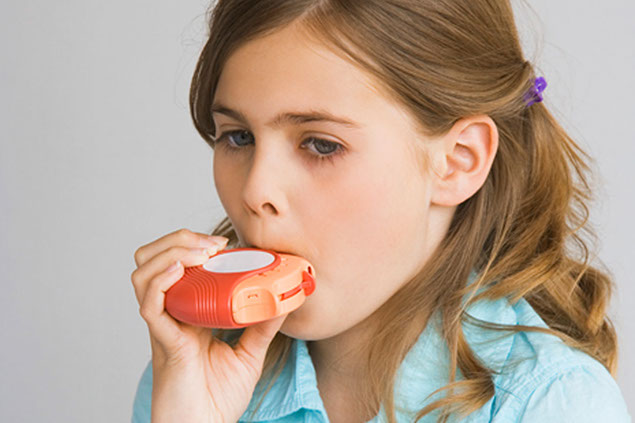
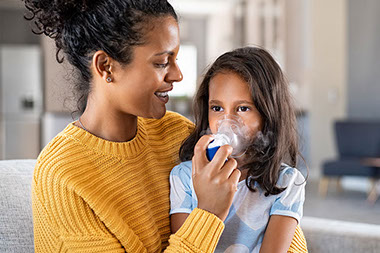
    Mom helping child with a breathing treatment.

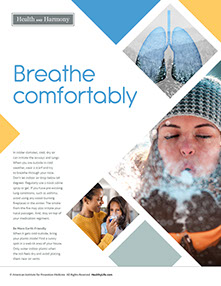
    In colder climates, cold, dry air can irritate the airways and lungs. When you are outside in cold weather, wear a scarf and try to breathe through your nose. Don’t let indoor air drop below 64 degrees. Regularly use a nasal saline spray or gel. If you have pre-existing lung conditions, such as asthma, avoid using any wood-burning fireplaces in the winter. The smoke from the fire may also irritate your nasal passages. And, stay on top of your medication regimens.

    Be More Earth-Friendly

    When it gets cold outside, bring your plants inside! Find a sunny spot in a well-lit area of your house. Only water indoor plants when the soil feels dry and avoid placing them near air vents.

    Health at Home Lifetime book by the American Institute for Preventive Medicine. www.HealthyLife.com. All rights reserved.

    © American Institute for Preventive Medicine