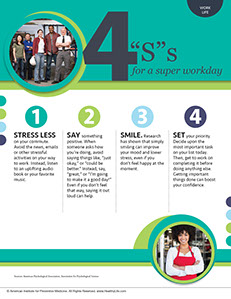
Category: Work Life

  • Working Through Cancer

    WORK LIFE

    Image of co-workers hugging.

    A person is considered a cancer survivor from the minute he or she is diagnosed with the disease. Staying at work during treatment or going back to work after treatment can pose challenges along with fighting the disease.

    Employers are required to support a survivor’s decision to work, said Teri Hoenemeyer, director of education and supportive services at the University of Alabama at Birmingham Comprehensive Cancer Center.

    “Cancer is classified as a disability, and working survivors have protections and rights under the Americans with Disabilities Act, so employers will need to provide time for doctors’ appointments and treatments that may go above and beyond Family Medical Leave,” she said.

    Whether it’s a work colleague, family member, or yourself, this advice may help, say survivors:

    *  Take it all in one bit at a time-one day, one treatment, one surgery, one radiation.

    *  Though it can be difficult, stay positive.

    *  Understand that cancer will take away your hair, your energy, and control of your schedule, but it will give back many new things such as supportive friends and coworkers, notes of encouragement, and a new outlook on life.

    Hoenemeyer said once back in the workplace following a diagnosis, survivors must take special care of themselves.

    “Extra rest, a healthy diet, physical activity, and low stress are all important factors to the survivor at work,” Hoenemeyer said. “Take time out of the day to do something that focuses on managing stress and anxiety; it could be meditation, sitting still with some music or taking a walk.”

    © American Institute for Preventive Medicine

  • Avoiding Digital Eye Strain

    WORK LIFE

    Image of man working on computer.

    Many people spend a lot of time in front of a computer screen at their job. And when we’re not at our desks, we may be looking at a smartphone or tablet or watching TV. All of these digital screens add up to a lot of strain on the eyes. Viewing a digital screen is hard on the eyes due to glare and reflections. Most screens also have less defined letters than printed paper, making them harder to read.

    Digital eye strain, or computer vision syndrome, may cause dry eyes or blurred vision, but it can affect other areas of the body as well. Some people also experience headaches and neck and shoulder pain. If these symptoms bother you when you’re using a digital screen, you may have digital eye strain.

    When you are viewing a screen for long periods, protect your eyes from strain by following these tips:

    *  Keep your screen about four to five inches below eye level.

    *  Avoid glare by moving the screen away from windows and bright lights. Consider a screen glare filter if needed.

    *  Rest your eyes throughout the day with the 20-20-20 rule. Every 20 minutes, look at an object 20 feet away for 20 seconds.

    *  Think about blinking. Many people blink less frequently while viewing a screen. Be intentional about blinking so your eyes stay moist.

    *  Get regular eye exams from a qualified doctor or optometrist. Be sure to tell your doctor if you notice any symptoms of digital eye strain or vision changes.

    Source: American Optometric Association

    © American Institute for Preventive Medicine

  • Make The Most Of Your Commute

    WORK LIFE

    Image of man on phone while waiting at the subway.

    A commute is just a part of life for many working people. But whether you spend that time on a bus, train, or in a car, your commute doesn’t have to be a low point in your day. Instead, use that time to make your day better! Try these tips:

    *Practice relaxation.If you’re not driving, try doing some meditation or guided imagery. You can purchase scripts and songs for your phone or other device to listen to.

    *Stay cool while driving.If you’re driving, listen to peaceful music and focus on slow, deep breaths. Breathe in through the nose and out through the mouth. This can help relieve “road rage” while you focus on driving.

    *Wait for work time.Don’t check email or do other work tasks before you’ve arrived at work. Instead, stay “unplugged” for a more relaxing start to your day. This is especially important if you’re driving!

    *Exercise your brain.An audiobook or podcast can help you feel productive during this down time. Some mobile phone apps and podcasts can even help you learn a new language.

    Commuter-friendly snacks

    If you’re starving by the time you walk through the door each night, you can end up overeating or reaching for the first bag of chips you see. Hold off your hunger by packing a snack for your ride home:

    *  An ounce of nuts, such as almonds, cashews, or walnuts

    *  A cup of fresh berries and a piece of string cheese

    *  Baby carrots or celery with hummus

    *  Plenty of water to stay hydrated, fight fatigue, and curb hunger

    © American Institute for Preventive Medicine

  • 3 “C”S To Be Your Best At Work

    WORK LIFE

    Two coworkers sitting at the table looking at the computer screen.

    Every job can be done half-heartedly – or done really well. Doing your best will help you feel satisfied with your job, which is great for your mental health.

    1.Confidence:Be confident in your abilities, especially your ability to go above and beyond at work. Not only is this good for your clients, coworkers and/or customers, but it has an added bonus: you’ll feel great too!

    2.Connect:Build positive relationships with people at work to help you succeed. If you’re experienced, help others learn from you. If you need guidance, don’t be afraid to ask others for their advice and input.

    3.Communicate:If you see a problem, speak up. Constructive feedback can be done in a way that’s respectful and kind. If you see good things happening, point those out, too. It’s a great way to build morale.

    © American Institute for Preventive Medicine
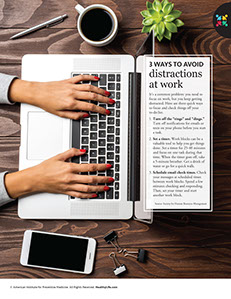
  • Avoiding Distractions At Work

    WORK LIFE

    Close up image of laptop with hands and phone.

    We all have days that are more productive than others. But you can be your best each day if you learn how to avoid the biggest distractions at your workplace.

    Put the phone away

    Is your phone frequently dinging with texts or people calling you “just to chat?” Do you find yourself checking social media or playing with apps when you should be working?

    Smart phones are a major cause of work-related distractions. Some employers have policies that prohibit cell phone use on the job. If that’s the case, you’ll need to follow those rules. But if your employer allows cell phones, turn off notifications and put the phone in a place that’s harder to reach. Some phones have an option that filters all calls except those from important or emergency numbers. This is a great way to allow people to reach you when it’s necessary, but to avoid non-essential calls and notifications.

    Use white noise

    If other people’s conversations or office noises are bothering you, consider ways you can soften or filter some of the sound. A white noise machine, fan or even headphones that play white noise or quiet non-distracting music may be helpful.

    Ways to get your focus back

    Everyone needs a mental break once in a while. Instead of checking your phone or social media, try these healthy tips that can energize you and help you get back to your work:

    *  Take a short walk around the building.

    *  Eat a healthy snack, such as fruits, vegetables, or lean protein.

    *  Drink a glass of water. Add a lemon or cucumber slice for more flavor.

    *  Get up from your chair and stretch for 3 minutes.

    *  Clean or organize your workspace. Clutter in your space can make your brain feel cluttered, too.

    © American Institute for Preventive Medicine

  • Overwhelmed At Work? How To Handle It

    WORK LIFE

    Image of stressed women at work.

    No matter what your job, you’re bound to feel overwhelmed sometimes. Whether you have new responsibilities, are worried about a certain project, or just have too much on your plate, it’s normal to feel the pressure occasionally. Though you may not be able to change what’s causing these feelings, you can find ways to deal with these situations in a healthy way.

    Jot it down.

    If your mind is swimming with a list of to-dos, put it on paper. Sometimes seeing the list can help you come up with a plan to get it done. You can figure out what needs to be done first, and then you have a starting point.

    Take a break from work when you’re off-duty.

    If your life revolves around the buzzing of your phone with emails and work demands, try to take some time each day to turn it off. You may find you feel more relaxed and ready to focus when you return to work.

    Start with just one step.

    If a huge project feels too difficult to start, then just think about the first thing you need to do. It can be something minor, such as sending an email or writing down a task list. Every big project begins with one step. Consider what needs to be done right now, and do that first. Once you get started, it may be easier to keep going.

    Talk to your supervisor.

    If possible, bring up your main concerns to your boss. Be specific about your problem, and focus on what you can do to help solve it. For instance, if you have too many tasks, tell them what you are able to do in the time you have, and suggest alternate ways to get the rest done. Perhaps you can ask for more time to get a project done. Or, see if you can delegate the task to a co-worker.

    An organized desk gives you control

    If you’re feeling buried at work, look in front of you. A messy desk can create more stress and anxiety. Clean up your space by:

    *  Going through papers as you get them, rather than letting them pile up

    *  Creating a “pending” or “in progress” folder for things you need to do

    *  Clean up your space before you leave each day

    *  Put things back as soon as you’re done using them

    A tidy desk can brighten your outlook and boost your productivity.

    Source: American Psychological Association

    © American Institute for Preventive Medicine

  • 3 Ways To Avoid Distractions At Work

    WORK LIFE

    Close up of hands typing on laptop keyboard.

    It’s a common problem: you need to focus on work, but you keep getting distracted. Here are three quick ways to focus and check things off your to-do list.

    1. Turn off the “rings” and “dings.” Turn off notifications for emails or texts on your phone before you start a task.

    2. Set a timer. Work blocks can be a valuable tool to help you get things done. Set a timer for 25-40 minutes and focus on one task during that time. When the timer goes off, take a 5-minute breather. Get a drink of water or go for a quick walk.

    3. Schedule email check times. Check your messages at scheduled times between work blocks. Spend a few minutes checking and responding. Then, set your timer and start another work block.

    Source: Society for Human Resource Management

    © American Institute for Preventive Medicine