Category: Be Fit

  • A Shopper’S Guide To Exercise Equipment

    Fitness

    Image of exercise equipment.

    Treadmills, stationary bikes, trampolines, rowing machines, and cross-country ski simulators have been called dream machines because people sometimes expect belts, cogs, pulleys, and wheels to help make all their fitness dreams come true. And exercise equipment is a universal fixture in many homes as well as health clubs.

    This “hardware for soft bodies” can provide a good workout. But you have to understand what the equipment is designed to do for you. A stationary bike, for instance, is good for burning calories, toning the lower body, and conditioning your heart. But it won’t tighten your abdominal muscles or strengthen your upper arms.

    Once you’ve decided what type of apparatus you need, you can narrow the selection down to the best choice if you:

    *  Find out if the company who makes the equipment (and the dealer who sells it) is reputable.

    *  Talk to other people who own the model you’re considering (or one like it).

    *  Decide if the price fits your budget.

    *  Test the equipment.

    *  Determine if it’s easy to assemble, install, or move, and what maintenance it requires.

    *  Look for a reasonable warranty.

    *  Be sure the equipment will challenge you, so you don’t “grow out of it” in a short time.

    Page image from A Year of Health Hints book by the American Institute for Preventive Medicine. www.HealthyLife.com. All rights reserved.

    © American Institute for Preventive Medicine

  • Take These Weather Wise Steps To Exercise

    Fitness

    If you live in a climate with distinctly different seasons, you’re lucky: You can vary your fitness program with changing conditions. But weather adds more than interest to your routine; it can affect your body’s response to exercise. An exercise done comfortably in one season-like jogging in the spring or fall, for instance-can become unpleasant, or even dangerous, if pursued in summer and winter without allowing for hotter or colder temperatures.

    In cold, wintry weather:

    Image of person streching outside in winter.

    *  Try to cover up all exposed skin on windy, chilly days.

    *  Wear a wool hat. You can lose up to 40 percent of your body heat through your head if it’s not covered.

    *  Wear three to five layers of lightweight clothing rather than a single layer or two of heavy clothing. A layer of lightweight polypropylene next to the skin keeps moisture from collecting and chilling you.

    *  Move against the wind on your way out and with the wind on your way home. You’ll be cutting down on the wind-chill factor when you’re perspiring the most.

    *  Try to avoid running in open areas. Town houses, office buildings, and homes in subdivisions can help to block chilling winds.

    *  Avoid smoking cigarettes or drinking beverages that contain caffeine or alcohol; such substances increase your susceptibility to the cold.

    In warm weather:

    *  Wear lightweight, loose clothing that allows sweat to evaporate easily. Don’t wear long-sleeved or full-length sweat suits in hot, humid weather. And don’t wear rubberized clothing which prevents evaporation of sweat, the body’s way of keeping you cool. Use a sunscreen to avoid sunburn.

    *  Exercise at a moderate pace.

    *  Drink at least 8 to 10 ounces of plain water 10 to 15 minutes before you start to exercise. And to compensate for fluids lost through perspiration, drink water during your workout, even if you don’t feel thirsty.

    *  Work out in the cooler parts of the day-early morning or after sundown.

    Page image from A Year of Health Hints book by the American Institute for Preventive Medicine. www.HealthyLife.com. All rights reserved.

    © American Institute for Preventive Medicine

  • Exercise Lowers Breast Cancer Risk

    BE FIT

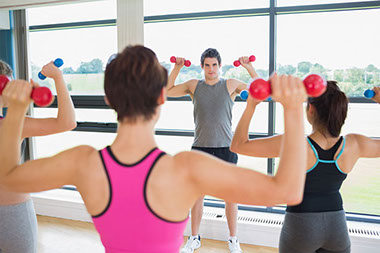
    Women using weights.

    In just 30 minutes a day, a woman can lower her risk of breast cancer. You don’t need special equipment or a gym. Power walking is a good choice to make a difference!

    Exercise lowers breast cancer risk by:

    *  Helping you get to a healthy weight. Being overweight raises the risk of getting breast cancer. This is because fat cells make estrogen that can allow some types of breast cancer cells to grow.

    *  Boosting your immune system. This could help stop or slow the growth of cancer cells.

    Source: National Breast Cancer Foundation

    © American Institute for Preventive Medicine

  • Know Your Fitness Goals

    BE FIT

    Two men with hands in the air sitting on bikes.

    The reason you exercise and move is unique to you. Knowing your fitness goals will help you stay focused on the types of movements that will provide you the most benefits for your physical, mental, and emotional health.

    Fitness goals

    *  Increased energy

    *  Better sleep

    *  Weight loss

    *  Stress reduction

    *  Improved strength

    *  Better balance

    *  Reduced disease risk

    *  Joint health

    *  Increased mobility

    *  Recovery from injury

    *  Maintain independence as you age

    Identify needs

    Reflect on these questions:

    *  How do I feel when I don’t move or exercise?

    *  How do I feel when I get more movement?

    *  Are there parts of my body that cause me pain?

    *  How might exercise reduce any current or future health problems?

    *  What do I want my health to look like in the next 5 to 10 years?

    Prioritize goals

    *  Choose 2-3 goals as your main focus.

    *  Find activities that match your goals.

    *  Don’t compare yourself to others.

    *  Connect with other people who have similar goals.

    *  Reevaluate your goals over time.

    © American Institute for Preventive Medicine

  • Boost Your Exercise With Caffeine

    BE FIT

    Caffeine does more than just give you energy. It can improve exercise performance too. And if you are someone who struggles with motivation, caffeine may give you the mental boost you need to get moving.

    Caffeine may help you get just a little more out of your exercise session. It may improve:

    *  Muscle endurance

    *  Speed of movement

    *  Muscle strength

    *  Aerobic endurance

    *  Alertness and focus

    Make caffeine work for you:

    *  Consume a dose of caffeine an hour before you exercise.

    *  1-3 mg caffeine per pound of body weight has been shown to be most effective.

    *  One cup of coffee has about 100 mg of caffeine.

    *  Energy drinks and other forms of caffeine can also work. But be wary of what else may be in them and read the label carefully.

    *  Talk to your doctor before taking any supplements.

    *  Don’t overdo it! More is not better and won’t give any additional benefit.

    © American Institute for Preventive Medicine

  • Dance With Or Without The Stars

    Fitness

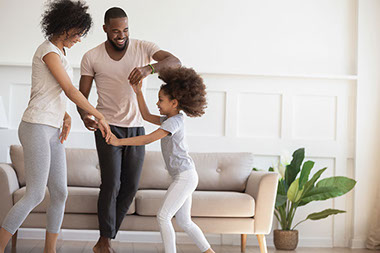
    Image of older couple ballroom dancing.

    Tone, tighten & shrink your body with constant movement.

    You may never earn a spot on Dancing With the Stars, but you can get the same benefits they’ve been touting – tight, toned bodies and noticeable weight loss – simply by moving to your own groove or learning a new one.

    Be forever young.

    With so many varieties of dance – each with different tempos, moves, music and styles, it’s good exercise for people of all ages and all fitness levels. Those with physical limitations can alter movements to work with their mobility challenges. Start with a few minutes of stretching and practice a few moves to warm up your muscles. Begin with slower, less demanding rhythms and build up to faster tempos. If you feel fatigue or shortness of breath, sit out a number.

    Dance the night away.

    If you just want to bust a move, head to the nearest nightclub to show off your be-bopping, hip-hopping or belly-flopping moves. Or turn on the jams at home and  get footloose.

    Benefits of dancing

    *  Strengthens muscles and bones. This lowers the risk of arthritis, sprains, and broken bones.

    *  Increases stamina

    *  Burns calories (150 to 200 per 30 minutes, depending on tempo)

    *  Lowers blood pressure and improves cholesterol levels

    *  Increases flexibility, improves balance, and lowers the risk of falls

    *  Benefits cardiovascular system and lung capacity

    *  Releases stress and tension

    *  Boosts self-confidence

    *  Elevates mood

    Action Step

    If you are having trouble picking a dance style, think about the kind of music you like. If it’s country, step into line, square dancing, or swing dancing. YouTube has lots of how-to videos to start you off on the right foot.

    Page image from Ways to Well-Being book by the American Institute for Preventive Medicine. www.HealthyLife.com. All rights reserved.

    © American Institute for Preventive Medicine

  • Healthy Exercise Tips For Children

    Fitness

    Image of 2 young kids running.

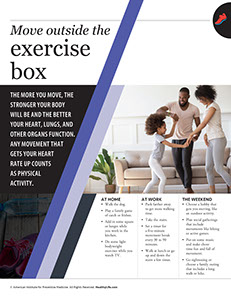
    *  Set a good example. Be active and get your family to join you. Have fun together. Play with the kids or pets. Go for a walk. Tumble in the leaves. Play catch.

    *  Take the President’s Challenge as a family. Keep track of physical activities each of you does. Earn awards for active lifestyles atwww.presidentschallenge.org.

    *  Get into a routine. Set aside time each day as activity time. Walk, jog, skate, cycle, or swim. Adults need at least 30 minutes of physical activity most days of the week. Children need 60 minutes everyday or most days of the week.

    *  Have an activity party. Make the next birthday party centered on physical activity. Try backyard Olympics or relay races. Have a bowling or skating party.

    *  Set up a home gym. Use things you have in the house. Use canned foods for weights. Use stairs for stair machines.

    *  Move it! Limit TV watching and computer time. When you watch TV, exercise or at least get up and move during TV ads. When you talk on the phone, lift weights or walk around.

    *  Give activity gifts. Give gifts that promote physical activity. Give sporting equipment or active games.

    *  Promote group sports. Children get regular exercise during practice and during games. Being part of a team can be good for children’s self-esteem, too.

    Page image from the Children's Self-Care Book by the American Institute for Preventive Medicine. www.HealthyLife.com. All rights reserved.

    © American Institute for Preventive Medicine

  • Test Your Fitness Level

    Fitness

    Image of women talking to her fitness trainer.

    How do you measure the success of your fitness program? By how much weight you lose? How many inches you trim off your waistline or hips? How well you sleep at night? How energetic you feel?

    These are all worthwhile criteria. Another way to evaluate your fitness level-and assess your progress-is to keep track of your resting heart rate (that is, your pulse rate when you’re least active).

    The idea is, the lower your resting heart rate, the better shape your heart is in. So as you become more fit, your resting heart rate should drop.

    Here’s how to measure it.

    1.  Take your pulse as soon as you wake up in the morning, before you get out of bed.

    2.  Count the number of beats for 10 seconds and multiply by six. This will give you your pulse in beats per minute.

    3.  Repeat the following morning. Then calculate the average of the two. (That is, add the two numbers together and divide by two.) This is your resting heart rate.

    Calculate your resting heart rate every three months, as conditioning takes some time to have an effect.

    Take the “Talk Test”

    No, this isn’t a suggestion that you audition to guest host “The Tonight Show.” It’s just a simple way for you to tell if you’re overdoing it when you exercise. If you’re too out of breath to comfortably carry on a conversation with another person as you dance, run, or slam-dunk your way to fitness, you’re probably working too hard and should slow down. (On the other hand, you should be working hard enough to break a mild sweat.) And of course, any unusual sign of physical distress (such as chest discomfort, pain of any kind, or dizziness) is a signal to slow down to a stop.

    Page image from A Year of Health Hints book by the American Institute for Preventive Medicine. www.HealthyLife.com. All rights reserved.

    © American Institute for Preventive Medicine

  • Exercise Safely In The Heat

    BE FIT

    Man sitting on bench beside his bike.

    Summer seems like an ideal time to exercise. After all, you don’t have to worry about slipping on ice or wearing extra layers to keep warm.

    But summer comes with its own set of safety issues. Heat illness can affect anyone, even people who are in great shape and healthy.

    What is heat illness?

    Heat illness happens when a person’s body gets too hot. This often happens when a person exercises in high temperatures.

    Heat illness can be mild to severe. Sometimes it’s just a sign that you need to cool off and get out of the sun. But other times, it can be dangerous or life-threatening.

    Time to chill out

    Signs of a mild heat illness include heat rash and heat cramps. A heat rash may be red and look like pimples. Heat cramps are muscle cramps or spasms.

    If you notice either of these signs when exercising, seek some shade and cool off. These are not usually serious conditions.

    People who have heart conditions or who follow a low-salt diet should talk to a doctor if they notice muscle cramps or spasms with exercise. If your heat rash doesn’t go away within a couple of days, see your doctor.

    When the heat is an emergency

    Heat exhaustion may cause:

    *  Heavy sweating

    *  Cold or clammy skin

    *  Feeling weak

    *  Weak but fast pulse

    *  Feeling sick

    *  Headache

    *  Fainting

    *  Dizziness

    If you notice these signs in yourself or another person, don’t wait. Seek shade or go indoors. Put cool, wet cloths on the body and head or take a cool bath. Get medical help if it doesn’t get better within an hour or if the person is throwing up.

    Heat stroke is the most severe kind of heat illness.

    It may cause:

    *  Temperature over 103ºF

    *  Skin that is clammy, hot or red, and even dry to the touch.

    *  Fast and strong pulse

    *  Headache or confusion

    *  Dizziness and/or fainting

    *  Feeling sick

    If you suspect heat stroke, get emergency medical care. Call 911 right away. Move the person to a cooler place. Apply cool cloths to their body. Do not give them anything to drink.

    Sources: Centers for Disease Control and Prevention, American Academy of Family Physicians

    © American Institute for Preventive Medicine

  • Lift Weights The Safe Way

    BE FIT

    Grandfather and grandson exercising by lifting weights.

    Lifting weights is great exercise. But if you don’t do it properly, you can get hurt. Here’s how you can get started, get stronger and avoid injuries.

    Learn good technique

    Have an instructor show you how to lift. You can use books, videos or virtual instruction if you can’t see a trainer in person.

    Keep your back straight when lifting, and wear shoes with good grip to avoid slipping. Stop the exercise if it hurts and wait a few days before trying it again.

    Set doable goals

    Don’t work the same muscles more than three times per week. Let muscles rest for 24 hours before working them again. Don’t try to do too much, too quickly. You’ll likely feel soreness for a day or two after lifting, and that’s normal.

    Warm up and cool down

    Warm up your muscles with active stretching, light jogging/walking or leg squats before you lift. When you’re done lifting, cool down and  stretch again.

    Stretching should not hurt. Hold the stretch steady – don’t bounce.

    When to see your doctor

    If you have ongoing pain or you think you hurt yourself while lifting, talk to your doctor.

    Source: American Academy of Family Physicians

    © American Institute for Preventive Medicine