Category: Healthy Travel

  • Traveling

    Healthy Travel

    Smiling women standing in front of the Leaning Tower of Pisa, holding a camera.

    The best of travel plans can be ruined if you get sick or aren’t able to deal with health problems on your trip. Discuss your travel plans with your doctor.

    Make sure to take enough medicines you need for the whole trip.

    Depending on your destination, this may include insect repellant, sunscreen (SPF 30 or higher), hand sanitizer (60% alcohol or higher), and face masks.

    Find out if and what your health insurance covers if you need medical care during your trip. You may consider purchasing additional travel health insurance. Find out where to go for care, if needed.

    Certain vaccines may be required by some countries before you visit them. Find out if and what vaccines are required for places that you plan to travel from the CDC Travelers’ Health Web site atcdc.gov/travel.

    Page from HealthyLife Weigh book by the American Institute for Preventive Medicine. www.HealthyLife.com. All rights reserved.

    © American Institute for Preventive Medicine

  • Healthy Travel Basics

    Healthy Travel

    Travel Tips

    *  Leave your trip’s itinerary with someone.

    *  Do not look like a tourist. Wear plain clothes and little, if any, jewelry.

    *  Walk at night with others and in well-lit, safe areas. Ask hotel staff for advice.

    *  Take healthy snacks or buy them at a nearby grocery.

    *  Use the hotel stairs as a stair stepper.

    *  Stretch using a bath towel or exercise with a jump rope.

    Traveler’s First-Aid Kit

    *  Rubbing alcohol or alcohol wipes

    *  Antibacterial cream or spray

    *  Bandages and gauze pads

    *  Elastic bandages

    *  Mild pain reliever (e.g., acetaminophen, ibuprofen). Before your trip, ask your doctor what you should take.

    *  Antacids

    *  Cough and cold remedies

    *  Diarrhea medication

    *  Broad-spectrum antibiotic (requires a doctor’s prescription)

    Reducing Travel Stress

    *  Prepare for your trip well in advance. Make a list of things to do each day.

    *  Finish packing your bags at least one full day before you leave. Devote the remaining time to getting organized, i.e. plants watered.

    *  Allow plenty of time to reach your destination or flight.

    *  Don’t over-schedule activities.

    *  Sleep enough, exercise, and don’t overeat.

    *  Schedule your return so you have a day to “decompress”.

    Airplane & Car

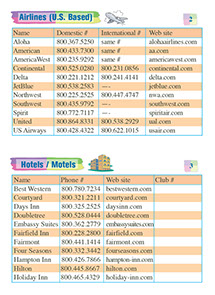
    Airlines (US only)

    Aloha

    800.367.5250  *www.alohaaircargo.com

    American

    800.433.7300  *www.aa.com

    Delta

    800.221.1212  *www.delta.com

    JetBlue

    800.538.2583  *www.jetblue.com

    Southwest

    800.435.9792  *www.southwest.com

    Spirit

    800.772.7117  *www.spiritair.com

    United

    800.864.8331  *www.ual.com

    US Airways

    800.428.4322  *www.usair.com

    Jet Lag

    *  Three nights before you leave, change your bedtime. If traveling to a different time zone and going east, go to bed 1 hour earlier for each time zone you cross; if you’re traveling west, go to bed one hour later for each time zone you cross.

    *  Once on the plane, change your watch to match the time where you are going. Act according to that time. For example, if it is time to sleep in the place you are going, try to sleep on the plane. If it is daytime, do activities that keep you awake.

    *  Ask your doctor about using melatonin, an OTC product that may help “reset” your natural awake/sleep cycle. Also ask about taking vitamin B12 and vitamin C supplements.

    *  During the flight, avoid sleeping pills, alcohol, and caffeine. Drink plenty of fluids to avoid dehydration.

    *  If you arrive at your destination during the day, plan to spend some time outdoors. Try to expose yourself to as many hours of daylight as the number of time zones you crossed.

    *  Don’t go to bed until evening.

    In-Flight Ear Pops

    Note: Consult your physician if you have an acute ear infection, a severe head cold, or sinusitis before flying.

    *  Swallow frequently, yawn, or gently blow through your nose while pinching the nostrils shut to equalize pressure within your ears. (Don’t do this if you have a head cold as it will promote an ear infection.)

    *  If you have a mild head cold, use a nasal spray to keep the nasal passages open. You can also take a decongestant if okay with your doctor.

    Infants and Young Children

    *  Have your infant suck on a pacifier or bottle during the takeoff and landing. (Nursing a baby also helps.)

    *  Ask your doctor about giving children a mild decongestant and antihistamine 1 hour before takeoff and 1 hour before landing.

    Fitness in Flight

    *  Tense your feet for 5 seconds, then relax them. Repeat with each muscle group, including your calves, thighs, buttocks, shoulders, neck, forearms, and hands.

    *  Drop your head forward. Then slowly move it to your right and continue rotating your head to the back, to the left, and to the front again. Repeat four times. Then reverse direction and repeat five times.

    *  Raise both shoulders, then move them back, down, and forward in a circular motion.

    *  Reaching toward the ceiling, stretch your right arm. Then repeat with your left arm.

    To promote leg circulation

    *  Flex and extend your feet, pointing your toes up and down.

    *  Try to get up and walk at least once every 2 hours, if possible. You should also make an effort to breathe slowly and deeply. Aircraft air is lower in oxygen than outdoor air. Deep breathing helps you to get enough oxygen into your blood and avoid fatigue or sluggishness.

    Alamo:  800.462.5266  *www.alamo.com

    Avis:  800.230.4898  *www.avis.com

    Budget:  800.527.0700  *www.budgetrentacar.com

    Dollar:  800.800.3665  *www.dollar.com

    Enterprise:  800.736.8222  *www.enterprise.com

    Hertz:  800.654.3131  *www.hertz.com

    National:  800.227.7368  *www.nationalcar.com

    Payless:  800.237.2804  *www.paylesscar.com

    Thrifty:  800.847.4389  *www.thrifty.com

    Auto Europe: 888.223.5555  *www.autoeurope.com

    Hotel

    Hotel Safety

    *  When you enter your room, prop the door open, turn on the lights, and check all areas before you close the door.

    *  Make sure that windows and connecting doors are locked.

    *  Avoid first floor rooms and those with doors facing outside.

    *  Lock your door using the safety chain.

    *  When you are not in your room, turn the TV on and hang the “Do Not Disturb” sign.

    *  Study the emergency exit map to prepare for an escape.

    Best Western:  800.780.7234  *www.bestwestern.com

    Courtyard:  800.321.2211  *www.courtyard.com

    Days Inn:  800.325.2525  *www.daysinn.com

    Doubletree:  800.528.0444  *www.doubletree.com

    Embassy Suites:  800.362.2779  *www.embassysuites.com

    Fairmont:  800.441.1414  *www.fairmont.com

    Four Seasons:  800.332.3442  *www.fourseasons.com

    Hampton Inn:  800.426.7866  *www.hampton-inn.com

    Hilton:  800.445.8667  *www.hilton.com

    Holiday Inn:  800.465.4329  *www.holiday-inn.com

    Howard Johnson:  800.654.2000  *www.hojo.com

    Hyatt:  800.233.1234  *www.hyatt.com

    LaQuinta:  800.531.5900  *www.laquinta.com

    Le Meridien:  800.543.4300  *www.lemeridien.com

    Marriott:  800.228.9290  *www.marriott.com

    Motel 6:  800.4motel6  *www.motel6.com

    Omni:  800.843.6664  *www.omnihotels.com

    Radisson:  800.333.3333  *www.radisson.com

    Ramada:  800.228.2828  *www.ramada.com

    Red Lion:  800.733.5466  *www.redlion.com

    Red Roof: 800.843.7663  *www.redroof.com

    Residence Inn:  800.331.3131  *www.residenceinn.com

    Ritz Carlton:  800.241.3333  *www.ritzcarlton.com

    Sheraton:  800.325.3535  *www.sheraton.com

    Super8:  800.848.8888  *www.super8.com

    Travel Lodge:  800.255.3050  *www.travelodge.com

    Westin:  888.625.5144  *www.westin.com

    Wyndham:  800.822.4200  *www.wyndham.com

    Motel Sickness

    Preventing Motion Sickness

    Aboard a ship

    *  Spend as much time as you can on deck in the fresh air.

    *  If you’re going to be spending nights on a boat, try to get a cabin near the middle and close to the waterline where there’s less pitching and rolling.

    On a plane

    *  Request a seat over the wings. Avoid sitting in the tail section as it’s the bumpiest.

    *  Open the overhead vents and direct air at your face.

    On a train or car

    *  Fix your gaze on the scenery straight ahead, not to the side.

    *  Sit by an open window for fresh air unless in a polluted area.

    *  If you’re traveling by car, offer to drive. The driver doesn’t usually get motion sickness.

    Other Tips

    *  Get plenty of rest before setting out. Fatigue makes you more vulnerable to motion sickness.

    *  Avoid drinking alcohol before or during travel and don’t overindulge the night before.

    *  Take an OTC medication (i.e., Dramamine®) 30 minutes before travel begins.

    *  If OTC products don’t bring relief, ask your doctor about a prescription medication with scopolamine (a patch).

    *  Don’t read while traveling and don’t try to focus on any other stationary object. Aboard a ship, lie down on your back and close your eyes.

    *  If any of your traveling companions get motion sickness, move away, otherwise you may get sick.

    Page from the Travel CareKit book by the American Institute for Preventive Medicine. www.HealthyLife.com. All rights reserved.

    © American Institute for Preventive Medicine

  • What To Do If Turista Strikes

    Healthy Travel

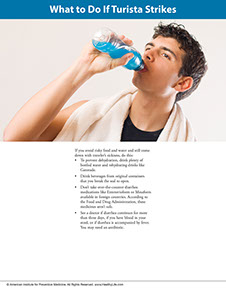
    Image of man rehydrating with liquids.

    If you avoid risky food and water and still come down with traveler’s sickness, do this:

    *  To prevent dehydration, drink plenty of bottled water and rehydrating drinks like Gatorade.

    *  Drink beverages from original containers that you break the seal to open.

    *  Don’t take over-the-counter diarrhea medications like Enterovioform or Mesaform available in foreign countries. According to the Food and Drug Administration, these medicines aren’t safe.

    *  See a doctor if diarrhea continues for more than three days, if you have blood in your stool, or if diarrhea is accompanied by fever. You may need an antibiotic.

    Page image from A Year of Health Hints book by the American Institute for Preventive Medicine. www.HealthyLife.com. All rights reserved.

    © American Institute for Preventive Medicine

  • Your Pre-Vacation Checklist

    Healthy Travel

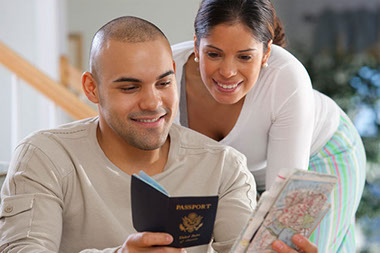
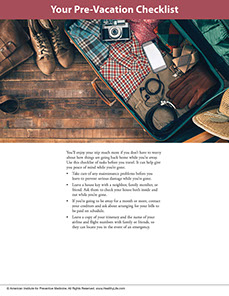
    Image of couple looking at passport and map.

    You’ll enjoy your trip much more if you don’t have to worry about how things are going back home while you’re away. Use this checklist of tasks before you travel. It can help give you peace of mind while you’re gone.

    *  Take care of any maintenance problems before you leave to prevent serious damage while you’re gone.

    *  Leave a house key with a neighbor, family member, or friend. Ask them to check your house both inside and out while you’re gone.

    *  If you’re going to be away for a month or more, contact your creditors and ask about arranging for your bills to be paid on schedule.

    *  Leave a copy of your itinerary and the name of your airline and flight numbers with family or friends, so they can locate you in the event of an emergency.

    Page image from A Year of Health Hints book by the American Institute for Preventive Medicine. www.HealthyLife.com. All rights reserved.

    © American Institute for Preventive Medicine

  • How To Locate A Physician Away From Home

    Healthy Travel

    Image of doctor with medical icons.

    The best made travel plans can’t guarantee against illness or injuries. Although travelers don’t like thinking about the possibility of a medical emergency, a little forethought can save you a lot of misery or aggravation. Knowing what to do and who to contact should you need medical help, especially when traveling abroad, reduces anxiety and avoids wasting time when minutes count.

    Specialized travel medical clinics exist in some areas. Consult the following for names of physicians you can contact, if need be, in the area you plan to visit.

    International Association for Medical Assistance to Traveler (IAMAT)

    1623 Military Rd. #279

    Niagra Falls, NY 14304-1745

    716.754.4883

    www.iamat.org

    Overseas Citizens Services (OCS), Bureau of Consular Affairs

    1.888.407.4747

    http://travel.state.gov/about/contact/contact_4745.html

    The American Embassy or American, British, or Canadian consul or consulate in the country you’re visiting.

    Page image from A Year of Health Hints book by the American Institute for Preventive Medicine. www.HealthyLife.com. All rights reserved.

    © American Institute for Preventive Medicine

  • You’re Built For Adventure

    Healthy Travel

    Women standing on rock in middle of a creek.

    Setting up daily routines can help you rest your brain so that your creative side can blossom. It’s much easier to plan new ventures and reach goals when your mind isn’t overly taxed with daily problem-solving.

    Do you ever get the itch to do something extraordinary? That may be your inner adventurer calling. People are often drawn to challenges that excite them. When you combine the outdoors with adventure, that can also be a recipe for better mental and physical health.

    *  Activities like biking, hiking or kayaking require mental focus similar to meditation.

    *  Outdoor adventures done with others help you develop better empathy skills.

    *  Outdoor activity offers great cardiovascular benefits, but take precautions to avoid injury.

    *  Being outdoors can help you get the vitamin D you need. But after 15 minutes, cover up or put on an SPF 30 or higher sunblock to protect your skin from the sun.

    Page from HealthyLife Weigh book by the American Institute for Preventive Medicine. www.HealthyLife.com. All rights reserved.

    © American Institute for Preventive Medicine