Nutrition

© American Institute for Preventive Medicine
Nutrition
© American Institute for Preventive Medicine
Nutrition
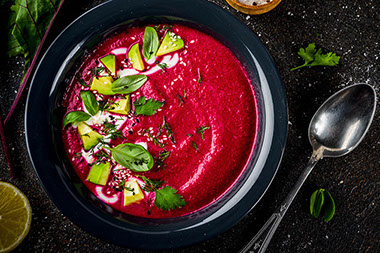
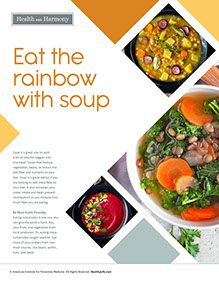
Soup is a great way to pack a lot of colorful veggies into one meal! Soups that feature vegetables, beans, or brown rice add fiber and nutrients to your diet. Soup is a great option if you are looking to add more fiber to your diet. It also increases your water intake and helps prevent constipation as you increase how much fiber you are eating.
Be More Earth-Friendly
Eating sustainably is one way you can give the earth a hand. Buy your fruits and vegetables from local producers. Try eating more sustainably caught seafood. Get more of your protein from non-meat sources, like beans, lentils, nuts, and seeds.
© American Institute for Preventive Medicine
Nutrition
Healthy eating means getting enough (but not too much) of the nutrients you need for good health. These are protein, carbohydrates, fat, vitamins, minerals, and water.
The Dietary Guidelines for Americans* give the basics for healthy eating. (These guidelines are for persons aged two years and older.)
* Get updates for these fromwww.DietaryGuidelines.gov.
What is Healthy Eating?
Eat a balanced diet that stays within your calorie needs.
A balanced diet gives nutrients that your body needs. It also limits saturated and trans fats, cholesterol, salt, added sugars, and alcohol. These things increase the risk of health problems, like heart disease, high blood pressure, and obesity.
Maintain body weight in a healthy range.
Balance the calories you eat with physical activity. To prevent weight gain over time, make small decreases in calories and increase physical activity. Lose weight if you are overweight.
Choose and prepare foods with less salt.
Health experts suggest limiting sodium to 2,300 mg a day; 1,500 mg if you have high blood pressure, are African-American, or are middle aged or older. You can easily get this amount from foods you eat without adding salt at the table.
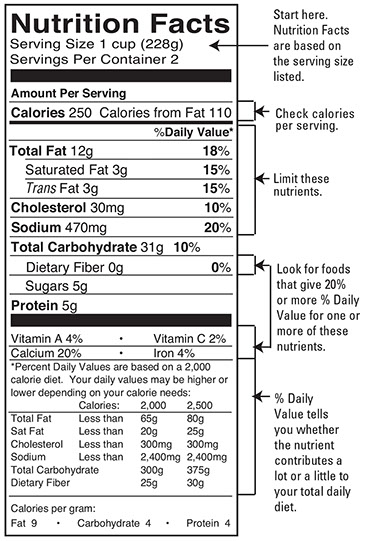
* Read the “Nutrition Facts” on food labels for sodium content. Choose ones low in sodium and that are labeled “no added salt,” “reduced sodium,” and “low-sodium.”
* Choose fresh or frozen fish, shellfish, poultry, and meat over processed ones, like luncheon meats.
* Have potassium-rich foods, such as oranges, bananas, potatoes, and other fruits and vegetables.
* Use spices and herbs, rather than salt, to enhance the flavor of food. Leave the salt shaker off the table. Go easy on condiments, such as soy sauce, ketchup, mustard, pickles, and olives
If you drink alcoholic beverages, do so in moderation.
This means no more than 1 drink a day for women and persons over age 65; no more than 2 drinks a day for men.
1 Alcoholic Drink = 12 oz. beer (150 calories), 4 to 5 oz. wine (100 calories), or 1-1/4 oz. 80 proof liquor (100 calories).
Choose a variety of whole grains daily.
Examples are whole-wheat bread, whole-grain ready-to-eat cereals, oatmeal, whole barley in soup, and cracked wheat in tabouli salad. Whole grains provide energy, vitamins and minerals, dietary fiber, and healthy plant chemicals. Limit high-fat choices, like croissants, pastries, and granola. Limit sugar-sweetened cereals.
Choose a variety of fruits and vegetables.
* Strive for five or more servings a day. Choose ones of different colors to get a variety of vitamins, minerals, and healthy plant chemicals.
* Every week, choose vegetables from five subgroups (dark green; orange, yellow, and red; beans and lentils; starchy vegetables, such as green peas; and other vegetables).
* Keep ready-to-eat fruits and vegetables on the counter and in clear containers in the front of your refrigerator. Use these for snacks or meals-on-the-go.
* Limit fried vegetables and ones in cream or cheese sauces.
Keep food safe to eat.
* Wash your hands before you handle food. Use clean utensils and clean surfaces when you prepare foods.
* Separate raw, cooked, and ready-to-eat foods while shopping, preparing, or storing.
* Cook foods to a safe temperature. Check and follow the label or recipe.
* Keep hot foods higher than 140ºF and cold foods at 40ºF or below. Do not eat these foods when kept for more than 2 hours between 40ºF and 140ºF.
* Refrigerate perishable foods promptly. When in doubt, throw it out.
Choose a diet that is low in saturated and trans fats and cholesterol and moderate in total fat.
* Have as little trans fats as possible. These come from foods with hydrogenated oils (e.g., stick margarine, shortenings, processed snack foods, such as crackers). Trans fats are thought to raise LDL (“bad”) cholesterol.
* Add little fat to food. When you do, use monounsaturated fats (e.g., canola and olive oils) or polyunsaturated fats (e.g., corn and soybean oils). Limit foods with creamy sauces.
* Use nonfat and low-fat dairy products. Use soy milks and yogurts.
* Choose lean cuts of beef, pork, lamb, chicken, and turkey. Trim fat from meat. Take skin off poultry before eating. Limit fried meats, etc.
* Eat fish 2 to 3 times a week (e.g., salmon, mackerel, anchovies, and tuna). Fish has omega-3 fatty acids, a healthy unsaturated fat. This is in cod liver oil, too. Some fish have mercury, a harmful substance. Follow your doctor’s advice on eating fish, especially if you are pregnant.
* Read food labels. Choose foods low in total fat and saturated fat.
* Limit dietary cholesterol, as advised by your doctor.
Choose and prepare foods and beverages with little added sugars or caloric sweeteners.
* Read food labels for sugar content. This is listed under “Total Carbohydrate” in the “Nutrition Facts” section. Sugar content includes the natural sugar in the food and added sugars, if any. Look at the ingredient list. Avoid or limit foods that list sugar, high fructose corn syrup, etc. as the 1st or 2nd ingredient.
* Between meals, limit foods and beverages with sugars and starches. If you do have them, brush your teeth afterwards to reduce the risk of tooth decay. Chew a sugar-free gum with the artificial sweetener xylitol.
* Sugar substitutes (acesulfame, aspartame, saccharin, and sucralose) provide a sweet taste without the calories of sugar. Use them in moderation, if at all.
* Choose water, unsweetened beverages, and nonfat milk over beverages high in added sugars, such as soft drinks and fruitades.
* Choose fruit for desserts and snacks. Limit cakes, cookies, pies, and candy.
Use ChooseMyPlate.gov
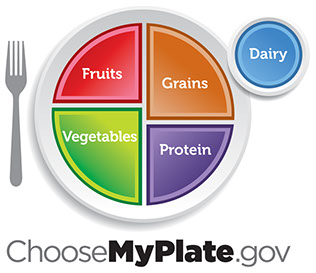
Find out about this at:www.choosemyplate.gov. At this Web site, you can:
* Get a Daily Food Plan based on your age, gender, height, weight, and physical activity level. Your plan shows how many calories you need each day and the number of servings from basic food groups, subgroups, and oils to meet your calorie needs. Serving sizes are given in cups; ½ cups, etc.
* Use SuperTracker to help you plan and track your food intake and physical activities.
* Use Food-A-Pedia to look up nutrition information for over 8,000 foods. You can also compare foods side-by-side to help you make healthy choices.
* Get nutrition tips.
* Find out about healthy eating on a budget.
Read Food Labels
Look at dates on the label. Don’t buy food items that are spoiled or will spoil before you use them.
* Read the ingredients. Check for items that you or family members are allergic or sensitive to, such as peanuts, milk, eggs, and wheat.
* Know that ingredients are listed in order from most to least used. Avoid or limit foods that list fats and sugar sources first or second.
Healthy Eating Tips
When you shop for foods, buy whole grains, fruits and vegetables (fresh, frozen, etc.), nonfat dairy foods, lean meats, etc. Limit high fat, high calorie snack foods.
* Drink 6 to 8 or more glasses of water a day.
* Eat at regular times each day. Don’t skip breakfast.
* Eat when you are truly hungry, not as a response to emotions.
* Get recommended grams (gms.) of dietary fiber/day. Males age 50 and younger need 38 gms./day; 30 gms./day if over age 50. Women age 50 and younger need 25 gms./day; 21gms./day if over age 50. Fiber is a type of carbohydrate (from plant foods only) that the body does not digest. Read food labels for dietary fiber content. Increase fiber gradually. Drink plenty of water, too.
For Eating Out
* Choose a restaurant that offers low-fat choices. Order an item from the menu instead of opting for the “all-you-can-eat” buffet.
* Order appetizer or side dish sizes for entrees. Ask for half orders or share an order with another person. When served whole orders, eat half. Take the rest home for another meal.
* Choose baked, roasted, poached, and steamed items. Limit fried items.
* Ask that sauces and salad dressings be served on the side. Use small amounts, if any.
* At fast-food places, order small sandwiches, salads, and low-fat milk or unsweetened drinks. Limit jumbo double decker sandwiches, etc. Don’t supersize meals. Go easy on regular salad dressings and fatty sauces.
* Order pizza with lots of vegetables, less meat, and half the cheese.
* When going to a party where many high-fat foods will be served, offer to take a fresh fruit or vegetable dish.
For a Busy Lifestyle
* Take healthy snacks with you. Examples are fresh fruits, bagels, and meal replacement drinks or bars.
* Drink bottled water instead of regular and diet colas and other beverages with caffeine.
* When you cook, prepare enough for 3 or 4 meals. Freeze meals in portions. Reheat as needed.
* For a super quick meal, eat a sandwich, a bowl of vegetable soup, fresh fruit, and drink a glass of skim milk. If you eat out, you can get these at a deli and grocery stores.
Resources
ChooseMyPlate.gov
Food & Drug Administration
Nutrition.Gov
Office of Dietary Supplements National Institutes of Health
© American Institute for Preventive Medicine
Nutrition
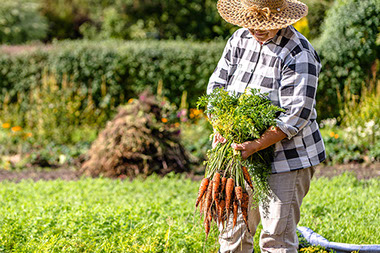
* Eat green, orange, yellow, red, purple and other colors of fruits and vegetables. Have 5 to 9 servings every day.
* Choose other plant-based foods, such as whole-grain breads and cereals, beans, peas, and nuts.
* Buy organic foods. Choose fresh produce in season and locally grown foods to save money and energy spent on transporting foods from up to thousands of miles away.
* Wash fruits and vegetables with clean tap water before using to remove soil particles and pesticides that might be on the foods. Wash items over a bowl. Pour the water from the bowl over your plants instead of down the drain.
* Create a compost in your backyard. Find out how fromepa.gov/recycle/composting-home. Use it to fertilize your lawn.
* When you eat out, try restaurants that use locally grown foods. Find ones fromdinegreen.com.
© American Institute for Preventive Medicine
Nutrition

Coronary heart disease is the leading cause of premature death among Americans. And it’s largely self-inflicted. When vital arteries leading to the heart become clogged by fatty deposits of cholesterol, the blockage can lead to a heart attack. Luckily, a few simple changes in eating habits can reduce your risk of heart disease.
* Substitute skim or 1/2% milk for 2% or whole milk.
* Eat less meat and fewer eggs. A good rule of thumb is no more than 3 to 5 ounces of meat per serving and no more than five to seven servings a week, and no more than three egg yolks per week (unless your physician advises otherwise).
* Use one egg yolk and two whites for every two eggs required in a recipe.
* Trim all visible fat from meat before cooking. Remove skin from poultry.
* Bake, roast, or broil meat, poultry, or fish. Don’t fry.
* Chill soup made from meat or poultry, then skim off the fat before reheating and serving.
* Poach foods like fish or eggs instead of sautéing them in butter.
* To cut down on the need for oil in cooking, use a vegetable cooking spray and/or pans with a nonstick surface.
* Substitute liquid vegetable oil for solid shortening and replace butter with oil, soft margarine, and spreads made with plant sterols and stanols, such as the brands Benecol and Take Control. Use less total fat.
* Limit how much oil-based or creamy salad dressing you use. Substitute oil-free salad dressing, lemon juice, or flavored vinegar.
* When you use small amount of fats, use olive oil or canola oil. Some research shows they may protect against heart disease.
* Bake, steam, or stir-fry vegetables. Don’t deep-fry vegetables or sauté them in lots of butter.
© American Institute for Preventive Medicine
Nutrition
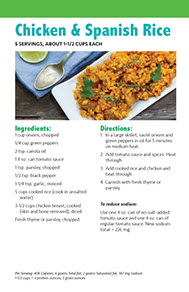
5 Servings, about 1-1/2 cups each
Ingredients:
1 cup onions, chopped
1/4 cup green peppers
2 tsp. vegetable oil
1 8 oz. can tomato sauce
1 tsp. parsley, chopped
1/2 tsp. black pepper
1-1/4 tsp. garlic, minced
5 cups cooked rice. (Cook in unsalted water.)
3-1/2 cups chicken breast, cooked (skin and bone removed), diced
Directions:
1. In a large skillet, sauté onions and green peppers in oil for 5 minutes on medium heat.
2. Add tomato sauce and spices. Heat through.
3. Add cooked rice and chicken and heat through.
To reduce sodium:
Use one 4 oz. can of no-salt-added tomato sauce and one 4 oz. can of regular tomato sauce. New sodium total = 226 mg.
Per Serving:
Calories – 406
Total fat – 6 grams
Saturated fat – 2 grams
Sodium – 367 mg
© American Institute for Preventive Medicine
Nutrition
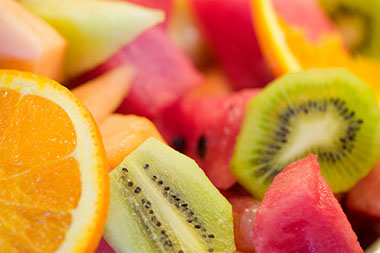
Have you ever wondered whether drinking a glass of orange juice is much different, nutritionally, than eating an orange? Or whether a glass of apple juice is better than an apple?
Fruit juice is a fine alternative to soda or alcoholic beverages. And in some cases, juice is a rich and convenient source of vitamin C. But whole fruit has some advantages over juice. Ounce for ounce, whole fruit:
* Is more filling, and therefore satisfying.
* Contains fewer calories.
* Has more fiber.
Studies show that fiber (present in fruit, but not in juice) helps regulate metabolism of carbohydrates, so sugar in fruit is absorbed more slowly than the same sugar in fruit juice. And when sugar of any kind moves into the bloodstream more slowly, your body releases less insulin, a hormone that regulates blood sugar levels and keeps them from fluctuating wildly. And you feel better when your blood sugar levels are on an even keel.
Be aware, too, that many “juice drinks” contain only a small percentage of real juice. The rest is water, sweeteners, coloring, and flavoring. Whole fruit, on the other hand, is 100 percent fruit.
© American Institute for Preventive Medicine
Nutrition

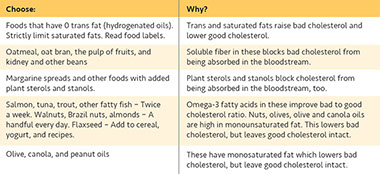
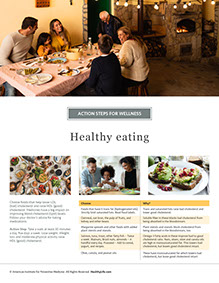
Choose foods that help lower LDL (bad) cholesterol and raise HDL (good) cholesterol. Medicines have a big impact on improving blood cholesterol (lipid) levels. Follow your doctor’s advice for taking medications.
Action Step:Take a walk at least 30 minutes a day, five days a week. Lose weight. Weight loss and moderate physical activity raise HDL (good) cholesterol.
© American Institute for Preventive Medicine
Nutrition
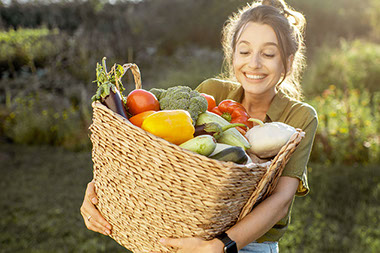
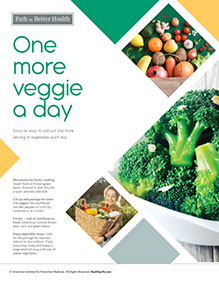
Focus on ways to add just one more serving of vegetables each day.
*Microwave for faster cooking:Steam fresh or frozen green beans, broccoli or bok choy for a quick and easy side dish.
*Cut up and package for later:Use veggies like cauliflower and bell peppers in a stir-fry, casserole or as a snack.
*Frozen – just as nutritious as fresh:Good buys include frozen peas, corn and green beans.
*Enjoy vegetable soups:Look on the package for reduced-sodium or low-sodium. If you have time, make and freeze a large batch of soup with lots of added vegetables.
© American Institute for Preventive Medicine
Nutrition
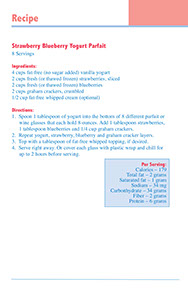
8 Servings
Ingredients:
4 cups fat-free (no sugar added) vanilla yogurt
2 cups fresh (or thawed frozen) strawberries, sliced
2 cups fresh (or thawed frozen) blueberries
2 cups graham crackers, crumbled
1/2 cup fat-free whipped cream (optional)
Directions:
1. Spoon 1 tablespoon of yogurt into the bottom of 8 different parfait or wine glasses that each hold 8-ounces. Add 1 tablespoon strawberries, 1 tablespoon blueberries and 1/4 cup graham crackers.
2. Repeat yogurt, strawberry, blueberry and graham cracker layers.
3. Top with a tablespoon of fat-free whipped topping, if desired.
4. Serve right away. Or cover each glass with plastic wrap and chill for up to 2 hours before serving.
Per Serving:
Calories – 179
Total fat – 2 grams
Saturated fat – 1 gram
Sodium – 34 mg
Carbonhydrate – 34 grams
Fiber – 2 grams
Protein – 6 grams
© American Institute for Preventive Medicine