Category: Nutrition

  • Turkey-Cabbage Casserole

    Nutrition

    8 Servings, about 1 cup each

    Ingredients:

    1 cup cabbage, shredded

    1 pound ground turkey

    1/2 cup onion, chopped

    1 cup white rice, uncooked

    2 cups tomato sauce

    1/2 tsp. garlic powder

    1/2 tsp. ground oregano

    Directions:

    1.  Place shredded cabbage in a lightly greased 2-quart casserole dish.

    2.  In skillet, cook turkey until browned and no longer pink in color. Add chopped onions; stir occasionally and cook 3 minutes. Add uncooked rice to cooked turkey.

    3.  Place turkey-rice mixture over cabbage in casserole dish.

    4.  Combine tomato sauce, garlic, and oregano. Pour over cooked turkey.

    5.  Cover and bake at 350ºF, about 1 hour.

    Per Serving:

    Calories – 190

    Total fat – 5.5 grams

    Saturated fat – 1.5 grams

    Sodium 415 mg

    Page from HealthyLife Weigh Recipe book by the American Institute for Preventive Medicine. www.HealthyLife.com. All rights reserved.

    © American Institute for Preventive Medicine

  • An Easy Guide For Healthy Eating

    Nutrition

    Image of women eating a healthy salad.

    Get your plate and body in shape.

    At the websitewww.ChooseMyPlate.gov, the dinner plate (and glass) graphic is an easy way to know the right portions of fruit, vegetable, grain, protein, and dairy food groups to eat at meals. But the website offers so much more.

    Interaction Helps You Get and Stay On Track

    ChooseMyPlate.govhas tools and resources to help you make healthy food and physical activity choices that meet your specific needs. Click on “SuperTracker.” Then click on “Create Your Profile.” Use this tool to:

    *  Get a custom eating and physical activity plan to meet your needs.

    *  Track what you eat and drink and your physical activity progress.

    *  Get guidance to help you manage your weight.

    The site also helps you personalize menus and provides quick access to calorie and nutrient comparisons of foods using My Food-A-Pedia. You can also download useful brochures and get White House recipes and Food Group recipes for healthy dishes like Rise and Shine Breakfast Cobbler and Caribbean Casserole.

    Tips to build a healthy plate

    *  Make half your plate fruits and vegetables. Choose ones of different colors to get a variety of nutrients.

    *  Drink skim or 1% milk.

    *  Make at least half your grains whole, such as brown rice and 100% whole wheat bread.

    *  Vary your protein food choices, such as lean beef, chicken, turkey, fish, beans and tofu.

    *  Avoid foods that have trans fats.

    *  Choose foods with little or no added sugars.

    Action Step

    When buying packaged foods, read the Nutrition Facts labels. Compare serving sizes and calories. Read the ingredients.

    Page from Ways to Well-Being book by the American Institute for Preventive Medicine. www.HealthyLife.com. All rights reserved.

    © American Institute for Preventive Medicine

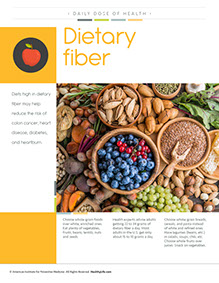
  • Dietary Fiber

    Nutrition

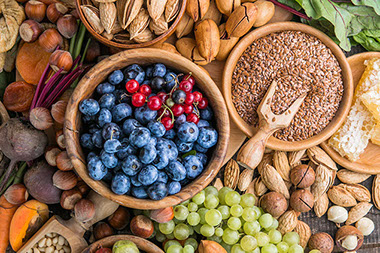
    A variety of foods high in fiber.

    Diets high in dietary fiber may help reduce the risk of colon cancer, heart disease, diabetes, and heartburn.

    Choose whole-grain foods over white, enriched ones. Eat plenty of vegetables, fruits, beans, lentils, nuts and seeds.

    Health experts advise adults getting 22 to 34 grams of dietary fiber a day. Most adults in the U.S. get only about 15 to 18 grams a day.

    Choose whole-grain breads, cereals, and pasta instead of white and refined ones. Have legumes (beans, etc.) in salads, soups, chili, etc. Choose whole fruits over juices. Snack on vegetables.

    Page from HealthyLife Weigh book by the American Institute for Preventive Medicine. www.HealthyLife.com. All rights reserved.

    © American Institute for Preventive Medicine

  • Get More Food & Nutrients For The Calories You Eat

    Nutrition

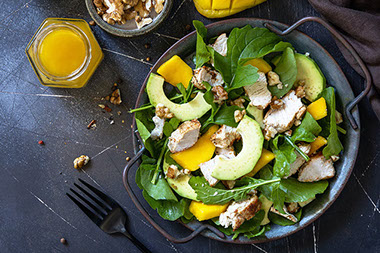
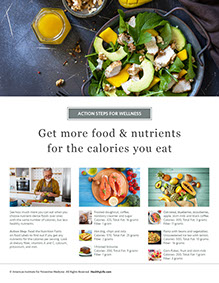
    Salad with walnuts, mangos, chicken and avocado.

    See how much more you can eat when you choose nutrient-dense foods over ones with the same number of calories, but less healthy nutrients.

    Frosted doughnut, coffee, nondairy creamer and sugar

    Calories: 325; Total Fat: 16 grams

    Fiber: 1 gram

    Hot dog, chips and cola

    Calories: 570; Total Fat: 25 grams

    Fiber: 2 grams

    1 frosted brownie

    Calories: 200; Total Fat: 9 grams

    Fiber: 1 gram

    Oat cereal, blueberries, strawberries, apple, skim milk and black coffee

    Calories: 300; Total Fat: 3 grams

    Fiber: 11 grams

    Pasta with beans and vegetables. Unsweetened ice tea with lemon.

    Calories: 500; Total Fat: 10 grams

    Fiber:  16 grams

    Corn flakes, fruit and skim milk

    Calories: 200; Total Fat: 1 gram

    Fiber: 3 grams

    Action Step:Read the Nutrition Facts on food labels to find out if you get any nutrients for the calories per serving. Look at dietary fiber, vitamins A and C, calcium, potassium, and iron.

    Page from HealthyLife Weigh book by the American Institute for Preventive Medicine. www.HealthyLife.com. All rights reserved.

    © American Institute for Preventive Medicine

  • Miniguide To Minerals

    Nutrition

    Nutrients like calcium, iron, and zinc are just as essential as vitamins. The table below shows, in capsule form, how much you need, what foods supply significant amounts, and the functions various minerals perform. Use it to plan a mineral-rich menu. (As with vitamins, however, sometimes diet alone can’t satisfy the need for certain minerals. Pregnancy, menstruation, illness, crash dieting, food allergies, use of medication, or other circumstances may call for mineral supplements.)

    Calcium

    Primary Functions

    Needed for building strong bones and teeth and maintaining strong bones throughout life. Required for normal muscle contraction and relaxation, heart action, nerve function and blood clotting.

    Food Sources

    Milk and dairy products, sardines, salmon eaten with bones, oysters, tofu, green leafy vegetables, clams, citrus fruit.

    Dietary Reference Intake (DRI)*

    1,000 milligrams

    Deficiency Symptoms

    Stunted growth in children, weakened bones in adults, bones that break easily. (Deficiency disease: osteoporosis.)

    Chromium

    Primary Functions

    Works with insulin to take sugar into cells. Involved in breakdown of sugar to release energy.

    Food Sources

    Brewers yeast, meat, clams, whole grains, unrefined foods, cheeses, nuts.

    Dietary Reference Intake (DRI)*

    35 micrograms

    Deficiency Symptoms

    Impaired glucose metabolism. (May lead to adult onset diabetes.)

    Copper

    Primary Functions

    Needed for hemoglobin and to make red blood cells. Forms protective coverings for nerves. Part of several enzymes. May be involved with vitamin C in forming collagen. Needed in respiration and release of energy.

    Food Sources

    Organ meats, shellfish (especially oysters), whole grains, nuts, legumes, lean meat, fish, fruits, vegetables.

    Dietary Reference Intake (DRI)*

    900 micrograms

    Deficiency Symptoms

    Anemia, bone defects, retarded growth, impaired metabolism.

    Iodine

    Primary Functions

    Part of thyroxide, a hormone secreted by the thyroid gland, which helps to regulate growth, development, reproduction, and metabolic rate (rate at which calories are burned.)

    Food Sources

    Iodized salt, sea salt, seafood, seaweed, foods grown in iodine-rich soil, dairy products from animals fed iodine-rich feed.

    Dietary Reference Intake (DRI)*

    150 micrograms

    Deficiency Symptoms

    Enlarged thyroid gland (goiter), sluggishness, and weight gain. Can cause severe retardation of developing fetus during pregnancy.

    Iron

    Primary Functions

    Part of hemoglobin which carries oxygen to cells. Part of myoglobin which makes oxygen available for muscle contraction. Needed for use of energy by the cells.

    Food Sources

    Organ meats, red meat, fish, shellfish, poultry, enriched breads and cereals, egg yolks, legumes, leafy green vegetables, dried fruits, blackstrap molasses.

    Dietary Reference Intake (DRI)*

    8 milligrams

    Deficiency Symptoms

    Anemia, fatigue, muscle weakness, headaches, pale skin, inability to concentrate.

    Magnesium

    Primary Functions

    Builds protein. Needed to release energy from food. Helps relax muscles after contraction. Helps resist tooth decay. Needed for transmission of nerve impulses.

    Food Sources

    Whole grains (especially wheat germ and bran), nuts, legumes, dark green vegetables, seafood, chocolate, cocoa.

    Dietary Reference Intake (DRI)*

    400 milligrams

    Deficiency Symptoms

    Confusion, nervousness, disorientation, hallucinations. Muscle weakness can progress to convulsions, and ultimately tetany. (Deficiencies are unlikely unless another medical problem exists.)

    Phosphorus

    Primary Functions

    Aids in building strong bones and teeth. Activates vitamins for use.  Needed to release energy from food. Needed for trans-mission of nerve impulses.

    Food Sources

    Milk and dairy products, fish, meat, poultry, egg yolks, nuts, legumes, peas, whole grains, processed foods, soft drinks.

    Dietary Reference Intake (DRI)*

    700 milligrams

    Deficiency Symptoms

    Muscle weakness, loss of appetite, bone pain. (Deficiencies are un-likely unless another medical problem exists.)

    Potassium

    Primary Functions

    Needed for muscle contraction, heart action, nerve transmission, fluid balance. Involved in making proteins. Needed for maintenance of acid-base balance. Required for formation of glycogen (short-term storage of energy).

    Food Sources

    Lean meat, fresh fruits and vegetables, milk and dairy products, nuts, legumes, most salt substitutes.

    Dietary Reference Intake (DRI)*

    4,700 milligrams

    Deficiency Symptoms

    Muscle weakness, irregular heartbeat, apathy, confusion and loss of appetite. (Deficiencies are un-likely, unless excessive water loss occurs through vomiting, diarrhea, extreme sweating, or use of diuretics.)

    Selenium

    Primary Functions

    Works with vitamin E to act as antioxidant and protect cell membranes.

    Food Sources

    Organ meats, seafood, lean meats, eggs, whole grains, wheat germ.

    Dietary Reference Intake (DRI)*

    55 micrograms

    Deficiency Symptoms

    Heart muscle abnormalities, anemia (rare).

    Sodium

    Primary Functions

    Needed for normal fluid balance, both inside and outside cells; nerve transmission, acid-base balance, and muscle contraction.

    Food Sources

    Salt, soy sauce, monosodium glutamate (MSG), and most processed foods (especially regular soups, sauces, and cured meats), milk and dairy products.

    Dietary Reference Intake (DRI)*

    1,500 milligrams

    Deficiency Symptoms

    Muscle cramps, weakness, mental apathy, loss of appetite. (Deficiencies unlikely, unless another medical problem exists.)

    Zinc

    Primary Functions

    Works as part of many enzymes. Present in insulin. Needed for making reproductive hormones, normal sense of taste, and wound healing.

    Food Sources

    Liver, egg yolks, oysters, lean meat, fish, poultry, milk and dairy products, whole grains, vegetables.

    Dietary Reference Intake (DRI)*

    11 milligrams

    Deficiency Symptoms

    Retarded growth, prolonged wound healing, slow sexual development, loss of taste (as a result, loss of appetite).

    * Dietary Reference Intake (DRI) is a system of nutrition recommendations from the Institute of Medicine (IOM) of the National Academy of Sciences. The DRI system includes:

    *  Recommended Dietary Allowances (RDA) – Daily dietary intake levels of nutrients considered enough to meet the needs of 97-98% healthy individuals in each life stage and gender group

    *  Adequate Intakes (AIs) – Amounts of nutrients considered to be adequate where no RDAs have been established

    Page from A Year of Health Hints book by the American Institute for Preventive Medicine. www.HealthyLife.com. All rights reserved.

    © American Institute for Preventive Medicine

  • Put Your Menu On A Diet

    Nutrition

    Careful menu planning can make the difference between gaining, maintaining, or losing weight. Look at the caloric differences between the three meal plans shown below. Make a point to plan each day’s meals in advance and select food items with their caloric value in mind. (Note: You can reduce calories without cutting back drastically on how much you eat simply by selecting low-fat foods.)

    Page from A Year of Health Hints book by the American Institute for Preventive Medicine. www.HealthyLife.com. All rights reserved.

    © American Institute for Preventive Medicine

  • Turkey Meatloaf

    Nutrition

    5 Servings, about 1 slice (3 oz.) each

    Ingredients:

    1 pound ground turkey, lean

    1/2 cup oats, regular, dry

    1 large egg, whole

    1 Tbsp. onion, dehydrated

    1/4 cup ketchup

    Directions:

    1.  Combine all ingredients and mix well.

    2.  Bake in a loaf pan at 350ºF for 25 minutes or to internal temperature of 165ºF.

    3.  Cut into five slices and serve.

    Per Serving:

    Calories – 196

    Total fat – 7 grams

    Saturated fat – 2 grams

    Sodium – 217 mg

    Page from HealthyLife Weigh Recipe book by the American Institute for Preventive Medicine. www.HealthyLife.com. All rights reserved.

    © American Institute for Preventive Medicine

  • Read Food Labels

    Nutrition

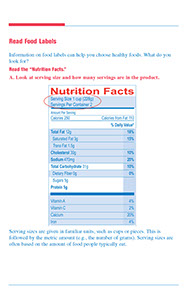
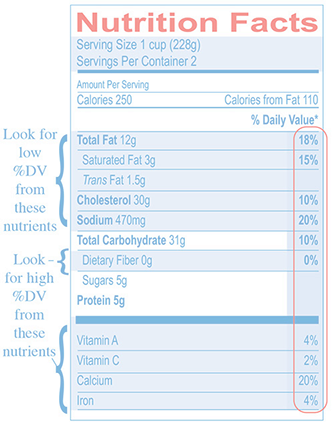
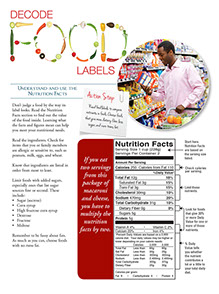
    Information on food labels can help you choose healthy foods. What do you look for?

    A. Read the “Nutrition Facts”

    Look at serving size and how many servings are in the product. Serving sizes are given in familiar units, such as cups or pieces. This is followed by the metric amount (e.g., the number of grams). Serving sizes are often based on the amount of food people typically eat.

    B. Read calories per serving

    Calories tell you how much energy you get from a serving of this food. The label also tells you how many of the calories in one serving come from fat. In the example, there are 250 calories in a serving of this macaroni and cheese; 110 calories are from fat. This means almost half of the calories come from fat.

    C. Look at the nutrients per serving

    The nutrients listed first are the ones people eat enough, or too much of. Eating too much saturated and trans fats or too much sodium may increase your risk of heart disease, some cancers, and high blood pressure.

    Most people don’t get enough dietary fiber, vitamin A, vitamin C, calcium, and iron in their diets. Eating enough of these nutrients can improve your health and help reduce the risk of some diseases and conditions. For example, getting enough calcium can reduce the risk of osteoporosis, in which bones become brittle and break as one ages.

    D. Look at Percent Daily Value (%DV)

    Daily Values (DVs) are a way to tell if a food is high or low in nutrients. In general 5% DV or less is low in a nutrient; 20% or more is high in a nutrient.

    The Percent Daily Value (%DV) on food labels is based on a 2000 calorie diet. This means that they are not exact for what Daily Values are for 1200-1300, 1500-1600, and 1800 calorie diets. So, use food label %DVs as a general guide to see if a food gives any nutrients for the calories it has.

    Quick Tip

    In general, look for foods that have low %DV for total fat, saturated fat, cholesterol, and sodium. Balance foods that have 20% or more of these with ones that have 5% DV or less.

    In general, look for foods that have 20% or more for fiber and/or at least one of the vitamins and iron or other minerals that can be listed.

    Compare Nutrition Facts for Three Cereals

    After comparing these three labels, which cereal would you choose?

    One advantage for all three is that they are a set portion (a small box that is one serving size). Overall, the wheat squares may be the best choice based on the nutrients you get for the calories it has. It would even be better to choose wheat squares that are not sweetened. The same serving size would have less added sugar and calories. Corn flakes is also a good choice. One serving has 70 calories. This is close to the amount of calories in 1 serving of grains & starches (80 calories).

    Can These Meals Be Part of a Healthy Daily Diet?

    Besides looking at saturated fat, of the two choices, the Deluxe Combo Pizza has more dietary fiber (6g) and less sodium (550mg).

    Four Cheese Pizza:

    This choice is harder to fit into a healthy diet. One serving (the whole pizza) uses 50% of a daily saturated fat allowance, leaving only 50% for all other foods and drinks that day.

    Deluxe Combo Pizza:

    This meal is easier to fit into a healthy diet. One serving (the whole pizza), gives 18% of a daily saturated fat allowance. This leaves 82% for all other foods and drinks that day.

    Is this a Healthy Snack Food?

    Answer: The good thing about this snack food is that it does not have trans fat. This is because it has vegetable oil, not “hydrogenated” vegetable oil. It does, though, have 250 calories and 12 grams of fat. That is a lot for a snack. Eat foods like this less often. Make 2 or 3 servings out of this individual snack bag, too.

    Ingredient List

    This lists what’s in the food from most to least by weight. There is more of the first ingredient than the second and so on. Choose foods that list acceptable ingredients first, second, and third. Also, check the list for ingredients that you may be allergic or sensitive to, such as milk, eggs, peanuts, and wheat.

    Preparation Instructions

    Look at the instructions on package directions. You can change the way the food is prepared to lower total fat, saturated fat, and sodium, as well as to increase nutrients, such as fiber and vitamin C.

    Open Dating

    Look at this so you won’t buy food items that are spoiled or will spoil before you use them. Buy them before “sell by” or “expiration date,” which is the last date the product should be used.

    Resources

    Food and Drug Administration (FDA)

    www.fda.gov

    Page from HealthyLife Weigh book by the American Institute for Preventive Medicine. www.HealthyLife.com. All rights reserved.

    © American Institute for Preventive Medicine

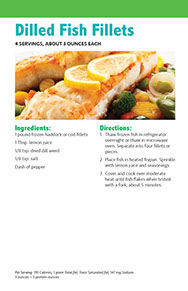
  • Dilled Fish Fillets

    Nutrition

    4 Servings, about 3 ounces each

    Ingredients:

    1 pound frozen haddock or cod fillets

    1 Tbsp. lemon juice

    1/8 tsp. dried dill weed

    1/8 tsp. salt

    Dash of pepper

    Directions:

    1.  Thaw frozen fish in refrigerator overnight or thaw in microwave oven. Separate into four fillets or pieces.

    2.  Place fish in heated frypan. Sprinkle with lemon juice and seasonings.

    3.  Cover and cook over moderate heat until fish flakes when tested with a fork, about 5 minutes.

    Microwave Directions:

    Place fish in a glass baking dish. Cover with wax paper. Cook at “medium” power for 3 minutes. Remove cover, turn fish over, and sprinkle with lemon juice and seasonings. Cover and continue cooking at “medium” power for 3 minutes or until fish flakes with a fork.

    Per Serving:

    Calories – 195

    Total fat – 1 gram

    Saturated fat – Trace

    Sodium – 147 mg

    Page from HealthyLife Weigh Recipe book by the American Institute for Preventive Medicine. www.HealthyLife.com. All rights reserved.

    © American Institute for Preventive Medicine

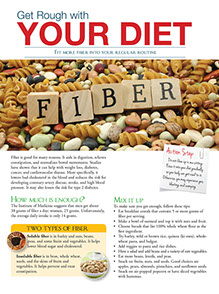
  • Get Rough With Your Diet

    Nutrition

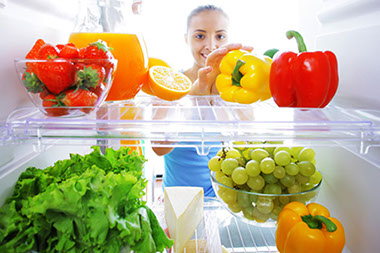
    Image of fresh produce in the fridge.

    Fit more fiber into your regular routine.

    Fiber is good for many reasons. It aids in digestion, relieves constipation, and normalizes bowel movements. Studies have shown that it can help with weight loss, diabetes, cancer, and cardiovascular disease. More specifically, it lowers bad cholesterol in the blood and reduces the risk for developing coronary artery disease, stroke, and high blood pressure. It may also lessen the risk for type 2 diabetes.

    How much is enough

    The Institute of Medicine suggests that men get about 38 grams of fiber a day; women, 25 grams. Unfortunately, the average daily intake is only 14 grams.

    Mix it up

    To make sure you get enough, follow these tips:

    *  Eat breakfast cereals that contain 5 or more grams of fiber per serving.

    *  Make a bowl of oatmeal and top it with nuts and fruit.

    *  Choose breads that list 100% whole wheat flour as the first ingredient.

    *  Try barley, wild or brown rice, quinoa (ki-nwa), whole-wheat pasta, and bulgur.

    *  Add veggies to pasta and rice dishes.

    *  Have a salad and add beans and a variety of raw vegetables.

    *  Eat more beans, lentils, and peas.

    *  Snack on fruits, nuts, and seeds. Good choices are apples, pears, almonds, pistachios, and sunflower seeds.

    *  Snack on air-popped popcorn or have sliced vegetables with hummus.

    Two types of fiber

    Soluble fiber is in barley and oats, beans, peas, and some fruits and vegetables. It helps lower blood sugar and cholesterol.

    Insoluble fiber is in bran, whole wheat, seeds, and the skins of fruits and vegetables. It helps prevent and treat constipation.

    Action Step

    Do not fiber up in one sitting. Ease it into your diet gradually so your body can get used to it. Otherwise, you may experience gas, bloating, and cramping.

    Page from Ways to Well-Being book by the American Institute for Preventive Medicine. www.HealthyLife.com. All rights reserved.

    © American Institute for Preventive Medicine