Category: Tobacco Cessation

  • 10 Action Steps To Quit Tobacco

    Tobacco Cessation

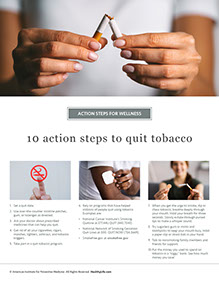
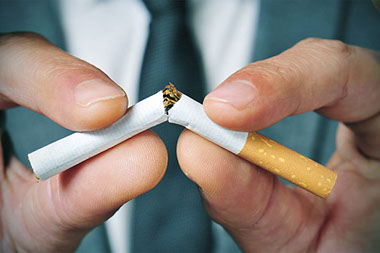
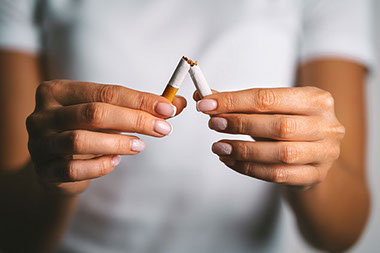
    Close up of female hands breaking a cigarette in half.

    1.  Set a quit date.

    2.  Use over-the-counter nicotine patches, gum, or lozenges as directed.

    3.  Ask your doctor about prescribed medicines that can help you quit.

    4.  Get rid of all your cigarettes, cigars, matches, lighters, ashtrays, and tobacco triggers.

    5.  Take part in a quit tobacco program.

    6.  Rely on programs that have helped millions of people quit using tobacco. Examples are:

    *  National Cancer Institute’s Smoking Quitline at 877.44U.QUIT (448.7848)

    *  National Network of Smoking Cessation Quit Lines at 800. QUIT.NOW (784.8669)

    *  Smokefree.gov atsmokefree.gov

    7.  When you get the urge to smoke, dip or chew tobacco, breathe deeply through your mouth. Hold your breath for three seconds. Slowly exhale through pursed lips to make a whisper sound.

    8.  Try sugarless gum or mints and toothpicks to keep your mouth busy. Hold a paper clip or stress ball in your hand.

    9.  Talk to nonsmoking family members and friends for support.

    10. Put the money you used to spend on tobacco in a “ciggy” bank. See how much money you save!

    Cover image to the Fitness brochure by the American Institute for Preventive Medicine. www.HealthyLife.com. All rights reserved.

    © American Institute for Preventive Medicine

  • Avoid Secondhand Smoke

    Tobacco Cessation

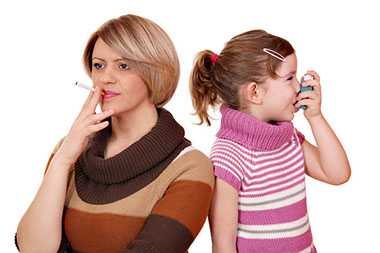
    Image of women smoking and child using an asthma inhaler.

    Somebody else’s habit can destroy your health.

    All that smoke that gets in your eyes is also getting in your airways and lungs, causing potentially fatal heart disease and cancer. It is also blamed for increased risk of sudden infant death syndrome, ear infections, colds, pneumonia, bronchitis, and more severe asthma. Researchers report that there is no safe level of exposure.

    What is secondhand smoke?

    Secondhand smoke is the combination of smoke given off a burning tobacco product and the smoke exhaled by a smoker. People can be exposed to secondhand smoke in homes, cars, the workplace, and public places, such as bars, restaurants, and leisure settings. It contains at least 250 harmful chemicals including hydrogen cyanide, carbon monoxide, and ammonia.

    Laws protect your air.

    Federal law bans smoking on most public transportation and in federally owned buildings. Many states and local governments have passed laws that ban smoking in public facilities, such as schools, hospitals, airports, bus terminals, parks, and beaches, as well as private workplaces, including restaurants and bars.

    Health risks of secondhand smoke:

    *  Breast cancer

    *  Cancers of the nose, throat, and sinus cavity

    *  Leukemia

    *  Lymphoma

    *  Brain tumors in children

    *  Sudden infant death syndrome (SIDS)

    *  Ear infections

    *  Colds

    *  Pneumonia

    *  Bronchitis

    *  Severe Asthma

    *  Coughing and wheezing

    Avoid thirdhand smoke, too!

    Thirdhand smoke is the residue left from tobacco smoke that lingers on a person’s clothing, skin, hair, and on carpet, drapes, walls, and furniture. And it does this long after the tobacco use has stopped. Thirdhand smoke has the same harmful chemicals as secondhand smoke.

    Even if you do not allow tobacco use in your home, avoid or limit being in homes and other places where smoking is allowed. And reserve nonsmoking hotel rooms and rental cars.

    Action Step

    Don’t let anyone, including your mate, smoke in your home. Never eat at restaurants that allow smoking or travel in a car with others who are smoking.

    Page from Ways to Well-Being book by the American Institute for Preventive Medicine. www.HealthyLife.com. All rights reserved.

    © American Institute for Preventive Medicine

  • Help Someone Quit Smoking

    Tobacco Cessation

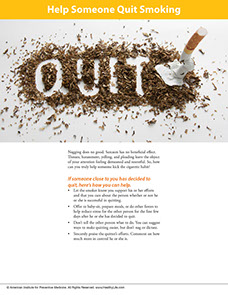
    Image of note with 'Quit Smoking' written on it.

    Nagging does no good. Sarcasm has no beneficial effect. Threats, harassment, yelling, and pleading leave the object of your attention feeling demeaned and resentful. So, how can you truly help someone kick the cigarette habit?

    If someone close to you has decided to quit, here’s how you can help.

    *  Let the smoker know you support his or her efforts and that you care about the person whether or not he or she is successful in quitting.

    *  Offer to baby-sit, prepare meals, or do other favors to help reduce stress for the other person for the first few days after he or she has decided to quit.

    *  Don’t tell the other person what to do. You can suggest ways to make quitting easier, but don’t nag or dictate.

    *  Sincerely praise the quitter’s efforts. Comment on how much more in control he or she is.

    Page from A Year of Health Hints book by the American Institute for Preventive Medicine. www.HealthyLife.com. All rights reserved.

    © American Institute for Preventive Medicine

  • Nicotine Gum Can Help Smokers Quit

    Tobacco Cessation

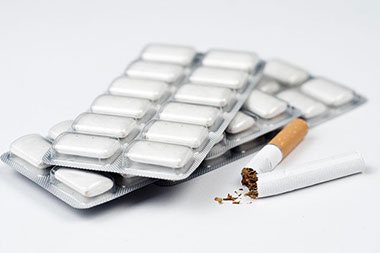
    Image of cigarette broken in half with nicotine gum next to it.

    Until lately, many people assumed cigarette smoking was just a bad habit (albeit an unhealthy one). In 1988, the Surgeon General’s Report on Smoking and Health changed that view. After reviewing over 2,000 scientific studies, the report confirmed what many scientists suspected: Smoking cigarettes is addictive, because they contain nicotine. So in order for you to quit smoking, you need to break the physical addiction as well as the psychological habit.

    A technique called nicotine replacement therapy can help break that stranglehold. With a nicotine replacement product, smokers absorb small amounts of nicotine. These little doses enable them to reduce their nicotine cravings and wean themselves off cigarettes with little anxiety, irritability, sleepiness, headaches, or other symptoms that make nicotine withdrawal such torture. (Some say nicotine withdrawal is worse than heroin withdrawal-or close to it.)

    If you think nicotine replacement therapy might help you to quit smoking:

    *  Talk to your doctor about prescribed medicines (nicotine inhaler or nicotine nasal spray) or over-the-counter nicotine replacement products, such as a patch, gum, or lozenges.

    *  Follow all instructions for the product you use.

    In order for nicotine replacement therapy to work, a smoker should also follow the kind of behavior modification techniques outlined in the previous tip. Or you can attend a reputable stop-smoking program. Studies have shown that combining a nicotine replacement product with a stop-smoking program can triple your chances for success.

    Page from A Year of Health Hints book by the American Institute for Preventive Medicine. www.HealthyLife.com. All rights reserved.

    © American Institute for Preventive Medicine

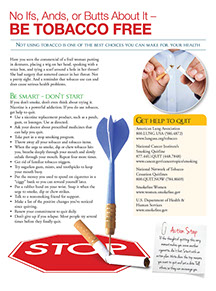
  • No Ifs, Ands, Or Butts About It. Be Tobacco Free.

    Tobacco Cessation

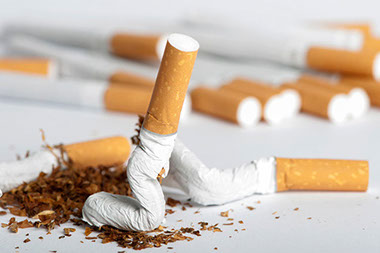
    Image of crushed cigarettes.

    Not using tobacco is one of the best choices you can make for your health.

    Have you seen the commercial of a frail woman putting in dentures, placing a wig on her head, speaking with a voice box, and tying a scarf around a hole in her throat? She had surgery that removed cancer in her throat. Not a pretty sight. And a reminder that tobacco use can and does cause serious health problems.

    Be smart, don’t start.

    If you don’t smoke, don’t even think about trying it. Nicotine is a powerful addiction. If you do use tobacco, get help to quit.

    *  Use a nicotine replacement product, such as a patch, gum, or lozenges. Use as directed.

    *  Ask your doctor about prescribed medicines that  can help you quit.

    *  Take part in a stop smoking program.

    *  Throw away all your tobacco and tobacco items.

    *  When the urge to smoke, dip or chew tobacco hits you, breathe deeply through your mouth and slowly exhale through your mouth. Repeat four more times.

    *  Get rid of familiar tobacco triggers.

    *  Try sugarless gum, mints, and toothpicks to keep your mouth busy.

    *  Put the money you used to spend on cigarettes in a “ciggy” bank so you can reward yourself later.

    *  Put a rubber band on your wrist. Snap it when the urge to smoke, dip or chew strikes.

    *  Talk to a nonsmoking friend for support.

    *  Make a list of the positive changes you’ve noticed since quitting.

    *  Renew your commitment to quit daily.

    *  Don’t give up if you relapse. Most people try several times before they finally quit.

    Bidis – Not a Safe Alternative

    Bidis are thin brown cigarettes made in India and other Southeast Asian countries. They are filled with tobacco flakes and dust and rolled in dried tendu or temburni leaves (plants native to Asia). These unfiltered cigarettes may be tied with a string at one or both ends. To mask the poor quality of tobacco used, flavors are often added. These include cherry, chocolate, mango, and vanilla.

    Bidis are cheaper and easier to buy than regular cigarettes, but have serious health risks.

    *  One bidi produces more than three times the carbon monoxide than one cigarette.

    *  Smoke from an unfiltered bidi has three to five times the amount of nicotine as a regular cigarette. This increases risk for nicotine addiction.

    *  One bidi releases three to five times more tar than a regular cigarette.

    *  Bidi smoke contains more deadly chemicals, such as ammonia than the smoke of one regular cigarette.

    *  Smoking bidis increases the risk for:

    *  Lung cancer, oral cancer, stomach cancer, and cancer of the esophagus

    *  Heart attack and coronary heart disease

    *  Chronic bronchitis and emphysema

    In India, the majority of bids are made by women and children and in their homes. Exposure to particles and dust in the process leads to many health problems. These include:

    *  Asthma

    *  Lung cancer

    *  Tuberculosis

    *  Skin problems

    *  Eye problems

    Resources

    American Lung Association

    800.LUNG.USA (586.4872)

    www.lungusa.org/tobacco

    National Cancer Institute’s Smoking Quitline

    877.44U.QUIT (448.7848)

    www.cancer.gov/cancertopics/smoking

    National Network of Tobacco Cessation Quitlines

    800.QUIT.NOW (784.8669)

    Smokefree Women

    www.women.smokefree.gov

    U.S. Department of Health & Human Services

    www.smokefree.gov

    www.surgeongeneral.gov/tobacco

    Action Step

    If the thought of quitting this very moment makes you crave another cigarette, don’t fret. Start with an action plan. Write down the top reasons you want to quit and set a date. Tell others so they can encourage you.

    Page from Ways to Well-Being book by the American Institute for Preventive Medicine. www.HealthyLife.com. All rights reserved.

    © American Institute for Preventive Medicine

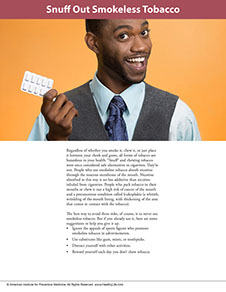
  • Snuff Out Smokeless Tobacco

    Tobacco Cessation

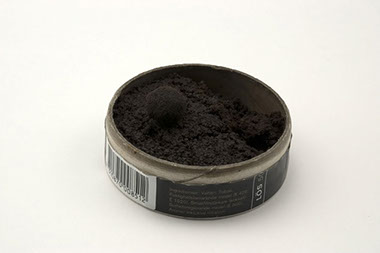
    Image of smokeless tobacco.

    Regardless of whether you smoke it, chew it, or just place it between your cheek and gums, all forms of tobacco are hazardous to your health. “Snuff” and chewing tobacco were once considered safe alternatives to cigarettes. They’re not. People who use smokeless tobacco absorb nicotine through the mucous membrane of the mouth. Nicotine absorbed in this way is no less addictive than nicotine inhaled from cigarettes. People who pack tobacco in their mouths or chew it run a high risk of cancer of the mouth and a precancerous condition called leukoplakia (a whitish, wrinkling of the mouth lining, with thickening of the area that comes in contact with the tobacco).

    The best way to avoid these risks, of course, is to never use smokeless tobacco. But if you already use it, here are some suggestions to help you give it up.

    *  Ignore the appeals of sports figures who promote smokeless tobacco in advertisements.

    *  Use substitutes like gum, mints, or toothpicks.

    *  Distract yourself with other activities.

    *  Reward yourself each day you don’t chew tobacco.

    Page from A Year of Health Hints book by the American Institute for Preventive Medicine. www.HealthyLife.com. All rights reserved.

    © American Institute for Preventive Medicine

  • Tobacco Cessation Basics

    Tobacco Cessation

    Image of cigarette being broken in half.

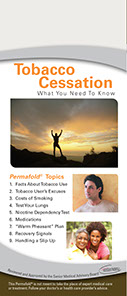
    Facts About Tobacco Use

    * Tobacco use is the top preventable cause of illness and premature death in the U.S. Each year, nearly one in every 5 deaths-about 480,000 people-die from tobacco-related illnesses. These include:

    – Cancers of the lungs, mouth, throat, bladder, cervix, kidney, and stomach

    – Chronic obstructive pulmonary disease (COPD)

    – Heart disease, stroke, and abdominal aortic aneurysm

    – Emphysema

    – Pneumonia

    * Tobacco users are prone to cataracts and oral problems, too. These include gum disease, tooth loss, stained teeth, and bad breath.

    * These problems are more likely to happen in babies of pregnant women who smoke:

    – Preterm labor

    – Low birth weight

    – Reduced lung function

    – Stillbirth

    * In nonsmokers, secondhand smoke causes:

    – About 7,300 deaths each year from lung cancer

    – About 34,000 deaths from heart disease. The effects of secondhand smoke are about 80% as bad as for smokers. It takes only minutes of exposure to cause unhealthy effects for the heart.

    – Increased risk for sudden infant death  syndrome (SIDS)

    – Increased risk for asthma and respiratory ailments, especially in children

    Tobacco User’s Excuses

    Below are common reasons people use to explain why they smoke, chew, or dip and why these reasons are not valid.

    *  I’ll gain weight if I quit. Nicotine does raise metabolism, which increases the amount of calories used, but the health benefits of quitting smoking far “outweigh” the average weight gain of 4-10 pounds. The health damage of a pack of cigarettes a day is about the same as carrying an extra 60 or more pounds. To help control weight gain, choose healthy foods and replace cigarettes with sugarless gum or candy instead of putting food in your mouth.

    *  I need to smoke (or chew) to relax. Actually, nicotine is a stimulant. After you get over the initial stress of quitting tobacco, you will find that without all that nicotine in your body, you will feel calmer and more relaxed.

    *  I know lots of people who use tobacco – they’re still healthy. We all know people like this, but they’re the exception rather than the rule.

    *  Tobacco won’t hurt me – I’m in good shape. Even if you don’t die from smoking, you’ll probably have some problems – like trouble breathing, a hacking cough, high blood pressure, and/or heart disease.

    *  I’ve tried to quit dozens of times – it’s no use. Each try increases the chance that you’ll succeed.

    *  I can’t imagine life without tobacco. You lived before using tobacco. You’ll live after you quit.

    Costs of Smoking

    The table below shows the amount you can save if you or a family member quits smoking now. It is based on a cost of $8.00 per pack of cigarettes. The totals don’t include the interest you would earn if you put this money in the bank.

    With smoking, another $700 or more per year can be spent on the following:

    *  Lighters, ashtrays, and other smoking items

    *  Extra dry cleaning and costs to clean, repair, and restore household items or a car due to cigarette burns or smoke residue

    *  Mouthwashes, colognes, and special toothpastes

    *  Missed work days

    *  Extra costs for medical and dental care

    *  Higher costs for life, health, and homeowner’s insurance

    * Does not include increases in cost over the years. If you pay more or less than $8.00 a pack, find out how much smoking costs you atwww.smokefree.gov/savings-future.

    Nicotine Dependency Test

    Nicotine is what makes people addicted to cigarettes. Some smokers depend more on nicotine than others. The test below can help you figure out just how dependent you may be.

    Scores of 7 or higher show that you are very dependent on nicotine. Scores of 6 or less show that you have a low to moderate nicotine dependence. If your score indicates that you are very dependent on nicotine, talk to your doctor or pharmacist about products that can help you stop smoking.

    Medications

    *  Over-the-counter medications. Nicotine patches, gum, and lozenges wean you off of nicotine.

    *  Prescribed medicines.

    – Nicotine nasal spray

    – Nicotine inhaler

    – Buproprion (Zyban®). This helps reduce nicotine withdrawal symptoms and the urge to smoke.

    – Varenicline (Chantix®). This lessens nicotine withdrawal symptoms and blocks the effects of nicotine from cigarettes if you start smoking again.

    To increase your chances of success if you use medication, use behavior change techniques, too.

    Note: Discuss, with your doctor, the hazards of using e-cigarettes as a quit method. They can contain nicotine and toxic and cancer-causing chemicals. When eaten, less than one tablespoon of liquid nicotine from the e-cigarette cartridge can kill an adult; one teaspoon can kill a child.

    Recovery Signals

    Quitting tobacco may cause changes in your body. Some of these changes you will enjoy. Some changes may be a little unpleasant. Everyone is different. Most people will have only a few of these signals and they usually last less than a week.

    *  Increased Hunger. Your taste buds become more keen, so food tastes better. Also, you may substitute food for tobacco. This could lead to weight gain. Eat low calorie snacks, drink more water, and increase physical activity.

    *  Irritability/Anxiety. Studies offer 2 reasons for this:

    – Nicotine use serves as a mild calming agent for some. The body is very tense until it adjusts.

    – Your life has been disrupted. Try a relaxation exercise, a warm shower, or yoga.

    *  Coughing. The hairlike fibers that line the bronchial tubes are starting to work to get rid of the mucus caused by smoking. As the mucus loosens, you cough.

    *  Sweating. Toxins leave the body through the skin’s pores. This may show up as sweat.

    *  Frequent Urination. This may happen because of the extra liquids you are drinking.

    *  Constipation. Nicotine causes the release of the hormone adrenaline. Often, this helps move the bowels. Eat high fiber foods, raw fruits, vegetables, bran, and whole grains.

    *  Loss of Sleep. Quitting tobacco may make you restless at night. Increase daytime activity to make you tired. Drink a warm glass of milk at bedtime.

    *  Dizziness. More oxygen is entering the body because your bronchial tubes are clearing up and you are not taking in smoke with carbon monoxide. The result could be dizziness. Sit down until it passes.

    *  Sleepiness. For many people, nicotine provides a “lift.” Take it away and you feel sleepy. The stress of quitting can also tire you out. Try to get more sleep.

    *  Mouth Sores/Bad Taste. Sores or bad tastes in the mouth may be due to body chemicals that used to counteract the effects of the toxins in tobacco.

    – Use an oral pain reliever for sores or see a doctor or dentist.

    – Use mouthwash or breath mints for the bad taste.

    *  Lack of Focus. Quitting tobacco may make it harder for you to concentrate. A short walk can be helpful.

    *  Dreaming of Tobacco. Many quitters dream about using tobacco. This is normal. Take pride and focus on being tobacco free while awake.

    *  Sense of Loss. Quitting can make you feel sad. You may feel you’re missing something. This will pass with time. Try to stay busy.

    *  Headaches. Your blood vessels open up due to withdrawal from nicotine. Try deep breathing.

    People tend to react to quitting in many ways, so signals not listed may occur. Also, signals listed may be due to other things. If you have questions, talk to your doctor or health care provider. Do not focus on the bad recovery signals. You might overlook the good signals that are taking place. The good changes occur because you no longer use tobacco. Keep in mind – NO ONE EVER DIED FROM QUITTING. Many have died from using tobacco.

    Handling a Slip-Up

    No one is perfect. If you slip-up, you may feel guilt or conflict. You may feel a sense of being helpless or hopeless. These are normal feelings that may cause you to go back to your old coping plan – using tobacco.

    Don’t focus on the slip-up. You have not failed in your efforts. A “lapse” is not a “relapse.” Focus on your new goal – to choose not to use tobacco again.

    Test Your Lungs

    Do you get winded dashing upstairs? If you’re a smoker, diminished lung power may be why. Take this test to determine your lung capacity.

    *  Strike a match. When the flame steadies, hold it about 6 inches from your mouth.

    *  Inhale deeply. Try to blow out the match by exhaling quickly through your mouth, without pursing your lips. Try more than once, if you must.

    *  If you can’t blow out the match, your lung capacity may be impaired. See your health care provider.

    Resources

    U.S. Department of Health & Human Services

    www.smokefree.gov

    www.espanol.smokefree.gov

    www.smokefree.gov/apps-quitguide

    www.smokefree.gov/smokefreetext

    www.womensmokefree.gov

    Center for Disease Control and Prevention

    www.cdc.gov/tobacco

    National Cancer Institute’s Smoking Quitline

    877.44U.QUIT (448.7848)

    National Network of Tobacco Cessation Quitlines

    800.QUIT.NOW (784.8669)
    Cover image to the Fitness brochure by the American Institute for Preventive Medicine. www.HealthyLife.com. All rights reserved.

    © American Institute for Preventive Medicine

  • Wean Yourself Off Pipes Or Cigars

    Tobacco Cessation

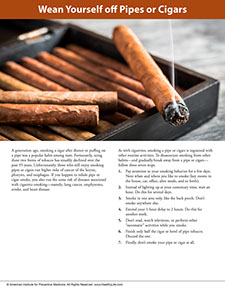
    Image of pipe with tobacco.

    A generation ago, smoking a cigar after dinner or puffing on a pipe was a popular habit among men. Fortunately, using these two forms of tobacco has steadily declined over the past 35 years. Unfortunately, those who still enjoy smoking pipes or cigars run higher risks of cancer of the larynx, pharynx, and esophagus. If you happen to inhale pipe or cigar smoke, you also run the same risk of diseases associated with cigarette smoking-namely, lung cancer, emphysema, stroke, and heart disease.

    As with cigarettes, smoking a pipe or cigars is ingrained with other routine activities. To disassociate smoking from other habits-and gradually break away from a pipe or cigars-follow these seven steps.

    1.  Pay attention to your smoking behavior for a few days. Note when and where you like to smoke (key rooms in the house, car, office, after meals, and so forth).

    2.  Instead of lighting up at your customary time, wait an hour. Do this for several days.

    3.  Smoke in one area only, like the back porch. Don’t smoke anywhere else.

    4.  Extend your 1-hour delay to 2 hours. Do this for another week.

    5.  Don’t read, watch television, or perform other “automatic” activities while you smoke.

    6.  Finish only half the cigar or bowl of pipe tobacco. Discard the rest.

    7.  Finally, don’t smoke your pipe or cigar at all.

    Page from A Year of Health Hints book by the American Institute for Preventive Medicine. www.HealthyLife.com. All rights reserved.

    © American Institute for Preventive Medicine