Category: Children’s Health

  • Eye Problems

    Children’s Health

    Signs, Symptoms & Causes

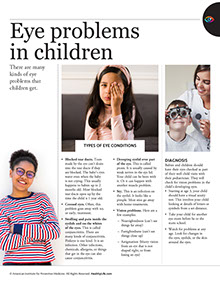
    There are many kinds of eye problems that children get. Here are some of them:

    *  Blocked tear ducts. Tears made by the eye can’t drain into the tear ducts if they are blocked. The baby’s eyes water even when the baby is not crying. This usually happens to babies up to 2 months old. Most blocked tear ducts open up by the time the child is 1 year old.

    *  Crossed eyes. Often, this problem goes away with no treatment.

    *  Swelling and pain inside the eyelids and on the whites of the eyes. This is called conjunctivitis. There are many kinds of conjunctivitis. Pinkeye is one kind. It is an infection. Other infections, chemicals, allergens, or things that get in the eye can also cause conjunctivitis.

    *  Drooping eyelid over part of the eye. This is called ptosis. It is usually caused by weak nerves in the eye lid. Your child can be born with it. Or it can happen with another muscle problem.

    *  Sty. This is an infection on the eyelid. It looks like a pimple. Most sties go away with home treatments.

    *  Vision problems. Here are a few examples:

    – Nearsightedness (can’t see things far away).

    – Farsightedness (can’t see things close up).

    – Astigmatism (blurry vision from an eye that is not shaped right, or from losing an eye).

    It’s hard to know if your child has vision problems until he or she is 3 years old. (The eye is still developing until then.)

    *  Take your child for their first  eye exam at 3 years old.

    *  Take your child for another eye exam before he or she starts school.

    *  Watch for problems at any age. Look for changes in the eyes, eyelids, or the skin around the eyes.

    Questions to Ask

    Self-Care

    A doctor should treat a hurt or infected eye. But you can treat some eye problems at home.

    *  For a blocked tear duct:

    1. Wash your hands.

    2. Press gently on the inner corner of the eye with a cotton swab. Press up, not down, for a few seconds to a few minutes.

    *  For dry eyes, try over-the-counter “tears.” Some kinds are Ocu-Lube®, Refresh®, or Liquifilm®. Wash your hands before you put drops in the eyes. If your child’s eyes don’t get better, take him or her to the doctor.

    *  To help with an insect bite, gently wash the eyes with warm water.

    *  To help the pain of a hurt eye that is not infected:

    – Put a warm (not hot), wet wash cloth on the eye for 5 minutes. Do this 2 or 3 times a day.

    – Use over-the-counter eye drops.

    – Don’t  let your child wear contact lenses or makeup until the eye is better.

    *  If the eye is infected:

    – Wash your hands and your child’s hands every time you touch the eye. (Pinkeye is very easy to catch.)

    – Don’t  share a towel with someone who has pinkeye.

    – Keep your child away from light if he or she got pinkeye from the measles.

    – Don’t  cover the eye. This can make the infection worse.

    *  Here’s how to get something out of your child’s eye: (Make sure you can see the speck before you try to get it out.)

    1. Wash your hands.

    2. Drip clean water into the eye to rinse it.

    3. Twist a piece of tissue at each end. Wet the tip with tap water, not spit. Gently touch the speck with the tip. The speck should stick to the tip.

    – Tell your child to look down if the speck is under the upper lid. Pull the upper lid away from the eye. Do this by gently pulling on the eyelashes. When you can see the speck, try to touch it with the tissue.

    – Don’t  rub the eye. And never use anything sharp to touch your child’s eye.

    4. Gently wash the eye with cool water.

    *  To help with pain from a sty:

    – Put a warm (not hot), wash cloth on the sty 3 or 4 times a day for 5 or 10 minutes each time.

    – Keep your child away from dust and dirt that can get in his or her eyes.

    – Don’t poke or squeeze the sty!
    Children's Self-Care book by the American Institute for Preventive Medicine. www.HealthyLife.com. All rights reserved.

    © American Institute for Preventive Medicine
  • Seizures

    Children’s Health

    And How to Keep Your Child From Getting Fever Seizures

    Signs, Symptoms & Causes

    A seizure is like a short-circuit in the brain. Information in nerves in the brain gets mixed up. There are many forms of seizures.

    A general seizure. This affects the whole brain. A convulsion happens with this kind. These are signs of a convulsion.

    *  The neck muscles or all the body muscles get stiff.

    *  The arms or legs jerk around.

    *  The eyes roll up and back in the head.

    *  The child falls down.

    *  The child blacks out.

    *  The child wets or soils his or her clothes.

    An absence seizure. A convulsion does not happen with this kind of seizure. These are signs of this kind of seizure:

    *  The child stares into space. It looks like the child is not paying attention.

    *  The child smacks his or her lips.

    *  The child may blink over-and-over.

    Seizures that come with a high fever.

    In fact, high fevers cause most seizures in children ages 6 months to 5 years old. This happens when the body’s own temperature control isn’t working just right yet.

    Sicknesses that make a child’s temperature go up fast can bring on seizures. Here are some other causes of seizures:

    *  Epilepsy.

    *  Poisons.

    *  Infections that cause a high fever.

    *  Drugs.

    *  Reye’s Syndrome.

    *  Snakebites.

    *  Some vaccinations.

    Most seizures last from 1 to 5 minutes. Short seizures don’t cause problems unless the child stops breathing and turns blue. But a seizure that lasts longer than 5 minutes can be a sign of a big problem. Let your child’s doctor know if your child has any kind of seizure.

    How to Keep Your Child From Getting Fever Seizures

    Keep trying to bring the fever down until it is 101ºF or less. Try to bring your child’s fever down fast:

    *  Dress your child in light, loose clothes or take off most of his or her clothes.

    *  Ask your doctor about fever-lowering suppositories.

    *  Put washcloths rinsed in lukewarm (not cold) water on your child’s forehead and neck. Don’t use rubbing alcohol.

    *  Give your child acetaminophen or ibuprofen. Make sure you give the right kind and dose for his or her weight. Do this if the fever gets above 103°F. (Note: Do not give aspirin. Aspirin and other medicines that have salicylates have been linked to Reye’s Syndrome.)

    Questions to Ask

    Self-Care

    Don’t panic! A fever seizure will stop by itself in a few minutes. The two things you can do are:

    *  Try to keep your child from getting hurt during the seizure.

    *  Lower his or her fever.

    Follow these tips during the seizure:

    *  Protect your child from falling and hitting his or her head. (Watch out for tables and sharp things.)

    *  Make sure your child can breathe:

    – Roll the child on his or her side so spit can drain from the mouth.

    – Gently pull on the jaw and bend the neck back. (This opens up the throat.)

    *  Don’t put anything in your child’s mouth. Children hardly ever bite their tongues during a fever seizure.

    *  Don’t give your child any medicine, food, or drink by mouth.

    Follow these tips after the seizure:

    *  If the seizure was from a fever, start lowering the fever. Sponge your child’s body with lukewarm water. Don’t use rubbing alcohol. Don’t put the child in a bathtub. Don’t use an ice pack. It drops the temperature too fast.

    *  Your child will probably be sleepy after the seizure. He or she may not remember anything. This is O.K.

    *  Dress the child in light, loose clothes. Put him or her to sleep in a cool room.

    *  Let your child’s doctor know about the seizure.

    Children's Self-Care book by the American Institute for Preventive Medicine. www.HealthyLife.com. All rights reserved.

    © American Institute for Preventive Medicine
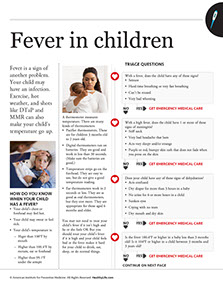
  • Fever In Children

    Children’s Health

    How do you know when your child has a fever?

    *  Your child’s chest or forehead may feel hot.

    *  He or she may sweat or feel sick.

    *  Your child’s temperature is:

    – Higher than 99.5ºF by mouth or ear. (Higher than 100.5ºF with a pacifier thermometer.)

    – Higher than 100.4ºF by rectum.

    – Higher than 89.5ºF under the armpit.

    Signs, Symptoms & Causes

    Fever is a sign of another problem. Your child may have an infection. Exercise, hot weather, and shots like DTaP and MMR can also make your child’s temperature go up.

    A thermometer measures temperature. There are many kinds of thermometers:

    *  Pacifier thermometers. These are for children 3 months old to 2 years old.

    *  Digital thermometers run on batteries. They are good and work in less than 30 seconds. (Make sure the batteries are good.)

    *  Temperature strips go on the forehead. They are easy to use, but do not give a good temperature reading.

    *  Ear thermometers work in 2 seconds or less. They are as good as oral thermometers, but they cost more.

    You may not need to treat your child’s fever if it isn’t high and he or she feels O.K. But you should treat your child’s fever if it is high and your child feels bad or the fever makes it hard for your child to drink, eat, sleep, or do normal things.

    You can take your child’s temperature by mouth, armpit, ear, or rectum. (The rectum is the opening where you pass solid waste.) A rectal reading is better than a mouth reading. It is 1°F higher than a mouth reading. An armpit reading is 1°F lower than a mouth reading, but does not give as good a reading.

    Questions to Ask

    Self-Care

    *  Make sure your child drinks a lot of fluids. Give fruit juice, water, and other cool drinks.

    *  Dress your child in light clothing.

    *  Have your child rest.

    *  For a high fever, sponge your child with warm (not cold or cool) water. Don’t use rubbing alcohol. Don’t let your child shower. Showering can make the fever go up.

    *  Give your child acetaminophen or ibuprofen. Make sure you give the right kind and dose for his or her weight. (Note: Do not give aspirin. Aspirin and other medicines that have salicylates have been linked to Reye’s Syndrome.)

    *  A fever can occur with other health problems. They include:

    – Chickenpox.

    – Coughs.

    – Croup.

    – Cuts, Scrapes & Punctures.

    – Diarrhea.

    – Earaches.

    – Flu.

    – Headaches.

    – Seizures.

    – Sore Throats.

    – Swollen Glands.

    – Wheezing.

    Children's Self-Care book by the American Institute for Preventive Medicine. www.HealthyLife.com. All rights reserved.

    © American Institute for Preventive Medicine
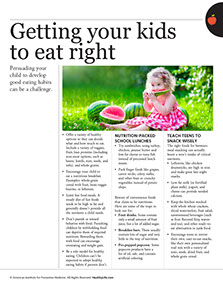
  • Getting Your Kids To Eat Right

    Children’s Health

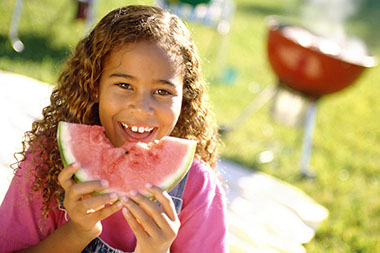
    Image of young girl eating watermelon.

    Persuading your child to develop good eating habits can be a challenge. Here are some pointers.

    *  Start your child’s day with a good breakfast. Hot cereal is a better choice than over-sweetened breakfast foods that are heavily advertised to kids.

    *  Buy snacks that are low in fat, sugar, and salt. Fresh fruit, unbuttered popcorn, whole-grain muffins, juice, milk, and yogurt are tasty, nutritious foods that appeal to kids. Crackers with small amounts of peanut butter or cheese are also acceptable between-meal treats.

    *  Limit fast-food meals. A steady diet of fast-food menu items tends to be high in fat and generally doesn’t provide all the essential nutrients a child needs.

    *  Don’t punish or reward behavior with food. Punishing children by withholding food can deprive them of required nutrients. Rewarding them with food can encourage overeating and weight gain.

    *  Set a good example. Children can’t be expected to adopt good eating habits if parents don’t.

    For nutrition-packed school lunches:

    *  Try sandwiches, using turkey, chicken, peanut butter with no added oil or sugar, and low-fat cheese or tuna fish instead of processed lunch meats.

    *  Pack finger foods like grapes, carrot sticks, celery stalks, and other fruit or crunchy vegetables instead of potato chips. Single-serving cans of fruit or applesauce are also handy ways to round out a lunch.

    Beware of convenience foods that claim to be nutritious.

    Here are some of the traps to look out for.

    *  Fruit drinks. Some contain only a small amount of fruit juice, but a lot of added sugar.

    *  Breakfast bars. These usually contain lots of sugar and very little in  the way of nutrition.

    *  Pre-popped popcorn. Some popcorn products have a lot of oil, salt, and contain artificial coloring.

    Teach Teens to Snack Wisely

    Once kids reach their teens, they tend to eat what they want, when they want it. But these years of rapid growth and change call for added nutrients which might be lacking in diets that are hit-or-miss. And as their bones grow rapidly, teens need plenty of calcium. Adolescent girls need plenty of iron to offset iron lost due to menstrual flow. If the right foods are available, between-meal snacking can actually boost a teen’s intake of those critical nutrients.

    *  Leftovers, like chicken drumsticks, are high in iron and make good late-night snacks.

    *  Low-fat milk, yogurt, and cheese can provide needed calcium.

    *  Keep the kitchen stocked with whole wheat crackers, sliced watermelon, fruit salad, and other ready-to-eat alternatives to junk food.

    *  Encourage teens to invent their own, easy-to-eat snacks, like “ants on a log”-celery stalks stuffed with peanut butter and dotted with raisins.

    Resources

    Page from A Year of Health Hints book by the American Institute for Preventive Medicine. www.HealthyLife.com. All rights reserved.

    © American Institute for Preventive Medicine
  • Healthy Eating Tips

    Children’s Health

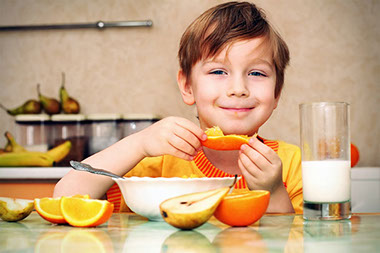
    Image of young boy eating oranges.

    *  Make half your grains whole. Choose whole-grain food, like whole-wheat bread, oatmeal, and brown rice more often.

    *  Vary your veggies. Go dark green and orange with your vegetables. Eat spinach, broccoli, carrots and sweet potatoes.

    *  Focus on fruits. Eat them at meals. Eat them at snack times, too. Choose fresh, frozen, canned or dried fruits. Go easy on fruit juices.

    *  Go lean with protein. Eat lean or low-fat meat, chicken, turkey, and fish. Also, choose dry beans and peas more often. Add chick peas, nuts, or seeds to a salad. Add pinto beans to a burrito. Add kidney and/or other beans to soup.

    *  Get calcium-rich foods. Have low-fat and fat-free milks, yogurts, and cheeses. If you have soy milks and yogurts, choose ones with calcium. Have broccoli, kale and collard greens. Calcium helps to build strong bones.

    *  Change your oil. Get yours from fish, nuts, and liquid oils, like canola, corn, olive, and soybean. Avoid foods with trans fat. Read food labels.

    *  Don’t sugarcoat it. Choose foods and beverages that do not list sugar, corn syrup and other sugars as one of the first ingredients. Added sugars give calories, but have few, if any, nutrients.

    Page from Children's Self-Care book by the American Institute for Preventive Medicine. www.HealthyLife.com. All rights reserved.

    © American Institute for Preventive Medicine
  • Acne For Children

    Children’s Health

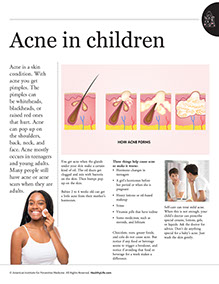
    Acne is a skin condition. With acne you get pimples. The pimples can be white-heads, blackheads, or raised red ones that hurt. Acne can pop up on the shoulders, back, neck, and face. Acne mostly occurs in teenagers and young adults. Many people still have acne or acne scars when they are adults.

    Signs & Symptoms

    You get acne when the glands under your skin make a certain kind of oil. The oil ducts get clogged and mix with bacteria on the skin. Then bumps pop up on the skin.

    Babies 2 to 4 weeks old can get a little acne from their mother’s hormones. These things help cause acne:

    *  Hormone changes in teenagers.

    *  A girl’s hormones before her period or when she is pregnant.

    *  Heavy lotions or greasy makeup.

    *  Stress.

    *  Vitamin pills that have iodine.

    *  Some medicines, such as steroids, and lithium.

    Causes

    Chocolate, nuts, greasy foods, and cola do not cause acne.

    Self-Care Tips treat mild acne. When this is not enough, your child’s doctor can prescribe special creams, lotions, gels, or liquids. Ask the doctor for advice. Don’t do anything special for a baby’s acne. Just wash the skin gently.

    For very bad acne, a doctor may prescribe a strong medicine, such as Accutane®. Know that this kind of medicine may lead to depression and even suicide. It can also cause birth defects.

    Questions to Ask

    Self-Care / Prevention

    *  Keep the skin clean. Wash often with plain soap and water. Use a washcloth. Work the soap into the skin gently for a minute or two. Rinse well. Don’t scrub.

    *  Have your child use a clean washcloth every day. Bacteria grow on a wet washcloth, and they can give your child more pimples.

    *  Have your child try an astringent lotion, degreasing pads, or a face scrub.

    *  Ask your child’s doctor for the name of a good acne soap.

    *  Leave your child’s skin alone! Tell your child not to squeeze, scratch, or poke at pimples. They can get infected and leave scars.

    *  Buy a lotion, cream, or soap that has benzoyl peroxide. Follow what the label states. (Some people are allergic to benzoyl peroxide. Try a little on your child’s arm first to make sure it doesn’t hurt the skin.)

    *  Have your child wash after he or she exercises and sweats.

    *  Have your child wash his or her hair at least every other day.

    *  Have your child use only water- based makeup. Don’t let him or her use greasy or oily creams, lotions, or makeups.

    *  Don’t let your child spend too much time in the sun.

    *  Don’t let your child use a sun lamp.

    Children's Self-Care book by the American Institute for Preventive Medicine. www.HealthyLife.com. All rights reserved.

    © American Institute for Preventive Medicine

  • Hiccups In Children

    Children’s Health

    Signs, Symptoms & Causes

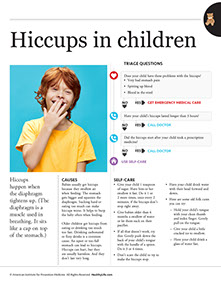
    Hiccups happen when the diaphragm tightens up. (The diaphragm is a muscle used in breathing. It sits like a cap on top of the stomach.)

    Babies usually get hiccups because they swallow air when feeding. The stomach gets bigger and squeezes the diaphragm. Sucking hard or eating too much can make hiccups worse. It helps to burp the baby often when feeding.

    Older children get hiccups from drinking too much soda pop or eating too much too fast. An upset or too-full stomach can lead to hiccups. Hiccups can hurt, but they are usually harmless. And they don’t last very long.

    Questions to Ask

    Self-Care

    *  Give your child 1 teaspoon of sugar. Have him or her swallow it fast. Do it 3 or more times, once every 2 minutes, if the hiccups don’t stop right away. (Note: For younger children, use 1 teaspoon of corn syrup.)

    *  Give babies a swallow of water.

    *  If all that doesn’t work, try this: Gently push down the back of your child’s tongue with the handle of a spoon. Do it 3 or 4 times.

    *  Don’t scare the child to try to make the hiccups stop.

    *  Have your child drink water with their head forward and down.

    *  Here are some old folk cures you can try:

    – Hold your child’s tongue with your clean thumb and index finger. Gently pull on the tongue.

    – Give your child a little cracked ice to swallow.

    – Have your child drink a glass of water fast.

    Children's Self-Care book by the American Institute for Preventive Medicine. www.HealthyLife.com. All rights reserved.

    © American Institute for Preventive Medicine
  • Asthma For Children

    Children’s Health

    Signs & Symptoms

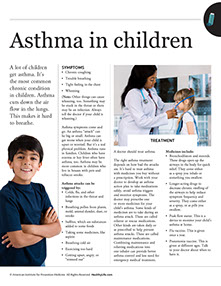
    A lot of children get asthma. Asthma cuts down the air flow in the lungs. This makes it hard to breathe. These are all symptoms of asthma:

    *  Chronic coughing.

    *  Trouble breathing.

    *  Tight feeling in the chest.

    *  Wheezing.

    (Note: Other things can cause wheezing, too. Something may be stuck in the throat or there may be an infection. Always tell the doctor if your child is wheezing.)

    Asthma symptoms come and go. An asthma “attack” can be big or small. Asthma can get worse when your child is upset or worried. But it’s a real physical problem. A doctor should treat your child if he or she has asthma. Asthma runs in families. Children who have eczema or hay fever often have asthma, too. Asthma may be more common in children who live in houses with pets and tobacco smoke.

    Causes

    Asthma attacks can come on with:

    *  Colds, flu, and other infections in the throat and lungs.

    *  Breathing pollen from plants, mold, animal dander, dust, or smoke.

    *  Sulfites. These are additions in some foods.

    *  Taking some medicines, like aspirin.

    *  Breathing cold air.

    *  Exercising too hard.

    *  Getting upset, angry, or “stressed out.”

    Treatment

    The right asthma treatment depends on how bad the attacks are. It’s hard to treat asthma with medicines you buy without a prescription. Your child’s doctor should keep track of how your child is doing. The doctor may prescribe one or more medicines for your child’s asthma. Some kinds of medicines are for your child to take during an asthma attack. Other kinds are taken daily or as prescribed to help prevent asthma attacks. Medicines include:

    *  Bronchodilators. These drugs open up the airways in the body. They come either as a spray or as something you swallow.

    *  Drugs to help with swelling of the airways in the body. They come either as a spray, or as pills you swallow.

    *  Drugs to help with chronic swelling of the airways in the body. They come as pills.

    *  Peak flow meter. This is a device to monitor your child’s asthma at home.

    *  Flu vaccine. This is given once a year.

    Questions to Ask

    Self-Care / Prevention

    *  Don’t smoke or let your child smoke. Don’t allow smoking in the house.

    *  Have your child drink a lot of water, juice, and other fluids. (Ask your child’s doctor how much fluid your child should have each day.)

    *  Find out what triggers your child’s asthma. Get rid of things that bother your child at home, at school, and where he or she plays.

    *  If you don’t have a dog, cat, or other pet, don’t get one. If you have a pet, keep it outside if you can. If not, don’t let it in your child’s bedroom.

    *  Keep things your child is allergic to out of his or her bedroom.

    *  Have your child sleep with no pillow or the kind the doctor says is O.K.

    *  Cover your child’s mattress and pillow with a plastic cover or one that says allergen-free. Wash mattress pads in hot water every week.

    *  Use throw rugs that can be washed often instead of carpets. Pollen, pet dander, mold, and dust mites collect in carpets. Use blinds and curtains that can be washed often, too.

    *  Try not to have stuffed animals kept in your child’s bedroom. Or have only one that can be washed. Wash it in hot water once a week.old, and dust mites collect in carpets. Use blinds and curtains that can be washed often, too.

    *  If you can, use a vacuum with a HEPA filter and double-thickness bags. When you vacuum, have your child wear a filter mask over his or her nose and mouth.

    *  Use air filters with your furnace and air-conditioning unit. Or use portable air cleaners to keep the air clean. Change or wash filters often. Keep the humidifier filter clean, if you use one. Use distilled (not tap) water in humidifiers and vaporizers.

    *  Don’ t hang sheets and blankets outside to dry. Pollen can get on them.

    *  It’s good for your child to do sports like swimming. But tell your child to stop exercising if he or she starts to wheeze.

    *  When outdoors in cold weather, have your child wear a scarf around his or her mouth and nose. The scarf warms the air before your child breathes it in.

    *  Don’t let your child eat foods or medicines that have sulfites. Shellfish, for example, often have sulfites. They bother many people with asthma.

    *  Have your child sit up during an asthma attack. Don’t let your child lie down.

    *  Don’t run out of your child’s asthma medicine. Keep the medicine handy. Have your child take it as soon as he or she starts to feel an attack.

    *  Don’t give your child aspirin! Some people with asthma are allergic to aspirin. Use acetaminophen instead.

    (Note: Aspirin and other medicines that have salicylates have been linked to Reye’s Syndrome, a condition that can kill.)

    Children's Self-Care book by the American Institute for Preventive Medicine. www.HealthyLife.com. All rights reserved.

    © American Institute for Preventive Medicine
  • Lice

    Children’s Health

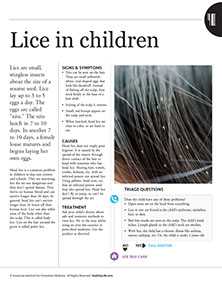
    Lice are small, wingless insects about the size of a sesame seed. Lice lay up to 3 to 5 eggs a day. The eggs are called “nits.” The nits hatch in 7 to 10 days. In another 7 to 10 days, a female louse matures and begins laying her own eggs.

    Head lice is a common problem in children in day- care centers and schools. Head lice only affect humans. They thrive on human blood and can survive longer than 30 days. In general, head lice can’t survive longer than 24 hours off their human host. Lice can also infest areas of the body other than the scalp. This is called body lice. Lice on the hair around the groin is called pubic lice.

    Signs & Symptoms

    For Head Lice

    *  Nits can be seen on the hair. They are small yellowish-white, oval-shaped eggs that look like dandruff. Instead of flaking off the scalp, they stick firmly to the base of a hair shaft.

    *  Itching of the scalp is intense.

    *  Small, red bumps appear on the scalp and neck.

    *  When hatched, head lice are clear in color, so are hard to see.

    Causes

    Head lice does not imply poor hygiene. It is caused by the spread of the insects through direct contact of the hair or head with someone who has head lice. Sharing hats, towels, combs, helmets, etc. with an infected person can spread lice. Using pillows, head rests, etc. that an infected person used may also spread lice. Head lice don’t fly or jump, so can’t be spread through the air.

    Treatment

    Ask your child’s doctor about safe and nontoxic methods to treat lice. He or she may advise using an over-the-counter or prescribed medicine. Use the product as directed.

    Questions to Ask

    Self-Care / Prevention

    Check everyone in your home for lice and nits. Treat only those who have lice. Lice-killing products won’t prevent lice.

    *  Use an over-the-counter shampoo, lotion, or cream made to get rid of lice and nits. Follow the directions on the package.

    *  Wear plastic or latex gloves. Don’t use too much shampoo. Doing this will make the child’s head too dry.

    Things to Tell Your Child

    *  Don’t share hats, brushes, or combs. If you must share helmets, wipe them with a damp towel and wear a baseball cap under the helmet.

    *  Don’t lie on a pillow that another child uses.

    *  Wash your hair and bathe often.

    To Remove the Nits

    *  Shine a flashlight on the hair roots. Nits are gray and hard to see, especially in blond hair.

    *  Start at one spot and go row by row or even strand by strand. Use the nit comb that comes in the package. Dip the comb in vinegar first. This will help loosen the nits.

    *  Comb the hair from the roots to the ends. Check the comb for nits after each pass, or, break the hair up into 4 or 5 sections with hair clips. Lift about an inch of hair up and out. Put the comb against your child’s head. Comb all the way to the tips of the hair. Keep going until you’ve done the whole head.

    *  Soak all combs, brushes, hair clips, and barrettes for 1 to 2 hours in the insecticidal shampoo. Or, soak them for 1 hour in soap and water, rubbing alcohol, or Lysol.

    *  Check for nits every 2 to 3 days for 2 to 3 weeks until all lice and nits are gone.

    *  A week to 9 days later, use the shampoo for lice again to kill any newly hatched nits. You don’t have to remove nits after treatment is finished except for cosmetic reasons.

    Other Things You Should Do

    *  Vacuum all mattresses, pillows, rugs, and furniture made of cloth, especially where children play. Use the long, thin attachment to suck the lice or nits out of car seats, toys, etc. Put the vacuum cleaner bags outside in the trash.

    *  Wash bedding and clothes right away in water 130ºF or hotter. Put them in the dryer on high for 30 minutes. Heat kills the lice and nits. Dry-clean clothes and hats that you can’t wash.

    *  Don’t use bug spray on lice, furniture, stuffed animals, etc.

    *  As soon as you know your child has lice, call your child’s school, child-care center, parents of your child’s friends, etc.

    *  Check your children for head lice and nits once a week. Check more often if your child scratches his or her head. Look for nits behind the ears and on the back of the neck. Spread hairs apart using a nit comb to look for the nits on the hair shafts.

    Resources

    National Pediculosis Association

    www.headlice.org

    Healthier at Home book by the American Institute for Preventive Medicine. www.HealthyLife.com. All rights reserved.

    © American Institute for Preventive Medicine
  • Bed-Wetting

    Children’s Health

    Passing urine during sleep is called “bed-wetting” when it occurs after age 5 or 6. Children are usually expected to have nighttime bladder control by this age. Bed-wetting is a very common problem. In the U.S., 5 to 7 million children have it.

    Enuresis is a medical term for bed-wetting. {Note: Bed-wetting itself, can’t be prevented, but damage to a child’s self- image can. Explain that bed-wetting is not his or her fault and that it will get better in time.}

    Causes

    Children don’t wet the bed on purpose. These are causes of bed-wetting:

    *  A lot of urine is made in the evening and during the night. A full bladder does not wake the child up.

    *  A child’s small bladder does not hold urine for an entire night.

    *  Other conditions, such as a urinary tract infection and diabetes. (Daytime wetting and other symptoms occur with these conditions.)

    *  For children who have been dry at night for 6 or more months, sometimes, emotional upsets and major changes can cause bed-wetting. An example is having a new baby in the house.

    *  Children are more likely to wet the bed if both parents did when they were children.

    Treatment

    Most of the time, children outgrow bed-wetting. Until then, self-care measures help with the problem. Medication can be prescribed when no other treatment works.

    Questions to Ask

    Self-Care / Prevention

    Be patient and give your child lots of support. Children who wet the bed can’t help it. Getting angry only makes the problem worse.

    Until Your Child Outgrows Bed-Wetting

    *  Do not blame or punish your child for wetting the bed.

    *  Limit fluids in the evening, especially 2 hours before bedtime. Ask your child’s doctor how much your child should drink. Don’t give drinks with caffeine, such as colas.

    *  Have your child urinate in the toilet right before getting into bed.

    *  See that your child can easily get to the toilet during the night. Keep the path clear. Use night lights, etc. If needed, put a portable potty close to your child’s bed. Assign a place the potty can be moved to for daytime, if your child wants to do this.

    *  Tell other members of the household that “teasing” about bed-wetting is not allowed. Respect your child’s privacy and feelings.

    *  You may want your child to use pull-up (training) pants when he or she sleeps away from home, camps, etc. On a regular basis, encourage your child to wake up to use the toilet.

    *  Keep a change of pajamas, a flannel covered pad, clean sheets, dry towels, etc., near your child’s bed. Show your child how to use these when he or she wets the bed. Include your child in the clean-up process.

    *  Have your child rehearse getting up from bed and using the toilet. Do this at bedtime. Do it during the day when your child gets the urge to urinate. Have your child lay down in his or her bed, wait a few minutes, and then get up to urinate in the toilet.

    *  If your child is 5 years old or older and he or she agrees to it, get a bed-wetting alarm. The child wears the alarm on his or her underwear. The first drop makes the alarm buzz. This wakes the child up. After awhile, the child learns to wake up when he or she has to urinate. Some of these alarms help prevent wet beds 85 to 90 percent of the time.

    Resources

    National Kidney Foundation

    888.WAKE.DRY (925.3379)

    www.kidney.org

    Healthier at Home book by the American Institute for Preventive Medicine. www.HealthyLife.com. All rights reserved.

    © American Institute for Preventive Medicine