Category: Children’s Health

  • Nutrition For Children

    Children’s Health

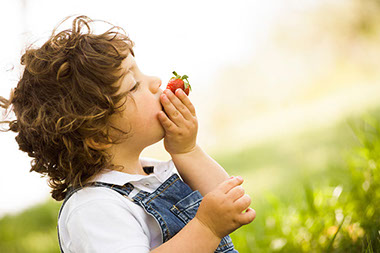
    Image of toddler eating a strawberry.

    Birth to 2 Years Old

    *  Breast-feed your baby from birth to 6 months of age. Breast-feed for the first year, if you can. If you can’t breast-feed or don’t want to, give iron-enriched formula (not cow’s milk) for the first 12 months. After that and up to age 2, use whole cow’s milk to replace formula or breast milk. Don’t limit fat for the first 2 years of life.

    *  Follow your child’s doctor’s advice on breast-feeding and what formula and vitamins to give your baby. Breast-fed babies who do not get regular exposure to sunlight may need vitamin D supplements.

    *  Start solid foods as advised by your baby’s doctor. It is common to do this at 4 to 6 months of age. Iron-enriched infant rice cereal is usually the first food given.

    *  Start new foods one at a time. Wait 1 week before adding each new cereal, vegetable, or other food. Doing this makes it easier to find out which foods your baby has a problem with.

    *  Use iron-rich foods, such as grains, iron-enriched cereals, and meats.

    *  Do not give honey to infants during the first 12 months of life.

    *  Don’t let a baby fall asleep with a bottle that has formula, juice, or milk. The sugars in these can cause tooth decay.

    Two Years and Older

    *  Give a variety of healthy foods for meals and snacks. Follow guidelines from theChooseMyPlate.gov/kidsWeb site. Let your child choose which healthy foods and how much to eat to satisfy his or her hunger.

    *  Help your child maintain a healthy weight. Give proper foods. Promote regular exercise. Lead by example. Children learn from what they see parents do, as well as, from what parents say. Eat with your children. Be a role model for good eating. Exercise, too.

    *  Let your child help plan meals and snacks, shop for food, and prepare foods.

    *  Don’t force your child to eat certain foods. Don’t use food to reward or punish behavior.

    *  Don’t give foods that can lead to choking, such as hard candies and whole grapes.

    *  Teach healthy behaviors in a fun way. For ideas to help get children to eat well and be more active, access the Web sites under “Resources”.

    Resources

    5-2-1-0 Let’s Go!

    www.letsgo.org

    ChooseMyPlate.gov

    www.choosemyplate.gov/kids/index.html

    We Can!™ Ways to Enhance Children’s  Activity & Nutrition
    www.nhlbi.nih.gov/health/educational/wecan

    Page from Healthier at Home book by the American Institute for Preventive Medicine. www.HealthyLife.com. All rights reserved.

    © American Institute for Preventive Medicine
  • Signs Of Reye’S Syndrome

    Children’s Health

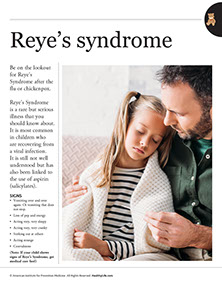
    Be on the lookout for Reye’s Syndrome after the flu or chickenpox. Reye’s Syndrome does not happen very often. But you should know about it. Look for these signs:

    *  Vomiting over and over again. Or vomiting that does not stop.

    *  Loss of pep and energy.

    *  Acting very, very sleepy.

    *  Acting very, very cranky.

    *  Striking out at others.

    *  Acting strange.

    *  Convulsions.

    (Note: If your child shows signs of Reye’s Syndrome, get medical care fast!)

    Children's Self-Care book by the American Institute for Preventive Medicine. www.HealthyLife.com. All rights reserved.

    © American Institute for Preventive Medicine
  • Colds & Flu

    Children’s Health

    Colds and flu are infections of the nose and throat. Both are caused by viruses.

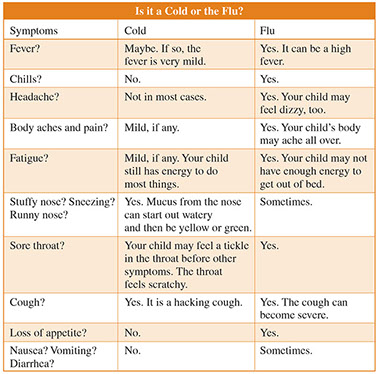
    It can be hard to tell if your child has a cold or the flu. Why? They both have the same type of symptoms. But symptoms for the flu are worse than ones for a cold. Flu symptoms come on fast. Ones for a cold come on slower.

    Signs & Symptoms

    Chart showing symptoms of a cold vs a flu.

    Prevention

    Antibiotics do not treat colds and flu. Most colds clear up in about a week. Sometimes, a cold lasts up to 2 weeks.

    Fever and most flu symptoms usually go away after 5 days, but coughing and feeling weak can last up to 2 weeks.

    To Help Prevent Colds and Flu

    *  Take your child for a yearly flu vaccine as advised.

    *  Don’t smoke or let your child smoke.

    *  Keep your child away from persons who have the flu or a cold.

    *  See that your child eats and sleeps well and gets lots of exercise.

    Tell your child to do these things:

    *  Wash your hands often. Keep them away from your nose, eyes, and mouth.

    *  Cover your nose when you sneeze. Use a handkerchief or tissues when you sneeze, cough, or blow your nose. This helps prevent passing germs to others.

    Questions to Ask

    Self-Care

    Have your child do these things:

    *  Rest.

    *  Drink lots of liquids. They help clear out the respiratory tract. This can help prevent other problems, like bronchitis.

    *  Eat chicken soup. It helps clear out mucus.

    If your child’s throat is sore, have him or her do these things:

    *  Gargle every few hours with 1/4 teaspoon of salt in 1/2 cup of warm water, if able to. (A child can usually do this starting at age 6.)

    *  Suck on a piece of hard candy or cough drop once in a while. (Don’t  give these to children under 5 years old.)

    Things you can do:

    *  Try to clear your child’s nose. This is very important in babies under 6 months old, because some can’t breathe through their mouths yet. Also, they can’t breast or bottle-feed if they can’t breathe through the nose. To clear your child’s nose:

    – Use an over-the-counter spray or drops for the nose made of salt and water. An example is Ocean® brand. Follow the label’s advice or that of your child’s doctor.

    – For a baby who can’t blow his or her nose, leave the salt drops in for 1 minute. Then use a soft rubber suction bulb to draw out the mucus. Lie the baby on his or her back. Aim the bulb straight down, not at an angle! (You can get a suction bulb at the drug store.) Or use a cotton swab to wipe the mucus out. Don’t put the suction bulb or cotton swab too far into the nose. You could cause a nosebleed.

    – For a child who can blow his or her own nose, have the child do it 1 minute after the salt drops are in.

    *  Put a cool-mist vaporizer or humidifier in your child’s room. Use distilled (not tap) water. Clean it every day.

    *  For fever and muscle aches, give your child acetaminophen or ibuprofen. Make sure you give the right kind and dose for your child’s weight. (Note: Do not give aspirin. Aspirin and other medicines that have salicylates have been linked to Reye’s Syndrome.

    *  Check with your child’s doctor about using over-the-counter medicines for colds and flu for children under  age 2.

    *  Call your child’s doctor if he or she gets a fever after a cold or after the flu has gone away.

    *  Washing the hands often helps stop spreading the flu. Have your child wash his or her hands:

    – After playing with others.

    – When he or she gets home from school.

    – After blowing his or her nose.

    – After touching toys or other people’s things.

    Signs of Reye’s Syndrome

    Be on the lookout for Reye’s Syndrome after the flu or chickenpox. Reye’s Syndrome does not happen very often. But you should know about it. Look for these signs:

    *  Vomiting over and over again. Or vomiting that does not stop.

    *  Loss of pep and energy.

    *  Acting very, very sleepy.

    *  Acting very, very cranky.

    *  Striking out at others.

    *  Acting strange.

    *  Convulsions.

    (Note: If your child shows signs of Reye’s Syndrome, get medical care fast!)

    Children's Self-Care book by the American Institute for Preventive Medicine. www.HealthyLife.com. All rights reserved.

    © American Institute for Preventive Medicine
  • Self-Care Medicines & Supplies For Children

    Children’s Health

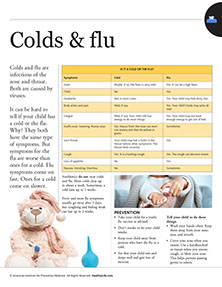
    Here is a list of medicines and other things you should keep at home.

    *  Store items in a handy, dry place, but out of children’s reach.

    *  Check the expiration dates often. Throw away and replace outdated items.

    *  Find out what kind and how much of each medicine you can give your child. Ask your child’s doctor. Ask the pharmacist. Read and understand the medicine’s label. Brand names are often listed. Store brands are just as good.

    Over-the-Counter Medicines

    *  Acetaminophen. An example is Children’s Tylenol®. Or have ibuprofen. Examples are Children’s Advil® and Children’s Motrin®. Stock the right kind for your child’s weight.

    *  Antihistamine tablets or syrup. An example is Benadryl®.

    *  Cough medicine. Ask your child’s doctor which one(s) you should stock.

    *  Decongestant tablets or liquid. Do not give to children under 2 years old. An example is Dimetapp®.

    Basic Supplies

    *  Antibiotic ointment.

    *  Antiseptic ointment or wipes.

    *  Bandages of different sizes.

    *  Eye dropper.

    *  Medicine spoon & dropper.

    *  Cold pack.

    *  Cotton-tipped swabs.

    *  Elastic wrap and closures.

    *  Flashlight.

    *  Roll of adhesive tape.

    *  Rubbing alcohol.

    *  Sterile gauze pads and a roll of gauze.

    *  Sunscreen with an SPF of 15 or higher.

    *  Thermometer (digital or ear).

    *  Tongue depressor.

    *  Toothache medicine. An example is Anbesol®.

    *  Tweezers.

    *  Vaporizer (cool mist).

    Children's Self-Care book by the American Institute for Preventive Medicine. www.HealthyLife.com. All rights reserved.

    © American Institute for Preventive Medicine
  • Colic

    Children’s Health

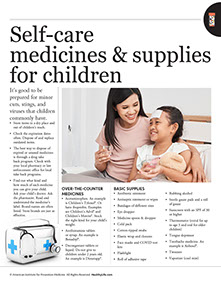
    Babies cry when they are hungry, sick, too hot, etc. In general, babies start to have colic when they are about three weeks old. The colic worsens at around six weeks of age and stops by 3 months of age. Colic does not harm babies, but is very hard on parents and caretakers.

    Signs & Symptoms

    *  Fussy crying occurs for no known reason. The baby is not hungry, sick, in pain, etc. The crying lasts for minutes to hours at a time.

    *  The baby may pull his or her knees up to the stomach.

    *  Colic episodes often occur in the evening.

    Causes

    The exact cause is not known. Babies with colic are very, very sensitive to stimulation. Noises in the house bother them. Also, they may need to be cuddled more than babies without colic.

    Bottle feeding too fast (less than 20 minutes) or giving too much formula can trigger colic episodes. So can foods the breast-feeding mother eats (e.g., caffeine, dairy products, and nuts).

    Treatment

    After other medical problems are ruled out, colic is treated by finding out and getting rid of colic triggers and giving comfort to the baby.

    Questions to Ask

    Self-Care / Prevention

    *  Be sure the baby has enough to eat. Check with the baby’s doctor about trying a new formula.

    *  Try different bottle nipples. Make the hole bigger if it is too small. Cut across the hole that is already there. (You will make an X- shaped hole.) Here’s how to find out if the hole is too small:

    –  Put cold formula in the bottle.

    –  Turn the bottle upside down.

    –  Count the drops of formula that fall out. If the drops come out slower than 1 drop per second, the hole is too small.

    *  Don’t allow smoking in your home.

    *  Do not give fruit juice (e.g., apple juice, pear juice) to infants younger than 6 months old.

    *  Hold the baby up for feeding. Keep holding the baby up for awhile after feeding.

    *  Burp the baby after each ounce of formula or every few minutes when breast-feeding.

    *  Use a pacifier, but never put a pacifier on a string around the baby’s neck.

    *  Give the baby a warm bath and a massage.

    *  Wrap or swaddle the baby snugly in a soft blanket. Rock him or her or use a baby swing.

    *  Try the “colic carry.” Lay the baby on his or her stomach across your arm. Put the baby’s face in your hand and let the legs straddle your inner elbow. Hold the baby’s back with your other hand so he or she won’t fall. Walk around like this for awhile.

    *  Carry the baby while you vacuum. Use a baby carrier that you wear on your back or chest.

    *  Play soft, gentle music.

    *  Take your baby for a stroller or car ride.

    *  Run the dryer or dishwasher. Buckle your baby in a baby seat. Lean the seat against the side of the dryer or on the counter near the dishwasher. The sounds from these machines may help the baby fall asleep. Stay with your baby. Make sure the heat or steam won’t hurt the baby.

    *  Don’t give the baby antacids like Maalox or simethicone drops unless a doctor tells you to.

    *  Let your baby cry himself or herself to sleep if nothing else helps and your baby has been fed within 2-1/2 hours. Do call the doctor if the baby cries for more than 2 hours without stopping.

    *  Get someone else to take care of your baby if you get too stressed. Get some rest.

    Resources

    American Academy of Pediatrics

    www.aap.org

    Healthier at Home book by the American Institute for Preventive Medicine. www.HealthyLife.com. All rights reserved.

    © American Institute for Preventive Medicine
  • Sore Throat & Tonsillitis

    Children’s Health

    Tonsillitis is when the tonsils are swollen mostly due to infection. This can be viral or bacterial. Take your child to the doctor if he or she has a bad sore throat. Some sore throats that aren’t treated can lead to other problems like abscesses, kidney problems, or rheumatic heart disease. The doctor may take a throat culture to find out what is wrong. The doctor may give your child antibiotics if the sore throat is from strep or some other bacteria.

    Signs, Symptoms & Causes

    There are 2 kinds of sore throats:

    *  Bacterial sore throats usually cause a high fever, headaches, or swollen neck glands. But sometimes children with bacterial sore throats have no other problems. Strep throat is one kind of bacterial sore throat. Antibiotics can help cure a bacterial sore throat.

    *  Viral sore throats are more common. They may or may not cause the same problems as a bacterial sore throat. You can’t cure a viral sore throat with antibiotics.

    Questions to Ask

    Self-Care

    Try these tips for your child’s sore throat pain:

    *  Have your child gargle with 1/4 teaspoon of salt in 1/2 cup of warm water. Do this every few hours. Only do this with children over 6 years old.

    *  Give your child warm drinks like tea and soup. The tea can be plain or with honey. (Don’t give honey to a baby under 1 year old.)

    *  For strep throat, give cold foods and liquids, like popsicles and frozen yogurt.

    *  Keep your child away from secondhand smoke.

    *  Use a cool-mist vaporizer in the room where your child spends most of the time. Clean it every day. Use distilled (not tap) water.

    *  Feed your child foods that are soft and/or cold. The food should be easy to swallow. Don’t give your child spicy foods.

    *  Have your child suck on a piece of hard candy or a cough drop if he or she is 5 or more years old. You can give corn syrup to a younger child.

    *  For pain and fever give your child acetaminophen or ibuprofen. Make sure to give the right kind and dose for his or her weight. (Note: Do not give aspirin. Aspirin and other medicines that have salicylates have been linked to Reye’s Syndrome.)

    *  Don’t use throat sprays. Some throat sprays have benzocaine. Benzocaine bothers some children.

    Children's Self-Care book by the American Institute for Preventive Medicine. www.HealthyLife.com. All rights reserved.

    © American Institute for Preventive Medicine
  • Constipation In Children

    Children’s Health

    Signs, Symptoms & Causes

    Constipation is when you can’t pass solid waste, or stool. (Passing stool is also called “having a bowel movement.”) Constipation is not usually serious. Here are some reasons for constipation:

    *  Your child has the flu or some other sickness.

    *  Your child isn’t getting enough water.

    *  Your child is holding in the bowel movement because he or she:

    – Has a bad diaper rash.

    – Has a tear in the rectum (the opening where stool comes out).

    – Is being toilet trained.

    Sometimes a child won’t have a bowel movement for many days. They may start getting stains in their underpants. This is called “soiling.” It is a sign of a bigger problem.

    You can do things to help your child’s stool be softer. This makes it easier to pass. (See the Self-Care Tips in this section.) Don’t give your child a laxative or an enema unless the doctor tells you to. (Laxatives and enemas are medicines for constipation.) Your child doesn’t have to pass stool every day.

    Questions to Ask

    Self-Care

    *  Give your child lots of water and other things to drink. (This is very important when the weather is hot.)

    *  Give your child prune juice.

    *  To help your baby pass stool, lie the baby on his or her back. Move the baby’s legs like he or she is riding a bicycle. Or bend your baby’s legs at the knees and hold them up to your baby’s chest.

    *  Don’t give honey to an infant.

    *  Feed your child foods with fiber:

    – Babies 6 months old and older can have whole wheat baby cereal.

    – Older children can eat fruit, and whole-wheat breads and cereals, and vegetables.

    *  Try giving your baby light Karo® syrup. (You can get it at the grocery store.) Here’s how to give it to your baby:

    – Put 1/4 to 1/2 teaspoon of syrup in 4 ounces of water.

    OR

    – Put 1/4 to 1/2 teaspoon of syrup in 4 ounces of formula.

    Note: You may have to give your child an over-the-counter medicine. Be sure to check with the doctor first. Some medicines are:

    *  Mineral oil. (Don’t give mineral oil to a child under 3 years old.)

    *  Glycerin suppositories.

    *  Laxatives like Colace® or Metamucil®.

    Children's Self-Care book by the American Institute for Preventive Medicine. www.HealthyLife.com. All rights reserved.

    © American Institute for Preventive Medicine
  • Swollen Glands In Children

    Children’s Health

    Signs, Symptoms & Causes

    There are many lymph glands in the body. They protect the body from infection. They make a white blood cell that kills germs in the body. Lymph glands also trap viruses, bacteria, and cancer cells.

    You can feel your child’s lymph glands when they swell up. When a lymph gland swells up from an infection, it usually hurts when you touch it. Sometimes the glands stay swollen for a long time after the infection is gone. They usually don’t hurt and are not dangerous.

    Watch out for swollen glands that are:

    *  Hard.

    *  “Rubbery.”

    *  Without pain.

    *  Getting bigger.

    These glands can be signs of lymphoma (cancer of the lymph glands), leukemia, or some other cancer.

    The salivary glands are another kind of gland. They are under the tongue, on the bottom of the mouth, and just below the ear. They are not lymph glands. They make saliva, or “spit.” The salivary glands in front of the ears swell up when your child has mumps.

    What Causes Swollen Glands?

    *  A throat or ear infection is a  common cause of swollen glands in the neck.

    *  An infection in the feet, legs, or groin can make the lymph glands in the groin swell.

    *  Mononucleosis can make neck glands swell. (High school and college students call this “mono” or “the kissing disease.”)

    *  Mumps.

    *  Cat scratch fever. A cat’s claws carry this sickness.

    *  Medicines, like Dilantin®. (This medicine is for epilepsy.)

    *  Dental work.

    *  Lymphoma, a cancer of the lymph glands, or leukemia.

    *  Tuberculosis (TB).

    How to Keep Your Child from Getting Swollen Glands

    *  Make sure your children’s measles, mumps, and rubella (MMR) shots are up-to-date.

    *  Keep your child away from people who have sicknesses they can catch.

    Questions to Ask

    Self-Care

    There isn’t much you can do for swollen glands. You have to treat the problem that made them swell. Watch to see if the glands get bigger. Watch to see if any other glands swell up. Call the doctor if the glands keep getting bigger, or if they last 3 or 4 weeks.

    Try these tips to make your child feel better:

    *  Tell your child to rest when they feel tired. Tell them not to “overdo it.”

    *  Give your child plenty to drink.

    *  Put warm, wet washcloths and antiseptic creams on scratches and other wounds.

    Children's Self-Care book by the American Institute for Preventive Medicine. www.HealthyLife.com. All rights reserved.

    © American Institute for Preventive Medicine
  • Coughs In Children

    Children’s Health

    Signs, Symptoms & Causes

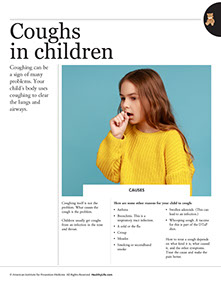
    Coughing can be a sign of many problems. Your child’s body uses coughing to clear the lungs and airways. Coughing itself is not the problem. What causes the cough is the problem. Children usually get coughs from an infection in the nose and throat.

    Here are some other reasons for your child to cough:

    *  Asthma.

    *  Bronchitis. This is a respiratory tract infection.

    *  A cold or the flu.

    *  Croup.

    *  Measles.

    *  Smoking or secondhand smoke.

    *  Swollen adenoids. (This can lead to an infection.)

    *  Whooping cough. A vaccine for this is part of the DTaP shot.

    How to treat a cough depends on what kind it is, what caused it, and the other symptoms. Treat the cause and make the pain better.

    Questions to Ask

    Self-Care

    *  Give your child plenty of liquids, like water and clear soup. These help loosen mucus and soothe a sore throat. Fruit juices are good, too.

    *  Use a cool-mist vaporizer, especially in the bedroom. Use distilled (not tap) water. Put a humidifier on the furnace. Keep them very clean. Remember to change the filter on the humidifier.

    *  Sit with your child in the bathroom with the shower running. The steam can help thin the mucus. (If your child has asthma, do not follow this tip.)

    *  Raise your child’s head when resting if he or she has a cold or respiratory infection.

    *  Put your child’s head lower than his or her chest if the infection is in the lungs.

    *  Ask your child’s doctor or pharmacist what kind of cough medicine is O.K. to give your child.

    *  Make your own cough medicine. Mix 1 part lemon juice and 2 parts honey. (Don’t give this to children under 1 year old.)

    *  Have your child suck on cough drops, hard candies, or suckers. Give suckers that have safety loops instead of hard sticks. (Don’t give these to a child under 5 years old.)

    *  If your baby coughs after eating:

    – Have your baby sit up when he or she eats.

    – If your baby drinks from a bottle, burp your baby after each ounce of formula. Burp the baby every few minutes when breast-feeding.

    – Don’t lie the baby down after feeding.

    *  Don’t smoke. Keep your child away from secondhand smoke. Tell your child not to smoke.

    *  Keep your child away from chemical gases that can hurt their lungs.

    *  When your child is better, promote exercise on a regular basis. Your child’s breathing muscles will get stronger. Your child will fight infection better, too.

    *  Keep your child’s shots up-to-date.

    *  For fever and aches, give your child acetaminophen or ibuprofen. Make sure you give the right kind and dose for your child’s weight.

    *  If your child gets bronchitis easily, keep him or her away from air pollution as much as you can. Use  air conditioning and air filters. Have your child wear a filter mask over his or her nose and mouth if needed. Keep your child inside when air pollution is heavy.

    *  Call the doctor if your child doesn’t get better in 24 hours.

    (Note: Do not give aspirin. Aspirin and other medicines that have salicylates have been linked to Reye’s Syndrome.)

    To Help Prevent a Cough and Choking from Something Caught in the Throat or Windpipe

    *  Keep coins, paper clips, balloons, and small toy parts out of the reach of babies and small children. Anything that is small enough to fit through the center of a paper towel roll is a choking hazard for babies and small children.

    *  Watch your child when he or she eats. For a child less than 4 years old, give foods that are soft and cut up. Don’t give foods in the list below to a child less than 4 years old.

    – Peanuts and other nuts.

    – Popcorn.

    – Hot dogs (even when cut in round pieces).

    – Raisins and other dried fruit.

    – Raw carrots.

    – Chewing gum.

    – Peanut butter from a spoon.

    – Hard candy, sunflower or pumpkin seeds. (Wait until a child is age 5 years old to give these.)

    Children's Self-Care book by the American Institute for Preventive Medicine. www.HealthyLife.com. All rights reserved.

    © American Institute for Preventive Medicine