Category: Children’s Health

  • Vomiting & Nausea In Children

    Children’s Health

    Signs, Symptoms & Causes

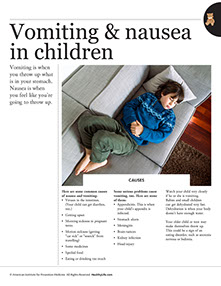
    Vomiting is when you throw up what is in your stomach. Nausea is when you feel like you’re going to throw up.

    Here are some common causes of nausea and vomiting:

    *  Viruses in the intestines. (Your child can get diarrhea, too.)

    *  Getting upset.

    *  Morning sickness in pregnant teens.

    *  Motion sickness (getting “car sick” or “seasick” from travelling).

    *  Some medicines.

    *  Spoiled food.

    *  Eating or drinking too much.

    Some serious problems cause vomiting, too. Here are some of them:

    *  Appendicitis. This is when your child’s appendix is infected.

    *  Stomach ulcers.

    *  Meningitis.

    *  Brain tumors.

    Watch your child very closely if he or she is vomiting. Babies and small children can get dehydrated very fast. Dehydration is when your body doesn’t have enough water.

    Your older child or teen may make themselves throw up. This could be a sign of anorexia nervosa or bulimia.

    Questions to Ask

    Self-Care

    *  Be calm and loving. Throwing up can scare a child.

    *  Keep a bowl or basin near your child. Hold your hand against your child’s forehead when he or she vomits.

    *  Give your child water to rinse his or her mouth out after throwing up. Sponge your child’s face.

    *  Take away dirty clothes or bedding. Change to clean ones.

    *  Don’t smoke near your child.

    *  Don’t feed your child solid food. Don’t give your child milk.

    *  Wait 1 hour after your child throws up. Then give your child clear fluids (not too cold or too hot). Here are some examples:

    – Pedialyte®, Revital Ice®-rehydrating freezer pops, or other over-the-counter mixtures.

    – Lemon-lime soda or ginger ale for  older children. Stir the soda until the fizz is gone.

    – Gelatin (any color but red).

    *  Start with 1 teaspoon to 1 tablespoon of liquid every 10 minutes for babies. Start with 1 to 2 ounces every 15 minutes for children. Give twice as much each hour after the vomiting stops. If your child is still vomiting, stop fluids for 1 hour. Then start to give small amounts of fluid again.

    *  Slowly give your child more and more clear fluids. Don’t make your child drink when he or she doesn’t want anything.

    *  If you are breast-feeding:

    – If the baby throws up 3 or more times, give your baby Pedialyte® or other over-the-counter mixture.

    – Go back to nursing when your baby has gone 2 to 4 hours without vomiting. But feed less. Do only one side, and only for about 10 minutes.

    – Go back to nursing on both sides after 8 hours of no vomiting. But feed your baby less than usual for about 8 hours.

    *  For bottle-fed babies: After 12 hours of no vomiting, give formula. But mix 1/2 formula with 1/2 water.

    *  After your child stops throwing up, keep giving him or her clear fluids, like broth and gelatin (any color but red). Do this for 8 hours. Then give foods easy to digest, like crackers and rice. Then go back to the usual foods your child eats. But wait 12 to 24 hours after the last time your child vomited to give milk.

    *  Don’t give your child over-the-counter medicine unless the doctor tells you to.

    Call the doctor if your child doesn’t get better or if the vomiting comes back.
    Children's Self-Care book by the American Institute for Preventive Medicine. www.HealthyLife.com. All rights reserved.

    © American Institute for Preventive Medicine
  • Croup

    Children’s Health

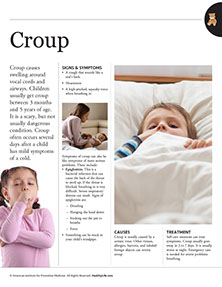
    Croup causes swelling around vocal cords and airways. Children usually get croup between 3 months and 5 years of age. It is a scary, but not usually dangerous condition. Croup often occurs several days after a child has mild symptoms of a cold.

    Signs & Symptoms

    *  A cough that sounds like a seal’s bark.

    *  Hoarseness.

    *  A harsh, crowing noise with breathing in.

    Symptoms of croup can also be like symptoms of more serious problems. These include:

    *  Something can be stuck in your child’s windpipe.

    *  Epiglottitis. This is a bacterial infection that can cause the back of the throat to swell up. If the throat is blocked, breathing in is very difficult. Severe respiratory distress can result. Signs of epiglottitis are:

    – Drooling.

    – Hanging the head down.

    – Sticking out the jaw to breathe.

    – Fever.

    Causes

    Croup is usually caused by a certain virus. Other viruses, allergies, bacteria, and inhaled foreign objects, can mimic croup.

    Treatment

    Self-care measures can treat symptoms. Croup usually goes away in 3 to 7 days. It is usually worse at night. Emergency care is needed for severe problems breathing.

    Questions to Ask

    Self-Care / Prevention

    *  Don’t panic. You can help your child stay calm if you stay calm. Hold your child to comfort him or her. The windpipe may open up a little if your child relaxes. Call your child’s doctor or get immediate care if you are not sure what to do.

    *  Go into the bathroom with your child and close the door.

    –  Turn on the hot water in the sink and shower. Let the steam fill the room.

    –  Don’t put your child in the shower. Sit with your child. (Don’t sit on the floor.) Read a book or play a game with your child. This will help pass the time.

    –  Open the window to let cool air in. This helps make more steam.

    –  Stay in the bathroom about 10 to 15 minutes.

    *  If it is cold outside, instead of using the bathroom to make steam, put a coat, etc. on your child and take him or her outside to breathe the cold night air.

    *  Use a humidifier in your child’s room. Use warm, distilled water, not tap water. Clean the humidifier every day. Put a humidifier on your furnace. Change the filter often.

    *  Give your child a clear liquid. Warm it first. Warm liquids may help loosen the mucus. Give babies under 6 months old water or electrolyte water, such as Pedialyte, if okay with your child’s doctor. Give water, apple juice, etc. to a child who is 6 months old or older.

    *  Try to keep your child calm. Croup symptoms tend to get worse if your child is crying and upset.

    To Help Prevent Croup and Other Infections

    *  See that your child’s immunizations for diphtheria (DTaP), measles (MMR), and H. influenzae type b (Hib) are up-to-date.

    *  Follow prevention measures inColds & Flu.

    Resources

    The American Academy of Pediatrics

    www.aap.org

    Healthier at Home book by the American Institute for Preventive Medicine. www.HealthyLife.com. All rights reserved.

    © American Institute for Preventive Medicine
  • Diarrhea In Children

    Children’s Health

    Signs, Symptoms & Causes

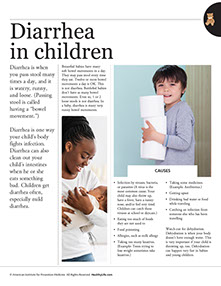
    Diarrhea is when you pass stool many times a day, and it is watery and loose. (Passing stool is called having a “bowel movement.”)

    Diarrhea is one way your child’s body fights infection. Diarrhea can also clean out your child’s intestines when he or she eats something bad. Children get diarrhea often, especially mild diarrhea.

    Breast-fed babies have many soft bowel movements in a day. They may pass stool every time they eat. Twelve or more bowel movements a day is O.K. This is not diarrhea. Bottle-fed babies don’t have as many bowel movements. Even so, 1 or 2 loose stools is not diarrhea. In a baby, diarrhea is many very runny bowel movements.

    Watch out for dehydration. Dehydration is when your body doesn’t have enough water. This is very important if your child is throwing up, too. Dehydration can happen very fast in babies and young children.

    Many things can cause diarrhea:

    *  Infection by viruses, bacteria, or parasites (A virus is the most common cause. Your child may also throw up, have a fever, have a runny nose, and/or feel very tired. Children can catch these viruses at school or daycare.)

    *  Eating too much of foods they are not used to.

    *  Food poisoning.

    *  Allergies. (Example: milk allergy).

    *  Taking too many laxatives. (Example: Teens trying to lose weight sometimes take laxatives.)

    *  Taking some medicines. (Example: Antibiotics.)

    *  Getting upset.

    *  Drinking bad water or food while traveling.

    *  Catching an infection from someone else who has been travelling.

    Questions to Ask

    Self-Care

    Do the tips that follow if your child shows these signs of dehydration

    – Is thirsty.

    – Has a dry mouth and dry skin.

    – Has a dry diaper or passed little or no urine.

    – Is confused or dizzy.

    – Is weak or has a weak cry.

    *  Get medical care fast.

    *  Stop solid foods. Give clear liquids. Give the liquids the doctor tells you to give.

    *  Don’t give your child very cold or hot liquids or boiled milk.

    *  Don’t give your child liquids with lots of sugar, like soft drinks, gelatins, grape juice, and apple juice. These can make the diarrhea worse.

    *  Don’t give just clear liquids for more than 24 hours. Start normal meals within 12 hours.

    * For bottle-fed babies and children under 2, give over-the-counter mixtures like Pedialyte®. They have liquid and minerals.

    – For breast-fed babies, nurse the baby. But give only as much breast milk as the baby wants. Feed every 2 hours. Ask the baby’s doctor about giving water and over-the-counter mixtures.

    – For children over age 2, give up to 6 cups of liquid per day. Good choices are: Over-the-counter mixtures, like Pedialyte®; Kool-Aid®; Sports drinks, like Gatorade®. Water, but don’t give just water. Give other clear liquids, too.

    Do the tips that follow if there are no signs of dehydration

    *  Feed your child normal meals. Your child may want to eat smaller amounts than normal.

    *  Don’t give fatty or fried foods.

    *  Don’t give your child foods that upset his or her stomach.

    *  Don’t feed your child just a B.R.A.T. diet. This was an old way to treat diarrhea. B.R.A.T. stands for ripe Bananas, Rice, Applesauce, and dry Toast. It is O.K. to give your child these foods with other ones, though.

    *  Don’t let your child exercise too hard until the diarrhea is all gone.

    *  Don’t give your child Kaopectate® or other over-the-counter medicines to stop diarrhea unless your child’s doctor says it’s O.K. And, don’t give your child Pepto-Bismol®. Like aspirin, Pepto-Bismol® has salicylates which have been linked to Reye’s Syndrome, a condition that can kill.

    *  To keep diarrhea germs from spreading, follow these tips:

    – Make sure your child washes his or her hands after using the toilet.

    – Give your child paper towels to dry his or her hands.

    – Have everyone at home wash their hands often, so the infection doesn’t spread.

    – Be sure to wash your hands after changing diapers or washing your child.

    Follow these steps to avoid food poisoning

    *  Wash your hands with warm soapy water for 20 seconds (count to 30) before you handle food or items used to prepare foods.

    *  Use clean tools and clean surfaces when you prepare foods.

    *  Keep raw meat, poultry, eggs, and fish away from other foods, utensils, and serving plates.

    *  Wash your hands after you touch or prepare raw meat, poultry, fish, shellfish, or eggs. Wash the items used to prepare these foods, too. Use hot soapy water or put them in the dishwasher.

    *  Don’t mix raw foods with cooked and ready-to-eat foods when you shop, prepare, and store foods.

    *  Store foods that can spoil in the refrigerator. Read food labels. Use leftovers stored in the refrigerator within 3 to 4 days.

    *  Don’t eat raw eggs or eggs that aren’t cooked enough. Don’t eat foods with raw eggs like cookie batter.

    *  Cook foods to a safe temperature. Check and follow the label or recipe.

    *  Keep hot foods hot (higher than 140ºF) and cold foods cold (40ºF or lower).

    Children's Self-Care book by the American Institute for Preventive Medicine. www.HealthyLife.com. All rights reserved.

    © American Institute for Preventive Medicine
  • Earaches In Children

    Children’s Health

    Signs, Symptoms & Causes

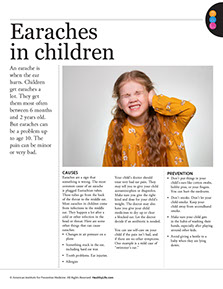
    An earache is when the ear hurts. Children get earaches a lot. They get them most often between 6 months and 2 years old. But earaches can be a problem up to age 10. The pain can be minor or very bad.

    Earaches are a sign that something is wrong. The most common cause of an earache is plugged Eustachian tubes. These tubes go from the back of the throat to the middle ear. Most earaches in children come from infections in the middle ear. They happen a lot after a cold or other infection in the head or throat.

    Here are some other things that can cause earaches:

    *  Changes in air pressure on a plane.

    *  Something stuck in the ear.

    *  Tooth problems. Ear injuries.

    *  Allergies.

    Your child’s doctor should treat very bad ear pain. He or she may tell you to give your child acetaminophen or ibuprofen. Make sure you give the right kind and dose for your child’s weight. The doctor may also have you give your child medicines to dry up or clear a blocked ear. Let the doctor decide if an antibiotic is needed.

    You can use self-care on your child if the pain isn’t bad, and if there are no other symptoms. One example is a mild case of “swimmer’s ear.”

    To Prevent Earaches

    *  Don’t put things in your child’s ears like cotton swabs, bobby pins, or your fingers. You can hurt the eardrums.

    *  Don’t smoke. Don’t let your child smoke. Keep your child away from secondhand smoke.

    Questions to Ask

    Self-Care

    To help with pain

    *  Put a warm washcloth next to the sore ear. Or put an ice bag or ice in a wet washcloth over the ear for 20 minutes.

    *  Give your child acetaminophen or ibuprofen. Make sure you give the right kind and dose for your child’s weight. (Note: Do not give aspirin. Aspirin and other medicines that have salicylates have been linked to Reye’s Syndrome.)

    For “swimmer’s ear”

    Swimmer’s ear is when you get water stuck in your ears after swimming. This can lead to an infection. To treat this:

    *  Have your child shake his or her head.

    *  Dry the ear canal with a tissue. Twist each corner of the tissue into a tip. Stick each tip into the ear canal for 10 seconds. Use a clean tissue on the other ear.

    *  Use a product like Swim-Ear®. Drop it into the ears to fight the infection.

    To get a bug out of your child’s ear

    *  Put the child in a dark room. Shine a light near the ear for a few minutes. (The bug may fly out.)

    *  Pour a little warm olive oil, baby oil, or mineral oil in the ear to make the bug float out. Pull the earlobe gently back and up as you pour. If this doesn’t work, call your child’s doctor.

    To open up and drain the Eustachian tubes

    Have your child do these things:

    *  Sit up.

    *  Sleep with his or her head raised.

    *  Yawn. Yawning moves the muscles that open the tubes.

    *  Hold his or her nose closed and have your child blow gently through the nose until he or she hears a pop. This can be done many times a day. It can also be done on a plane when it starts to land.

    *  Stay awake during airplane take-offs and landings. (If your child is an infant, nurse or bottle-feed him or her as the plane takes off, gets ready to land, and when it lands.)

    *  Chew gum or suck hard candy. This helps a lot on an airplane, too. It can also help when your child wakes up at night with ear pain. But only let your child do this if he or she is more than 5 years old.

    And try these tips

    *  Don’t let your child swim in dirty water. Have your child wear a bathing cap when he or she swims.

    *  Use a cool-mist vaporizer, especially at night. Clean it every day.

    *  Give your child lots of liquids to drink.

    *  Hold a baby upright when you bottle-feed.

    Children's Self-Care book by the American Institute for Preventive Medicine. www.HealthyLife.com. All rights reserved.

    © American Institute for Preventive Medicine