Category: Brain & Nervous System

  • Cognitive Function

    Brain & Nervous System

    Exam to Assess Mental Status

    A number of tests can assess mental status. A common one used is called “Mini-Mental State Examination.” It was written by M.S. Folstein, S.E. Folstein, and P.R. McHugh. Adapted from this examination are the questions that follow. They were taken from “Working With Your Older Patient: A Clinician’s Handbook” by B. Gaskel, Bethesda, MD: National Institute on Aging, National Institutes of Health.

    Chart of questions and tasks to assess mental status.
    Health at Home Lifetime book by the American Institute for Preventive Medicine. www.HealthyLife.com. All rights reserved.

    © American Institute for Preventive Medicine

  • Dementias

    Brain & Nervous System

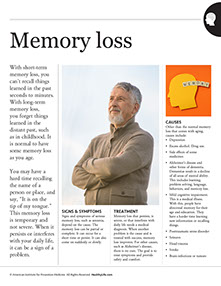
    Dementias are brain diseases. They result in a decline of all areas of mental ability. This includes learning, memory, problem solving, behaviors, and language.

    Signs & Symptoms

    Symptoms of most forms of dementia usually appear slowly over time. However, with a certain form, multi- infarct dementia, the onset of symptoms can be sudden. Symptoms of dementia include:

    *  Poor memory of recent events, etc.

    *  Making up stories to explain memory loss

    *  Getting lost in familiar settings

    *  Not being able to finish tasks

    *  Decreased energy

    *  Social withdrawal or depression

    *  General confusion

    *  Behaviors that are paranoid, anxious, irritating, childlike, or rigid

    *  No interest in personal hygiene, grooming, or dressing oneself

    *  Unclear speech

    Causes & Care

    Primary or True Dementias

    The origin of the dementia is in the brain itself. Examples of this type are:

    *  Alzheimer’s disease. This is the most common type of dementia.

    *  Multi-infarct dementia. This is due to blocked blood vessels in the brain. Often the cause is a stroke.

    *  Parkinson’s disease

    *  Pick’s disease. This is like Alzheimer’s disease, but has different changes in the brain.

    *  Huntington’s disease. This is an inherited disease. Dementia symptoms usually start in middle age. Facial tics and other uncontrolled movements also occur.

    *  Creutzfeldt-Jacob disease. This is caused by a virus that lies dormant in the body for years. When the virus is activated, the dementia progresses quickly.

    *  Multiple sclerosis. With this, scar tissue in the brain can prevent the normal travel of nerve impulses used for mental function. Dementia with multiple sclerosis is rare, though, and may occur with the end stage of this disease.

    Secondary Dementias

    *  Depression

    *  Alcohol problems

    *  Reactions to certain medicines

    *  Poor nutrition. Lack of vitamin B12.

    *  Hypothyroidism

    *  Dehydration

    *  Head injuries

    *  Infections, such as HIV which causes AIDS or syphilis

    *  Brain tumors

    {Note: A recent study found that older Veterans with posttraumatic stress disorder (PTSD) are nearly two times as likely to have dementia than their peers who do not have PTSD.}

    Dementias need medical diagnosis and treatment. When another condition, such as depression, is the cause and is treated with success, the dementia can be cured. For others, such as Alzheimer’s disease, there is no cure. The goal of treatment is to treat symptoms and provide safety and comfort.

    Self-Care

    The person with dementia needs to:

    *  Follow a simple daily routine

    *  Limit activities

    *  Wear an ID tag

    *  Be kept in a safe environment

    *  Have labels put on objects

    *  Eat a well balanced diet and drink plenty of fluids

    *  Have regular sensory stimulation, like touching, exercising, etc.

    Caretakers should:

    *  Assume a non-combative approach to difficult behaviors. Steer the person into another activity.

    *  Give medicines as advised by the person’s doctor and report and review medicines with the doctor and/or pharmacist.

    *  Get home care, respite care, hospital, or nursing home care, if needed.

    When to Seek Medical Care

    Contact Doctor When:

    *  You are unable to care for someone with dementia or he or she is too agitated or hostile to control.

    *  A medical evaluation is needed for a person with symptoms of dementia.

    Get Immediate Care When:

    Any of the “Stroke Warning Signs” are present.

    Delirium

    Delirium is mental confusion, behavior changes, etc. that develop in a matter of hours to a day or so. Delirium is a symptom of another condition, such as:

    *  A high fever

    *  Pneumonia or other infection

    *  Diabetes

    *  Substance abuse or withdrawal

    *  Misuse or withdrawal of certain medicines

    Immediate medical care is needed for delirium so the cause can be found and treated.

    Health at Home Lifetime book by the American Institute for Preventive Medicine. www.HealthyLife.com. All rights reserved.

    © American Institute for Preventive Medicine

  • Dizziness & Vertigo

    Brain & Nervous System

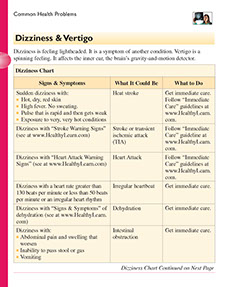
    Dizziness is feeling lightheaded. It is a symptom of another condition. Vertigo is a spinning feeling. It affects the inner ear, the brain’s gravity-and-motion detector.

    Dizziness Conditions

    Heat Stroke

    Signs & Symptoms

    Sudden dizziness with:

    *  Hot, dry, red skin

    *  High fever. No sweating.

    *  Pulse that is rapid and then gets weak

    *  Exposure to very, very hot conditions

    What to Do

    Get immediate care.

    Stroke or Transient Ischemic Attack
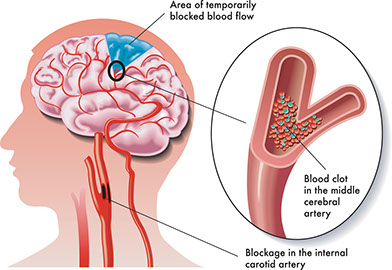
    Illustration on how a stroke is caused.

    Signs & Symptoms

    Dizziness with “Stroke Warning Signs

    What to Do

    Follow “Immediate Care” guideline.

    Heart Attack
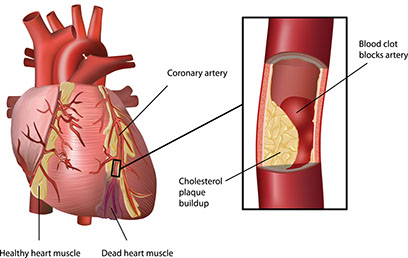
    Illustration of how a heart attack is caused.

    Signs & Symptoms

    Dizziness with “Heart Attack Warning Signs

    What to Do

    Follow “Immediate Care” guidelines

    Irregular Heartbeat

    Signs & Symptoms

    Dizziness with a heart rate greater than 130 beats per minute or less than 50 beats per minute or an irregular heart rhythm

    What to Do

    Get immediate care.

    Dehydration

    Signs & Symptoms

    Dizziness with “Signs & Symptoms” of dehydration

    What to Do

    Get immediate care.

    Intestinal Obstruction

    Signs & Symptoms

    Dizziness with:

    *  Abdominal pain and swelling that worsen

    *  Inability to pass stool or gas

    *  Vomiting

    What to Do

    Get immediate care.

    Dissecting Aortic Aneurysm
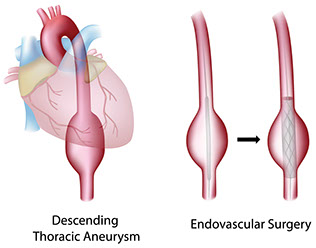
    Illstration of a descending thoracic aneurysm.

    This is a tear in the main artery from the heart.

    Signs & Symptoms

    Dizziness and fainting. Severe chest pain with extreme pain felt across the upper back (not just on one side) that came on within 15 minutes for no apparent reason, such as an injury or back strain. The pain can spread to the abdomen.

    What to Do

    Get immediate care. (Do not take aspirin.)

    Ear Infection

    Signs & Symptoms

    Dizziness with ear pain, ringing in the ear, pus or other ear discharge, fever

    What to Do

    Contact doctor.
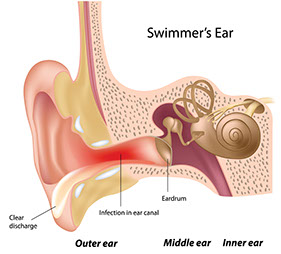
    Illustration of swimmer's ear.

    Labyrnthitis

    This is an inflammation in the ear that usually results from an upper respiratory infection.

    Signs & Symptoms

    Dizziness with:

    *  True spinning sensation

    *  Loss of balance

    *  Nausea and vomiting

    *  Ringing in the ears

    *  Jerky movements of the eye

    What to Do

    Contact doctor.

    Low Blood Sugar

    This can occur in persons taking insulin or oral pills for diabetes and/or after not eating for 4 or more hours.

    Signs & Symptoms

    Dizziness with hunger, sweating, trembling, anxiety, and confusion

    What to Do

    Use self-care.

    Temporary Drop in Blood Pressure (Orthostatic Hypotension)

    This could be a side effect of taking medicines, such as ones for high blood pressure and depression.

    Signs & Symptoms

    Dizziness when getting up too quickly from a seated or lying position

    What to Do

    Use self-care.

    Other Causes of Dizziness:

    *  Alcohol

    *  New medications, antibiotics, or high doses of aspirin

    *  A change in altitude or motion sickness

    *  Sudden movement, such as with turning the head quickly

    *  Seeing fast moving objects Treatment for dizziness depends on the cause.

    Vertigo

    Signs & Symptoms

    *  Wooziness

    *  Sense that the room is spinning

    *  Nausea

    *  Blurred vision

    *  Floating, rocking, and/or rolling feeling

    *  Sense of walking on an uneven surface

    *  Loss of balance

    Causes, Risk Factors & Care

    Vertigo is caused by a problem with the inner ear. Causes of vertigo are:

    *  Benign Positional Vertigo (BPV). This is the most common type. It may happen when you turn over in bed, get up, sit down, bend over, or just tilt your head. The sensations start within seconds of changing positions and last less than a minute. As bothersome as BPV is, it rarely signals more serious disease. Risk factors for BPV are aging, viral infections, and a prior head injury.

    *  Ménière’s disease. This condition may be due to spasms of blood vessels in the inner ear, fluid retention in the inner ear, or allergic reactions. Ménière’s disease is linked with a decrease in hearing and tinnitus. It sometimes leads to permanent hearing loss.

    *  Multiple sclerosis. With this, the covering that protects nerves (myelin) is destroyed. Over time, scar tissue (sclerosis) forms where the myelin used to be in the brain and spinal cord. Scar tissue or inflammation in the brain may cause vertigo symptoms.

    After proper diagnosis, most cases of vertigo are easily treated in the doctor’s office or at home with self-care.

    While attacks of Ménière’s disease can continue for many years, some symptoms can be controlled with medication.

    Self-Care

    For Orthostatic Hypotension:

    *  Don’t jump out of bed. Go from a lying position to a sitting position slowly. Sit on the edge of the bed a few minutes. Stand up slowly.

    *  From a sitting position, stand up slowly. Hold onto the arms of the chair or the head of the bed for support.

    *  If you feel lightheaded, sit back down for a few minutes. Take a few deep breaths. Get up again, slowly.

    For Benign Positional Vertigo (BPV):

    *  Sit on the side of the bed and lean to your right, resting the right ear on the bed. This might make you dizzy and nauseous at first.

    *  Wait 20 seconds until the dizziness stops and sit up straight.

    *  Wait another 20 seconds and repeat steps 1 and 2 on your left side.

    *  Do this exercise 10 to 15 times, 3 times a day.

    For Ménière’s Disease:

    *  Lie still in bed until the dizziness and nausea are gone.

    *  Walk with assistance.

    *  Don’t change positions too fast.

    *  Do not drive, climb ladders, or work around dangerous machinery.

    *  Decrease the amount of salt and fluids in your diet.

    *  Avoid bright lights. Do not read when you have a spinning feeling.

    *  Resume your normal activities when symptoms go away.

    *  Avoid alcohol, caffeine, and tobacco.
    Health at Home Lifetime book by the American Institute for Preventive Medicine. www.HealthyLife.com. All rights reserved.

    © American Institute for Preventive Medicine

  • Headaches

    Brain & Nervous System

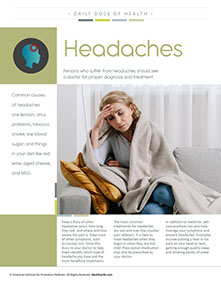
    Women sitting with blanket and holding forehead.

    Persons who suffer from headaches should see a doctor for proper diagnosis and treatment.

    Common causes of headaches are tension, sinus problems, tobacco smoke, low blood sugar, and things in your diet like red wine, aged cheese, and MSG.

    Keep a diary of when headaches occur, how long they last, and where and how severe the pain is. Keep track of other symptoms, such as nausea, too. Show this diary to your doctor to help them identify which type of headache you have and the most beneficial treatments.

    The most common treatments for headaches are rest and over-the-counter pain relievers. It is best to treat headaches when they begin or when they are still mild. Prescription medication may also be prescribed by your doctor.

    In addition to medicine, self-care practices can also help manage your symptoms and prevent headaches. Examples include putting a heat or ice pack on your head or neck, getting enough quality sleep, and drinking plenty of water.

    Health at Home Lifetime book by the American Institute for Preventive Medicine. www.HealthyLife.com. All rights reserved.

    © American Institute for Preventive Medicine
  • Learn For Brain Health

    Brain & Nervous System

    Illustration of person standing with arms open holding large puzzle piece with brain.

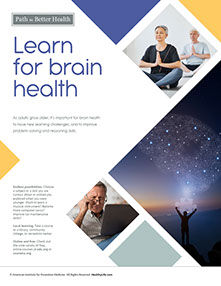
    As adults grow older, it’s important for brain health to have new learning challenges, and to improve problem-solving and reasoning skills.

    Endless possibilities: Choose a subject or a skill you are curious about or wished you explored when you were younger. Want to learn a musical instrument? Become more computer-savvy? Improve car maintenance skills?

    Local learning: Take a course at a library, community college, or recreation center.

    Online and free: Check out the wide variety of free, online courses atedx.orgorcoursera.org.

    Health at Home Lifetime book by the American Institute for Preventive Medicine. www.HealthyLife.com. All rights reserved.

    © American Institute for Preventive Medicine