Category: Eye Conditions

  • Eye Health At Work

    Eye Conditions

    Man wearing protective eye and hearing gear while using machinery.

    Follow your workplace’s safety rules to protect your eyes. Wear safety glasses, goggles, face shields, etc. Keep your safety eyewear clean and in good condition.

    More than 700,000 persons in the U.S. have eye injuries at work a year. Most of these could have been prevented.

    Find out if and what type of eyewear is required for your job. Ask loved ones if they wear required safety eyewear at work.

    Persons who walk through work areas that have eye hazard areas need to wear protective eyewear.

    When you visit a worksite that poses a risk of eye injuries, ask for protective eyewear if it is not provided.

    Glasses and contact lenses used for other activities may not be effective when working with computer screens.

    Let your eye doctor know if you work at a computer so they can prescribe the proper eyewear for you to use.

    Health at Home Lifetime book by the American Institute for Preventive Medicine. www.HealthyLife.com. All rights reserved.

    © American Institute for Preventive Medicine

  • Eyestrain From Computer Use

    Eye Conditions

    Persons who use computer video display terminals (VDTs) at work and/or at home may notice eyestrain.

    Signs & Symptoms

    *  Eye discomfort or irritation. This includes dry, red, and/or watery eyes.

    *  Eye fatigue.

    *  Having a hard time focusing.

    *  Back pain, shoulder pain, and headaches may also occur.

    Causes

    The cause of eyestrain is most likely from conditions that surround the VDT, not the VDT itself. These include improper positioning of the VDT and supplies, poor lighting, and/or poor posture.

    A pre-existing eye problem may also be the cause.

    Treatment

    Self-care measures prevent and treat eyestrain when using VDTs.

    Questions to Ask

    Self-Care / Prevention

    *  Place the screen so that your line of sight is 10 to 15 degrees (about one-third of a 45-degree angle) below horizontal.

    *  Position the VDT screen about 2 feet away from your eyes. This is a little farther away than normal reading distance.

    *  Dust the screen often.

    *  Reduce glare. Place the VDT at right angles to a window. Turn off or shield overhead lights. Wear a visor to block them, if needed.

    *  Place your paperwork close enough that you don’t have to keep refocusing when switching from the screen to the paper. Use a paper document holder placed at the same height as the VDT screen.

    *  Blink often to keep your eyes from getting dry. Use “artificial tear” eyedrops, if needed.

    *  Tell your eye specialist that you use a VDT. Glasses and contacts worn for other activities may not be good for VDT work. With bifocals, the near-vision part of the lens is good for looking down, as when you read, but not for looking straight ahead, as when you look at a video display screen. You may need single-vision lenses for VDT work.

    *  If the image on the VDT screen is blurred, dull, or flickers, have it serviced right away.

    Resources

    Prevent Blindness America

    www.preventblindness.org

    Healthier at Home book by the American Institute for Preventive Medicine. www.HealthyLife.com. All rights reserved.

    © American Institute for Preventive Medicine

  • Floaters & Flashes

    Eye Conditions

    Signs & Symptoms

    *  Floaters are specks, dots, cobwebs, or wavy lines that seem to fall within the line of sight. They rarely affect eyesight. They are more visible against a plain or dark background.

    *  Flashes are streaks of light that “flash” across the field of vision. They can occur when the eyes are closed or in extreme darkness.

    Causes

    With aging, the middle portion of the eye, called the vitreous, becomes less solid and more liquid. This allows particles (floaters), which have always been in the eye, to begin to move around. Flashes can occur when the vitreous shrinks and pulls on the retina of the eye. This is common. On rare occasions, when the vitreous detaches from the retina, it can rip or tear the retina. This may lead to a detached retina. The retina peels away from the eye wall causing sight loss.

    Risk Factors for Floaters and Flashes

    *  Eye diseases or injuries.

    *  A tear in the retina. Aging and cataract surgery increase the risk for this.

    *  High blood pressure.

    *  Migraine headaches.

    *  Nearsightedness.

    Treatment

    Self-care is enough to treat floaters and flashes unless they are due to another medical condition.

    Questions to Ask

    Self-Care / Prevention

    *  Move your eyes up and down (not side to side) several times.

    *  Don’t focus on or stare at plain, light backgrounds, such as a blank pastel wall or the light blue sky.

    *  You may notice flashes less if you avoid moving suddenly, don’t bend over, and don’t get up quickly from sitting or lying down.

    Healthier at Home book by the American Institute for Preventive Medicine. www.HealthyLife.com. All rights reserved.

    © American Institute for Preventive Medicine

  • Glaucoma

    Eye Conditions

    Glaucoma is a group of eye diseases that damages the optic nerve and causes vision loss.

    Signs & Symptoms

    For Chronic (Open-Angle) Glaucoma

    This type takes place gradually, and causes no symptoms early on. Loss of side (peripheral) vision and blurred vision are the first signs.

    Later, symptoms include:

    *  Vision loss in side and central vision, usually in both eyes.

    *  Blind spots. Seeing halos around lights.

    *  Poor night vision.

    *  Blindness, if not treated early.

    For Acute (Angle-Closure) Glaucoma

    This type is a medical emergency! These symptoms occur suddenly:

    *  Severe eye pain and nausea.

    *  Blurred vision. Seeing halos around lights.

    *  Redness in the eye. Swollen upper eyelid.

    *  Severe headache that throbs.

    Causes

    Glaucoma occurs when the pressure of the liquid in the eye gets too high and causes damage to the optic nerve. Increased eye pressure without damage is not glaucoma, but increases the risk for it. Antihistamines and long-term corticosteroid use can trigger or worsen glaucoma.

    Risk Factors for Glaucoma

    *  Being over age 60, especially Mexican Americans.

    *  Being African American over age 40.

    *  Having a family history of glaucoma.

    *  Having diabetes.

    *  Being nearsighted.

    Treatment

    Treatments help with current vision. They do not improve sight already lost from glaucoma. Glaucoma may not be preventable, but the blindness that could result from it is. Get tested for glaucoma when you get regular vision exams. If pressure inside the eyeball is high, an eye doctor will prescribe treatment. This includes:

    Medicines used for acute glaucoma are prescribed for life. If medicines do not control the pressure, your doctor may advise:

    *  Laser beam surgery.

    *  Surgery that drains fluid from the eye.

    *  Medicines. These are the most common early form of treatment.

    – Prescribed eye drops or pills lower eye pressure, cause the eye to make less fluid, or help drain fluid from the eye.

    – Take medicines on a regular basis.

    – Let your eye doctor know of side effects.

    Questions to Ask

    Self-Care / Prevention

    *  Don’t smoke. If you smoke, quit.

    *  Do not take any medicine, including over-the-counter ones, without first checking with your doctor or pharmacist. Most cold medications and sleeping pills, for example, can cause the pupil in the eye to dilate. This can lead to increased eye pressure.

    *  If prescribed eye drops for glaucoma, use them as directed.

    *  Ask your eye doctor about low vision services and devices.

    *  Try not to get upset and fatigued. These can increase pressure in the eye.

    Resources

    National Eye Institute (NEI)

    www.nei.nih.gov

    Healthier at Home book by the American Institute for Preventive Medicine. www.HealthyLife.com. All rights reserved.

    © American Institute for Preventive Medicine

  • Eye Irritations & Injuries

    Eye Conditions

    As you age, your eyes can get irritated more easily because they make less tears. Poorer vision increases the risk for eye injuries.

    Signs & Symptoms

    You feel burning, dryness, itching, and/or pain and swelling in one or both eyes.

    Causes

    For Eye Irritation:

    Causes include particles in the eye; too much sun exposure, low humidity; strong wind; and scratches from contact lenses. Other causes are allergies, infections, and conditions that make your eyes dry.

    For Eye Injuries:

    Causes include a physical blow to the eye; harsh chemicals; and a foreign body that is stuck in the eye.

    Mild eye irritations and injuries can be treated with self-care. More serious problems need medical care.

    Treatment

    *  Wear safety glasses for activities that expose your eyes to sawdust, etc.

    *  When using harsh chemicals, wear rubber gloves and protective glasses. Don’t rub your eyes if you’ve touched harsh chemicals. Turn your head away from chemical vapors.

    *  To help prevent dry eyes, use a humidifier and limit exposure to smoke, dust, and wind. Avoid alcohol.

    *  Use artificial tear drops with your doctor’s okay.

    *  Don’t stare directly at the sun, especially during a solar eclipse.

    *  Wear sunglasses that block UV rays.

    *  Don’t use eye makeup when an allergy or chemical irritant bothers your eye(s).

    Self-Care / Prevention

    To Ease the Discomfort of Dry Eyes:

    With your doctor’s okay, use over-the-counter artificial tear drops, such as Ocu-Lube. Read the label. Refrigerate the solution, if needed. Wash your hands before using.

    To Treat an Insect Bite Without a Severe Allergic Reaction:

    *  Wash the eye(s) with warm water.

    *  Take an antihistamine if okay with your doctor.

    To Remove a Foreign Particle On the White of the Eye or Inside the Eyelids:

    *  Do not remove an object imbedded in the eye, a metal chip, or a foreign body over the colored part of the eye. (See “First Aid for Foreign Body Sticking Into the Eye” on this page.)

    *  Wash your hands.

    *  If the foreign object is under the upper lid, have the person look down and pull the upper lid away from the eyeball by gently grabbing the eyelashes. Press a cotton-tipped swab down on the skin surface of the upper eyelid and pull it up and toward the brow. The upper lid will invert. Touch and remove the debris with the tip of the tissue.

    *  Twist a piece of tissue, moisten the tip with tap water (not saliva) and gently try to touch the speck with the tip. Carefully pass the tissue over the speck, which should cling to the tip.

    *  Do not rub the eye or use tweezers or anything sharp to remove a foreign object.

    *  Gently wash the eye with cool water.

    To Treat a Bruise from a Minor Injury that Surrounds the Eye but Does Not Damage the Eye Itself:

    *  Put a cold compress over the injured area right away. Keep doing this for 15 minutes, every hour, for 48 hours.

    *  Take an over-the-counter medicine

    *  After 48 hours, put a warm compress over the injured area.

    *  Seek medical attention if these measures do not help.

    First Aid for Foreign Body Sticking Into the Eye Before Immediate Care:

    *  Do not remove the object.

    *  Don’t press on, touch, or rub the eye.

    *  Cover the injured eye with a paper cup or other clean object that will not touch the eye or the foreign object. Hold the paper cup in place with tape without putting pressure on the eye or the foreign object.

    *  Gently cover the uninjured eye with a clean bandage and tape, too, to keep the injured eye still.

    First Aid for Harmful Chemicals in the Eye(s) Before Immediate Care:

    *  Flush the eye(s) with water immediately!

    *  Hold the injured eye open with your thumb and forefinger.

    *  At the faucet or with a pitcher or other clean container, flush the eye with a lot of water. Start at the inside corner and pour downward to the outside corner. This lets the water drain away from the body and keeps it from getting in the other eye.

    *  Keep pouring the water for 10 to 30 or more minutes. Flush the eye with water until you get medical help.

    *  If both eyes are injured, pour water over both eyes at the same time or quickly alternate the above procedure from one eye to another. Or, place the victim’s face in a sink or container filled with water. Tell the victim to move his or her eyelids up and down and remove the face from the water at intervals in order to breathe. Use this method on yourself if you are the victim and are alone.

    *  Loosely bandage the eye with sterile cloth and tape. Don’t touch the eye.

    When to Seek Medical Care

    Contact Doctor When:

    You have any of these problems:

    *  Eye pain with eye irritation

    *  An eye that is red and/or swollen

    *  Yellow-green pus is under the eyelid or drains from the eye.

    Get Immediate Care When:

    *  Harmful chemicals have gotten into the eye(s). {Note: Before you get immediate care, give “First Aid for Harmful Chemicals in the Eye(s) Before Immediate Care” on this page.}

    *  A foreign body sticks into the eye. {Note: See “First Aid for Foreign Body Sticking Into the Eye Before Immediate Care” on this page.}

    *  A cut to the eye or eyelid occurs.

    *  Any of these problems occurs with a blow to the eye or other eye injury:

    – Loss of vision

    – Blurred or double vision

    – Blood in the pupil
    Healthier at Home book by the American Institute for Preventive Medicine. www.HealthyLife.com. All rights reserved.

    © American Institute for Preventive Medicine

  • Macular Degeneration

    Eye Conditions

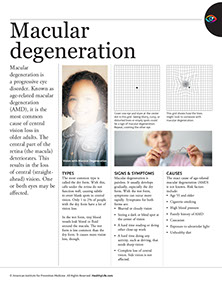
    Macular degeneration is a progressive eye disorder. Known as age-related macular degeneration (AMD), it is the most common cause of central vision loss in older Americans. The central part of the retina (the macula) deteriorates. This results in the loss of central (straight-ahead) vision. One or both eyes may be affected. The most common type is called the dry form. With this, cells under the retina do not function well, causing subtle to overt blank spots in central vision. Only 1 to 2% of people with the dry form have a lot of vision loss. In the wet form, tiny blood vessels leak blood or fluid around the macula. The wet form is less common than the dry form. It causes more vision loss, though.

    Signs & Symptoms

    Macular degeneration is painless. It usually develops gradually, especially the dry form. With the wet form, symptoms can occur more rapidly. Symptoms for both forms are:

    *  Blurred or cloudy vision.

    *  Seeing a dark or blind spot at the center of vision.

    *  A hard time reading or doing other close-up work.

    *  A hard time doing any activity, such as driving, that needs sharp vision.

    *  Complete loss of central vision. Side vision is not affected.

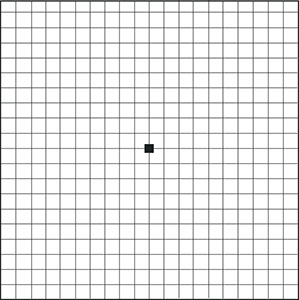
    Cover one eye and stare at the center dot in this grid. Seeing blurry, curvy, or distorted lines or empty spots could be a sign of macular degeneration. Repeat, covering the other eye.

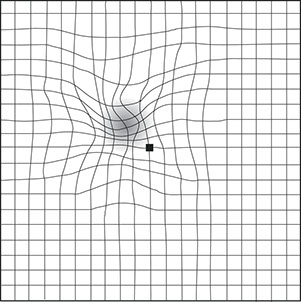
    This grid shows how the lines might look to someone with macular degeneration.

    Causes

    The exact cause of age-related macular degeneration (AMD) is not known. Risk factors are:

    *  Advancing age.

    *  Cigarette smoking. High blood pressure.

    *  Family history of AMD.

    *  Having light-colored eyes.

    *  Exposure to ultraviolet light.

    *  Poor diet.

    Treatment

    Treatment for the wet form includes photodynamic therapy and laser therapy. Medicine called “anti-VEGF therapy” can also be given. Most dry form cases are not treatable. Your eye doctor may prescribe special eyeglasses and low vision aids. He or she may also prescribe a specific high dose vitamin and mineral to reduce the risk of advanced AMD.

    Questions to Ask

    Self-Care / Prevention

    To Reduce the Risk for AMD

    *  Don’t smoke. If you smoke, quit.

    *  Follow a healthy diet. Include green leafy vegetables and fish.

    *  Protect your eyes from the sun’s ultraviolet rays. Wear sunglasses with UV block. Wear a hat with a wide brim.

    *  Use Self-Care / Prevention measures to control high blood pressure and heart disease.

    To Treat AMD

    *  Wear the special eyeglasses and use other vision aids, such as magnifying devices, as advised by your doctor.

    *  Talk to your doctor before taking vitamin and mineral supplements.

    Resources

    Macular Degeneration Foundation

    www.eyesight.org

    National Eye Institute (NEI)

    www.nei.nih.gov

    Healthier at Home book by the American Institute for Preventive Medicine. www.HealthyLife.com. All rights reserved.

    © American Institute for Preventive Medicine