Category: First Aid

  • Eye Injuries & Irritation

    First Aid

    Signs & Symptoms

    Signs and symptoms depend on the cause. Common symptoms are:

    *  Pain and/or swelling in or around the eye(s).

    *  The eyes burn, are dry, and/or itch.

    Causes

    For Eye Injuries

    *  A physical blow to the eye.

    *  Harsh chemicals.

    *  A foreign body is stuck in the eye.

    For Eye Irritation

    *  Particles in the eye.

    *  Too much sun exposure.

    *  Low humidity.

    *  Strong wind.

    *  Scratches from contact lenses.

    Other causes are allergies, infections, and conditions that make the eyes dry. With aging, the eyes can get irritated more easily because they make less tears.

    Treatment

    Mild eye irritations and injuries can be treated with self-care. More serious problems need medical care.

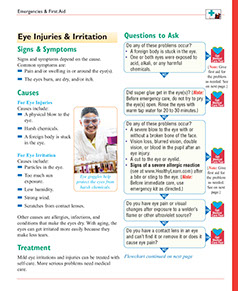
    Questions to Ask

    Self-Care / Prevention

    For a Foreign Body Sticking Into the Eye

    *  Do not remove the object.

    *  Don’t press on, touch, or rub the eye.

    *  Cover the injured eye with a clean object, such as a paper cup that will shield, but not touch the eye or the foreign object. Use tape to hold the cup in place without putting pressure on the eye or the foreign object.

    *  Gently cover the uninjured eye with a clean bandage and tape, too. This helps to keep the injured eye still. Get Immediate Care!

    For Harmful Chemicals in the Eye(s)

    *  Flush the eye(s) with water immediately!

    *  Hold the injured eye open with your thumb and forefinger. At the faucet or with a pitcher or other clean container, flush the eye with a lot of water. Start at the inside corner and pour downward to the outside corner. This lets the water drain away from the body and keeps it from getting in the other eye.

    *  Keep pouring the water for 10 to 30 or more minutes. Flush the eye with water until you get medical help.

    *  If both eyes are injured, pour water over both eyes at the same time. Or, flush one eye at a time with water. Switch back and forth quickly to treat both eyes. Or, place the face in a sink or container filled with water. Tell the person to move his or her eyelids up and down and remove the face from the water to take breaths. Use this method if chemicals get in your eyes and you are alone.

    *  Loosely bandage the eye with sterile cloth and tape. Don’t touch the eye. Get Medical Care Right Away!

    For a Bruise from a Minor Injury that Surrounds the Eye, But Does Not Damage the Eye Itself

    *  Put a cold compress over the injured area right away. Do this for 15 minutes, every hour, for 48 hours.

    *  Take an over-the-counter medicine for the pain and swelling.

    *  After 48 hours, put a warm compress over the injured area.

    *  Seek medical care if these measures do not help.

    To Remove a Foreign Particle On the White of the Eye or Inside the Eyelids

    *  Do not remove an object stuck in the eye, a metal chip, or a foreign body over the colored part of the eye.

    *  Wash your hands.

    *  If the foreign object is under the upper lid, look down and pull the upper lid away from the eyeball by gently grabbing the eyelashes. Press a cotton-tipped swab down on the skin surface of the upper eyelid and pull it up and toward the brow. The upper lid will invert.

    *  Twist a piece of tissue. Moisten the tip with tap water (not saliva). Gently try to touch the speck with the tip. Carefully pass the tissue over the speck which should cling to the tip.

    *  Do not rub the eye or use tweezers or anything sharp to remove a foreign object.

    *  Gently wash the eye with cool water.

    For Dry, Irritated Eyes

    With your doctor’s okay, use over-the-counter artificial tear drops, such as Ocu-Lube. Refrigerate the solution, if needed. Wash your hands before using.

    For an Insect Bite Without a Severe Allergic Reaction

    *  Wash the eye(s) with warm water.

    *  Take an antihistamine if okay with your doctor.

    Prevention

    *  Wear safety glasses when your eyes are exposed to sawdust, etc. Wear sunglasses that block UV rays.

    *  When using harsh chemicals, wear rubber gloves and protective glasses. Don’t rub your eyes if you’ve touched harsh chemicals. Turn your head away from chemical vapors.

    *  To help prevent dry eyes, use a humidifier. Limit exposure to smoke, dust, and wind. Don’t drink alcohol.

    *  Use artificial tear drops with your doctor’s okay.

    *  Don’t stare directly at the sun, especially during a solar eclipse.

    *  Don’t use eye makeup when an allergy or chemical irritant bothers your eye(s).

    *  Don’t allow a child to stick his or her head out of the window of a moving car, etc. Sand, insects, and other flying objects can strike the eye and irritate or damage the cornea.

    *  Don’t let children play with or near sparklers, bottle rockets, and other fireworks.
    Healthier at Home book by the American Institute for Preventive Medicine. www.HealthyLife.com. All rights reserved.

    © American Institute for Preventive Medicine
  • Learn Cpr. It Could Help Save A Life!

    First Aid

    An image of a class learning CPR.

    Knowing how to perform cardiopulmonary resuscitation (CPR) can mean the difference between life and death. CPR can restore the flow of oxygen to the brain if the heart has stopped beating due to heart attack, drowning, electrical shock, suffocation, or a drug overdose. Learn to perform CPR correctly. Take a CPR training course to learn:

    *  How to contact emergency medical help.

    *  How to use an automated external defribrillator (AED).

    *  How to give rescue breaths, compress the person’s chest and when and how to do chest-compression only CPR. (It is important to push hard and push fast, giving 100 compressions a minute in cycles of 30 compressions for every 2 breaths.) {Note: Guidelines for CPR may change. Get updates for CPR and find out where you can learn how to perform it from the American Heart Association atwww.americanheart.org.}

    You can also call your local chapter of the Red Cross or your local hospital to find out where you can learn CPR.

    A Year of Health Hints book by the American Institute for Preventive Medicine. www.HealthyLife.com. All rights reserved.

    © American Institute for Preventive Medicine
  • Fainting & Unconsciousness

    First Aid

    Signs & Symptoms

    Fainting is a brief loss of consciousness. It can last from seconds to 30 minutes. Just before fainting, a person may feel a sense of dread, feel dizzy, see spots, and have nausea.

    If a person falls and can’t remember the fall itself, he or she has fainted.

    An unconscious person is hard to rouse and can’t be made aware of his or her surroundings. The person is unable to move on his or her own.

    Causes

    Fainting is due to a sudden drop in blood flow or glucose supply to the brain. This causes a temporary drop in blood pressure and pulse rate. Medical reasons for this include:

    *  Low blood sugar (hypoglycemia). This can occur in diabetics, in early pregnancy, in persons on severe diets, etc.

    *  Anemia. Eating disorders.

    *  Conditions which cause rapid loss of blood.

    *  Abnormal heart rhythm. Heart attack. Stroke.

    *  Head injury. Heat stroke. Heat exhaustion.

    Other things that can lead to feeling faint or fainting include:

    *  A sudden change in body position like standing up too fast. This is called postural hypotension.

    *  A side effect of some medicines. Drinking too much alcohol.

    *  Anxiety or sudden emotional stress or fright.

    *  Being in hot, humid weather or in a stuffy room. Standing a long time in one place.

    *  Extreme pain.

    Treatment

    Treatment depends on the cause.

    Questions to Ask

    Self-Care / Prevention

    For Unconsciousness

    *  Check for a response. Call 9-1-1! Give Rescue Breaths and CPR, or treat for Shock, as needed.

    *  Check for a medical alert tag or information. Call the emergency number if there is one. Follow instructions given.

    *  Don’t give the person anything to eat or drink, not even water.

    For Fainting

    *  Catch the person before he or she falls.

    *  Lie the person down with the head below heart level. Raise the legs 8 to 12 inches to promote blood flow to the brain. If the person can’t lie down, have him or her sit down, bend forward, and put the head between the knees.

    *  Loosen any tight clothing.

    *  Don’t slap or shake a person. Don’t give anything to eat or drink.

    *  Check for a medical alert tag. Respond as needed.

    To Reduce the Risk of Fainting

    *  Follow your doctor’s advice to treat any medical problem which may lead to fainting. Take medicines as prescribed. Let the doctor know about any side effects.

    *  Get up slowly from bed or from a chair.

    *  Avoid turning your head suddenly.

    *  Wear loose-fitting clothing around the neck.

    *  Don’t exercise too much when it is hot and humid. Drink a lot of fluids when you exercise.

    *  Avoid stuffy rooms and hot, humid places. When you can’t do this, use a fan.

    *  If you drink alcohol, do so in moderation.

    For a Low Blood Sugar Reaction

    *  Have a sugar source, such as: One half cup of fruit juice or regular (not diet) soda; 6 to 7 regular (not sugar free) hard candies; 3 glucose tablets; or 6 to 8 ounces of milk.

    *  If you don’t feel better after 15 minutes, take the same amount of sugar source again. If you don’t feel better after the second dose, call your doctor.

    Healthier at Home book by the American Institute for Preventive Medicine. www.HealthyLife.com. All rights reserved.

    © American Institute for Preventive Medicine
  • Near-Drowning

    First Aid

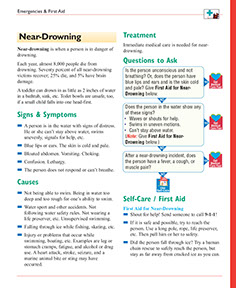
    Near-drowning is when a person is in danger of drowning. Each year, almost 8,000 people die from drowning. Seventy percent of all near-drowning victims recover; 25% die, and 5% have brain damage.

    A toddler can drown in as little as 2 inches of water in a bathtub, sink, etc. Toilet bowls are unsafe, too, if a small child falls into one head-first.

    Signs & Symptoms

    *  A person is in the water with signs of distress. He or she can’t stay above water, swims unevenly, signals for help, etc.

    *  Blue lips or ears. The skin is cold and pale.

    *  Bloated abdomen. Vomiting. Choking.

    *  Confusion. Lethargy.

    *  The person does not respond or can’t breathe.

    Causes

    *  Not being able to swim. Being in water too deep and too rough for one’s ability to swim.

    *  Water sport and other accidents. Not following water safety rules. Not wearing a life preserver, etc. Unsupervised swimming.

    *  Falling through ice while fishing, skating, etc.

    *  Injury or problems that occur while swimming, boating, etc. Examples are leg or stomach cramps, fatigue, and alcohol or drug use. A heart attack, stroke, seizure, and a marine animal bite or sting may have occurred.

    Prevention

    For Children

    *  Never leave an infant or child alone in any type of bathtub. Supervise young children in the bathroom.

    *  Never leave a child alone near water, swimming pools, etc. Lock gates to keep children from getting near swimming pools.

    *  Have a phone near outdoor pools, etc.

    *  Teach children to swim. Tell them not to swim alone and not to swim too far from shore without a lifeguard or other adult swimmer.

    *  Put a personal floatation device on each child when near the water or on a boat.

    *  Tell children to check the depth of water before diving in. It should be at least 9 feet deep.

    *  Do not allow children to go on untested ice.

    *  Take CPR and water safety courses.

    For Adults

    *  Learn to swim. Never swim alone at the beach or in a swimming pool. A lifeguard or other adult swimmer should be nearby in case you suffer a leg cramp or other problem.

    *  Wear a personal floatation device when you are on a boat, when you fish, etc.

    *  Check the depth of the water before diving in. It should be at least 9 feet deep. Never dive into an above-ground pool.

    *  Do not use a hot tub or jacuzzi if you’ve had any alcoholic drinks. You could fall asleep, slip under the surface, and drown.

    *  Take CPR and water safety courses.

    Questions to Ask

    Self-Care / First Aid

    First Aid for Near-Drowning

    *  Shout for help! Send someone to call 9-1-1!

    *  If it is safe and possible, try to reach the person. Use a long pole, rope, life preserver, etc. Then pull him or her to safety.

    *  Did the person fall through ice? Try a human chain rescue to safely reach the person, but stay as far away from cracked ice as you can.

    *  If you must swim to the person, be sure you are strong and capable enough. Take a flotation device with you. Approach the person from behind in a calm manner. Grab a piece of the person’s clothing. Or, cup one hand under the person’s chin.

    *  When getting the person out of the water, support the head and neck. (Suspect a neck injury, especially with diving or water sports.)

    *  CHECK for a response. Give Rescue Breaths and CPR, as needed. If you suspect a spinal injury, use jaw thrust instead of chin-lift for rescue breaths.

    *  Once out of the water, keep checking the person for a response. Give first aid, as needed.

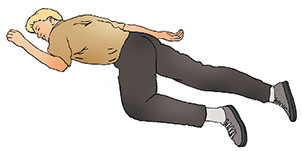
    *  Put the person in the Recovery Position. Immobilize the person as much as possible. If the person is vomiting, clear his or her mouth of it.

    *  Remove cold, wet clothes. Cover the person with a blanket, etc.

    Healthier at Home book by the American Institute for Preventive Medicine. www.HealthyLife.com. All rights reserved.

    © American Institute for Preventive Medicine
  • Fire & Burn Awareness

    First Aid

    Dental hygiene products, tooth brush, tooth paste, mouth wash, etc.

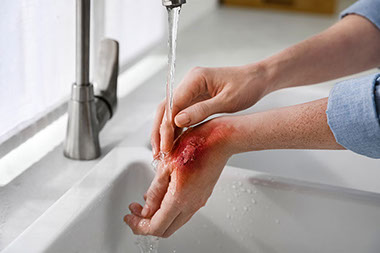
    Fires & burns are a leading cause of unintended home injuries & related deaths.

    Every home should have at least one fire extinguisher mounted securely and in plain sight.

    Install smoke detectors. If you use space heaters, keep them 3 feet away from items that can catch fire. Never smoke in bed.

    Loose-fitting clothing can easily catch on fire if it gets too close to burning candles or hot burners.

    If your clothes catch on fire, don’t run. Motion fans the flames. STOP where you are. DROP to the ground. ROLL back and forth, again and again, until the flames go out.

    To use a fire extinguisher, think of the acronym PASS:

    Pull the pin. Aim the nozzle or barrel at the base of the fire, not at the flames. Squeeze the handle. Sweep back and forth at the base of the fire.

    Health at Home Lifetime book by the American Institute for Preventive Medicine. www.HealthyLife.com. All rights reserved.

    © American Institute for Preventive Medicine
  • Objects In The Ear Or Nose

    First Aid

    A foreign object stuck in an ear or the nose needs to be removed. If not, an infection could result. Damage to structures in the nose or ear could also occur.

    Signs & Symptoms

    A child may be able to tell if an object was put in a nostril or an ear and didn’t come out. If not, signs and symptoms can help identify this problem.

    For an Object Stuck in an Ear

    *  Feeling of fullness in the ear.

    *  Ear pain or discomfort.

    *  Hearing loss and/or feeling dizzy.

    *  Foul odor from the ear and/or drainage from the ear.

    *  Bleeding from an ear.

    For an Object Stuck in the Nose

    *  Constant nasal discharge from one nostril.

    *  Foul odor. Pus or blood drains from a nostril.

    *  Pain, swelling, and/or tenderness.

    Causes

    *  An object or substance is placed in the ear or nose on purpose and won’t come out.

    *  Objects get stuck in the nose or ear by injury or by accident.

    *  An insect flies or crawls into an ear.

    Treatment

    Medical care is needed for foreign objects that can’t be removed with self-care. After an object is removed, an antibiotic may be needed if an infection is present. Small, button-sized batteries need to be removed to prevent burns.

    Questions to Ask

    Self-Care / Prevention

    To Remove an Insect from an Ear

    *  Kill the insect before you try to remove it. To do this, tilt the person’s head to put the ear with the insect in an upward position. Pour warm (not hot) mineral, olive, or baby oil into the ear. As you pour the oil, straighten the ear canal. In a child, pull the earlobe gently backward and downward; backward and upward in an adult.

    *  The goal is to suffocate the insect and cause it to float out.

    To Remove Objects Other Than Insects

    *  Don’t use oil.

    *  Tilt the head toward the side with the foreign object. Gently shake the head toward the floor to try to get the object out. Do not shake a baby. Gently pull the ear up and back.

    *  Don’t use a sharp tool, cotton swab, etc., to try to locate and remove the object. This risks pushing the object farther into the ear. Doing this could damage the middle ear.

    *  Remove the object with blunt tweezers if it is easily seen and can be grasped and pulled out.

    To Remove Objects in the Nose

    *  Don’t use a sharp tool, cotton swab, etc., to try to locate and remove the object.

    *  Breathe through the mouth until the object is removed.

    *  Apply gentle pressure to close the other nostril and gently try to blow the object out.

    *  Remove the object with blunt tweezers, if it is easily seen and can be grasped and pulled out.

    Healthier at Home book by the American Institute for Preventive Medicine. www.HealthyLife.com. All rights reserved.

    © American Institute for Preventive Medicine

  • First Aid Checklist

    First Aid

    Keep basic tools handy for those little emergencies.

    Mom’s kisses are great, but some boo-boos need a little more care to keep infections away. A well-stocked first-aid kit may be all you need for life’s little emergencies. Keep one at home, but out of the reach of children. Store a second one in the car. And if you hike, camp, or bike, take a kit with you.

    First-aid kit items:

    The first-aid kit should have a first-aid guide that includes step-by-step instructions for each item.

    *  Acetaminophen, aspirin, or ibuprofen

    *  Adhesive bandages of different sizes. Sterile gauze pads, a roll of gauze, and tape.

    *  Antibiotic ointment or spray. Antiseptic ointment or wipes.

    *  Antihistamine tablets or syrup

    *  Calibrated medicine spoon and dropper

    *  Cold pack

    *  Cotton-tipped swabs

    *  Elastic wrap and closures

    *  Flashlight and extra batteries

    *  Hydrocortisone ointment

    *  Scissors

    *  Sunscreen (SPF 15 or higher)

    *  Tweezers

    Extra items for a car or boat:

    *  Clean, folded sheet and blanket

    *  Large flashlight. Extra batteries. Rope. Flares.

    *  Protective clothing and footwear

    *  Plastic bottle of water, tightly capped

    Learn how to handle common injuries & wounds:

    *  Rinse cuts and scrapes with cool water.

    *  To stop bleeding, apply firm but gentle pressure, using gauze. If blood soaks through it, add more gauze, keeping the first layer in place. Keep applying pressure until the bleeding stops.

    *  Do the Heimlich maneuver for people who are choking.

    *  Know CPR basics to help someone who collapsed due to cardiac arrest.

    Action Step

    Take a basic first-aid course for hands-on practice in giving first aid and CPR. Check with your local Red Cross, police and/or fire department to find locations and dates.

    Ways to Well-Being book by the American Institute for Preventive Medicine. www.HealthyLife.com. All rights reserved.

    © American Institute for Preventive Medicine
  • Poisoning

    First Aid

    Concept image of smoke forming a skull.

    Poisons are harmful substances that are swallowed, inhaled, or that come in contact with the skin. Each year about 10 million poisonings occur; 80% of them are in children under five years old.

    Signs & Symptoms

    Signs and symptoms depend on the substance. They include a skin rash, upset stomach, and more severe problems. Some poisons can cause death.

    Causes

    Things Not Meant to Be Swallowed or Inhaled

    *  Household cleaners, such as bleach, drain cleaners, ammonia, and lye.

    *  Insecticides. Rat poison.

    *  Gasoline. Antifreeze. Oil. Lighter fluid. Paint thinner.

    *  Lead.

    *  Airplane glue. Formaldehyde.

    *  Rubbing alcohol. Iodine. Hair dye. Mouthwash. Mothballs.

    *  Some indoor and outdoor plants.

    *  Carbon monoxide. This has no color, odor, or taste.

    Things That Are Poisonous in Harmful Amounts

    *  Alcohol. Drugs. Over-the-counter and prescribed medicines.

    *  Medicinal herbs.

    *  Vitamins and minerals. Iron in these can be deadly to a small child.

    Treatment

    Treatment depends on the poison and its effects. Information to give the Poison Control Center, emergency department, etc.:

    *  The name of the substance taken.

    *  The amount and when it was taken.

    *  A list of ingredients on the label.

    *  Age, gender, and weight of the person who took the poison. How the person is feeling and reacting. Any medical problems the person has.

    Prevention

    *  Buy household products, vitamins, and medicines in child-resistant packaging. Keep these and all poisons out of children’s reach.

    *  Put child-resistant latches on cabinet doors. Follow instructions for use and storage of pesticides, household cleaners, and other poisons.

    *  Keep products in original containers. Don’t transfer them to soft drink bottles, plastic jugs, etc.

    *  Teach children not to take medicine and vitamins unless an adult gives it to them. Don’t call these “candy” in front of a child.

    *  Wear protective clothing, masks, etc., when using chemicals that could cause harm if inhaled or absorbed by the skin.

    *  Install carbon monoxide detectors in your home and garage.

    Questions to Ask

    Self-Care / First Aid

    For Swallowed Poisons

    1.  If the person is unconscious, shout for help. Call 9-1-1!

    2.  For a conscious person, call the Poison Control Center (800.222.1222). Follow instructions. Do not give Syrup of Ipecac to induce vomiting unless the Poison Control Center tells you to. {Note: The American Academy of Pediatrics recommends that parents don’t give Syrup of Ipecac to children.}

    3.  Lay the person on his or her left side to keep the windpipe clear, especially if the person vomited. Keep a sample of the vomit and the poison container.

    For Inhaled Poisons

    1.  Protect yourself. Move the person to fresh air (outdoors if you can). Try not to breathe the fumes yourself.

    2.  Follow steps 1 and 2 above for Swallowed Poisons. Get medical care.

    For Chemical Poisons on Skin

    1.  Protect yourself. Flood the skin with water for 5 or more minutes. Remove clothing that was in contact with the person.

    2.  Gently wash the skin with soap and water. Rinse well. Get medical care.

    Healthier at Home book by the American Institute for Preventive Medicine. www.HealthyLife.com. All rights reserved.

    © American Institute for Preventive Medicine
  • First Aid For Choking

    First Aid

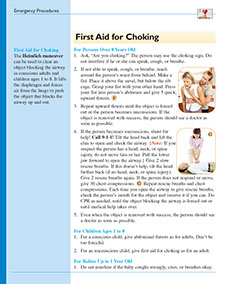
    The Heimlich maneuver can be used to clear an object blocking the airway in conscious adults and children ages 1 to 8. It lifts the diaphragm and forces air from the lungs to push the object that blocks the airway up and out.

    Persons Over 8 Years Old

    1. Ask, “Are you choking?”

    The person may use the choking sign. Do not interfere if he or she can speak, cough, or breathe.

    2. If not able to speak, cough, or breathe, reach around the person’s waist from behind.

    Make a fist. Place it above the navel, but below the rib cage. Grasp your fist with your other hand. Press your fist into person’s abdomen and give 5 quick, upward thrusts. See image A.

    Image of giving a person first aid for choking.

    Image A

    3. Repeat upward thrusts until the object is forced out or the person becomes unconscious.

    If the object is removed with success, the person should see a doctor as soon as possible.

    4. If the person becomes unconscious, shout for help! Call 9-1-1!

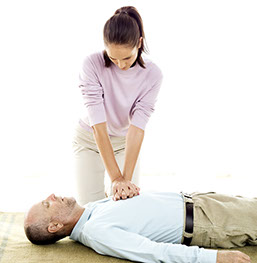
    Tilt the head back and lift the chin to open and check the airway. {Note: If you suspect the person has a head, neck, or spine injury, do not move him or her. Pull the lower jaw forward to open the airway.} Give 2 slow rescue breaths. If this doesn’t help, tilt the head further back (if no head, neck, or spine injury). Give 2 rescue breaths again. If the person does not respond or move, give 30 chest compressions. See image B. Repeat rescue breaths and chest compressions. Each time you open the airway to give rescue breaths, check the person’s mouth for the object and remove it if you can. Do CPR as needed, until the object blocking the airway is forced out or until medical help takes over.

    Image of adult chest compressions.

    Image B

    5. Even when the object is removed with success, the person should see a doctor as soon as possible.

    Children Ages 1 to 8

    1.  For a conscious child, give abdominal thrusts as for adults. Don’t be too forceful.

    2.  For an unconscious child, give first aid for choking as for an adult.

    Babies Up to 1 Year Old

    1.  Do not interfere if the baby coughs strongly, cries, or breathes okay.

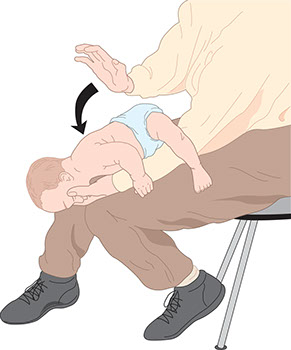
    2.  If the baby is conscious, hold the baby’s head (face down) in one hand. Straddle the baby over your forearm. Rest your forearm on your leg for support. Keep the baby’s head lower than the rest of his or her body.

    3.  With the heel of your free hand, give up to 5 quick, forceful blows on the baby’s back between the shoulder blades. See image C. If the object still blocks the airway, go to step 4.

    4.  Turn the baby over (face up). Cradle the baby on your forearm. Support the head with one hand. Keep the baby’s head lower than the rest of his or her body. Rest your arm on your leg for support. Place 2 fingers 1/2 inch below and in between the nipples on the baby’s chest. Give 5 quick downward thrusts. Depress the sternum about 1-1/2 inches with each thrust.

    5.  Repeat steps 3 and 4 until the object is removed or the baby is unconscious.

    6.  If the baby is unconscious, shout for help. Have someone call 9-1-1! If no one calls 9-1-1, give first aid for 1 minute, stop to call 9-1-1, then resume rescue efforts.

    7.  Put the baby on his/her back. Keep the head tilted back with one hand and give 30 chest compressions using 2 fingers on your other hand. Give 2 slow rescue breaths. If the object is expelled, stop. If not, give cycles of 30 compressions and 2 slow rescue breaths until the object is removed or help arrives.

    8.  Check for and remove the object in the airway, if visible. Repeat steps 7 and 8 as needed.

    9.  Don’t give up! Give CPR until medical help takes over or until the object is removed. Even if it is, get medical care right away.

    Illustration on giving a baby first aid when choking.

    Image C

    Healthier at Home book by the American Institute for Preventive Medicine. www.HealthyLife.com. All rights reserved.

    © American Institute for Preventive Medicine
  • Recovery Position

    First Aid

    The recovery position may need to be used in many conditions that need first aid, such as unconsciousness. It should not be used when a person: Is not breathing; has a head, neck, or spine injury; or has a serious injury.

    To Put a Person in the Recovery Position

    1.  Kneel at his or her side.

    2.  Turn the person’s face toward you. Tilt the head back to open the airway. Check the mouth if the person is unconscious and remove false teeth or any foreign matter.

    3.  Place the person’s arm nearest you by his or her side and tuck it under the person’s buttock.

    4.  Lay the person’s other arm across his or her chest. Cross the person’s leg that is farthest from you over the one nearest you at his or her ankles.

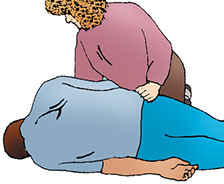
    5.  Support the person’s head with one hand and grasp his or her clothing at the hip farthest from you. Have him or her rest against your knees. See image A.

    6.  Bend the person’s upper arm and leg until each forms a right angle to the body. Pull the other arm out from under his or her body. Ease it out toward the back from the shoulder down. Position it parallel to the person’s back. See image B.

    7.  Make sure the person’s head is tilted back to keep the airway open.

    Illustration on how to place a person in the recovery position.

    Image A

    Illustration on how to put a person in a recovery position.

    Image B

    Healthier at Home book by the American Institute for Preventive Medicine. www.HealthyLife.com. All rights reserved.

    © American Institute for Preventive Medicine