Category: First Aid

  • Heat Illnesses

    First Aid

    Man outside in bright sun, wiping forehead with towel.

    Most heat-related deaths occur in the hot summer months. Elderly and very young persons and people with chronic health problems are most at risk.

    Sweating normally cools the body. During hot weather, sweating isn’t enough. Body temperature can rise to dangerous levels and you can develop a heat illness. This includes heat stroke, which can be life-threatening. Heat exhaustion, if not treated, can turn into heat stroke.

    A less serious heat illness is a heat rash. Signs include small red pimples, pink, blotchy skin, and itching. To treat a heat rash, bathe in cool water every couple of hours. Let your skin air dry. Put cornstarch or calamine lotion on itchy areas.

    When the heat starts to rise, slow down. Drink plenty of fluids (ones without alcohol or caffeine). Stay in the shade or indoors. Wear light, loose-fitting clothing and a wide brimmed hat. Do not stay in or leave anyone in a closed, parked car during hot weather.

    Health at Home Lifetime book by the American Institute for Preventive Medicine. www.HealthyLife.com. All rights reserved.

    © American Institute for Preventive Medicine

  • Dehydration

    First Aid

    Image of women drinking a glass of water.

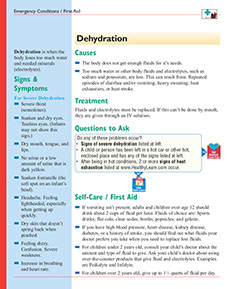
    Dehydration is when the body loses too much water and needed minerals (electrolytes).

    Signs & Symptoms

    For Severe Dehydration

    *  Severe thirst (sometimes).

    *  Sunken and dry eyes. Tearless eyes. (Infants may not show this sign.)

    *  Dry mouth, tongue, and lips.

    *  No urine or a low amount of urine that is dark yellow.

    *  Sunken fontanelle (the soft spot on an infant’s head).

    *  Headache. Feeling lightheaded, especially when getting up quickly.

    *  Dry skin that doesn’t spring back when pinched.

    *  Feeling dizzy. Confusion. Severe weakness.

    *  Increase in breathing and heart rate.

    Causes

    *  The body does not get enough fluids for it’s needs.

    *  Too much water or other body fluids and electrolytes, such as sodium and potassium, are lost. This can result from: Repeated episodes of diarrhea and/or vomiting; heavy sweating; heat exhaustion; or heat stroke.

    Treatment

    Fluids and electrolytes must be replaced. If this can’t be done by mouth, they are given through an IV solution.

    Questions to Ask

    Self-Care / First Aid

    *  If vomiting isn’t present, adults and children over age 12 should drink about 2 cups of fluid per hour. Fluids of choice are: Sports drinks; flat cola; clear sodas; broths; popsicles; and gelatin.

    *  If you have high blood pressure, heart disease, kidney disease, diabetes, or a history of stroke, you should find out what fluids your doctor prefers you take when you need to replace lost fluids.

    *  For children under 2 years old, consult your child’s doctor about the amount and type of fluid to give. Ask your child’s doctor about using over-the-counter products that give fluid and electrolytes. Examples are Pedialyte and Infalyte.

    *  For children over 2 years old, give up to 1-1/2 quarts of fluid per day.
    Healthier at Home book by the American Institute for Preventive Medicine. www.HealthyLife.com. All rights reserved.

    © American Institute for Preventive Medicine

  • How To Use The Emergency Department

    First Aid

    Do Prepare for an E.R. Visit

    If you do need to use a hospital emergency department, follow these steps.

    Call the E.R. Ahead of Time

    If there is time, call the E.R. and report:

    *  Who the victim is

    *  What the problem is

    *  What caused the problem

    *  When you think you will get there

    *  If the victim will need help from the car

    *  Who the victim’s doctor is (name and phone number)

    Have These Things Ready

    Keep the things listed below in a handy place.

    *  Personal identification.

    *  Emergency phone numbers. Put them by the telephones in your home and in the glove compartment or first aid kit in your car. Memorize them.

    *  Medical record or information form for you and each family member

    *  Health insurance information

    *  Consent form or letter written by you to allow your child to get medical, surgical, and/or emergency treatment. Ask your child’s doctor where you can get a consent form or what to put in a letter. Make sure you sign this form or letter. You can get copies of “Medical Consent to Treat Form,” “Emergency Information Form for Children with Special Health Care Needs,” and “Personal Medical History” from the American Academy of Emergency Physicians’ Web site:www.acep.orgor by calling 800.798.1822.

    *  Phone numbers where you can be reached when someone cares for your children

    {Note: Let others who take care of your children know where these things are.}

    People with specific medical conditions and severe allergies should wear a medical alert tag (e.g., bracelet, neck chain.) This helps a rescuer know what special precautions may need to be taken. You can buy these tags at many drug stores or order one from Medic Alert Foundation International at 888.633.4298 orwww.medicalert.org.

    Do Take a Companion to the E.R.

    When you need emergency medical care, it’s a good idea to have a relative or friend go with you. He or she can do the following:

    *  Get you registered

    *  Answer questions for you if you can’t answer them yourself

    *  Speak on your behalf and in your best interest. {Note: If you have an advance directive – Durable Power of Attorney for Health Care, take a copy with you to the hospital. Let your relative or friend know if you have this and how it can be obtained (e.g., your lawyer’s or doctor’s phone number). If you do not have this advance directive, let your relative or friend know.}

    *  Serve as a “clear head” to monitor the procedures being done

    *  Check out what kind of service you’re getting

    *  Be available in the waiting area

    *  Take you home

    Do Know What to Expect at the E.R.

    Triage

    *  A triage nurse evaluates your condition. He or she ranks all the patients in 3 general categories:

    – Life-threatening

    – Urgent, but not  life-threatening

    – Less urgent

    *  You need to describe the problem and the steps that led to it. (You may have to tell this to other people as well.)

    *  The seriousness of your condition and of other people at the E.R. will determine how soon you are seen.

    Registration

    *  You are asked for personal and insurance information. A family member or friend may provide this information while you are in triage.

    *  A medical record is set up for your visit. If the problem is life-threatening, this step would be completed later.

    Waiting Room

    *  You’ll probably have to wait to be seen. How long you wait will depend on the number of people to be seen and where you rank on the triage list. Other people may come in with a more serious condition than yours while you are waiting. This can cause you to wait even longer.

    *  Let the triage nurse know if you feel worse while you are waiting.

    *  Don’t eat or drink anything or take any medication until you are seen by the doctor (unless the triage nurse tells you it is okay).

    Examination Room

    *  Here you are first seen by a nurse who gets more information to help diagnose your problem. This includes asking questions, taking your temperature, etc.

    *  While you are in the examination room, the nurse consults with the physician in the E.R.

    *  You are then seen by a physician who gets a more detailed medical history and examines you.

    Diagnosis and Treatment

    *  The doctor makes an initial diagnosis.

    *  The doctor may order blood tests, X-rays, etc.

    *  When a final diagnosis is made, treatment is prescribed or provided.

    Outcome

    Depending upon the diagnosis and treatment, you are either discharged, admitted to the hospital, or moved to a facility that is better equipped to treat the problem.

    What to Do When You Are Discharged

    *  Make sure you get a written list of things you are to do after you leave. Read the list before you leave. Make sure you understand what you are supposed to do.

    *  Before you leave, find out where you can get a prescription filled or any other supplies you need (i.e., 24 hour pharmacy).

    *  Ask the following questions:

    –  What follow-up care is needed?

    –  What is the name of the E.R. doctor who treated you?

    –  Are there special considerations for the next 24 to 48 hours?

    –  Should you contact your own doctor and how soon?

    *  Have someone else drive you home.

    *  Call your doctor and/or the E.R. when you are told to do so. It could be to report:

    –  What has happened

    –  How you are doing

    –  If you are getting worse

    –  If you have more problems

    First Aid WiseGuide book by the American Institute for Preventive Medicine. www.HealthyLife.com. All rights reserved.

    © American Institute for Preventive Medicine
  • Prevent Poisoning

    First Aid

    Do This, Not That

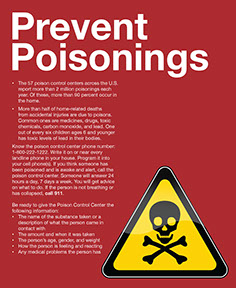
    *  The 57 poison control centers across the U.S. report more than 2 million poisonings each year. Of these, more than 90 percent occur in the home.

    *  More than half of home-related deaths from accidental injuries are due to poisons. Common ones are medicines, drugs, toxic chemicals, carbon monoxide, and lead. One out of every six children ages 6 and younger has toxic levels of lead in their bodies.

    Know the poison control center phone number: 1-800-222-1222. Write it on or near every landline phone in your house. Program it into your cell phone(s). If you think someone has been poisoned and is awake and alert, call the poison control center. Someone will answer 24 hours a day, 7 days a week. You will get advice on what to do. If the person is not breathing or has collapsed, call 911.

    Be ready to give the Poison Control Center the following information:

    *  The name of the substance taken or a description of what the person came in contact with

    *  The amount and when it was taken

    *  The person’s age, gender, and weight

    *  How the person is feeling and reacting

    *  Any medical problems the person has

    Chemical and Alcohol Poisoning

    Lead Poisoning

    Carbon Monoxide (CO) Poisoning

    Safe at Home - Do This, Not That Book. Published by the American Institute for Preventive Medicine.

    © American Institute for Preventive Medicine
  • Master The “Hug Of Life”

    First Aid

    Image of a man performing the Heimlich maneuver.

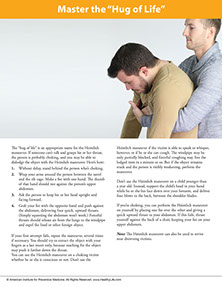
    The “hug of life” is an appropriate name for the Heimlich maneuver. If someone can’t talk and grasps his or her throat, the person is probably choking, and you may be able to dislodge the object with the Heimlich maneuver. Here’s how:

    1.  Without delay, stand behind the person who’s choking.

    2.  Wrap your arms around the person between the navel and the rib cage. Make a fist with one hand. The thumb of that hand should rest against the person’s upper abdomen.

    3.   Ask the person to keep his or her head upright and facing forward.

    4.  Grab your fist with the opposite hand and push against the abdomen, delivering four quick, upward thrusts. (Simply squeezing the abdomen won’t work.) Forceful thrusts should release air from the lungs to the windpipe and expel the food or other foreign object.

    If your first attempt fails, repeat the maneuver, several times if necessary.

    You should try to extract the object with your fingers as a last resort only, because reaching for the object may push it farther down the throat.

    You can use the Heimlich maneuver on a choking victim whether he or she is conscious or not. Don’t use the Heimlich maneuver if the victim is able to speak or whisper, however, or if he or she can cough. The windpipe may be only partially blocked, and forceful coughing may free the lodged item in a minute or so. But if the object remains stuck and the person is visibly weakening, perform the maneuver.

    Don’t use the Heimlich maneuver on a child younger than a year old. Instead, support the child’s head in your hand while he or she lies face down over your forearm, and deliver four blows to the back, between the shoulder blades.

    If you’re choking, you can perform the Heimlich maneuver on yourself by placing one fist over the other and giving a quick upward thrust to your abdomen. If this fails, thrust yourself against the back of a chair, keeping your fist on your upper abdomen.

    Note: The Heimlich maneuver can also be used to revive near drowning victims.

    A Year of Health Hints book by the American Institute for Preventive Medicine. www.HealthyLife.com. All rights reserved.

    © American Institute for Preventive Medicine
  • Electric Shock

    First Aid

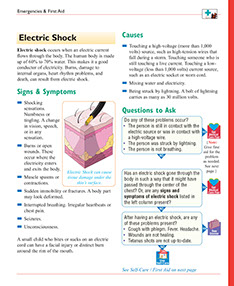
    Electric shock occurs when an electric current flows through the body. The human body is made up of 60% to 70% water. This makes it a good conductor of electricity. Burns, damage to internal organs, heart rhythm problems, and death, can result from electric shock.

    Signs & Symptoms

    *  Shocking sensations. Numbness or tingling. A change in vision, speech, or in any sensation.

    *  Burns or open wounds. These occur where the electricity enters and exits the body.

    *  Muscle spasms or contractions.

    *  Sudden immobility or fractures. A body part may look deformed.

    *  Interrupted breathing. Irregular heartbeats or chest pain.

    *  Seizures.

    *  Unconsciousness.

    A small child who bites or sucks on an electric cord can have a facial injury or distinct burn around the rim of the mouth.

    Causes

    *  Touching a high-voltage (more than 1,000 volts) source, such as high-tension wires that fall during a storm. Touching someone who is still touching a live current. Touching a low-voltage (less than 1,000 volts) current source, such as an electric socket or worn cord.

    *  Mixing water and electricity.

    *  Being struck by lightning. A bolt of lightning carries as many as 30 million volts.

    Treatment

    Contact with electricity from a high-voltage wire or being struck by lightning needs emergency medical care. Contact with electricity from a low-voltage current needs emergency medical care if any signs or symptoms are present. A person who does not have any symptoms should still see a doctor to check for possible internal injuries.

    To Avoid Being Harmed by Lightning

    *  Heed weather warnings.

    *  Take shelter in a building, if you can.

    *  Stay in your car (if it is not a convertible) rather than out in the open.

    *  If you are caught outside, avoid tall trees, open water, metal objects, and high ground. Crawl into a low-lying place or curl up on the ground, head to knees with your head touching the ground.

    Questions to Ask

    Self-Care / First Aid

    Beware! Do not put yourself in danger to give first aid. Do not touch the person until power is shut off.

    *  If the source is a high-voltage wire or lightning, call 9-1-1!

    *  It is safe to touch a person struck by lightning.

    *  If the source is a low-voltage current, remove the fuse or switch off the circuit breaker to the electrical outlet.

    *  If you can’t shut off the source, with dry feet and hands, use a board, wooden stick, rope, etc. to get the person away from the source.

    *  If it is safe for you to touch the person, check for a response. Give CPR, as needed.

    *  Unless it is absolutely necessary, don’t move the person. He or she could have a traumatic injury, especially to the head or neck.

    *  Check for burns. Cover burned areas with dry, sterile dressings.

    *  Give first aid for Shock, if needed.

    Prevention

    *  Stay clear of fallen wires. Inform the police, electric company, etc.

    *  Install ground-fault circuit-interrupters (GFCIs) in wall outlets of bathrooms, kitchens, etc. With GFCIs, when an electrical appliance falls into water, the current is instantly cut off.

    *  Don’t turn electrical switches on or off or touch an electric appliance while your hands are wet, while standing in water, or when sitting in a bathtub.

    *  Replace worn cords and wiring.

    *  Cover all electric sockets with plastic safety caps.

    *  Before you do electrical repairs, remove the fuse from the fuse box or switch off the circuit breaker. Don’t just turn off the appliance or light switch.

    Healthier at Home book by the American Institute for Preventive Medicine. www.HealthyLife.com. All rights reserved.

    © American Institute for Preventive Medicine
  • Hyperventilation

    First Aid

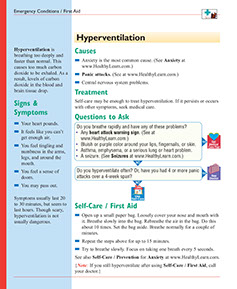
    Hyperventilation is breathing too deeply and faster than normal. This causes too much carbon dioxide to be exhaled. As a result, levels of carbon dioxide in the blood and brain tissue drop.

    Signs & Symptoms

    *  Your heart pounds.

    *  It feels like you can’t get enough air.

    *  You feel tingling and numbness in the arms, legs, and around the mouth.

    *  You feel a sense of doom.

    *  You may pass out.

    Symptoms usually last 20 to 30 minutes, but seem to last hours. Though scary, hyperventilation is not usually dangerous.

    Causes

    *  Anxiety is the most common cause.

    *  Panic attacks.

    *  Central nervous system problems.

    Treatment

    Self-care may be enough to treat hyperventilation. If it persists or occurs with other symptoms, seek medical care.

    Questions to Ask

    Self-Care / Prevention

    *  Open up a small paper bag. Loosely cover your nose and mouth with it. Breathe slowly into the bag. Rebreathe the air in the bag. Do this about 10 times. Set the bag aside. Breathe normally for a couple of minutes.

    *  Repeat the steps above for up to 15 minutes.

    *  Try to breathe slowly. Focus on taking one breath every 5 seconds.

    {Note: If you still hyperventilate after using Self-Care / First Aid, call your doctor.}

    Healthier at Home book by the American Institute for Preventive Medicine. www.HealthyLife.com. All rights reserved.

    © American Institute for Preventive Medicine