Category: Pregnancy & Prenatal Care

  • Gestational Diabetes

    Pregnancy & Prenatal Care

    A pregnant woman can have diabetes. If she didn’t have it before the pregnancy, it’s called gestational diabetes. (Gestational refers to pregnancy.) It can begin any time during pregnancy. It usually begins in the last half, though. It goes away after the baby is born. But the woman has a greater risk of getting diabetes later.

    Symptoms

    *  Feeling very tired

    *  Rapid weight gain

    *  Feeling very thirsty

    *  Having to pass urine often

    Also, a sign for gestational diabetes is when the baby gets too big during the pregnancy.

    All pregnant women should be screened for diabetes. Screening happens through urine and blood tests. Those are part of routine prenatal health care visits.

    Causes

    Any pregnant woman can develop gestational diabetes. But risk factors may be:

    *  Obesity before pregnancy

    *  High blood pressure before pregnancy

    *  Having a baby that weighed more than 9 pounds at birth in the past

    *  Having a stillbirth in the past

    *  Having a child with a birth defect in the past

    *  Being older than 25

    *  Being pregnant with more than one baby

    Treatment

    Special problems can be avoided with treatment. Without treatment, the baby can get too big. The mother may not be able to have a vaginal birth. Other problems are preeclampsia and preterm birth. Preterm birth is when the baby is born 3 or more weeks before the due date. There can also be delivery problems. But a woman with gestational diabetes can have a healthy baby. She needs proper medical care, though.

    Blood sugar must be controlled. This is done through:

    *  Special diet from the health care provider

    *  Exercises from the health care provider

    *  Insulin shots, in some cases, when diet and exercise are not enough. Insulin is a hormone. Among other things, it keeps blood sugar from getting too high. The provider teaches how to do the shots. The provider teaches the mother how to check her own blood sugar. It is important to do what the provider requests.

    *  Having prenatal visits more often. The provider checks the mother’s daily blood sugar record. Tests are done to see how the baby is doing.

    *  Extra care at delivery

    {Note: The baby should be checked for low blood sugar a day or so after birth.}

    Questions to Ask

    Self-Care / Prevention

    If you get diabetes during pregnancy:

    *  Follow the diet and exercise plan your health care provider or dietitian gives you.

    *  Drink at least 8 to 10 cups of fluids a day. Drink enough for your thirst. Limit ones with a lot of sugar. Examples: all kinds of sodas, fruit drinks and juices.

    *  Get plenty of rest when you feel tired.

    *  If you are told to do so, test your blood sugar levels at home. Your health care provider will tell you how. Keep a daily record of the results.

    *  After you have your baby, get your blood sugar checked when your doctor tells you to.

    {Note: Some pregnant women need to give themselves insulin shots at home. If your provider says you need to, you will be shown how. Be sure to give the insulin correctly. It’s an important way of taking care of yourself and your baby.}

    Prenatal Self-Care book by the American Institute for Preventive Medicine. www.HealthyLife.com. All rights reserved.

    © American Institute for Preventive Medicine

  • Getting Ready For Childbirth

    Pregnancy & Prenatal Care

    What to Do First

    *  Choose where you want to have your baby.

    *  Choose a health care provider.

    How to Get Ready

    *  Read books on pregnancy and childbirth.

    *  Take a childbirth class, if you can.

    *  Get regular prenatal care from your health care provider.

    Childbirth Classes Do These Things

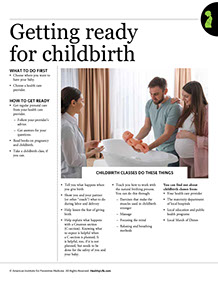
    *  Tell you what happens when you give birth

    *  Show you and your partner (or other “coach”) what to do during labor and delivery

    *  Help lessen the fear of giving birth

    *  Help explain what happens with a Cesarean section (C-section). Knowing what to expect is helpful when a C-section is planned. It is helpful, too, if it is not planned, but needs to be done for the safety of you and your baby.

    *  Teach you how to work with the natural birthing process. You can do this through:

    – Exercises that make the muscles used in childbirth stronger

    – Massage

    – Focusing the mind

    – Relaxing and breathing methods

    You can find out about childbirth classes from:

    *  Your health care provider

    *  The maternity department of local hospitals

    *  Local education programs

    *  Local March of Dimes

    Prenatal Self-Care book by the American Institute for Preventive Medicine. www.HealthyLife.com. All rights reserved.

    © American Institute for Preventive Medicine

  • Healthy Pregnancy Checklist

    Pregnancy & Prenatal Care

    You can do a lot of things to improve the chance of having a healthy pregnancy. And you should not do some other things! Knowing what to do and what to avoid will help you and your baby stay well.

    *  Ask your health care provider before you take any medicines, even ones you can buy without a prescription.

    *  Go to all your prenatal health care visits.

    *  Don’t drink alcohol, take drugs, or smoke. When you drink alcohol, smoke, or take drugs, your baby does, too!

    *  Have a routine for exercise. Follow your health care provider’s advice.

    *  Eat healthy foods.

    *  Take your prenatal vitamins (vitamin pills) every day. These also supply the minerals you need.

    *  Get plenty of rest.

    *  Wash your hands throughout the day.

    *  Accept all your emotions. Express your feelings to others.

    *  Learn to deal with stress. Experts think stress may limit blood supply to the placenta. The placenta is the baby’s only source of oxygen and nutrients.

    *  Don’t have X-rays unless your prenatal health care provider says it’s okay.

    *  Avoid harmful chemicals such as paint fumes, insect poisons, and weed killers. Ask your health care provider what else you should avoid.

    *  When you use cleaning agents, wear rubber gloves. Make sure there is plenty of fresh air.

    *  Don’t wear high-heeled shoes.

    *  Don’t pick up, carry, or move heavy objects.

    *  Stay out of hot tubs and saunas. When you bathe, use warm water only. Never use hot water. Put a rubber mat in the tub or shower to prevent slipping.

    *  Don’t handle cat feces or cat litter. If you have a cat, have someone else empty the litter box. Cat droppings can carry a disease called toxoplasmosis. (Eating meat that is not cooked enough can cause this, too.) If a pregnant woman gets this disease, the baby can be harmed. It’s okay to pet your cat.

    *  Don’t have any contact with hamsters, guinea pigs or any rodents. These animals can carry a virus that can cause severe harm to your baby.

    *  Discuss your work life with your health care provider. Find out if it is healthy for you and your baby.

    *  Find out if you should limit or stop having sex. Bleeding or pain during sex could be reasons. Ask your health care provider.

    *  Always wear lap and shoulder seat belts when you ride in a vehicle. Fasten the lap belt as low as you can, below your belly.

    *  Are you going far from home late in your pregnancy? Have your health care provider refer you to a provider in the area where you are going. Take a copy of your prenatal records with you.

    *  When you travel:

    – By plane or train, get up and walk around every now and then. Get an aisle seat.

    – By car, stop at least every 2 hours and do the same.

    Prenatal Self-Care book by the American Institute for Preventive Medicine. www.HealthyLife.com. All rights reserved.

    © American Institute for Preventive Medicine

  • Planning A Healthy  Pregnancy

    Pregnancy & Prenatal Care

    Healthy moms tend to have healthy babies. Take the steps below before you get pregnant. These steps can help your baby get off to a good start:

    *  Talk to your health care provider. Let him or her know you are planning to get pregnant. Follow his or her advice.

    *  Have a complete medical exam. This includes a gynecological exam. (That’s an exam of the female organs.) Some medical problems may cause harm to you and your baby. They are:

    – High blood pressure

    – Heart diseases

    – Diabetes

    – Bleeding

    – German measles (rubella), and some other viruses such as CMV

    – Rh disease (after the first pregnancy). This is not a problem if you get Rhogam. Rhogam keeps Rh disease from harming your next baby.

    – Obesity

    – STDs (sexually transmitted diseases)

    – HIV

    *  Keep your lifestyle healthy.

    *  Follow a balanced diet. Eat plenty of: Whole grains; Green leafy and other vegetables; Fruits; Calcium-rich foods (low-fat milk, yogurt, cheese; items that have calcium added to them like some juices and breads)

    *  Go easy on: High-fat and junk foods; Refined sugars. Don’t load up on Kool-Aid, for example.; Salt

    *  Before you get pregnant, stop using or have less than 400 milligrams of caffeine a day. After you get pregnant, follow your doctor’s advice.

    *  Begin or keep on with an exercise schedule.

    *  Don’t drink alcohol or use street drugs.

    *  Don’t smoke. If you smoke now, stop smoking. Ask your health care provider for help.

    *  All females who plan to get pregnant or are able to get pregnant should take   400 to 800 micrograms (mcg) of folic acid every day. Folic acid is a B-vitamin. It may prevent certain birth defects, such as spina bifida. For this effect, you take it before conception and during the early months of pregnancy. Ask your health care provider which vitamin pills you should take to get the folic acid and other vitamins and minerals you need.

    *  Do you use an IUD or “the pill”? Change your birth control method. Do this 1 to 2 months before you try to get pregnant. Let 1 to 2 normal periods happen. Your cycle needs to return to normal. Use another form of birth control during this time. Condoms or a diaphragm are good choices.

    *  Use condoms if you think your partner may have sex with others.

    *  Check that all your immunizations are up-to-date. These protect you from disease. Ask your health care provider about them.

    *  Also, ask your health care provider before you take any medicines. That’s even for ones you can buy without a prescription.

    *  Seek prenatal care. Do this as soon as you think you are pregnant.

    *  Take care of medical problems.

    – Do you have a chronic one? That’s a problem that lasts a long time, or comes back often. If so, ask your health care provider how it could affect your pregnancy.

    – Do you take any medications? Ask your health care provider if you have to stop taking any medications before you get pregnant. Follow his or her advice. Don’t stop taking a prescription medication on your own.

    *  Consider genetic tests or genetic counseling. These are a good idea if:

    – You or your partner has a family history of genetic health problems. These are problems that are passed down through families. Examples are sickle cell anemia and cystic fibrosis.

    – You are 35 or older

    – Your partner is 50 or older

    Prenatal Self-Care book by the American Institute for Preventive Medicine. www.HealthyLife.com. All rights reserved.

    © American Institute for Preventive Medicine

  • High Blood Pressure 2

    Pregnancy & Prenatal Care

    A blood pressure reading concerns the blood in the arteries. The top number in the reading is the systolic pressure. That’s the pressure when the heart muscle contracts. The bottom number is the diastolic pressure. That’s the pressure when the heart muscle relaxes.

    An example of a blood pressure reading is 120/80. This is measured in millimeters of mercury (mm Hg). A blood pressure reading should be taken before pregnancy or at its start. This is called a baseline blood pressure. The baseline reading shows what is normal for that woman. During the first several months of pregnancy, blood pressure may drop a little. It often rises slightly later in the pregnancy. That’s because of the extra work the mother’s body is doing. A slight rise is normal then. High blood pressure in pregnancy is when there is an increase of 30 or more in the systolic pressure (top number). An increase of 15 or more in the diastolic pressure (bottom number) is also a sign of high blood pressure.

    Causes

    Preeclampsia

    A common cause of high blood pressure in pregnancy is preeclampsia. This used to be called toxemia. Three things usually come with preeclampsia:

    *  High blood pressure

    *  Swelling of the face, hands, fingers, or feet

    *  Protein in the urine

    Other symptoms of preeclampsia are:

    *  Sudden weight gain or gaining more than 2 pounds a week

    *  Headaches

    *  Vision problems like spots before the eyes or blurry vision

    *  Pain in upper belly

    *  Severe indigestion that doesn’t go away

    Preeclampsia affects about 7 out of 100 pregnant women. It happens most often during a first pregnancy, but can occur again, especially with a new partner. And, it only happens during pregnancy. It goes away after delivery. Preeclampsia can lead to eclampsia. That’s when convulsions also occur. Eclampsia can result in a coma for the mother.

    Risk Factors

    The cause of preeclampsia is not known. High blood pressure does not have to be present before pregnancy. The things listed below may increase the risk for preeclampsia:

    *  First pregnancy or first pregnancy with a new partner

    *  Chronic high blood pressure or kidney disease

    *  Diabetes or lupus before the pregnancy

    *  Being overweight

    *  Being African American

    *  Pregnancy before age 20 or after age 35

    *  Being pregnant with more than one baby

    *  Preeclampsia in a past pregnancy or in a mother or sister

    Pregnancy Induced Hypertension (PIH)

    High blood pressure can develop during pregnancy without other symptoms. This is called pregnancy induced hypertension (PIH). This type of high blood pressure often happens after the 20th week. After delivery, blood pressure usually goes back to normal.

    Treatment

    High blood pressure and preeclampsia can range from mild to severe. They can be treated with medical help and home care. But if serious symptoms are present, medicine and/or hospital care may be needed. The health care provider may induce labor (bring on labor). Or a Cesarean section (C-section) may be done.

    When blood pressure remains high, not enough blood reaches the placenta. The fetus doesn’t get enough oxygen and nutrients. That can cause:

    *  Growth problems for the fetus

    *  Placenta abruptio.

    *  A baby that is born preterm, that has mental problems, is underweight, or stillborn

    Questions to Ask

    Self-Care

    *  Get a lot of rest. Sleep 8 to 12 hours at night. Take 2 naps during the day, if you can. When you sleep or rest, lie on your left side, as much as you can. This helps blood flow to the placenta. When you tire of lying on your left side, lie on your right side.

    *  Take medicine for high blood pressure as prescribed. If told to do so, take regular blood pressure readings at home. Ask your health care provider how to get a home test kit.

    *  Follow your health care provider’s advice about exercise.

    *  Do things to relax. Examples: listen to soft music, put your feet up, take a nap. Watch a TV show that makes you laugh. Put your hand on your belly to feel your baby move.

    *  Don’t take any medicine without your health care provider’s okay. That includes cold or sinus medicines and antacids.

    Prenatal Self-Care book by the American Institute for Preventive Medicine. www.HealthyLife.com. All rights reserved.

    © American Institute for Preventive Medicine

  • “Baby Blues” After Delivery

    Pregnancy & Prenatal Care

    It is very special to have a baby! Having a baby brings much joy! It also brings many changes. Your moods are apt to be very strong for the first few weeks after your baby is born. It is common to feel angry or worried. It is also common to feel sad. It is also common to feel like crying and to cry. This is known as the “baby blues”.

    The “baby blues” usually start about 3 days after the baby is born. They usually last up to a week or so. This is a normal part of having a baby. Hormone changes are a big part of this. Being tired can be a part of it, too.

    Some women get a bad case of the “baby blues.” Their sad feelings are very strong. They don’t go away after a week or even two. These women may have postpartum depression. This is an illness that needs medical care. It doesn’t mean the mother has failed.

    Let your health care provider know if you have any of these signs and symptoms:

    *  Thoughts of harming your baby or yourself.

    *  “Baby blues” that don’t go away after 2 weeks.

    *  Strong feelings of sadness and anger that start 1 to 3 months (or even as long as a year) after the baby comes.

    *  Feeling helpless, hopeless, or guilty. These feelings get stronger each week. They keep you from doing normal daily tasks.

    *  Sleeping most of the time. Or not being able to sleep even when you are tired.

    *  A big change in how you normally eat. You eat too much. Or you eat too little.

    *  Little or no interest in your baby or your family. Or you worry too much about your baby.

    *  Panic attacks. With a panic attack, you breathe fast. Your heart beats fast. Your hands sweat. It seems like you can’t breathe. You may think you are having a heart attack or are going to die. You feel out of control.

    Postpartum depression can happen after the baby comes or after you stop breast-feeding. The good news is that it can be treated. If it does happen, don’t wait to get help. Call your health care provider right away.

    Prenatal Self-Care book by the American Institute for Preventive Medicine. www.HealthyLife.com. All rights reserved.

    © American Institute for Preventive Medicine

  • Labor And Delivery

    Pregnancy & Prenatal Care

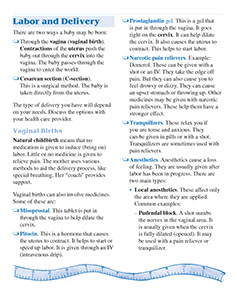
    There are two ways a baby may be born:

    *  Through the vagina (vaginal birth). Contractions of the uterus push the baby out through the cervix into the vagina. The baby passes through the vagina to enter the world.

    *  Cesarean section (C-section). This is a surgical method. The baby is taken directly from the uterus.

    The type of delivery you have will depend on your needs. Discuss the options with your health care provider.

    Vaginal Births

    Natural childbirth means that no medication is given to induce (bring on) labor. Little or no medicine is given to relieve pain. The mother uses various methods to aid the delivery process, like special breathing. Her “coach” provides support.

    Vaginal births can also involve medicines. Some of these are:

    *  Misoprostal. This tablet is put in through the vagina to help dilate the cervix.

    *  Pitocin. This is a hormone that causes the uterus to contract. It helps to start or speed up labor. It is given through an IV (intravenous drip).

    *  Prostaglandin gel. This is a gel that is put in through the vagina. It goes right on the cervix. It can help dilate the cervix. It also causes the uterus to contract. This helps to start labor.

    *  Narcotic pain relievers. Example: Demerol. These can be given with a shot or an IV. They take the edge off pain. But they can also cause you to feel drowsy or dizzy. They can cause an upset stomach or throwing up. Other medicines may be given with narcotic pain relievers. These help them have a stronger effect.

    *  Tranquilizers. These relax you if you are tense and anxious. They can be given in pills or with a shot. Tranquilizers are sometimes used with pain relievers.

    *  Anesthetics. Anesthetics cause a loss of feeling. They are usually given after labor has been in progress. There are two main types:

    *  General anesthesia. This puts the mother to sleep. It is used most often for emergency C-sections. But it can be used in a vaginal birth when the baby is in a breech position. That’s when the baby’s bottom or one or both feet reach the cervix before the head does.

    *  Local anesthetics. These affect only the area where they are applied. Common examples:

    – Pudendal block. A shot numbs the nerves in the vaginal area. It is usually given when the cervix is fully dilated (opened). It may be used with a pain reliever or tranquilizer.

    – Epidural block. This is the most popular anesthetic used for labor. The mother lies on her left side or she sits up and leans forward. A shot is given in the back to numb the area. A thin plastic tube is put into the epidural space of the spine. Medicine is given through the tube. This causes some loss of feeling from the waist down. How much numbness occurs depends on the drug and dose used. An epidural block can have other effects. It can lower the mother’s blood pressure. It can make her unable to pass urine on her own. In that case, a tube called a Foley catheter is used to empty urine from the bladder. An epidural block can also increase the chance that forceps will be used at delivery. {Note: Just pain medicine can be given through the tube. It does not cause a loss of feeling from the waist down. If this is done, the mother may be able to get out of bed and walk. But an adult should be with her.}

    Whether or not pain medicine is used is not what matters most. The goal in labor and delivery is to have a healthy baby and a healthy mother.

    Cesarean Births

    A C-section requires anesthetics. Either an epidural block or spinal is used. General anesthesia is rarely used. C-sections are usually done with a low, left-to-right incision (cut) near the line of pubic hair. This is called a lower-segment incision or a “bikini” cut. An up-and-down incision is rare these days. But it may be used in an emergency. The type of incision in the skin may be different from the one made in the uterus.

    C-sections may or may not be planned. Here are some reasons for doing one:

    *  The baby (or babies) or mother is not doing well

    *  The baby is too big for the mother’s pelvis

    *  The mother has placenta previa or placenta abruptio.

    *  The mother had a past C-section with an up-and-down incision on the uterus.

    *  The baby is lying in a way that makes it hard to deliver.

    *  The mother has an active outbreak of genital herpes.

    *  Labor does not progress the way it should.

    *  The umbilical cord is wedged between the cervix and the baby. This cuts off blood flow to the baby.

    *  The mother is not strong enough for a vaginal delivery.

    *  The mother has health problems, like diabetes, high blood pressure, kidney disease, or preeclampsia.

    *  The baby is more than 2 weeks late and the placenta does not nourish the baby well.

    Vaginal Births after C-Section (VBAC)

    Some pregnant women have already had a C-section delivery. Of this group, some might be able to have a safe vaginal delivery. Some might not for the next baby.

    A vaginal delivery after a C-section may be possible if:

    *  The incision for the C-section was the left-to-right, lower-segment type.

    *  Your pelvis is normal size.

    *  Reasons for the past C-section are not present now. Examples:

    – Breech baby

    – Separation of the placenta (placenta abruptio)

    – More than one baby

    – Baby in distress

    Signs of Prelabor

    Prelabor is the period just before labor begins. Call your health care provider if any of these signs of prelabor happen more than one month before your due date:

    *  The baby begins to settle into your pelvis. It looks and feels as if the baby has “dropped.” This process is called lightening and engagement. It’s easier for you to breathe after it happens.

    *  You feel more pressure on the pelvis and rectum (rear end). The pressure can cause a dull ache in the pelvic area or lower back. It feels like menstrual cramps.

    *  Vaginal discharge may increase and thicken.

    *  Your energy level changes. Some women feel less energy. Others feel more. They want to clean the whole house. The “nesting instinct” is a way of getting ready for the new baby.

    *  You lose the mucus plug. That’s a blob of thick stuff that blocks the cervix. You can lose it several days before labor starts. Or you can lose it just as labor starts.

    *  You may see the bloody show. When the cervix opens, small blood vessels often break. The blood colors the mucus plug pink. Or it may streak the mucus plug with red. When the mucus plug falls out, you may see the blood. You may pass a big clump that looks like a wet cotton ball. Some women don’t notice the bloody show. Bloody show usually means that labor will start within 24 hours. But sometimes labor could still be a few days away.

    *  You have diarrhea. Some women get this just before labor starts.

    *  The “bag of waters” (or your “water”) breaks. That’s the sac inside the uterus. It holds the amniotic fluid. The baby grows there. About 15 percent of the time, the water breaks before labor starts. More often, this happens during labor. The fluid can come out in a gush or a slow trickle. Call your provider right away if this happens.

    1st Stage of Childbirth

    The First Stage of Childbirth: Labor

    Labor has three parts:

    *  The first part is called early or latent labor. This is usually the longest part. It’s usually the least painful, too.

    – Real contractions begin. Contractions are when the muscles of the uterus tighten and then relax. The feelings usually start in the lower back and travel to the belly. Some contractions are felt only in your back. Others are felt only in your belly. Contractions usually start about 15 to 20 minutes apart and last 30 to 45 seconds.

    – The cervix dilates to open 3 centimeters across. That’s about the size of a silver 50¢ piece. It gets thinner. This can happen over a period of days or weeks. You may not even be aware of it. Or it can happen with stronger contractions over a period of 2 to 6 hours. Rarely, it could take up to 24 hours with the stronger contractions.

    – Call your health care provider during the first part of labor. Your provider may tell you to go to the hospital or birthing center. Make sure you’re packed!

    *  The second part is called active labor. This part of labor is usually shorter than the first part. On average, it lasts 2 to 3  hours. But its length can vary greatly. If you’re not already at the hospital or birthing center, you should get there early in this part of labor. Signs of this part of labor:

    – Contractions are stronger. They come more often, usually every 3 to 4 minutes. They last longer, from 40 to 60 seconds each.

    – The cervix dilates to 7 centimeters. That’s about the size of the rim of a coffee mug.

    *  The third part is called advanced active labor or transition. It is the most tiring part. But it is also the shortest. The average length is 15 to 60 minutes. Here are signs that you are in transition:

    – Contractions are even stronger. They come every 2 to 3 minutes. Each lasts 60 to 90 seconds.

    – The cervix dilates fully. It opens 7 to 10 centimeters. That’s about the size of a small grapefruit.

    2nd Stage of Childbirth

    The Second Stage of Childbirth: Delivery

    During delivery, you push the baby down the birth canal and out into the world.

    *  Contractions continue. They are usually more regular than before. They come less than two minutes apart. Each lasts about 60 to 90 seconds. You only push when you have contractions. Your health care provider will tell you when to push.

    *  Most babies come out head first. Then the shoulders. After this, the rest of the baby’s body slips out with ease. Your baby may be placed on your tummy.

    *  The umbilical cord is clamped and cut.

    *  The time for this stage varies greatly. It can take from 10 minutes to 3 hours or more.

    3rd Stage of Childbirth

    The Third Stage of Childbirth: Delivery of the Placenta

    Delivery of the placenta usually lasts from about 5 to 30 minutes. Delivery takes place through mild contractions. You might not even feel them. One more push from you can help the placenta come out. Or a nurse or your health care provider may gently press down on your abdomen. This, too, can help the placenta come out.

    {Note: The total time for labor varies from woman to woman. It also varies from pregnancy to pregnancy for the same woman. First babies tend to take longer than later ones. This is not always the case, though.}

    During Labor

    Things Your Health Care Provider May Do During Labor

    Your health care provider and his or her staff may do any of the things below during labor. What they will do depends on your special needs. But find out ahead of time which ones the provider is sure to do.

    *  Do a physical exam.

    – Your provider feels your belly. This helps the provider know how big the baby is. It helps the provider to know how the baby is lying.

    – Your provider gives you a pelvic exam. This shows how open and thin your cervix is. Your “bag of waters” could break by itself during this exam.

    *  Put an IV (intravenous drip) in a hand or arm vein. Here are reasons why this may be done:

    – To give you fluids. This keeps you from getting dehydrated (dried out or without enough body fluids).

    – To give you glucose. Glucose is a type of sugar. It gives you energy. This will help if you have a long labor.

    – To provide a way to give you medicine quickly, if you need it.

    *  Use a fetal monitor to check the baby. This small machine can check your baby’s heartbeat before the baby is born. It can also record your contractions. There are 2 kinds of fetal monitors:

    – External monitor. This kind has two wide straps. The straps go over your belly. One strap picks up your baby’s heartbeat by ultrasound. The other connects to a pressure gauge. The gauge records your contractions on a printout.

    – Internal monitor. This kind has a small tube that goes inside the uterus. The “bag of waters” must be broken before this monitor can be used. It gets there through the vagina and cervix. A small electrode goes on the baby’s head. This monitor gives more detail than the external one. It is used when the baby doesn’t seem to be doing well. It may also be used when the external monitor is not giving an accurate reading. This can happen if the baby is very active. It can happen when the mother is obese.

    *  Break your “bag of waters.” Your provider pricks the “bag of waters” with a small tool. The tool enters through the opened cervix. The provider looks at the color of the fluid. Clear is a good sign. Yellow or green could signal a problem.

    *  Use forceps to help the delivery. Forceps are metal tongs. They are cradled around the baby’s head. They help ease the baby out of the birth canal if the mother can’t push.

    *  Use vacuum extraction to help the delivery. A suction cup is put on the baby’s head in the birth canal. This helps the baby come out if the mother can’t push. The suction cup is attached to a vacuum pump. Your doctor uses this to pull the baby gently with each contraction. Many doctors prefer this method to forceps. {Note: Forceps and vacuum extraction are not used until the baby’s head can be seen at the vaginal opening.}

    *  Do an episiotomy. This is a surgical cut. It is made in the skin between the vagina and the anus just before the baby is born. The purpose is to widen the vaginal opening. That helps the baby come out. It also helps keep the skin in the vaginal area from tearing. After the baby is born, the cut is stitched.

    How long you stay in the hospital or birthing center will depend on:

    *  The type of delivery you have and where you give birth. You may go home within 12 to 24 hours in a birthing center. You may be able to stay in a hospital for up to two days. Both of these are with normal vaginal deliveries without problems. C-section stays vary. They usually last 2 to 3 days.

    *  Your health insurance. Find out what your insurance pays for.

    *  Your medical needs. You or your baby may need to stay in the hospital longer than usual if you have special medical needs. Sometimes you and your baby get home health care. Your hospital or health insurance may provide this.
    Prenatal Self-Care book by the American Institute for Preventive Medicine. www.HealthyLife.com. All rights reserved.

    © American Institute for Preventive Medicine

  • Backaches

    Pregnancy & Prenatal Care

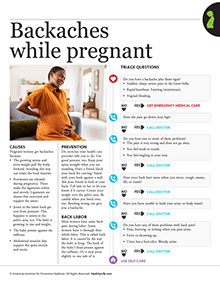
    Causes

    Pregnant women get backaches because:

    *  The growing uterus and extra weight pull the body forward. Standing this way can strain the back muscles.

    *  Hormones are released during pregnancy. These make the ligaments soften and stretch. Ligaments are tissues that surround and support the joints.

    *  Joints in the lower back get sore from pressure. This happens to joints in the pelvic area, too. The baby is growing in size and weight.

    *  The baby presses against the tailbone.

    Prevention

    Do exercises your health care provider tells you to do. Use good posture, too. Keep your spine straight when you are standing. Have a friend check your back for curving: Stand with your heels against a wall. Ask your friend to look at your back. Tell him or her to let you know if it curves. Center your weight over the pelvic area. Be careful when you bend over, too. Bending wrong can give you a backache.

    Back Labor

    Most women have some back pain during labor. Some women have it through their whole labor. This is called back labor. It is caused by the way the baby is lying. The back of the baby’s head presses against the tailbone. Or it may press slightly to one side of it. Back labor can occur in preterm labor, too.

    Questions to Ask

    Self-Care

    Tips for Good Posture

    When you stand:

    *  Stand straight.

    *  Tuck in your bottom.

    *  Don’t hollow your back.

    *  Don’t tighten your shoulders or hold them back. Keep them dropped.

    *  If you have to stand for a long time: Stretch your feet and shift your weight. Rest one foot and then the other on a footstool or telephone book.

    When you sit:

    *  Sit on a straight chair with a high back.

    *  Rest your back against the chair’s back.

    *  Put a pillow at the small of your back.

    *  Rest one or both feet on a footstool.

    *  Don’t sit too long. It strains your lower back. Get up and walk around.

    When you bend:

    *  To pick something up, squat down on your heels and bend your knees. Keep your upper body straight. Don’t lean over from the waist. Use the strength from your legs, not your back.

    *  To do something down low, kneel or squat. Or get down on all fours. That way, you help take the baby’s weight off your spine.

    When you lie down or sleep:

    *  Use a firm mattress. If you don’t have one, have someone help you place a board under your mattress. Or have someone put your mattress on the floor.

    *  Lie on your left side with your knees bent. Bend the upper knee more than the lower knee. Leave a lot of space between your legs.

    *  Put a pillow under your upper knee and leg.

    Other Self-Care Tips

    *  Don’t gain too much weight.

    *  Wear shoes with low (but not flat) heels.

    *  On a long car ride, stop every two hours. Get out and walk around.

    *  Don’t take medicine for pain. Ask your health care provider first.

    *  Don’t lift objects over 15 pounds.

    *  Don’t do exercises where you lift both legs at the same time.

    *  Do exercises for stronger back and belly muscles. Ask your health care provider for these.

    *  Do relaxation and deep breathing exercises. Do yoga.

    *  Have someone massage your lower back. Massage won’t cure a backache. It can loosen tight muscles, though.

    *  Apply warm, moist heat to your back. Use a hot water bottle or warm wash cloth.

    *  Ask your health care provider if you should wear a back support girdle, a back brace, or a special elastic sling.

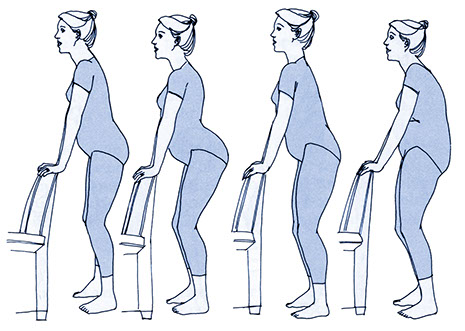
    *  Do an exercise called the “pelvic rock”. This exercise helps your lower back be more flexible. It helps make the muscles in your belly stronger.

    You can stand to do the pelvic rock.

    Step 1

    *  Stand 2 feet away from the back of a chair.

    *  Put your hands on the chair’s back. Keep your elbows straight.

    *  Bend a little forward from your hips.

    Step 2

    *  Push your hips backward and relax the muscles in your belly. Relax your back.

    *  Bend your knees a little.

    Step 3

    *  Slowly pull your hips forward.

    *  Tuck your buttocks under as if someone were pushing you from behind.

    Step 4

    *  Repeat steps 1, 2, and 3.

    Illustration of pregnant women doing the pelvic rock exercise while standing.

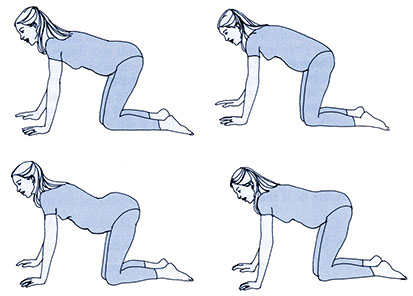
    You can do the pelvic rock on your hands and knees.

    Step 1

    Get down on all fours. Have your knees slightly apart. Have your back and elbows straight.

    Step 2

    Breathe in. As you breathe in, relax your back. Use the muscles in your lower belly.

    Step 3

    Breathe out. As you breath out, let your back relax down to a flat position. Do not let your back sag.

    Step 4

    Repeat steps 1, 2, and 3.

    {Note: Tell your health care provider if you get pain when you do the pelvic rock. Ask for help if you have a problem doing the pelvic rock.}

    Illustration of pregnant women doing the pelvic rock on hands and knees.
    Prenatal Self-Care book by the American Institute for Preventive Medicine. www.HealthyLife.com. All rights reserved.

    © American Institute for Preventive Medicine

  • More Than One Baby

    Pregnancy & Prenatal Care

    Causes

    Having more than one baby may happen more often if:

    *  There is a family history of it.

    *  The mother is taking medicine or having treatment to get pregnant.

    *  She is an older mother.

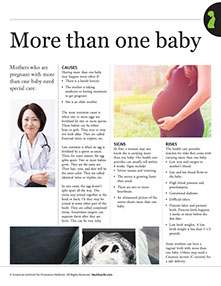
    More than one baby can happen in two ways. The most common way is when two or more eggs are fertilized by two or more sperm. These babies can be either boys or girls. They may or may not look alike. They are called fraternal twins or triplets, etc.

    Less common is when an egg is fertilized by a sperm as usual. Then, for some reason, the egg splits apart. Two or more babies grow. They are the same sex. Their hair, eyes, and skin will be the same color. They are called identical twins or triplets, etc.

    In rare cases, the egg doesn’t split apart all the way. The twins stay joined together at the head or back. Or they may be joined at some other part of the body. They are called conjoined twins. Sometimes surgery can separate them after they are born. This can be very risky.

    Signs

    At first, a woman may not know she is carrying more than one baby. Her health care provider can usually tell within 8 weeks, though. Signs include:

    *  Severe nausea and vomiting

    *  The uterus is growing faster than usual.

    *  There are two or more heartbeats.

    *  An ultrasound picture of the uterus shows more than one baby.

    Risks

    The health care provider watches for risks that come with carrying more than one baby.

    *  Low iron and oxygen in mother’s blood.

    *  Less and less blood flows to the baby.

    *  High blood pressure and preeclampsia.

    *  Gestational diabetes.

    *  Difficult labor

    *  Preterm labor and preterm birth. Preterm birth happens 3 weeks or more before the due date.

    *  Low birth weights. A low birth weight is less than 5-1/2 pounds.

    Some mothers can have a vaginal birth with more than one baby. Others may need a Cesarean section (C-section) for a safe delivery.

    Questions to Ask

    Self-Care / Prevention

    *  You will need more prenatal health care visits than with just one baby. You will need extra blood tests and blood pressure checks. Your provider will need to make sure each baby is doing well. Call your provider whenever you have questions during your pregnancy.

    *  Eat healthy foods.

    *  Eat smaller meals more often. This helps ease things as your growing uterus presses on your stomach.

    *  Take your prenatal vitamins (vitamin pills) every day. They should include iron and folic acid. They will supply other needed vitamins and minerals, too.

    *  Don’t smoke, drink alcohol, or take drugs.

    *  Exercise only with your health care provider’s consent. Women carrying more than one baby tire more easily. In later pregnancy, avoid any activity that takes a lot of energy. Avoid any activity that could injure you or your babies.

    *  Lie on your left side. This helps blood flow to the babies. It may help keep blood pressure down, too. It also makes you more comfortable. Don’t lie on your back.

    *  Reduce stress in your life. Stress can lead to early labor.

    *  Get enough sleep. Learn and use methods to relax.

    *  Follow your health care provider’s advice on rest during the day.

    *  Get help with daily tasks, like caring for other children. If you can, take time off from your job after the 24th week.

    *  Watch for signs of preterm labor. Your provider may have you wear an electronic monitor. It senses contractions of the uterus.

    *  Choose a well-equipped hospital. Do this with your health care provider’s help. The hospital should be well suited for births of more than one baby. Choose one with a neonatal intensive care unit (NICU). This has special staff and equipment for babies born too early.

    Prenatal Self-Care book by the American Institute for Preventive Medicine. www.HealthyLife.com. All rights reserved.

    © American Institute for Preventive Medicine

  • Birth Defects

    Pregnancy & Prenatal Care

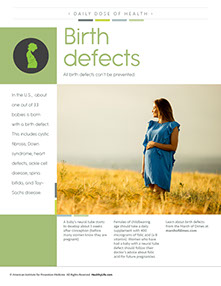
    Pregnant women standing in open field.

    In the U.S., about one out of 33 babies is born with a birth defect. This includes cystic fibrosis, Down syndrome, heart defects, sickle cell disease, spina bifida, and Tay-Sachs disease.

    A baby’s neural tube starts to develop about 3 weeks after conception (before many women know they are pregnant).

    Females of childbearing age should take a daily supplement with 400 micrograms of folic acid (a B vitamin). Women who have had a baby with a neural tube defect should follow their doctor’s advice about folic acid for future pregnancies.

    Learn about birth defects from the March of Dimes atmarchofdimes.com.

    Health at Home Lifetime book by the American Institute for Preventive Medicine. www.HealthyLife.com. All rights reserved.

    © American Institute for Preventive Medicine