Category: Pregnancy & Prenatal Care

  • Nausea And Vomiting

    Pregnancy & Prenatal Care

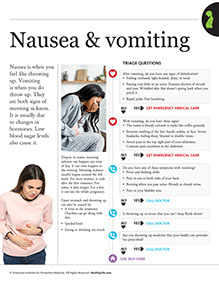
    Nausea is when you feel like throwing up. Vomiting is when you do throw up. They are both signs of morning sickness. It is usually due to changes in hormones. Low blood sugar levels also cause it.

    Despite its name, morning sickness can happen any time of day. It can even happen in the evening. Morning sickness usually begins around the 6th week. For most women, it ends after the first trimester. For some, it lasts longer. For a few, it can last the whole pregnancy.

    Upset stomach and throwing up can also be caused by:

    *  A virus in the intestines. Diarrhea can go along with this.

    *  Spoiled food

    *  Eating or drinking too much

    Questions to Ask

    Self-Care / Prevention

    *  Keep crackers or dry cereal by your bed. Eat a few crackers or a handful of dry cereal in bed. Do this before you lift your head up in the morning.

    *  Get up and out of bed slowly. If you can, sit in bed for a half-hour before you get up.

    *  Use these tips to keep your blood sugar from getting too low:

    – Eat small regular meals and snacks through the day. Focus on foods high in carbohydrates. Examples: whole grain breads and cereals, potatoes, pasta. More examples: rice, beans and other legumes, vegetables, fruits.

    – Have a good source of protein at each meal. Examples: low-fat milk, yogurt, low-fat cheese, dry beans, dry peas.

    – Have a snack before you go to bed at night. Have one if you wake up at night.

    – Avoid foods with high sugar content.

    – Don’t drink alcohol.

    *  Don’t smoke.

    *  Don’t eat fried or greasy foods. These foods have a lot of fat. Fat stays in the stomach for a long time. This can lead to nausea.

    *  Don’t eat spicy foods.

    *  Don’t take any medicine without your health care provider’s okay.

    *  Take your prenatal vitamins (vitamin pills) with meals. This helps prevent stomach upset. Your doctor may prescribe PremesisRx®. This is a vitamin that helps nausea.

    *  Ask your health care provider about taking ginger and in what form.

    *  Write down the times when your stomach is upset and when you throw up. These may happen only after you eat certain foods. Or they may happen with certain smells. Once you know what they are, you can avoid them.

    *  Stay away from smoke and smoky rooms. Even stay away from cooking smells.

    *  Get plenty of rest.

    *  Discuss any home remedies with your health care provider. Do this to make sure they are safe.

    *  Ask your health care provider about a relief band. That’s a wrist band that helps with an upset stomach and throwing up.

    *  If the Self-Care Tips bring no relief, call your health care provider. He or she can prescribe medicines. Sometimes, IV fluids are needed.

    *  To get rid of cooking smells and odors:

    – Open the windows.

    – Run fans in the house. Use the exhaust fan on the stove.

    – Use a portable air cleaner or air purifier.

    Prenatal Self-Care book by the American Institute for Preventive Medicine. www.HealthyLife.com. All rights reserved.

    © American Institute for Preventive Medicine

  • Hospital / Birthing Center Checklist

    Pregnancy & Prenatal Care

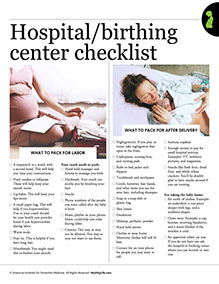
    What to Pack For Labor

    *  A watch with a second hand. This will help you time your contractions.

    *  Hard candies or lollipops. These will help keep your mouth moist.

    *  Lip balm. This will keep your lips moist.

    *  A small paper bag. This will help if you hyperventilate. You or your coach should let your health care provider know if you hyperventilate during labor.

    *  Warm socks

    *  Hair tie. This is helpful if you have long hair.

    *  Mouthwash. You might need this to freshen your mouth.

    Your Coach Needs to Pack

    *  Hand-held massager and lotions to massage you with

    *  Hairbrush. Your coach can soothe you by brushing your hair.

    *  Snacks

    *  Phone numbers of the people you want called after the baby is born

    *  Tape player and tapes or a radio. Music could help you relax during labor.

    *  Camera, tape recorder, video camera. These may or may not be allowed. You may or may not want to use them.

    What to Pack For After Delivery

    *  Nightgown(s). If you plan to nurse, take nightgowns that open in the front.

    *  Underpants, nursing bras, and nursing pads

    *  Robe or bed jacket

    *  Slippers

    *  Toothbrush and toothpaste

    *  Comb, barrettes, hair bands, and other items you use for your hair

    *  Shampoo

    *  Soap in a soap dish or plastic bag

    *  Skin lotion

    *  Deodorant

    *  Makeup, perfume, powder

    *  Hand held mirror

    *  Any other toilet items you use

    *  Sanitary napkins

    *  Clothes to wear home. Maternity clothes will still fit best.

    *  Pen and paper

    *  Address book with phone numbers for people you may want to call.

    *  Enough money to pay for small hospital services. Examples: TV, newborn pictures, newspapers, and magazines.

    *  Snacks like fresh fruit, dried fruit, and whole wheat crackers. You’ll be doubly glad to have snacks around if you are nursing.

    For Taking the Baby Home:

    *  An outfit of clothes. Example: an undershirt, a one-piece sleeper with legs, and a newborn diaper.

    *  Outer wear. Example: a cap, booties, receiving blanket(s), and a warm blanket if the weather is cold.

    *  An approved infant car seat. Do you already have one? If not, ask the hospital or birthing center where you can borrow or rent one.

    Prenatal Self-Care book by the American Institute for Preventive Medicine. www.HealthyLife.com. All rights reserved.

    © American Institute for Preventive Medicine

  • Safe Pregnancy After Age Thirty-Five

    Pregnancy & Prenatal Care

    Image of pregnant older women reading.

    Age is not the biggest factor in a healthy pregnancy. The biggest factor is the good health of the mother.

    Becoming pregnant after the age of 35, however, poses a number of potential problems. Chances for conception decrease with age. The incidence of miscarriage and premature birth is slightly higher in later-life pregnancies. So is the likelihood that the mother will develop diabetes or high blood pressure. The chances that a baby will be born with a genetic defect increases, too. So along with other health considerations, a pregnant woman in her mid-thirties or older should:

    *  Discuss with her doctor, in detail, her pregnancy plans, risk factors, and measures she needs to take for a healthy pregnancy.

    *  Talk to her doctor about prenatal genetic tests.

    About Amniocentesis

    Usually performed at about 16 weeks into the pregnancy, amniocentesis can detect Down’s syndrome, Tay-Sachs disease, sickle cell anemia, Rh incompatibility, and spina bifida. (Amniocentesis will also reveal the sex of the child, but it’s never done for that purpose alone.) The doctor uses a long needle to draw out a sample of amniotic fluid, which is tested for genetic abnormalities. The test itself presents some risk-there is about 1 chance in 100 to 1 chance in 200 that a miscarriage may occur.

    Amniocentesis is justified under the following conditions.

    *  The pregnant woman is 35 years old or older or requests genetic testing.

    *  Someone in the mother’s or father’s immediate family (a parent, sibling, or child) has a genetic or metabolic disorder.

    *  There is a family history of hemophilia (a bleeding disorder) or spina bifida (a neural tube defect).

    *  An earlier pregnancy produced a baby with chromosome abnormalities.

    Amniocentesis can’t detect abnormalities such as a club foot or cleft palate, so normal results don’t necessarily guarantee a normal baby. Another technique called chorionic villous sampling (CVS) analyzes a small sample of the placenta and can be performed earlier than amniocentesis, (between weeks 8 and 12 of the pregnancy). The earlier testing is done, the more time the prospective parents and their doctor have to decide on the best course of action.

    A Year of Health Hints book by the American Institute for Preventive Medicine. www.HealthyLife.com. All rights reserved.

    © American Institute for Preventive Medicine

  • Bleeding

    Pregnancy & Prenatal Care

    Pregnant women sometimes have light spotting. That’s when a tiny bit of blood leaks from the vagina or the surface of the cervix. It may happen after a vaginal exam. It may also happen after sex. If the blood starts out pink or red and turns dark brown, it is not active bleeding. This is not usually a problem. But let your health care provider know when there is any bleeding. He or she will decide what to do. Bleeding can be a sign of a problem if:

    *  The blood is bright red.

    *  Pain or cramps are present, too.

    *  The bleeding is heavy. Heavy means the bleeding soaks a sanitary pad.

    *  The spotting keeps going on.

    Causes

    Before the 20th week, bleeding could be, but is not always, a sign of miscarriage. Other causes of bleeding include:

    *  Loss of the mucus plug

    *  Kidney infection

    *  Preterm labor

    *  Placenta previa and other problems called vasa previa and marginal previa

    *  Placenta abruptio

    *  Swollen cervix

    Placenta Previa

    The placenta carries oxygen and food to the baby. In most pregnancies, the placenta attaches high in the uterus. In placenta previa, it attaches low, over the cervix. The lower uterus stretches during late pregnancy. Parts of the placenta tear from the wall. That causes bleeding.

    Placenta previa is rare. It happens in only 1 in 200 pregnancies. Its cause is not known. Falls and injuries are not factors. Symptoms of placenta previa are:

    *  Bright red vaginal bleeding. This could start as early as the 24th week. Often, it starts during the 34th or 35th week.

    *  Usually, there is no pain or cramping.

    A woman may not know that she has placenta previa until bleeding happens. Then an ultrasound test can show the problem.

    Women with placenta previa have to spend a lot of time in bed. Bed rest may last late into the pregnancy. Bed rest gives the baby time to grow. It prevents stress to the uterus. The goal is to keep blood loss down. A lot of blood loss means danger for both mother and baby. In severe cases, the mother may have to go to the hospital for treatment.

    In some cases, the bleeding stops, but the placenta blocks the cervix. The mother will need a Cesarean section (C-section) delivery if the placenta completely blocks the cervix. The mother may need a C-section if the placenta only partly blocks the cervix. When this happens, the mother may have more bleeding after she delivers the baby.

    {Note: Some pregnant women may have a “low lying placenta.” This means the placenta lies at the bottom of the uterus (not higher where it should be). An ultrasound can show a “low lying” placenta. If it is found before the 24th week, the placenta can move upward and out of the way of the cervix. If so, there is no longer a problem.}

    Placenta Abruptio

    There is a right time for delivery of the placenta. That’s after the baby is born. But sometimes it happens another way. The placenta starts to leave the wall of the uterus too early. It starts before the baby is born. This can happen whether the placenta is attached high or low.

    Placenta abruptio happens in about 1 in 200 pregnancies. Some cases are more serious than others. Causes might be high blood pressure or a serious blow to the belly. An older mother may be more apt to have placenta abruptio. So are women who use cocaine during pregnancy. Symptoms of placenta abruptio are:

    *  Bright red vaginal bleeding

    *  Severe pain in the abdomen. The pain lasts. It doesn’t come and go.

    There are no tests for placenta abruptio. Even ultrasound may not show it. Regular prenatal visits help. The health care provider looks for blood in the mother’s vagina. The provider finds out if the uterus is tender.

    Women with placenta abruptio need to go to the hospital right away. Some women can have a vaginal delivery. That’s if labor begins on its own and the baby is healthy. Otherwise, a C-section is done. The mother may be given blood.

    Questions to Ask

    Self-Care / Prevention

    *  Watch closely for bleeding. If you see any, call your health care provider.

    *  Rest in bed for light bleeding.

    *  Avoid doing things that could injure you. Examples: heavy lifting, hard exercise. Don’t do work, sports, or exercises that could give you a blow to the belly.

    *  Wear a special seat belt when you drive. You can get one that protects a pregnant woman’s belly.

    *  Don’t smoke.

    *  Don’t be exposed to other people’s smoke.

    *  Follow your health care provider’s advice about sex. You may be told to:

    – Avoid sex.

    – Use extra caution during sex:

    – Your partner can focus on more gentle touching.

    – Limit how deeply the penis enters the vagina. Use positions that help control the depth.

    Prenatal Self-Care book by the American Institute for Preventive Medicine. www.HealthyLife.com. All rights reserved.

    © American Institute for Preventive Medicine

  • How Your Body Changes, How Your Baby Grows

    Pregnancy & Prenatal Care

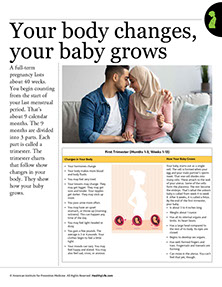
    A full-term pregnancy lasts about 40 weeks. You begin counting from the start of your last menstrual period. That’s about 9 calendar months. The 9 months are divided into 3 parts. Each part is called a trimester. The trimester charts that follow show changes in your body. They show how your baby grows.

    First Trimester

    (Months 1-3, Weeks 1-13)

    Changes in Your Body

    *  Your hormones change.

    *  Your body makes more blood and body fluids.

    *  You may feel very tired.

    *  You pass urine more often.

    *  You may have an upset stomach, or throw up (morning sickness). This can happen any time of the day.

    *  You may feel light-headed or dizzy.

    *  You gain a few pounds. The average is 3 or 4 pounds. Your clothes begin to feel a little tight.

    *  Your moods can vary. You may feel happy and elated. You may also feel sad, cross, or anxious.

    *  Your breasts may change.

    – They may get bigger.

    – They may get sore and tender.

    – Your nipples get darker. They may stick up more.

    How Your Baby Grows

    Your baby starts out as a single cell. The cell is formed when your egg and your male partner’s sperm meet. That one cell divides into many cells. These attach to the wall of your uterus. Some of the cells form the placenta. The rest become the embryo. That’s what the unborn baby is called from week 4 to week 8. After 8 weeks, it is called a fetus. By the end of the first trimester, your baby:

    *  Is about 3 to 4 inches long

    *  Weighs about 1 ounce

    *  Has all its internal organs and limbs. Its heart beats.

    *  Has a large head compared to the rest of its body. Its eyes are closed.

    *  Begins to develop sex organs

    *  Has well-formed fingers and toes. Fingernails and toenails are forming.

    *  Can move in the uterus. You can’t feel that yet, though.

    Second Trimester

    (Months 4-6, Weeks 14-27)

    Changes in Your Body

    *  You probably feel really good during this trimester. Most women do.

    *  You start to look pregnant as your belly expands. You gain about a pound a week. Loose or maternity clothes feel best.

    *  Your heart beats stronger. This helps push the extra body fluids around your body. It helps push them into the placenta, too.

    *  You start to feel your baby move. This usually starts between weeks 15 and 20 with a first baby. It may come earlier than that with babies after the first one. First you feel flutters. Then you feel kicks.

    *  Your breasts get ready to make milk.

    *  Your uterus starts to stretch out and get thinner.

    *  You may notice that you have:

    –  Backache

    –  Constipation

    –  Headache

    –  Mood swings

    –  Braxton-Hicks contractions

    –  Mild swelling of the ankles and feet

    –  Less morning sickness or none at all

    –  Less need to pass urine

    –  Bigger appetite

    –  Heartburn

    –  Larger veins in your hands and arms

    –  Stretch marks on your breasts and belly

    –  Leg cramps at night

    None of these is apt to change your sense of well-being, though.

    How Your Baby Grows

    Your baby begins to grow fast. Its organs mature. By the end of the second trimester, your baby:

    *  Is about 11 to 14 inches long

    *  Weighs about 2 to 2-1/2 pounds

    *  Swallows

    *  Sucks its thumb

    *  Moves and kicks

    *  Has wrinkly skin. Its skin is covered by a thick, white coating called vernix.

    *  Has hair growing on its head

    *  Has teeth forming in the jawbone

    *  Can open and close its eyelids

    *  Has eyes that are almost fully developed. Eyebrows and eyelashes start to grow.

    Third Trimester

    (Months 7-9, Weeks 28-40)

    Changes in Your Body

    You gain about a pound a week until the final few weeks. Then you may stop gaining weight or lose a pound or two. As the baby grows, your uterus and belly expand. You feel lots of pressure on your bladder. You need to pass urine more often.

    The baby pushes up on the bottom of your rib cage. The baby pushes up on the diaphragm. This can cause you to feel short of breath.

    The baby makes stronger movements and moves more often. You can feel its head, elbows, and feet as they push against your belly. You may be able to see the baby’s kicks! You may notice that:

    *  You feel hot and you sweat more than usual.

    *  A yellow liquid leaks from your breasts.

    *  Your hands and feet swell.

    *  Your navel may look flat or stick out.

    *  You feel tired.

    *  You have mood swings.

    Toward the very end of this trimester (near your due date):

    *  You may feel your uterus getting tight and hard.

    *  You may have “practice” contractions. These stop when you move your body or walk around.

    *  The baby “drops” into your pelvis. It is easier for you to breathe. It also makes you need to pass urine more often.

    *  You lose the mucus plug. You usually lose it shortly before delivery. It’s called bloody show then. You may notice it as a thick, stringy discharge for days. Or you may pass a big clump that looks like a wet cotton ball. Some women never notice the bloody show.

    How Your Baby Grows

    Your baby keeps growing and gaining weight. During this trimester, your baby:

    *  Grows to about 20 inches long

    *  Gains weight to 7 pounds or more

    *  Fills the uterus

    *  Opens and closes its eyes

    *  Responds to light and sound

    *  Moves a lot. Its movements are more like rolls and turns instead of kicks. These may slow down close to labor. But the baby does not stop moving before birth. Tell your health care provider if you notice a big decrease in your baby’s activity.

    *  Settles further down into your pelvis. Your baby is getting ready to be born!

    Prenatal Self-Care book by the American Institute for Preventive Medicine. www.HealthyLife.com. All rights reserved.

    © American Institute for Preventive Medicine

  • Pregnancy Tests

    Pregnancy & Prenatal Care

    How can you find out for sure if you are pregnant? Do a home pregnancy urine test. You can do one yourself. Facts about these tests:

    *  They test for a hormone called HCG. HCG is present in the urine only during pregnancy.

    *  You can buy them over-the-counter. Look for them at the drug store or supermarket.

    *  They are 95 to 100% error-free. But you have to do what the label says.

    *  They come in many brands. Some brands include a second test in the package.

    *  They are not all used the same way. Read the label to find out what to do. Some can be used the day after you miss a period. That’s about 14 days after conception. Some have you wait 3 to 5 days after you miss a period. Some have you use your first morning urine sample.

    {Note: If your test is positive, call your health care provider. Make a date to be seen. Ask what prenatal vitamins (vitamin pills) you should take. Do this if you are not already taking them. It is a good idea to start taking prenatal vitamins before you get pregnant and right at the start of pregnancy. Doing this, especially getting enough folic acid, may prevent some birth defects. Prenatal vitamins will supply the minerals you need, too.}

    *  Get a lab or in-office urine test. Ask your health care provider to order one. Facts about these tests:

    – They test for HCG in the urine.

    – They are nearly 100% error-free.

    – They can confirm pregnancy 7 to 10 days after conception.

    *  Get a blood test. Ask your health care provider to order it. Facts about these tests:

    – They test for HCG in the blood.

    – They are 100% error-free.

    – They can confirm pregnancy 7 days after conception. That’s even before you miss a period.

    Always follow up your pregnancy test with a medical exam. Your health care provider can see signs of pregnancy by or even before the 6th week!

    Prenatal Self-Care book by the American Institute for Preventive Medicine. www.HealthyLife.com. All rights reserved.

    © American Institute for Preventive Medicine

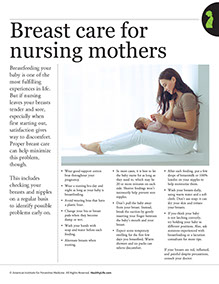
  • Breast Care For Nursing Mothers

    Pregnancy & Prenatal Care

    Image of women with newborn baby.

    Breast-feeding your baby is one of the most fulfilling experiences in life.  But if nursing leaves your breasts tender and sore, satisfaction gives way to discomfort. Proper breast care can minimize this problem, though.

    *  Wear good support bras throughout your pregnancy.

    *  Wear a nursing bra day and night as long as your baby is breast-feeding.

    *  Avoid wearing bras that have a plastic liner.

    *  Change your bra or breast pads when they become damp or wet.

    *  Alternate breasts when nursing.

    *  Avoid nursing your baby more than 20 minutes at a time on each breast.

    *  Don’t pull the baby away from your breast. Instead, break the suction by gently inserting your finger between the baby’s mouth and your breast.

    *  Expect some temporary swelling for the first few days you breast-feed. Warm showers and ice packs can relieve discomfort.

    *  Wash your breasts daily, using warm water and a soft cloth. Don’t use soap; it can dry your skin and irritate your breasts.

    If your breasts are red, inflamed. and painful despite precautions, consult your doctor.

    A Year of Health Hints book by the American Institute for Preventive Medicine. www.HealthyLife.com. All rights reserved.

    © American Institute for Preventive Medicine

  • Prenatal Health Care Visits

    Pregnancy & Prenatal Care

    How Many Visits

    How often will you need to see your prenatal health care provider? That depends on:

    *  Your medical history and needs

    *  How your pregnancy is going

    *  The provider’s advice

    Call your health care provider when you think or know you are pregnant. Ask to be seen. A common schedule for prenatal visits is:

    *  A first visit.

    *  About once a month for the first six months

    *  Every 2 weeks for the 7th and 8th months

    *  Every week after that until the baby is born

    You and your provider will schedule the exact dates of all of your visits.

    The First Visit

    Facts about the first prenatal visit:

    *  It confirms whether or not you are pregnant.

    *  It gives you a “due date.” That’s the date your baby is likely to be born.

    *  It takes longer than the rest of the visits.

    *  It gives you and your health care provider a lot of information.

    At the first visit, your health care provider will probably:

    *  Do a urine test or a blood test to make sure that you are pregnant.

    *  Ask questions about your medical history and your family’s medical history.

    *  Talk about depression, physical abuse, and safety concerns.

    *  Do a complete physical exam to check:

    – Your height and weight. These are used to get your body mass index (BMI) number. This tells if your weight is okay or too high or too low.

    – Your blood pressure

    – Your heart and lungs

    – Your ears, nose, and throat

    – Your breasts

    – Your abdomen

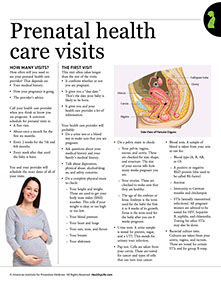
    *  Do a pelvic exam to check:

    – Your pelvis, vagina, uterus, and cervix. These are checked for size, shape, and structure. The size of your uterus tells how many weeks pregnant you are.

    – Your ovaries. These are checked to make sure that they are healthy.

    – The age of the embryo or fetus. Embryo is the term used for the baby the first 4 to 8 weeks of its growth. Fetus is the term used for the baby after you are 8 weeks pregnant.

    Do some other tests:

    * Blood tests. A sample of blood is taken from your arm to test for:

    – Blood type (A, B, AB, or O)

    – A positive or negative D blood type (this used to be called Rh factor)

    – Anemia

    – Immunity to German measles and chickenpox

    – STDs (sexually transmitted diseases). All pregnant women are advised to be tested for HIV, hepatitis B, syphilis, and chlamydia. Testing for other STDs may also be done.

    *  Bacterial culture tests:

    – Cell cultures are taken from your cervix, vagina, and rectum.

    – These are tested for certain STDs and for group B strep.

    *  Urine tests. A urine sample is tested for protein, sugar, and a UTI. This stands for urinary tract infection.

    *  Pap test. Cells are taken from your cervix. These are tested for cancer and types of cells that can turn into cancer.

    Rest of the Visits

    At later visits, you can expect your health care provider to:

    *  Weigh you.

    *  Feel your abdomen. This checks for the height of the uterus and the position of the baby.

    *  Take your blood pressure.

    *  Test your urine for protein and sugar.

    *  Test your blood for anemia.

    *  Give you a vaccine to help protect you from the flu. Your health care provider decides if vaccines are needed.

    *  Check for signs of swelling in your ankles, hands, face, and feet.

    *  Listen for your baby’s heartbeat (after the 10th week).

    *  Take a blood sample for a “quad marker screen.” This tests for four substances in the blood. High or low levels of the four substances can screen for certain birth defects. Other tests would need to be done to confirm a birth defect. Birth defects happen in only a very small number of babies, though. This test is done between weeks 15 and 20. You may be able to choose if you have this test or not.

    *  Ask you if you have started to feel your baby move.

    *  Test you for gestational diabetes. A test is done for this between weeks 24 and 28. It is done even when urine tests don’t show sugar. But it may be done earlier if a routine urine test shows sugar. It also may be done earlier if you are at high risk for diabetes.

    *  Do a second blood test from your arm.

    *  Test a second cell culture from your vagina and rectum (between weeks 35 and 37). This checks for group B strep. A cell culture test may also be done as early as week 32 if you have a lot of vaginal discharge or if you have a history of preterm labor. That’s when labor happens 3 or more weeks before your due date.

    What actually happens at each visit will depend on your needs at the time.

    Special Tests

    Ultrasound

    This test shows the baby’s position. It shows how the baby is growing. Your bladder should be full for this test. Here is what happens during an ultrasound:

    *  A gel is rubbed on your belly.

    *  A hand-held device is passed over your belly. It doesn’t hurt at all.

    *  The test usually lasts 5 to 10 minutes. It can take up to 45 minutes. This will depend on the baby’s position and movement.

    *  Sound waves and a TV-like screen give a picture, which you can see, of your baby.

    You may be given a video or printed copy of the picture. If so, ask your health care provider to explain it. The picture may show if your baby is a girl or boy. Would you rather keep the baby’s sex a surprise? If so, tell your provider before you have your ultrasound. That way, no one will let the secret slip. You see the picture only if it doesn’t show the baby’s sex.

    An ultrasound may be done to:

    *  Find an IUD that was in place at conception

    *  Tell the age of the fetus

    *  Show how the fetus is lying before amniocentesis and CVS tests.

    *  See if you are carrying more than one baby

    *  Diagnose some birth defects (if done around 19 weeks by a doctor certified in OB ultrasound)

    *  Identify the source of any problems

    Ultrasound is thought to be safe for both mother and baby. It is usually done between weeks 18 and 20 of the pregnancy. It may be done between weeks 10 and 14 if the baby is at high risk for Down’s syndrome.

    Amniocentesis

    Amniocentesis. This is a test for certain birth defects. It can also show how mature the fetus’s lungs are. The test takes about an hour. It is usually done between weeks 15 and 20. It can, though, be done at any time up to delivery, if needed. Here is what happens during amniocentesis:

    *  An ultrasound test locates the fetus and placenta.

    *  A needle is put into the uterus. The needle enters through the wall of the mother’s abdomen.

    *  The doctor uses ultrasound to guide the needle. The needle is put in an area away from the developing baby.

    *  Only two-thirds of an ounce of amniotic fluid is taken out. The fluid is sent to a lab.

    Amniocentesis will show the baby’s sex. But it is never done for that purpose alone. That’s because there is about 1 chance in 100 to 1 chance in 200 that the mother may miscarry. This could happen within 3 weeks after the test. Amniocentesis is not a routine test. It tests for genetic problems if:

    *  The mother is over age 35 or asks to have genetic testing.

    *  The mother or her partner has a parent, brother, sister, or child with a genetic or metabolic problem.

    *  The mother has had a baby with a defect in the past.

    *  The mother has a family history of special problems, such as hemophilia (a bleeding disorder) or spina bifida.

    *  Both mother and father are Ashkenazi Jews. These Jewish people are from Eastern European descent. A person of this ethnic group has a 1 in 4 chance of carrying the gene for Tay-Sachs disease. If both parents carry this gene, there is a 1 in 4 chance that their baby will get Tay-Sachs disease.

    It may feel scary to read about amniocentesis. Even if you have the test, it doesn’t mean your baby will have a birth defect. In fact, most tests give normal results.

    Amniocentesis may be done later in a pregnancy to find out if the baby’s lungs are mature enough for the baby to be able to breathe on its own after birth.

    CVS

    CVS stands for chorionic villus sampling. It shows birth defects early in a pregnancy. It is usually done during weeks 10 to 12. In CVS, ultrasound is used to help take a sample of the fetal membrane. The sample is taken from the uterus through the vagina and cervix. Or the fetal membrane sample can be taken from the wall of the mother’s abdomen in the same way as with amniocentesis. The sample is sent to the lab. Like amniocentesis, cells can be grown to look for genetic problems. But CVS can find these sooner, because it is done earlier in the pregnancy.

    CVS can’t show how mature the fetus’s lungs are. It does not test AFP. This is a protein in the blood. It is one of the four substances in the “quad marker screen.” The risk that the mother may miscarry is small. A CVS test should be done at centers that do a lot of CVS tests. A Maternal Fetal Medicine Specialist is skilled in doing this test.
    Prenatal Self-Care book by the American Institute for Preventive Medicine. www.HealthyLife.com. All rights reserved.

    © American Institute for Preventive Medicine

  • Choosing Your Health Care Provider

    Pregnancy & Prenatal Care

    Read the options below. Discuss them with your health insurance carrier. Do this before you get pregnant. Who you choose will partly depend on:

    *  Your health insurance coverage.

    *  You may need to choose from a certain list. Find out who is on it. Ask if there is a waiting period for maternity coverage.

    *  The health care providers in your area

    Your personal wishes are important, too. For example, do you prefer a female or a male provider? Do you want a provider who works alone? Or do you want one in a group practice?

    Where You Can Give Birth

    Where do you want to have your baby? These are places to think about:

    *  Hospitals. There may also be choices within hospitals. These could be:

    – Regular delivery room. Your family may be able to be with you here.

    – Birthing center or birthing room. Your family can be with you here.

    – Special high-risk pregnancy section. Sometimes mothers and newborns need high-risk care. Some hospitals offer high-risk care. Find out what services local hospitals can offer.

    *  Birthing centers not inside hospitals. These are sometimes called alternative birthing centers. They are for low-risk pregnancies. Find out what hospital is used when special needs arise.

    {Note: Your special needs during pregnancy may determine where you can have your baby. Do not plan a home birth. It is not safe for you and your baby.}

    Types of Providers

    *  OB/GYN (obstetrician/gynecologist). This doctor gives prenatal and delivery care. That care ends 6 weeks after delivery. The OB/GYN treats women when they’re not pregnant, too. You may already have an OB/GYN. If you do, you could choose this provider for your pregnancy. Most women choose an OB/GYN. If you belong to an HMO, you may need a referral for an OB/GYN. A referral is when your primary care provider says you need a special doctor. You don’t need a referral if the OB/GYN is your primary care provider. You also don’t need a referral if your HMO lets you pick an OB/GYN plus a primary care provider.

    *  Family practice doctor. A family practice doctor can act as an OB/GYN, an internist, and a pediatrician. That means the provider can give you prenatal care and deliver your baby. You and your child can both go on seeing this same provider afterward. But if you need a cesarean section (c-section), you will need an OB/GYN.

    *  Maternal and fetal medicine specialist. This provider may be needed to help with high-risk pregnancies. Your primary care doctor or your OB/GYN would give you a referral if he or she can’t provide the care needed for your high-risk problems.

    *  Infertility specialist. This provider helps persons who want to get pregnant, but haven’t been able to after trying for a year. You may want to see this doctor if your regular OB/GYN cannot help you with your needs.

    *  Certified nurse-midwife. This provider cares for women with low-risk pregnancies. The nurse-midwife is trained to handle low-risk births. Be sure he or she works with a medical doctor. A lay midwife cannot provide total care. Find out if your insurance will pay for a nurse-midwife. Be sure the midwife is certified. Call the American Midwifery Certification Board (AMCB) at 866.366.9632 or go to its Web site:www.amcbmidwife.org.

    How to Find a Provider

    There are a lot of ways to find providers who might suit you:

    *  Look in the directory of providers from your health insurance carrier.

    *  Ask your regular doctor or specialist.

    *  Do you have any friends who had a baby recently? Are their ideas about having babies like yours? Ask them.

    *  Call information at the hospital you want. Ask for the name and phone number of the nurse in charge of the maternity section. Ask for the name and phone number of a resident in obstetrics who works at that hospital. A resident is a doctor who is in training. Ask for the “Physician Referral Service.” Call any or all of them and ask what doctor(s) they recommend.

    *  Call the medical school closest to you. Ask which obstetricians it recommends.

    *  Ask your county medical society.

    *  Look in the Directory of the American Medical Association. Ask for this at your doctor’s office or library.

    *  Look in the Directory of Medical Specialties for OB/GYNs. Your doctor’s office or library should have this, too.

    *  Look for a doctor who can take care of special needs you may have.

    *  Do you want a doctor with a high interest in prepared childbirth? Prepared childbirth is a special approach. The pregnant mother goes to classes. Her partner or other childbirth “coach” goes with her. They both learn ways of helping the birth happen, like special breathing. The doctor works with the mother in this approach to childbirth.

    How to Follow Up with a Provider

    Have you found some likely prospects? Now you can:

    *  Call the American Board of Medical Specialties at 866.275.2267 or go to its Web site:www.abms.org. Find out if the provider is properly trained and licensed.

    *  Ask yourself some questions.

    – Do you think you could work well with the provider?

    – Does the provider’s office seem to be managed well?

    *  Ask the provider some questions. You may be able to do this on the phone. (You may be charged an office visit for the phone call.) Or you may need to make a date to meet in person. Here are some questions to ask. You will think of others.

    – Does the provider accept your health insurance? What do services cost? How must payment be made? How much do you have to pay?

    – What hospital(s) does the provider use?

    – Is the hospital accredited? The Joint Commission on Accreditation of Healthcare Organizations (JCAHO) does this.

    – Does the hospital have a birthing center or birthing room?

    – Does it have a Level III neonatal intensive care unit (NICU)?

    – Can fathers and other persons be with you in the delivery room? In the operating room?

    – Will the provider be the one who delivers your baby?

    – Does the provider have partners who share the practice? If so, what would their roles be?

    – Would a resident deliver your baby? A resident is a doctor in training.

    – How would you reach your OB/GYN or health care provider? Would this differ at certain times of day or night? For emergencies?

    – Who would take care of you when your health care provider is away?

    – What is the provider’s Cesarean section (C-section) rate? If the rate is more than 35%, ask why.

    – For what reasons does the provider do a C-section?

    – Does the provider prefer a certain form of pain relief? If so, what and why?

    – At the place you will deliver, can you get anesthetics for an epidural any time of the day or night? An epidural is an anesthesia that can block most of the pain during labor and delivery.

    – What else can be given for pain?

    You can talk to two or more providers. Compare the answers you get. Then you can decide who will give you care and deliver your baby.

    Prenatal Self-Care book by the American Institute for Preventive Medicine. www.HealthyLife.com. All rights reserved.

    © American Institute for Preventive Medicine