Category: Fitness

  • Don’T Be A Distracted Walker

    BE FIT

    Women walking and talking on the phone.

    Walking is great exercise, and it doesn’t require training or special equipment. But if you’re using a phone or playing music, you could be putting yourself at risk. While it may seem strange to talk about distracted walking, it does happen – and people can get seriously hurt.

    Don’t text while walking.

    You could trip on an object or crack in the sidewalk. Or, you could run into another person or worse, walk in front of a vehicle.

    If you wear headphones, keep the volume low.

    Walkers who play loud music may raise their risk of injury because they aren’t aware of their surroundings.

    If you want to chat, use an earpiece in one ear only.

    A single earbud allows you to hear out of the other ear while walking. And, you won’t have to worry about hurting your arm or your neck to hold your phone.

    © American Institute for Preventive Medicine

  • Kids, Puberty & Sports

    BE FIT

    Adult and teen playing basketball.

    Sports can be a great way for kids to develop social skills, teamwork and resilience. But it’s important to know that athletic ability changes as kids grow.

    Growth affects performance

    During puberty, boys and girls have a growth spurt that can change their athletic ability. After going through puberty:

    *  Boys may notice more muscle strength and overall bigger body size.

    *  Girls often lose some muscle mass. They may temporarily lose some of their speed or agility.

    *  Kids could feel “clumsy” as they adjust to being taller. The brain hasn’t yet adjusted to this new height and may affect balance skills or body control.

    *  It may be harder to throw or hit a ball with longer arms.

    *  Girls may have headaches, mood swings or cramps during menstruation.

    Puberty & knee injuries

    As kids get taller and heavier, they have a higher risk of anterior cruciate ligament (ACL) injury. The ACL is an important ligament that supports the knee.

    ACL injuries can be serious. They may require surgery and can increase the risk of knee arthritis later in life.

    Most ACL injuries happen when a person suddenly stops, changes direction, jumps or lands on the ground. They don’t usually happen from a blow to the knee. Sometimes an ACL injury causes a “popping” sound as it occurs.

    ACL injuries may cause swelling, severe pain, and inability to put weight on the knee. If your child injures their knee, see a doctor right away.

    Positive support is key

    Coaches who know about the effects of puberty can help kids. In addition, parents can help their kids by being positive and supportive. Yelling at kids or being put down may cause them to quit their sport. Remember that changes caused by puberty are only temporary.

    Source: American Academy of Pediatrics

    © American Institute for Preventive Medicine

  • 10 Minutes Of Fitness

    BE FIT

    Man working out at home.

    Making time for 30 minutes of exercise can feel like a deal breaker in our busy lives. But devoting just 10 minutes to movement several times during the day adds up. And breaking your movement goals into manageable chunks may increase the chance you’ll meet your body’s needs.

    So, set a timer and try these 10 minutes fitness activities. Go at your own pace and make it fun:

    *  Do as many rounds of 10 push-ups, 10 squats, and 10 lunges as you can in 10 minutes.

    *  Find some stairs and walk up and down for 10 minutes.

    *  Take a brisk walk around the block or inside your home or office building.

    *  Turn on some music and dance for 10 minutes.

    *  Play a quick round of tag, basketball, or any active game with your kids.

    *  Set a timer and speed clean your home or office, incorporating as many squats and lunges as possible.

    © American Institute for Preventive Medicine

  • Consider An Exercise Stress Test

    Fitness

    Image of man performing a stress test.

    An exercise stress test measures the heart’s response to physical exertion and can give your doctor an idea of how safe it would be for you to exercise and at what intensity you can exercise with relative safety. If you undergo an exercise test, your doctor will ask you to either pedal a stationary bike or walk on a motorized treadmill that increases in speed or grade. Electrodes placed on your chest will monitor your heart activity. Your blood pressure will be monitored, too.

    Should you have an exercise stress test? According to the National Heart, Lung, and Blood Institute, exercise stress testing isn’t routinely done to screen for problems, such as coronary artery disease (CAD). Usually, you will have to have symptoms of CAD before a doctor recommends exercise stress testing.

    You should check with your doctor about the need for an exercise stress test. In general you may be advised to have an exercise stress test if:

    *  You plan to start a vigorous exercise program and you are a male over the age of 45 or a female over the age of 55, especially if you have:

    – Diabetes or kidney disease.

    – Very high blood pressure.

    – Very high LDL (bad) blood cholesterol.

    – A family history of heart disease or many risk factors for it.

    *  You have chest pain during physical activity.

    *  You have a diagnosed heart ailment, lung disease, or metabolic disorder.

    *  You feel faint, get a rapid heartbeat, or feel a fluttering feeling in your chest when you exercise.

    *  You get short of breath at rest or when you exercise.

    *  You have had an abnormal resting electrocardiogram (ECG).

    Page image from A Year of Health Hints book by the American Institute for Preventive Medicine. www.HealthyLife.com. All rights reserved.

    © American Institute for Preventive Medicine

  • Give Water Exercise A Try

    Fitness

    Water exercise class in session.

    Water exercise (or aquatic exercise, as it’s sometimes called) is popular among people of all ages. Buoyed up by water, you feel light as a feather, and you can move in ways that are otherwise difficult or impossible yet still tone your muscles and improve your circulation, breathing, and endurance. You weigh 90 percent less in water than you do on land, easing the burden on weight-bearing joints like your hips, knees, and back. That means many people who find it difficult or painful to jog or perform other kinds of weight-bearing activities find it easier to work out in water. Water exercises take place in the shallow end of a pool, in waist- to chest-deep water, and you can usually hold on to the side of the pool for safety and comfort.

    Swim the English Channel (or Its Equivalent)

    Imagine the pride you’d feel if you could tell people, “I swam the English Channel.” As remarkable as it may sound, you can achieve such a feat, without leaving your hometown. Here’s how: Assuming one lap equals 60 feet, keep track of how many laps you swim and convert that figure into miles once a week. The English Channel is 21 miles wide which is the equivalent of 1,848 laps. You can apply this motivational tool to walking, bicycling, stair climbing, or running. Using the following table, decide on a goal-climbing a well-known mountain or skyscraper, swimming a famous body of water, walking to a faraway city. Then figure out the distance and get moving.

    Water exercise is excellent for people who:

    *  Are over 50 years old.

    *  Suffer joint pain.

    *  Have weak leg muscles or back problems.

    Page image from A Year of Health Hints book by the American Institute for Preventive Medicine. www.HealthyLife.com. All rights reserved.

    © American Institute for Preventive Medicine

  • Take That First Step

    Fitness

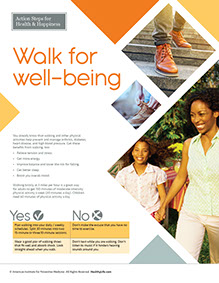
    Smiling women walking with walking sticks.

    Walking is one of the most beneficial, and safest, exercises you can do. That makes walking a great way to start if you’re just beginning an exercise routine. It’s also ideal for weight loss. And, it’s a great way to exercise with friends! Set a target for the number of steps you want to walk each day or week. Over time, you can increase the number of steps, or the intensity, by walking faster or including hills. Aim for at least 150 minutes of exercise each week.

    Be More Earth-Friendly

    Motor vehicles are responsible for significant amounts of greenhouse gas emissions in the U.S. Choose to walk rather than drive to help reduce air pollution and greenhouse gases.

    Page from HealthyLife Weigh book by the American Institute for Preventive Medicine. www.HealthyLife.com. All rights reserved.

    © American Institute for Preventive Medicine

  • Encourage Exercise In Others

    BE FIT

    Image of man and women doing pushups.

    Sticking to an exercise routine can be hard. But sometimes getting support from another person can help you get started. If you’ve been able to work out regularly, you can help a loved one do the same. Be a positive force in their life by supporting them, not forcing them. Try these strategies that can encourage them without pressure.

    *  Make it doable. Don’t suggest signing up for difficult classes or workouts right away. A walk in the evening or doing push-ups while watching TV can be less overwhelming.

    *  Try something new. A new walking route, different stretches or a fun strength program may help them get motivated. Get away from the same old routine that may not have worked in the past.

    *  Let them pick. See if they are interested in any local exercise classes or programs – and go with them.

    *  Plan a meetup time. Many people find exercising right after work is helpful. This may be easier than trying to go back out after you’ve come home to relax. Some people are able to stick to a lunchtime walk if they work in the same place.

    *  Be consistent. Try to make your exercise routine a regular part of your week. For instance, two times each week is a doable but consistent way to start.

    *  Be an early riser. If the person lives with you, see if you both can get up 30 minutes earlier for a walk first thing in the morning.

    *  Ditch the car when you can. If the store or coffee shop is close by, you can walk or bike there together.

    *  See things from their point of view. It’s hard to get started with exercise. Try to understand how challenging it can be. Ask them how you can best support them.

    A positive mindset

    When it comes to exercise, the mind is as important as the body. When starting a new healthy habit or helping someone else, remember to:

    *  Celebrate small efforts. Be happy about seeing an improvement – no matter how small – in strength or fitness level.

    *  Don’t let setbacks take over. If you miss a week or even two, get back to it. Tell the person you’re not giving up, and help them try again.

    Remember that every little bit of exercise is a step in the right direction!

    Source: U.S. Department of Health and Human Services

    © American Institute for Preventive Medicine

  • Knees Hurt During Exercise?

    BE FIT

    Man running.

    Knee pain can happen for many different reasons. But if you notice pain in the front of the knee during sports, jumping or running, you could have patellofemoral pain syndrome, also known as runner’s knee.

    What does runner’s knee feel like?

    Runner’s knee usually has one or more of these symptoms:

    *  The kneecap hurts when you touch it.

    *  It feels like the kneecap is grinding or clicking when you move it.

    *  The kneecap or front of the knee hurts after you’ve been active.

    What causes it?

    Runner’s knee is common in athletes, especially young adults and females. It may be caused by:

    *  Tight muscles in the legs, especially the hamstrings and Achilles tendons

    *  A kneecap that is slightly out of place

    *  Thigh muscles that are too weak

    *  Wearing shoes with poor support during exercise

    *  Exercising too hard or too long

    What to know about runner’s knee

    Runner’s knee often feels better with home care. Try these tips:

    *  Use ice packs on the knee for up to 20 minutes, several times a day.

    *  Replace the activity that hurts the knee with lower impact activities.

    *  Lightly wrap the knee in an elastic bandage.

    *  Rest the knee when you can, lifting it up higher than the heart.

    *  Take ibuprofen or naproxen for more bothersome pain, but ask a doctor before taking it more than seven days.

    Prevention matters

    You can help prevent runner’s knee if you:

    *  Stretch all your muscles, especially the legs, before and after exercise.

    *  Do a warm-up before you start vigorous workouts.

    *  Increase your exercise slowly.

    *  Maintain a healthy weight to reduce knee stress.

    See a doctor if knee pain doesn’t get better with a few days of rest and home care. Your doctor can recommend physical therapy, shoe inserts or other treatments to help. Always ask your doctor before starting a new exercise program.

    Source: American Academy of Orthopedic Surgeons

    © American Institute for Preventive Medicine

  • Consider Low-Impact Or Nonimpact Aerobics

    Fitness

    Image of man exercising at the gym.

    Fitness activities that involve steady, rhythmic motions of major muscle groups and burn oxygen for more than a brief spurt are considered aerobic. They force your heart and lungs to work at anywhere from 60 to 85 percent of their capacity. Brisk walking and bicycling are examples of aerobic activities. So is aerobic dance-informally choreographed routines that combine calisthenics and dance.

    Aerobic dance classes became the rage in the early 1980s, but shock to bones and tendons caused by repeated jumping and bouncing produced a number of injuries. Low-impact and nonimpact aerobics are kinder to your skeleton.

    Low-impact aerobics are designed so that:

    *  Your feet stay close to the floor, and only one foot leaves the floor at a time.

    *  Only moderate jumping is involved.

    *  Jerky movements are kept to a minimum.

    Nonimpact aerobics are designed so that:

    *  No jumping is involved.

    *  They rely on large muscles of the thighs (as in lifts) rather than muscles in the feet and calves (as in jogging and skipping in place).

    *  They require more arm movement than high-intensity aerobics.

    Page image from A Year of Health Hints book by the American Institute for Preventive Medicine. www.HealthyLife.com. All rights reserved.

    © American Institute for Preventive Medicine