Category: Mature Health: Over Age 50

  • How To Prevent Bowel Problems

    Mature Health: Over Age 50

    Image of fiber rich grains and berries.

    By the time people reach their forties, fifties, or sixties, they will usually experience some form of bowel trouble such as diverticulosis, irritable bowel, and constipation.

    To prevent various kinds of bowel trouble, practice these healthful habits.

    *  Eat a diet high in fiber. (Oat bran, wheat bran, beans, fruit, and vegetables are good sources of fiber.)

    *  Avoid routine use of laxatives, since they disrupt the normal rhythm of the bowel. To ease elimination, take a high-fiber preparation like Metamucil instead.

    *  Drink at least six to eight 8-ounce glasses of water a day.

    *  Avoid straining when passing stool.

    You should see your doctor if you notice blood in the stool, experience severe abdominal pain, pass pencil-thin stools, or note a significant change in your bowel habits.

    A Year of Health Hints book by the American Institute for Preventive Medicine. www.HealthyLife.com. All rights reserved.

    © American Institute for Preventive Medicine

  • Caregiver’S Guide

    Mature Health: Over Age 50

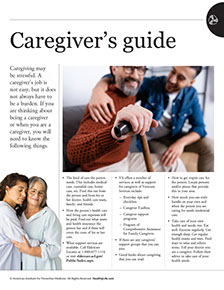
    Caregiving may be stressful. A caregiver’s job is not easy, but it does not always have to be a burden. If you are thinking about being a caregiver or when you are a caregiver, you will need to know the following things:

    *  The kind of care the person needs. This includes medical care, custodial care, home care, etc. Find this out from the person and from his or her doctor, health care team, family, and friends.

    *  How the person’s health care and living care expenses will be paid. Find out what assets and health insurance the person has and if these will cover the costs of his or her care.

    *  What support services are available. Call Eldercare Locator at 1-800-677-1116 or accesswww.eldercare.gov.

    *  If there are any caregivers’ support groups that you can join

    *  Good books about caregiving that you can read. Contact the National Institute on Aging for a list. Accesswww.nih.gov/niaor call 1-301-496-1752.

    *  How to get respite care for the person. Locate persons and/or places that provide this in your area.

    *  How much you can truly handle on your own and when the person you are caring for needs residential care.

    *  That it is necessary that you take care of your own health and needs, too. Eat well. Exercise regularly. Get enough sleep. Get regular health exams and tests. Tell your doctor you are a caregiver. Follow his or her advice to take care of your health needs.

    *  VA offers a number of services, as well as support for caregivers of Veterans. Services include:

    – Everyday tips and checklists

    – Caregiver Toolbox

    – How to find out about Adult Day Health Care (ADHC) Centers near you

    – Homemaker and Home Health Aide Program and Respite Care

    Resources

    The Alzheimer’s Association

    1-800-272-3900

    www.alz.org

    VA Caregiver Support

    1-855-260-3274

    www.caregiver.va.gov

    Health at Home Lifetime book by the American Institute for Preventive Medicine. www.HealthyLife.com. All rights reserved.

    © American Institute for Preventive Medicine

  • Enhance Your Sense Of Taste

    Mature Health: Over Age 50

    Image of fresh foods and herbs, such as potatos, tomatoes, onions, etc.

    Adding a lot of salt to foods, eating more sweets, and finding meals less enjoyable are signs that your sense of taste is fading. As you age, you may lose up to 50 percent of your taste buds. But you don’t have to resign yourself to a diet that tastes dull and bland. You can take the following steps to perk up your sense of taste.

    *  Eat fresh foods instead of canned or processed items. Fresh-cooked foods are more flavorful and have more texture, which adds to the enjoyment of food.

    *  Pep up your vegetables with flavor enhancers like savory herbs, lemon juice, slivered almonds, and sliced onions instead of extra salt.

    *  Marinate meats and fish in salad dressings or fruit juices before cooking.

    *  Include tart foods and beverages like salt-free pickles, oranges, and lemonade in your meals.

    *  Think visually. Colorful foods, garnishes, and an attractive table setting make meals more appetizing.

    *  Bring chilled foods to room temperature before serving. Flavors are more pronounced when food is warm.

    A Year of Health Hints book by the American Institute for Preventive Medicine. www.HealthyLife.com. All rights reserved.

    © American Institute for Preventive Medicine
  • Guard Against Denture Trouble

    Mature Health: Over Age 50

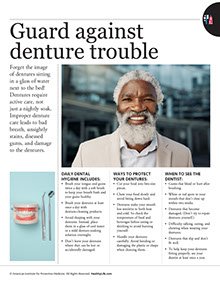
    Close up image of a mature women smiling showing her dentures.

    Forget the image of dentures sitting in a glass of water next to the bed! Dentures require active care, not just a nightly soak. Improper denture care leads to bad breath, unsightly stains, diseased gums, and damage to the dentures. Daily dental hygiene should include these measures.

    *  Brush your tongue and gums with a soft brush to keep your breath fresh and your gums healthy.

    *  Brush your dentures at least once a day with denture-cleaning products.

    *  Rinse your mouth with a mild salt-water solution (1 teaspoon of ordinary table salt in 1/2 cup warm water) after meals and before going to bed.

    *  Don’t leave your dentures where they can be lost or accidentally damaged.

    How you eat can also protect your dentures, so take these precautions.

    *  Cut your food into bite-size pieces.

    *  Chew your food slowly and avoid biting down hard.

    *  Dentures make your mouth less sensitive to both heat and cold. So check the temperature of food and beverages before eating or drinking to avoid burning yourself.

    To help keep your dentures fitting properly, see your dentist at least once a year. See your dentist if you have any of the following problems.

    *  Gums that bleed or hurt after brushing.

    *  White or red spots in your mouth that don’t clear up within two weeks.

    *  Dentures that become damaged. (Don’t try to repair dentures yourself.)

    *  Difficulty talking, eating, and chewing when wearing your dentures.

    *  Dentures that slip and don’t fit well.

    A Year of Health Hints book by the American Institute for Preventive Medicine. www.HealthyLife.com. All rights reserved.

    © American Institute for Preventive Medicine

  • Help For People Who Snore And Twitch

    Mature Health: Over Age 50

    Image of man snoring as spouse is awake plugging her ears.

    Does your bed partner snore or toss and turn during the night? Does he or she periodically twitch like a mackerel out of water for no reason at all? Are you faced with two alternatives: Sleeping in the guest room or not sleeping at all?

    Older adults-especially men-tend to develop two kinds of sleep disturbances. One is sleep apnea: Breathing stops for short periods of time and is followed by loud snoring. The other is nocturnal myoclonus, or restless legs-frequent jerking motions that sometimes awaken both the jerker and the person who shares the bed.

    Sleeping with the head of the bed elevated can make breathing easier and discourage snoring. Since being overweight and drinking alcohol seem to aggravate both sleep apnea and myoclonus, losing excess pounds and avoiding alcohol can help. Sleeping pills, too, can aggravate sleep apnea, so people who have this problem should use other ways to get a good night’s sleep.

    You may suffer one or both of these sleep disturbances and not even know it unless your partner complains-and you should take the complaints seriously.

    Sleep apnea may seem like nothing more than a nuisance, but it can be life-threatening if left untreated. So if you or your partner has this problem, see a doctor.

    A Year of Health Hints book by the American Institute for Preventive Medicine. www.HealthyLife.com. All rights reserved.

    © American Institute for Preventive Medicine

  • A Diet For Lifetime Health

    Mature Health: Over Age 50

    Image rich in B vitamins.

    Studies show that some older adults are deficient in vitamins B6, B12, and folate (a B vitamin). To guard against vitamin deficiencies, plan a diet that includes food sources of these nutrients.

    *  Lean meats, chicken, organ meats and fish, are high in B6.

    *  Milk, eggs, and lean meats are excellent sources of B12.

    *  Asparagus, brussels sprouts, and almost all green, leafy vegetables are high in folate. Other sources are cantaloupe, orange juice, and fortified grain products.

    *  Citrus fruits, tomatoes, cantaloupe, strawberries, green pepper, and broccoli are rich in vitamin C.

    It is also important to get adequate protein and calcium daily. Low-fat dairy products are rich sources of calcium. Two servings a day of 2 to 3 ounces of meat, chicken, or fish provide the protein you need. Other sources of protein include cooked dried beans, peanut butter, milk, and eggs.

    A Year of Health Hints book by the American Institute for Preventive Medicine. www.HealthyLife.com. All rights reserved.

    © American Institute for Preventive Medicine

  • Stress Relief For Caregivers

    Mature Health: Over Age 50

    Image of a caregiver helping a man in a wheelchair.

    If you’re the primary caregiver for a spouse, parent, or other relative, you face a tough challenge. Here’s what you can do to make the workload easier.

    *  Set up the sickroom on the main floor, so you don’t have to continually go up and down stairs.

    *  Purchase or rent equipment that will make caregiving easier. Examples include an electric hospital bed, an over-bed table, and a walker or wheelchair.

    *  Keep clean bed linens, towels, washcloths, hand lotion, drinking cups, and other supplies in or near the sickroom.

    *  Develop a daily schedule and stick to it.

    To reduce the stress of your ongoing responsibility:

    *  Delegate some tasks to family and friends.

    *  Investigate community services that provide transportation, deliver meals, and provide other kinds of help.

    *  Enlist the services of a home health care agency. The social service or discharge planning department of your hospital, Social Security Administration, local agency on aging, county public health department, or your physician, can refer you to an agency in your area.

    *  Plan to get out of the house to shop or socialize at least one day a week.

    *  Find out if the cost of hiring help to care for someone at home is covered by your medical insurance provider, Medicaid, or Medicare. The Veterans Administration may be able to provide financial assistance for veterans’ medical or nursing care.

    A Year of Health Hints book by the American Institute for Preventive Medicine. www.HealthyLife.com. All rights reserved.

    © American Institute for Preventive Medicine
  • Don’T Be Duped By Antiwrinkle Creams

    Mature Health: Over Age 50

    Image of women looking in a mirror examing her face.

    Don’t be misled by over-the-counter skin care products that claim to get rid of wrinkles. There’s no such thing. The closest thing to a wrinkleremoving cream is retinoic acid, a synthetic form of vitamin A. Applied to the skin surface, retinoic acid increases blood flow and stimulates skin cells called fibroblasts to produce new collagen (a protein that keeps skin smooth). This process can help to reduce tiny wrinkles and make deep wrinkles less noticeable. Retinoic acid also speeds up the rate that your skin’s cells move to the surface and die off to be replaced with new cells, so your skin looks younger.

    Retinoic acid is available as Retinol in over-the-counter products and by prescription under the trade name Retin-A. Regular vitamin A has no effect on wrinkles, whether it’s taken orally or applied directly to the skin.

    A Year of Health Hints book by the American Institute for Preventive Medicine. www.HealthyLife.com. All rights reserved.

    © American Institute for Preventive Medicine

  • Tips For Good Digestion

    Mature Health: Over Age 50

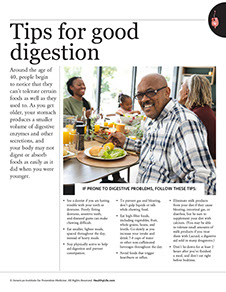
    Image of mature couple eating at home.

    Around the age of 40, people begin to notice that they can’t tolerate certain foods as well as they used to. As you get older, your stomach produces a smaller volume of digestive enzymes and other secretions, and your body may not digest or absorb foods as easily as it did when you were younger.

    If you are prone to digestive problems, follow these tips.

    *  See a dentist if you are having trouble with your teeth or dentures. Poorly fitting dentures, sensitive teeth, and diseased gums can make chewing difficult.

    *  Eat smaller, lighter meals, spaced throughout the day, instead of heavy meals. As a person ages, the blood supply to the small intestine declines, hindering the absorption of nutrients from a sudden, large delivery of food.

    *  To prevent gas and bloating, don’t gulp liquids or talk while chewing food.

    *  Limit the amount of gas-producing foods you eat. Cabbage, onions, and cooked dried beans are common offenders.

    *  Eliminate milk products from your diet if they cause bloating, intestinal gas, or diarrhea, but be sure to supplement your diet with calcium. (You may be able to tolerate small amounts of milk products if you treat them with Lactaid, a digestive aid sold in many health food stores.

    *  Avoid wearing tight clothing around your waist at mealtime.

    *  Don’t lie down for at least 2 hours after you’ve finished a meal, and don’t eat right before bedtime.

    A Year of Health Hints book by the American Institute for Preventive Medicine. www.HealthyLife.com. All rights reserved.

    © American Institute for Preventive Medicine

  • Guard Against Macular Degeneration

    Mature Health: Over Age 50

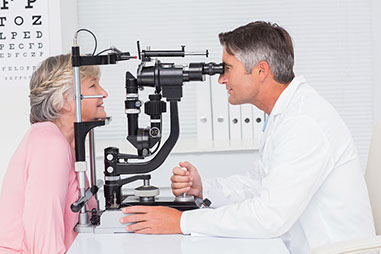
    Image of mature women receiving an eye exam.

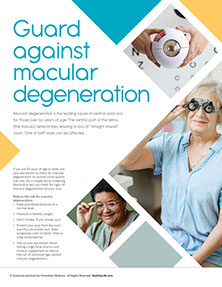
    Macular degeneration is the leading cause of central vision loss for those over 55 years of age. The central part of the retina (the macula) deteriorates, leading to loss of “straight ahead” vision. One or both eyes can be affected. If you are 50 years of age or older, ask your eye doctor to check for macular degeneration at routine vision exams. Ask, too, for a simple home screening device that lets you check for signs of macular degeneration on your own.

    To reduce the risk for macular degeneration:

    *  Keep your blood pressure at a normal level.

    *  Maintain a healthy weight.

    *  Don’t smoke. If you smoke, quit.

    *  Protect your eyes from the sun’s harmful ultraviolet rays. Wear sunglasses with UV block. Wear a wide-brimmed hat.

    *  Talk to your doctor about taking a high dose vitamin and mineral supplement to reduce the risk of advanced age-related macular degeneration.

    A Year of Health Hints book by the American Institute for Preventive Medicine. www.HealthyLife.com. All rights reserved.

    © American Institute for Preventive Medicine